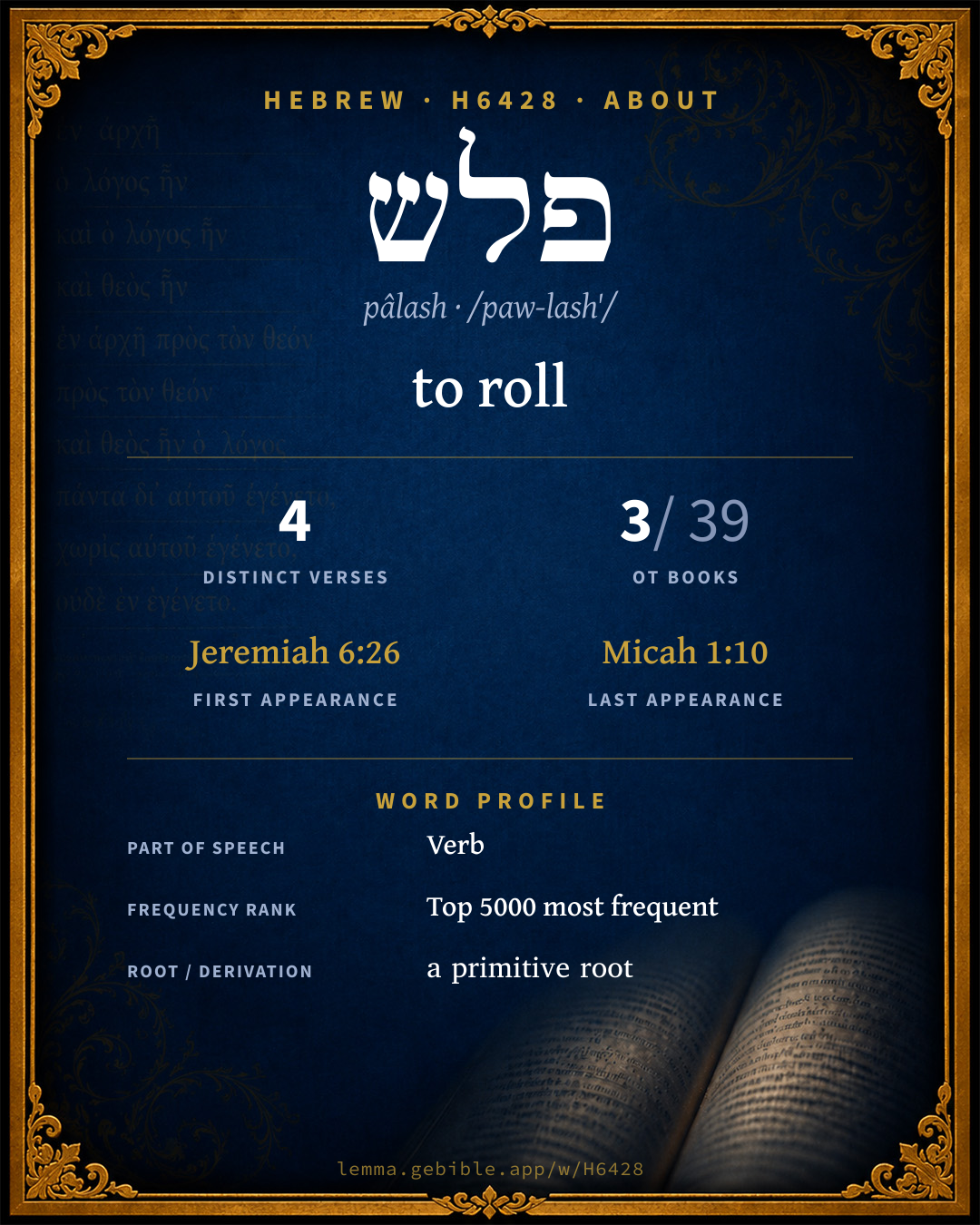
פָּלַשׁ
to roll
‘to roll’ is one of 2 main senses fuller range ↓
Full lexicon entry — Brown-Driver-Briggs (BDB)
From Brown-Driver-Briggs (BDB)
Where this word appears
Grammar key — what these labels mean
Part of speech
- Verb
- An action or state-of-being word.
Stem
- Hithpael
- The reflexive or reciprocal stem (the subject acts on itself).
Form
- Imperative
- A direct command (“write!”).
- Imperfect
- An incomplete, ongoing, or future action (“he will / would write”).
- Perfect
- A completed action or state — Hebrew marks aspect (completeness) more than strict tense (“he wrote”).
Person
- 2nd Person
- The one addressed (“you”).
- 3rd Person
- The one spoken about (“he / she / it / they”).
- 1st Person
- The speaker (“I / we”).
Gender
- Masculine
- Grammatically masculine.
- Common
- Either gender — not distinguished for this form.
- Feminine
- Grammatically feminine.
Number
- Plural
- More than one (in Hebrew, generally three or more).
- Singular
- One.
Every verse where H6428 appears in the Book of Ezekiel — 1 distinct verse. Click any verse to open its interlinear word-by-word view. Verse text shown in the World English Bible for context — . Each verse’s Hebrew form is shown with its reference; the English is not keyword-highlighted, since the data carries no word-level English alignment. Use “Compare translations” on any verse to read it across multiple English versions. This concordance covers the Hebrew Bible; Septuagint (Greek Old Testament) occurrences are not indexed here.
Ezekiel
About this entry
At a glance — auto-summarized from this page’s data, not written by a person. Every figure links to its source below. This summary describes the numbers; it doesn’t interpret them.
פלש (pâlash) is a Hebrew verb most often rendered “to roll.” With only 4 verses it sits in the long tail of Hebrew Bible vocabulary. It clusters heavily in Jeremiah, which alone accounts for 50% of its uses. Debuting at Jeremiah 6:26, it then recurs through the corpus. Its lexical range runs to 2 senses. The sections below give every sense, occurrence, and version rendering.
Gloss history
Strong's 1890 vs modern scholarship
About this word
Strong's H6428 catalogs a Hebrew word from the Hebrew Old Testament.
These counts are not copied from any lexicon or concordance. They are computed here, from the morphology-tagged Hebrew Old Testament. What Lemma adds →
- 4
- distinct verses
- The word appears in 4 distinct verses.
- 3 / 39
- OT books
- The word appears in 3 of 39 Old Testament books.
- #3,337
- by frequency
- Top 5000 most frequent Hebrew words (rank 3,337 of 8,640 Hebrew words by occurrence).
View all 4 occurrences in the concordance →
By section of the Old Testament
By traditional corpus
Conventional, traditional groupings — biblical authorship is debated, so this is a traditional corpus grouping, not an authorship claim. Each share is this word’s portion of its verses in that division of the Hebrew canon. Each figure is a share of the word’s 4 distinct verses.
- Prophets (Nevi'im) 4 verses · 100%
How translations render this word
Counts come from each version’s own published word-to-Strong’s tagging or interlinear alignment — an approximate guide to how each version renders this word, not a word-level alignment the data otherwise carries. Because each total is that version’s own tagged count, the per-version totals vary from one another and need not match the appearance or distinct-verse counts above. These counts may also differ from a printed concordance because Lemma counts each distinctly tagged rendering and does not collapse phrase taggings into a single head-word total. This is a fixed set of word-tagged versions (KJV, ASV, BSB, ULT) and does not change with the reading translation you choose elsewhere. Each version’s license is shown beside its name below (and on Sources).
- King James Version: Wallow 2×
- American Standard Version: Wallow 2×
- Berean Standard Bible: Roll 3×
- unfoldingWord Literal Text: Dust 1×, Roll about 1×, Roll in 1×
King James Version Public Domain
Renders H6428 across 4 tagged occurrences — most commonly:
Plus 2 renderings that appear only once — usually multi-word phrases or single function words the recovered tagging swept in, not distinct renderings. Not rendered by a distinct English word in 1 further occurrence.
American Standard Version Public Domain
Renders H6428 across 4 tagged occurrences — most commonly:
Plus 2 renderings that appear only once — usually multi-word phrases or single function words the recovered tagging swept in, not distinct renderings.
Berean Standard Bible Public Domain
Renders H6428 across 4 tagged occurrences — most commonly:
Plus 1 rendering that appears only once — usually multi-word phrases or single function words the recovered tagging swept in, not distinct renderings.
unfoldingWord Literal Text CC BY-SA 4.0
Renders H6428 across 5 tagged occurrences — most commonly:
Senses in BDB
The 2 senses BDB distinguishes for this word, in lexicon order (not ranked by frequency or importance). The full entry — with sub-senses — is in the Lexicon Entry tab.
- to roll
- (Hithpael) to roll in ashes or dust (as an act of mourning)
Word origin
[ פָּלַשׁ ] vb. Hithp. act of mourning, poss. roll in (dust, etc.; weakened fr. burrow into )
— Brown-Driver-Briggs (Oxford 1906, public domain), digitized via Sefaria, supplemented by the OpenScriptures HebrewLexicon (CC BY 4.0). See Sources.
Origin: a primitive root
Jastrow Dictionary
A second Hebrew/Aramaic lexicon for comparison, covering Aramaic and post-biblical (Talmudic, Targumic, Midrashic) usage that the biblical-Hebrew BDB does not. Matched by lemma rather than by Strong’s number, so a lemma may carry more than one Jastrow headword (shown separately below), and the entries cover usage well beyond the Bible.
פָּלַשׁ I
- to divide, go through.
- 1. to penetrate, go from end to end, perforate, v. infra., v. infra.
- 2. to search. Num. R. s. 14; Y. Snh. X, 29ᵇ bot. (play on עלי פלשת התרועעי, Ps. LX, 10) עלי לפַלֵּשׁ להם מעשים טובים לעשותן ריעים וכ׳ it is for me to search for their good deeds and make them friendly to wards one another. e.g. Psalms 60:10
- 3. (with אחר) [to dig after,] to go to extremes. Lam. R. to I, 1 הם לא פִּלְּשׁוּ אחר מדת הדין והיא לא פִלְּשָׁה (היתה) אחריהם (Ar. פִילְּ׳) they (the Israelites) did not go to the extreme of rebellion against Justice, and she (Justice) did not go to the extreme in punishing them; (Var. in Ar. חִיפְּשׁוּ, חִיפְּשָׁה); ib. to II, 4; 5; Yalk. Hos. 521.
- to be perforated. Y. Succ. III, 53ᵈ ניקב ולא פ׳ מבפנים (not פילש) if the Ethrog is punctured but not perforated within (all through the skin).—Part. מְפוּלָּשׁ; f. מְפוּלֶּשֶׁת; pl. מְפוּלָּשִׁים, מְפוּלָּשִׁין; מְפוּלָּשׁוֹת. Bab. Succ. 36ᵃ נקב מפ׳ a puncture going through (into the flesh). Sabb. XVI, 1 מפ׳ (מבוי) an open alley, expl. ib. 117ᵃ an alley opening into a street, not closed by a legally required fictitious partition, v. לֶחִי. Erub. IX, 4, a. e. גשרים המפ׳, v. גֶּשֶׁר. Y. ib. VIII, 25ᵇ top (ref. to פִּיוְסָרוֹס) לעולם אין … מפ׳ מסוף העולם וכ׳ we never call a road a public area (v. רָשׁוּת), unless it is cut through from one end of the world to the other, i.e. runs in a straight line. Tosef. Kil. II, 1 תלמים שלשה מפ׳ וכ׳ three furrows running from one end of the field to the other. Gen. R. s. 70; Yalk. ib. 124 (play on בנות, Gen. XXIX, 16 = בונית) כשתי קורות המפ׳ וכ׳ like two joists extending from one end of the world to the other, the one reared princes &c. Gen. R. s. 44 (ref. to ומאציליה, Is. XLI, 9) ממפ׳ שבה וכ׳ from the parts of the world that have been gone through (explored) have I called thee; a. fr. e.g. Genesis 29:16
פָּלַשׁ II
- to roll in, cover with.
- to roll one’s self, cover one’s self. Gitt. 58ᵃ קרעתו ונִתְפַּלְּשָׁח באפר (not קרעתה) she rent it (the shirt) and rolled herself in the dust; Yalk. Jer. 276.
פְּלַשׁ
- Ithpa. אִתְפַּלֵּשׁ same. Targ. Mic. I, 10.
A Dictionary of the Targumim, the Talmud Babli and Yerushalmi, and the Midrashic Literature (Marcus Jastrow; London, Luzac, 1903) — Public Domain. Digitized via Sefaria. Digitized via Sefaria. Full attribution on Sources.
Forms in the corpus
The 5 distinct written forms H6428 takes in the Hebrew Bible, most frequent first — each parse links to that stem’s occurrences in the concordance. Hebrew forms include their vowel points and cantillation, so a single lemma takes many written forms.
| Form | Parsing | Example | Uses |
|---|---|---|---|
| הִתְפַּלָּֽשִׁי | Verb, Hithpael, Imperative, 2nd Person, Feminine, Singular | Micah 1:10 | 1 |
| התפלשתי | Verb, Hithpael, Perfect, 1st Person, Common, Singular | Micah 1:10 | 1 |
| וְ/הִֽתְפַּלְּשׁוּ֙ | Verb, Hithpael, Imperative, 2nd Person, Masculine, Plural | Jeremiah 25:34 | 1 |
| וְ/הִתְפַּלְּשִׁ֣י | Verb, Hithpael, Imperative, 2nd Person, Feminine, Singular | Jeremiah 6:26 | 1 |
| יִתְפַּלָּֽשׁוּ | Verb, Hithpael, Imperfect, 3rd Person, Masculine, Plural | Ezekiel 27:30 | 1 |
Same root — word family
Other BDB entries built from the same root as H6428, grouped by Strong’s listed origin. These share a root / origin per the lexicon — not necessarily a shared meaning. Each links to that word’s own entry.
Proper names from this root
People and places named from this root — a name, not an additional meaning of the word.
Compare all same-root words → 1 of the same-root words is a proper name (a person or place). They share a root, not necessarily a meaning.
Septuagint verse parallels
This word appears in 3 verses that also exist in the Greek Old Testament (Septuagint), out of the 4 Hebrew verses it occurs in. You can read those verses in Greek by switching the Old Testament edition to the Septuagint.
Read these verses in the Septuagint
This is a verse-level parallel only — the same verses exist in both the Hebrew and Greek Old Testaments. No word-level Hebrew↔Greek correspondence is claimed: the data carries no such alignment, so no Greek word is shown as this Hebrew word’s translation. Coverage is not total — the Septuagint omits the deuterocanon and renumbers the Psalms, so some Hebrew verses have no direct Greek parallel.