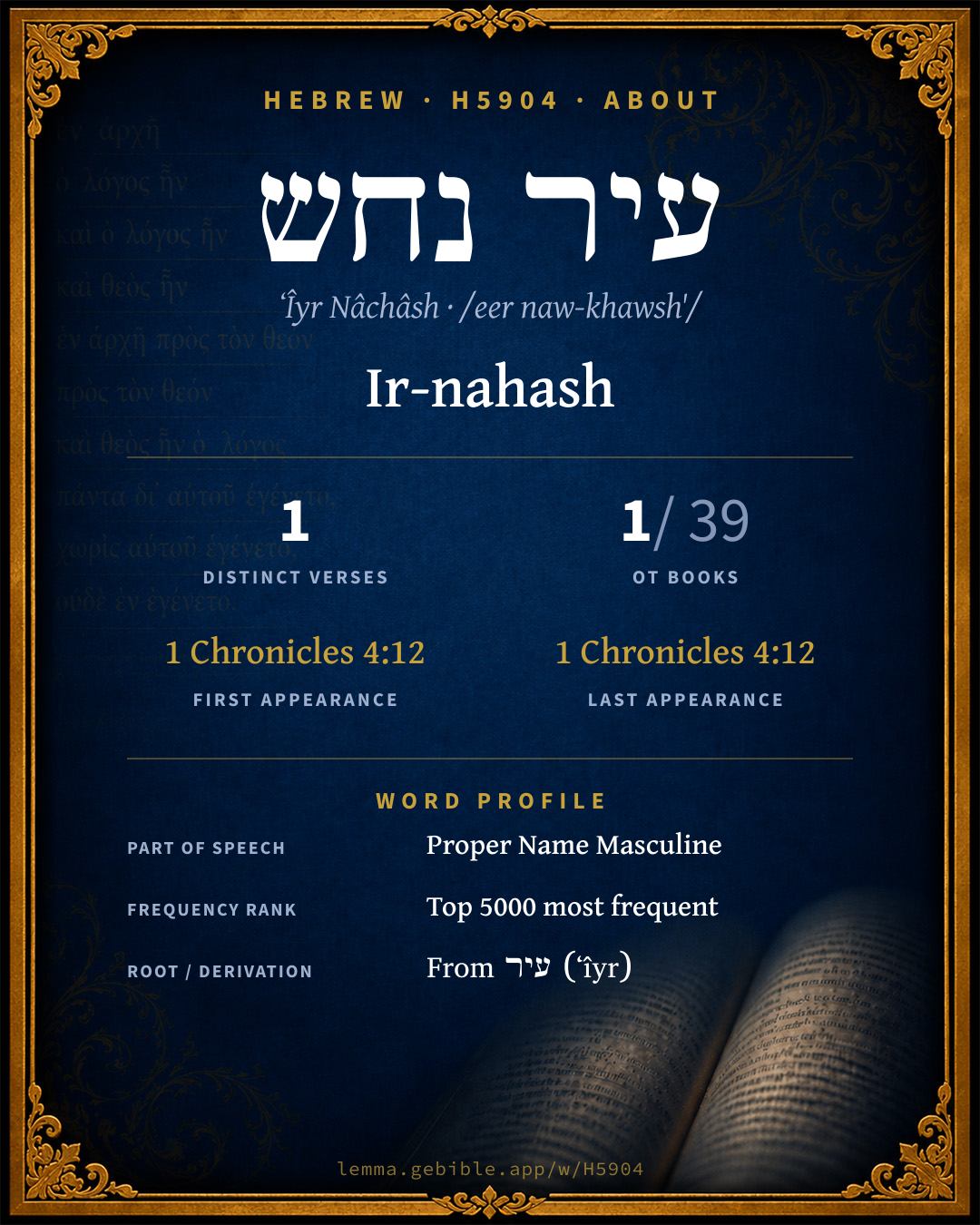
עִיר נָחָשׁ
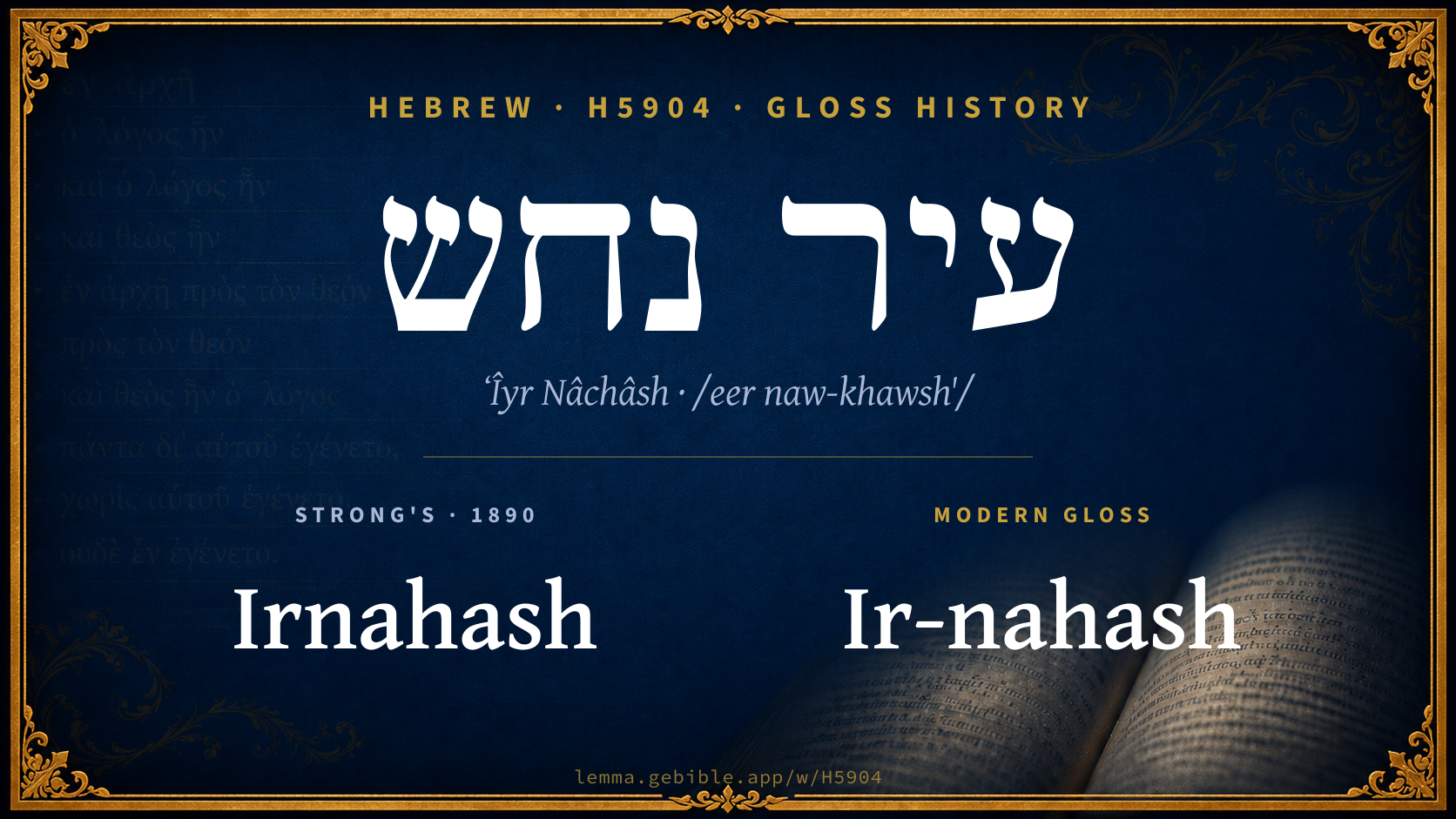
Ir-nahash
BDB lists 2 entries for ‘Ir-nahash’ fuller range ↓
Full lexicon entry — Brown-Driver-Briggs (BDB)
From Brown-Driver-Briggs (BDB)
Where this word appears
Grammar key — what these labels mean
Part of speech
- Noun
- A naming word — a person, place, thing, or idea.
Noun type
- Proper
- A name of a specific person, place, or people (e.g. Abraham, Zion, Israel).
Every verse where H5904 appears — 1 distinct verse across 1 book. Click any verse to open its interlinear word-by-word view. Verse text shown in the World English Bible for context — . Each verse’s Hebrew form is shown with its reference; the English is not keyword-highlighted, since the data carries no word-level English alignment. Use “Compare translations” on any verse to read it across multiple English versions. This concordance covers the Hebrew Bible; Septuagint (Greek Old Testament) occurrences are not indexed here.
1 Chronicles 1 verse
About this entry
At a glance — auto-summarized from this page’s data, not written by a person. Every figure links to its source below. This summary describes the numbers; it doesn’t interpret them.
The Hebrew name עיר נחש centers on the idea of “Ir-nahash.” It is rare — just 1 verse in the entire Hebrew Bible. The word gravitates to 1 Chronicles (100%). Found nowhere else but 1 Chronicles 4:12. Dig into 1-verse concordance and the renderings breakdown below.
Gloss history
Strong's 1890 vs modern scholarship
About this word
Strong's H5904 catalogs a Hebrew word from the Hebrew Old Testament.
These counts are not copied from any lexicon or concordance. They are computed here, from the morphology-tagged Hebrew Old Testament. What Lemma adds →
- 1
- distinct verses
- The word appears in 1 distinct verse.
- 1 / 39
- OT books
- The word appears in 1 of 39 Old Testament books.
- #4,807
- by frequency
- Top 5000 most frequent Hebrew words (rank 4,807 of 8,640 Hebrew words by occurrence).
View all 1 occurrence in the concordance →
Most concentrated in
- 1 Chronicles 1 verse 100%
By section of the Old Testament
By traditional corpus
Conventional, traditional groupings — biblical authorship is debated, so this is a traditional corpus grouping, not an authorship claim. Each share is this word’s portion of its verses in that division of the Hebrew canon. Each figure is a share of the word’s 1 distinct verse.
- Writings (Ketuvim) 1 verse · 100%
How translations render this word
Counts come from each version’s own published word-to-Strong’s tagging or interlinear alignment — an approximate guide to how each version renders this word, not a word-level alignment the data otherwise carries. Because each total is that version’s own tagged count, the per-version totals vary from one another and need not match the appearance or distinct-verse counts above. These counts may also differ from a printed concordance because Lemma counts each distinctly tagged rendering and does not collapse phrase taggings into a single head-word total. This is a fixed set of word-tagged versions (KJV, ASV, BSB, ULT) and does not change with the reading translation you choose elsewhere. Each version’s license is shown beside its name below (and on Sources).
BDB lists this Strong’s number as 3 distinct words (homographs). Each count above pools all of them and is not split by sense — see the Senses section below. A low-frequency rendering may belong to a different one of those words, not the primary meaning.
- King James Version†: Irnahash 1×
- American Standard Version†: Ir-nahash 1×
- Berean Standard Bible†: Ir-nahash 1×
- unfoldingWord Literal Text†: Ir 1×, Nahash 1×
King James Version Public Domain
Renders H5904 across 1† tagged occurrence — most commonly:
American Standard Version Public Domain
Renders H5904 across 1† tagged occurrence — most commonly:
Berean Standard Bible Public Domain
Renders H5904 across 1† tagged occurrence — most commonly:
unfoldingWord Literal Text CC BY-SA 4.0
Renders H5904 across 2† tagged occurrences — most commonly:
10 senses and sub-senses in the full BDB
What do BDB’s symbols mean?
BDB uses these scholarly abbreviations:
| Symbol | Meaning |
|---|---|
| 𝔊 | the Septuagint (the ancient Greek translation, LXX) |
| 𝔙 | the Vulgate (the Latin translation) |
| 𝔖 | the Syriac version (the Peshitta) |
| 𝔗 | the Targum (the Aramaic translation) |
| ψ | the Psalms |
| √ | root (the underlying root or stem) |
| ‖ | parallel passage (a synonymous or contrasted parallel) |
| † | the dagger: every passage where the word occurs is cited |
The 10 senses and sub-senses the full Brown-Driver-Briggs lexicon distinguishes for this word, in lexicon order (not ranked by frequency), with BDB’s own verbatim wording and sub-sense lettering. Shown in Hebrew script with BDB’s own scholarly abbreviations. The condensed entry is in the Lexicon Entry tab. See also the Forms in the corpus table below.
עיר נחש I
- 1. serpent:
- a. as biting, Am 5:19 Ec 10:8, in spite of charm (לַחַשׁ) v 11 [cf. Ecclus 12:13], Je 8:17 (+ צִפְעֹנִים; fig. of enemies); so הַנְּחָשִׁים הַשְּׂרָפִים Nu 21:6 (deadly; JE; cf. JacobArab. Dicht. iv. 10 ff.), and sg. v 9, also (coll.) v 7 cf. נ׳ שָׂרָף Dt 8:15 (+ עַקְרָב); נ׳ fig. of oppressor, מִשֹּׁרֶשׁ נָחָשׁ יֵצֵא צֶפַע וּפִרְיוֹ שָׂרָף מְעוֹפֵף Is 14:29; fig. of Dan Gn 49:17 (poem in J; ‖ שְׁפִיפֹן); חֲמַת נ׳ ψ 58:5 (sim. of perniciousness of ungodly), cf. נ׳ 140:4; sim. of effect of wine Pr 23:32 (‖ צִפִעֹנִי). e.g. Amos 5:19
- b. rod becomes נ׳ Ex 4:3 (J), cf. 7:15 (E); דֶּרֶךְ נ׳ עֲלֵי צוּר Pr 30:19. e.g. Exodus 4:3
- c. נ׳ (appar.) as hissing Je 46:22 (in sim., cf. Gie); as eating dust Is 65:25 cf. Mi 7:17 (in sim.; v. also Gn 3:14). e.g. Jeremiah 46:22
- d. as crafty tempter Gn 3:1, 2, 4, 13, 14. e.g. Genesis 3:1
- 2. נ׳ (הַ)נְּחשֶׁת, bronze image of serpent Nu 21:9(×2) 2 K 18:4 (cf. נְחֻשְׁתָּן). e.g. Numbers 21:9
- 3. mythol. נ׳ בָּרִחַ Jb 26:13 fleeing serpent, of eclipse-dragon (cf. לִוְיָתָן 3:6); also לִוְיָתָן נ׳ בָּרִחַ … לִוְיָתָן נ׳ עֲקַלָּתוֹן Is 27:1 (symbol. of world-powers); נ׳ of sea-monster Am 9:3.—נ׳ c. vb. נָשַׁךְ bite Nu 21:6 + 8 times. On supernat. character of serpents in Arabic belief v. NöZeitschr. für Völkerpsychol. i (1860), 412–416 RSKinship 197; Sem i. 421 f., 2d ed. 442 WeSkizzen iii. 147; Arab. Heid. 2, 152 f. JacobArab. Dicht. iv. 5. e.g. Job 26:13
עיר נחש II
- 1. king of Ammon 1 S 11:1(×2), 2; 12:12 2 S 10:2 1 Ch 19:1, 2; perhaps also 2 S 17:27; 𝔊 Ναας. e.g. 1 Samuel 11:1
- 2. father of Abigail and Zeruiah 2 S 17:25, si vera l.; 𝔊 Ναας, but 𝔊L Ιεσσαι (cf. 1 Ch 2:16); WeGesch. 2, 57 Anm. 1 Löhr defend נחשׁ; dub. WeSm HPS. e.g. 2 Samuel 17:25
- 3. giving name to a city עִיר נ׳ 1 Ch 4:12, 𝔊 πόλεως Ναας; 𝔊L Ηρναας. e.g. 1 Chronicles 4:12
עיר נחש III as n.pr.m. v. ii. נָחָשׁ.
Senses from the full Brown-Driver-Briggs lexicon (Brown, Driver, Briggs; Oxford 1906 — public domain), digitized via Sefaria, supplemented by the OpenScriptures HebrewLexicon (CC BY 4.0). Full attribution on Sources.
Word origin
I. n.m. Gn 3:1 serpent (NH id.; Arabic حَنَشٌ serpent, viper (Lane406 anything hunted) is cp. by LagM i. 230; BN 50, 188 BAES 48, but improb.; Arabic نَحِسَ v. sub [נָחַשׁ] infr.; on formation cf. LagBN 50);—abs. נ׳ Am 5:19 +; cstr. נְחָשׁ Nu 21:9 + 2 times; pl. נְחָשִׁים Nu 21:6 Je 8:17;—
I. as n.pr.m. v. ii. נָחָשׁ.
— Brown-Driver-Briggs (Oxford 1906, public domain), digitized via Sefaria, supplemented by the OpenScriptures HebrewLexicon (CC BY 4.0). See Sources.
Derived from עיר (ʻîyr) (H5892) — city.
Forms in the corpus
The 2 distinct written forms H5904 takes in the Hebrew Bible, most frequent first — each parse links to that state’s occurrences in the concordance. Hebrew forms include their vowel points and cantillation, so a single lemma takes many written forms.
| Form | Parsing | Example | Uses |
|---|---|---|---|
| נָחָ֑שׁ | Noun, Proper | 1 Chronicles 4:12 | 1 |
| עִ֣יר | Noun, Proper | 1 Chronicles 4:12 | 1 |
Same root — word family
Other BDB entries built from the same root as H5904, grouped by Strong’s listed origin. These share a root / origin per the lexicon — not necessarily a shared meaning. Each links to that word’s own entry.
Derives from
Proper names from this root
People and places named from this root — a name, not an additional meaning of the word.
- עיר ʻÎyr H5893 Ir
- עיר המלח ʻÎyr ham-Melach H5898 Ir-hammelech
- עיר התמרים ʻÎyr hat-Tᵉmârîym H5899 the city of palmtrees
- עירו ʻÎyrûw H5900 Iru
- עירי ʻÎyrîy H5901 Iri
- עירם ʻÎyrâm H5902 Iram
- עיר שמש ʻÎyr Shemesh H5905 Ir-shemesh
- ער ʻÂr H6144 Ar
Compare all same-root words → Showing 4 of 10 — not the complete family. 8 of the same-root words are proper names (people or places). They share a root, not necessarily a meaning.
Bible dictionary
Public-domain dictionary articles matched to this entry by name (Ir-nahash). A biblical name can be shared by more than one person or place, so an article may treat several.
Smith's Bible Dictionary · William Smith, 1863
(serpent city), a name which, like many other names of places, occurs in the genealogical lists of Judah. (1 Chronicles 4:12)
Classic public-domain reference works; full attribution on Sources.
Septuagint verse parallels
This word appears in 1 verse that also exists in the Greek Old Testament (Septuagint), out of the 1 Hebrew verse it occurs in. You can read those verses in Greek by switching the Old Testament edition to the Septuagint.
Read these verses in the Septuagint
This is a verse-level parallel only — the same verses exist in both the Hebrew and Greek Old Testaments. No word-level Hebrew↔Greek correspondence is claimed: the data carries no such alignment, so no Greek word is shown as this Hebrew word’s translation. Coverage is not total — the Septuagint omits the deuterocanon and renumbers the Psalms, so some Hebrew verses have no direct Greek parallel.