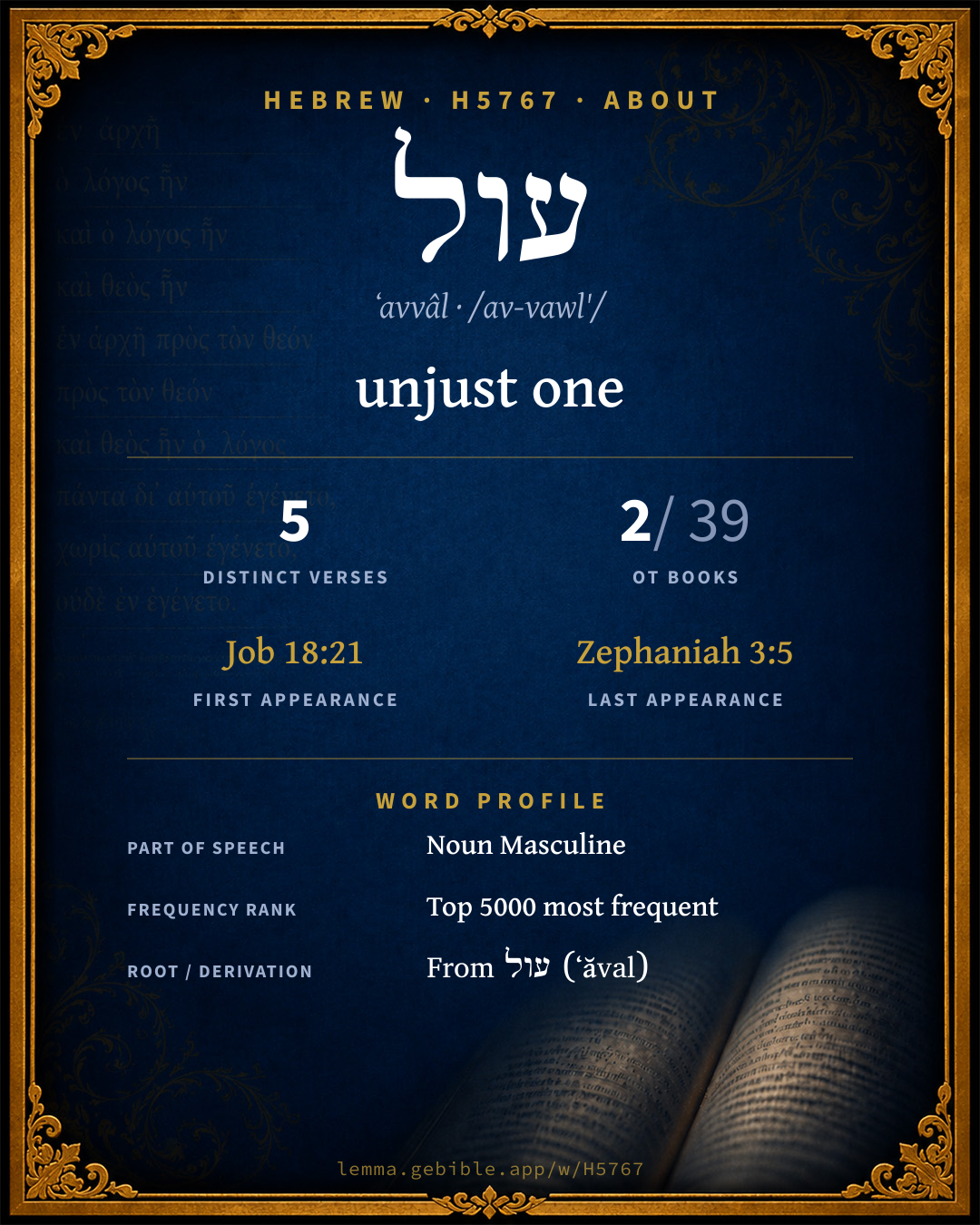
עַוָּל
unjust one
Full lexicon entry — Brown-Driver-Briggs (BDB)
From Brown-Driver-Briggs (BDB)
Where this word appears
Grammar key — what these labels mean
Part of speech
- Noun
- A naming word — a person, place, thing, or idea.
Noun type
- Common
- A common noun — a general class of person, place, or thing (“king,” “city,” “water”), not a specific name.
State
- Absolute
- The independent form of a noun, not bound to a following word.
Gender
- Masculine
- Grammatically masculine.
Number
- Singular
- One.
Every verse where H5767 appears in the Book of Zephaniah — 1 distinct verse. Click any verse to open its interlinear word-by-word view. Verse text shown in the World English Bible for context — . Each verse’s Hebrew form is shown with its reference; the English is not keyword-highlighted, since the data carries no word-level English alignment. Use “Compare translations” on any verse to read it across multiple English versions. This concordance covers the Hebrew Bible; Septuagint (Greek Old Testament) occurrences are not indexed here.
Zephaniah
About this entry
At a glance — auto-summarized from this page’s data, not written by a person. Every figure links to its source below. This summary describes the numbers; it doesn’t interpret them.
At its core, עול (ʻavvâl) means “unjust one.” The Hebrew Bible uses it only 5 verses. The word gravitates to Job (80%), then Zephaniah. Scripture first uses it in Job 18:21. It clusters with עול, עויל and עול under a shared root. Dig into 5-verse concordance and the renderings breakdown below.
Gloss history
Strong's 1890 vs modern scholarship
About this word
Strong's H5767 catalogs a Hebrew word from the Hebrew Old Testament.
These counts are not copied from any lexicon or concordance. They are computed here, from the morphology-tagged Hebrew Old Testament. What Lemma adds →
- 5
- distinct verses
- The word appears in 5 distinct verses.
- 2 / 39
- OT books
- The word appears in 2 of 39 Old Testament books.
- #3,337
- by frequency
- Top 5000 most frequent Hebrew words (rank 3,337 of 8,640 Hebrew words by occurrence).
View all 5 occurrences in the concordance →
By traditional corpus
Conventional, traditional groupings — biblical authorship is debated, so this is a traditional corpus grouping, not an authorship claim. Each share is this word’s portion of its verses in that division of the Hebrew canon. Each figure is a share of the word’s 5 distinct verses.
- Writings (Ketuvim) 4 verses · 80%
- Prophets (Nevi'im) 1 verse · 20%
How translations render this word
Counts come from each version’s own published word-to-Strong’s tagging or interlinear alignment — an approximate guide to how each version renders this word, not a word-level alignment the data otherwise carries. Because each total is that version’s own tagged count, the per-version totals vary from one another and need not match the appearance or distinct-verse counts above. These counts may also differ from a printed concordance because Lemma counts each distinctly tagged rendering and does not collapse phrase taggings into a single head-word total. This is a fixed set of word-tagged versions (KJV, ASV, BSB, ULT) and does not change with the reading translation you choose elsewhere. Each version’s license is shown beside its name below (and on Sources).
- King James Version: Wicked 3×
- American Standard Version: Unrighteous 3×
- Berean Standard Bible: Unjust 2×
- unfoldingWord Literal Text: Unrighteous 3×
King James Version Public Domain
Renders H5767 across 5 tagged occurrences — most commonly:
Plus 2 renderings that appear only once — usually multi-word phrases or single function words the recovered tagging swept in, not distinct renderings.
American Standard Version Public Domain
Renders H5767 across 5 tagged occurrences — most commonly:
Plus 2 renderings that appear only once — usually multi-word phrases or single function words the recovered tagging swept in, not distinct renderings.
Berean Standard Bible Public Domain
Renders H5767 across 5 tagged occurrences — most commonly:
Plus 3 renderings that appear only once — usually multi-word phrases or single function words the recovered tagging swept in, not distinct renderings.
unfoldingWord Literal Text CC BY-SA 4.0
Renders H5767 across 5 tagged occurrences — most commonly:
Plus 2 renderings that appear only once — usually multi-word phrases or single function words the recovered tagging swept in, not distinct renderings.
Senses in BDB
The 1 sense BDB distinguishes for this word, in lexicon order (not ranked by frequency or importance). The full entry — with sub-senses — is in the Lexicon Entry tab.
- unjust one, perverse one, unrighteous one
Word origin
n.m. unjust, unrighteous one;—especially of oppressive ruler Zp 3:5; Jb 18:21; 27:7 (‖ רָשָׁע), 29:17; 31:3 (‖ פֹּעֲלֵי אָ֑וֶן); prob. also 16:11 (for MT עֲוִיל, so Di; ‖ רְשָׁעִים).
— Brown-Driver-Briggs (Oxford 1906, public domain), digitized via Sefaria, supplemented by the OpenScriptures HebrewLexicon (CC BY 4.0). See Sources.
Derived from עול (ʻăval) (H5765) — to act wrongfully.
Jastrow Dictionary
A second Hebrew/Aramaic lexicon for comparison, covering Aramaic and post-biblical (Talmudic, Targumic, Midrashic) usage that the biblical-Hebrew BDB does not. Matched by lemma rather than by Strong’s number, so a lemma may carry more than one Jastrow headword (shown separately below), and the entries cover usage well beyond the Bible.
עוֹל
- imperat. of עֲלַל.
עוּל
- (interch. with עֲלַל)
- 1. to come, come in. Perf. עָל, עָאל; part. עָל, עָאֵיל, עָאֵל, עָיֵיל. Targ. O. Ex. VII, 23 על; Targ. Y. עאל (ed. Amst. אָעַל). Targ. Y. ib. XXXIII, 9 עאיל (ed. Amst. אָעֵיל). Targ. O. Gen. XXIII, 10 עָאלֵי (ed. Berl. a. oth. עָלֵי; Y. עֲלֵי). Targ. Prov. XVII, 10 עָאלָא ed. Lag. (oth. ed. עָלָא); a. fr.—Y. Kidd. II, 63ᵃ top דחק סומכוס ועאל S. pressed on and went in. Yoma 51ᵇ נֵיעוּל וכ׳ (Ms. M. נעביד) let him make his entrance in the way prescribed by R. J. Ib. 52ᵃ ניעול בין מנורה וכ׳ let him make his entrance between the candlestick and the wall. Pes. 112ᵃ; B. Bath. 21ᵃ שבשתא כיון דעל על a mistake once entered (into the mind) remains therein. Sabb. 98ᵇ האי עָיֵיל והאי נפיק one will go in (recede), the other go out (protrude, i.e. form an uneven surface.); a. v. fr.—
- *2. to bring in. Targ. Y. Gen. VI, 19 תֵעוֹל ed. Vien. (v. עֲלַל).—Gen. R. s. 67 (ref. to ועל חרבך Gen. XXVII, 40) עול חרבך וכ׳ bring thy sword home (into its sheath), and thou shalt live; (Yalk. ib. 115 תטול, read: תֵּעוּל). e.g. Genesis 27:40
- 1. to come in habitually. Inf. מְעַיֵּיל, v. מֵעֲלָא.
- 2. to bring in, insert. Ḥull. 42ᵇ אפיק … ועַיֵּיל, v. נֽפַק. Erub. 44ᵇ בעי עַיְּילִינְהוּ wanted to bring them in. Sabb. 96ᵇ מה לי אפוקי ומה לי עַיּיוּלֵי what is the difference between carrying out and bringing in? Erub. 38ᵇ ע׳ רב חסדא וכ׳ R. Ḥ. brought (the subject) in, in order to show a contradiction &c. Keth. 61ᵃ, עַיְּילִית וכ׳, v. חֲרִיקָא. Ib. 101ᵃ עַיְּילָא ליה גלימא if she brought him a cloak (as dowry). Yoma 47ᵃ נְעַיֵּיל והדר נעייל shall he bring in (one portion) and again bring in (another portion)?; a. fr.
- 3. to produce, develop, ripen. R. Hash. 13ᵃ ודילמא לא ע׳ כלל perhaps it means when it (the growing vegetation) had not yet begun to ripen at all? Ib. דע׳ ביד נכרי the barley of which the ‘Omer was brought had ripened while in the possession of a gentile (a Canaanite). Ib. דע׳ ריבעא if it has developped one fourth of the full size; a. e.
- to insert one’s self; to get in. Yoma 51ᵇ ולא מִתְעַיֵּיל ליה he could not get himself in (between the table and the wall).
- ; Ittaf. אִיתָּעַל, Ithpe. אִתְעַל, v. עֲלַל.
עוֹל ²
- yoke; also pole of a wagon. Kil. II, 6 מלא הע׳ השרוני the width of the yoke (the team) used in the plain of Sharon. Kel. XIV, 4 הע׳ של מתכות a metal pole (v. Maim. a. l.); ib. 5 הע׳ המצופה the metal-tipped pole. Sifré Num. 123 בע׳ שלא לעבודה וכ׳ the text speaks of a yoke not put on for working. Sot. 46ᵃ ע׳ פוסל בין בשעת וכ׳ the bearing of a yoke disqualifies the animal for the ceremony, whether it was put on at working time &c.; a. fr.—Trnsf. obligation, dependence. Ab. III, 5 כל המקבל עליו ע׳ תורה … ע׳ מלכות וע׳ דרך ארץ whosoever takes upon himself the yoke (obligations) of the Law, from him shall be removed the yoke of government (oppression) and the yoke of worldly affairs; וכל הפורק ממנו ע׳ תורה וכ׳ but he who throws off the yoke of the Law, will be made to feel the yoke of &c. Ber. II, 2 כדי שיקבל עליו ע׳ מלכות שמים … ע׳ מצות in order that he may acknowledge his dependence on divine government first (by reciting Deut. VI, 4 sq., v. שְׁמַע) and then his subjection to religious duties (by reciting Deut. XI, 13 sq.); a. fr.—Pl.) עוּלִּין. Tanḥ. V’zoth 5 שני ע׳ וכ׳ thou puttest two yokes upon thy children; Yalk. Deut. 952. e.g. Deuteronomy 6:4
עָוַל
- (b. h.), Pi. עִוֵּול, עִיוֵּל (denom. of עָוֶל) to act perversely; to do wrong, cheat. Tosef. B. Kam. VII, 8 המְעַוּוֵל במידות והמשקר וכ׳ he who cheats in measuring, and is false in weighing; Mekh. Mishp. s. 13. Yalk. Num. 765 מה אתה מועל ומשקר וכ׳ (read: מְעַוֵּל) why dost thou cheat and give false weights?; Tanḥ. Balak 12 מה אתה עושה מעולה ומשקר וכ׳ (corr. acc.); ib. ed. Bab. 16; a. e.
עָוֶל
- perversion, fault. Yalk. Lam. 999 לא מצא בי ע׳ found no fault with me. Ib. מצאתם בי ע׳ you found fault with me; a. e.
A Dictionary of the Targumim, the Talmud Babli and Yerushalmi, and the Midrashic Literature (Marcus Jastrow; London, Luzac, 1903) — Public Domain. Digitized via Sefaria. Digitized via Sefaria. Full attribution on Sources.
Forms in the corpus
The 4 distinct written forms H5767 takes in the Hebrew Bible, most frequent first — each parse links to that state’s occurrences in the concordance. Hebrew forms include their vowel points and cantillation, so a single lemma takes many written forms.
| Form | Parsing | Example | Uses |
|---|---|---|---|
| עַוָּ֑ל | Noun, Common, Masculine, Singular, Absolute | Job 18:21 | 2 |
| כְ/עַוָּֽל | Noun, Common, Masculine, Singular, Absolute | Job 27:7 | 1 |
| לְ/עַוָּ֑ל | Noun, Common, Masculine, Singular, Absolute | Job 31:3 | 1 |
| עַוָּ֖ל | Noun, Common, Masculine, Singular, Absolute | Zephaniah 3:5 | 1 |
Same root — word family
Other BDB entries built from the same root as H5767, grouped by Strong’s listed origin. These share a root / origin per the lexicon — not necessarily a shared meaning. Each links to that word’s own entry.
Derives from
Shares the same root
Compare all same-root words → They share a root, not necessarily a meaning.
Septuagint verse parallels
This word appears in 5 verses that also exist in the Greek Old Testament (Septuagint), out of the 5 Hebrew verses it occurs in. You can read those verses in Greek by switching the Old Testament edition to the Septuagint.
Read these verses in the Septuagint
This is a verse-level parallel only — the same verses exist in both the Hebrew and Greek Old Testaments. No word-level Hebrew↔Greek correspondence is claimed: the data carries no such alignment, so no Greek word is shown as this Hebrew word’s translation. Coverage is not total — the Septuagint omits the deuterocanon and renumbers the Psalms, so some Hebrew verses have no direct Greek parallel.