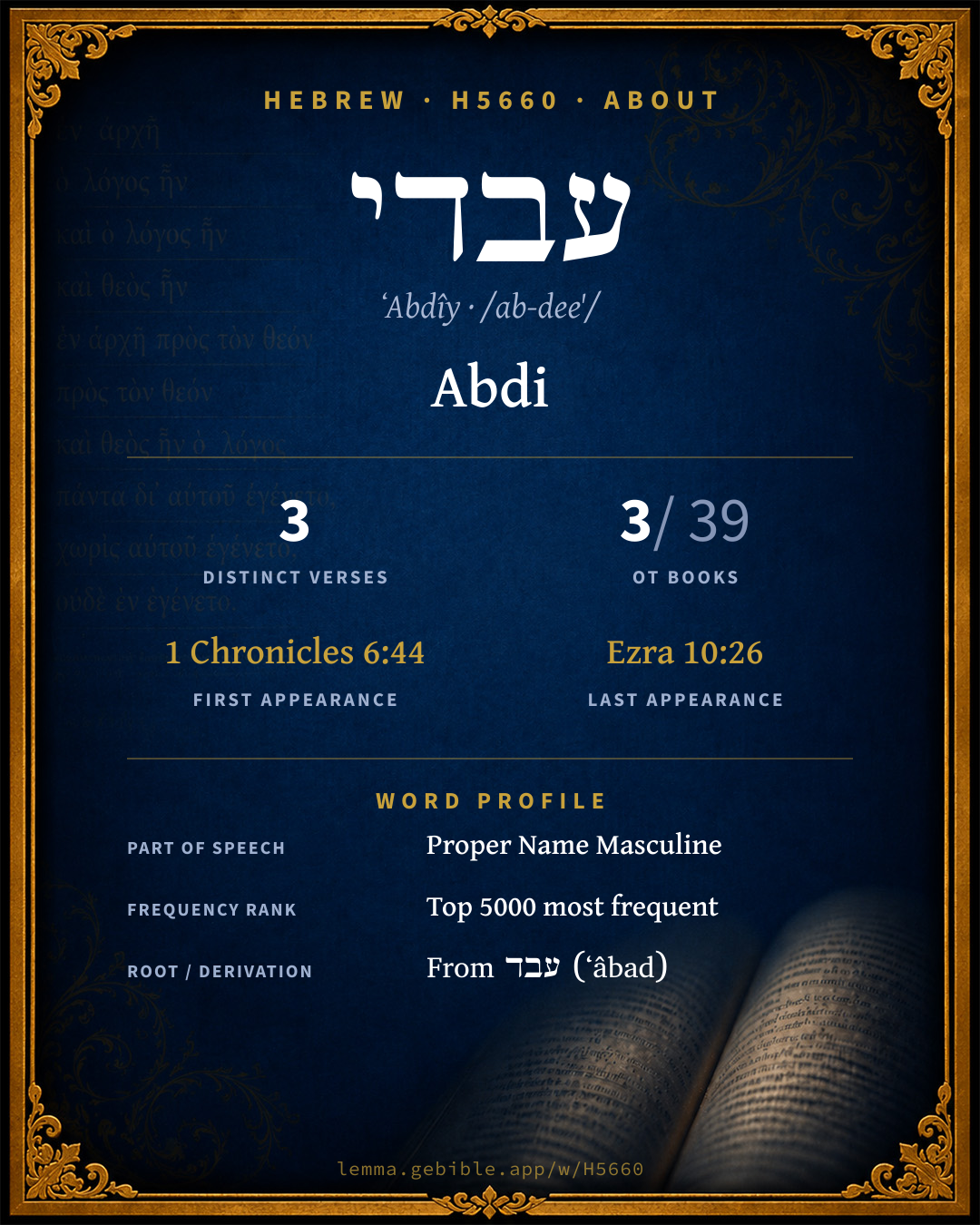
עַבְדִּי
Abdi
BDB lists 4 entries for ‘Abdi’ fuller range ↓
Full lexicon entry — Brown-Driver-Briggs (BDB)
From Brown-Driver-Briggs (BDB)
Where this word appears
Grammar key — what these labels mean
Part of speech
- Noun
- A naming word — a person, place, thing, or idea.
Noun type
- Proper
- A name of a specific person, place, or people (e.g. Abraham, Zion, Israel).
Every verse where H5660 appears in the Book of Ezra — 1 distinct verse. Click any verse to open its interlinear word-by-word view. Verse text shown in the World English Bible for context — . Each verse’s Hebrew form is shown with its reference; the English is not keyword-highlighted, since the data carries no word-level English alignment. Use “Compare translations” on any verse to read it across multiple English versions. This concordance covers the Hebrew Bible; Septuagint (Greek Old Testament) occurrences are not indexed here.
Ezra
About this entry
At a glance — auto-summarized from this page’s data, not written by a person. Every figure links to its source below. This summary describes the numbers; it doesn’t interpret them.
עבדי (ʻAbdîy) is a Hebrew name most often rendered “Abdi.” The Hebrew Bible uses it only 3 verses. 1 Chronicles dominates its distribution — 1 of 3 verses. It first appears in 1 Chronicles 6:44. The sections below give every occurrence and version rendering.
Gloss history
Strong's 1890 vs modern scholarship
About this word
Strong's H5660 catalogs a Hebrew word from the Hebrew Old Testament.
These counts are not copied from any lexicon or concordance. They are computed here, from the morphology-tagged Hebrew Old Testament. What Lemma adds →
- 3
- distinct verses
- The word appears in 3 distinct verses.
- 3 / 39
- OT books
- The word appears in 3 of 39 Old Testament books.
- #4,179
- by frequency
- Top 5000 most frequent Hebrew words (rank 4,179 of 8,640 Hebrew words by occurrence).
View all 3 occurrences in the concordance →
Most concentrated in
- 1 Chronicles 1 verse 33%
- 2 Chronicles 1 verse 33%
- Ezra 1 verse 33%
By section of the Old Testament
By traditional corpus
Conventional, traditional groupings — biblical authorship is debated, so this is a traditional corpus grouping, not an authorship claim. Each share is this word’s portion of its verses in that division of the Hebrew canon. Each figure is a share of the word’s 3 distinct verses.
- Writings (Ketuvim) 3 verses · 100%
How translations render this word
Counts come from each version’s own published word-to-Strong’s tagging or interlinear alignment — an approximate guide to how each version renders this word, not a word-level alignment the data otherwise carries. Because each total is that version’s own tagged count, the per-version totals vary from one another and need not match the appearance or distinct-verse counts above. These counts may also differ from a printed concordance because Lemma counts each distinctly tagged rendering and does not collapse phrase taggings into a single head-word total. This is a fixed set of word-tagged versions (KJV, ASV, BSB, ULT) and does not change with the reading translation you choose elsewhere. Each version’s license is shown beside its name below (and on Sources).
- King James Version: Abdi 3×
- American Standard Version: Abdi 3×
- Berean Standard Bible: Abdi 3×
- unfoldingWord Literal Text: Abdi 3×
King James Version Public Domain
Renders H5660 across 3 tagged occurrences — most commonly:
American Standard Version Public Domain
Renders H5660 across 3 tagged occurrences — most commonly:
Berean Standard Bible Public Domain
Renders H5660 across 3 tagged occurrences — most commonly:
unfoldingWord Literal Text CC BY-SA 4.0
Renders H5660 across 3 tagged occurrences — most commonly:
Senses in the full BDB
What do BDB’s symbols mean?
BDB uses these scholarly abbreviations:
| Symbol | Meaning |
|---|---|
| 𝔊 | the Septuagint (the ancient Greek translation, LXX) |
| 𝔙 | the Vulgate (the Latin translation) |
| 𝔖 | the Syriac version (the Peshitta) |
| 𝔗 | the Targum (the Aramaic translation) |
| ψ | the Psalms |
| √ | root (the underlying root or stem) |
| ‖ | parallel passage (a synonymous or contrasted parallel) |
| † | the dagger: every passage where the word occurs is cited |
The 2 senses and sub-senses the full Brown-Driver-Briggs lexicon distinguishes for this word, in lexicon order (not ranked by frequency), with BDB’s own verbatim wording and sub-sense lettering. Shown in Hebrew script with BDB’s own scholarly abbreviations. The condensed entry is in the Lexicon Entry tab. See also the Forms in the corpus table below.
- 1. a Levite 1 Ch 6:29; 2 Ch 29:12; 𝔊 Αβδ(ε)ι, 𝔊L 1 Ch Αβδια. e.g. 1 Chronicles 6:29
- 2. one with a foreign wife Ezr 10:26; 𝔊 Αβδε(ι)α. e.g. Ezra 10:26
Senses from the full Brown-Driver-Briggs lexicon (Brown, Driver, Briggs; Oxford 1906 — public domain), digitized via Sefaria, supplemented by the OpenScriptures HebrewLexicon (CC BY 4.0). Full attribution on Sources.
Word origin
n.pr.m. (= עֹבַדְיָה servant of Yah; v. however, GrayProp. N. 149 ff. and cf. Old Aramaic עבדו, Nab.Palm. עבדי Lzb333, 334 Cook87);—
— Brown-Driver-Briggs (Oxford 1906, public domain), digitized via Sefaria, supplemented by the OpenScriptures HebrewLexicon (CC BY 4.0). See Sources.
Derived from עבד (ʻâbad) (H5647) — to serve.
Jastrow Dictionary
A second Hebrew/Aramaic lexicon for comparison, covering Aramaic and post-biblical (Talmudic, Targumic, Midrashic) usage that the biblical-Hebrew BDB does not. Matched by lemma rather than by Strong’s number, so a lemma may carry more than one Jastrow headword (shown separately below), and the entries cover usage well beyond the Bible.
עֲבַד
- 1. same. Targ. Gen. IX, 25 (O. ed. Berl. עַבַד; ed. Vien. עֶבֶד). Ib. 26; a. fr.—Gen. R. s. 86 ע׳ זבין … ע׳ לתרויהון a slave (Potiphar) buys, the son of a handmaid (the Ishmaelite) sells, and the free man (Joseph) is the slave of both; Koh. R. to X, 7. Gitt. 13ᵃ, a. e. ע׳ בהפקרא וכ׳, v. הֶפְקֵרָא; a. fr.—[Y. Ber. IV, 7ᶜ נפק ע׳, read: עוּבְדָּא.]—Pl. עַבְדִּין, עַבְדַּיָּא, עַבְדֵּי. Targ. Gen. XXIV, 25. Targ. Is. LIV, 17. Targ. Prov. XII, 9; a. fr.—B. Kam. 97ᵃ הוה תקיף ע׳ דאינשי וכ׳ used to seize slaves of men against whom he had a claim &c. Kidd. 70ᵃ רגיל דקרי אינשי ע׳ he is in the habit of calling people slaves; a. fr.
- 2. worshipper. Ned. 62ᵇ ע׳ דנורא fire-worshipper (Geber); a. e.
A Dictionary of the Targumim, the Talmud Babli and Yerushalmi, and the Midrashic Literature (Marcus Jastrow; London, Luzac, 1903) — Public Domain. Digitized via Sefaria. Digitized via Sefaria. Full attribution on Sources.
Forms in the corpus
The 3 distinct written forms H5660 takes in the Hebrew Bible, most frequent first — each parse links to that state’s occurrences in the concordance. Hebrew forms include their vowel points and cantillation, so a single lemma takes many written forms.
| Form | Parsing | Example | Uses |
|---|---|---|---|
| וְ/עַבְדִּ֔י | Noun, Proper | Ezra 10:26 | 1 |
| עַבְדִּ֔י | Noun, Proper | 2 Chronicles 29:12 | 1 |
| עַבְדִּ֖י | Noun, Proper | 1 Chronicles 6:44 | 1 |
Same root — word family
Other BDB entries built from the same root as H5660, grouped by Strong’s listed origin. These share a root / origin per the lexicon — not necessarily a shared meaning. Each links to that word’s own entry.
Derives from
Shares the same root
- מעבד maʻbâd H4566 work
- עבד ʻăbad H5648 to make
- עבד ʻebed H5650 servant
- עבד ʻăbâd H5652 work
- עבדה ʻăbôdâh H5656 service
- עבדה ʻăbuddâh H5657 service
- עבדות ʻabdûwth H5659 bondage
Proper names from this root
People and places named from this root — a name, not an additional meaning of the word.
- עבדא ʻAbdâʼ H5653 Abda
- עבד אדום ʻÔbêd ʼĔdôwm H5654 Obed-edom
- עבדאל ʻAbdᵉʼêl H5655 Abdeel
- עבדון ʻAbdôwn H5658 Abdon
- עבדיה ʻÔbadyâh H5662 Obadiah
- עובד ʻÔwbêd H5744 Obed
Compare all same-root words → Showing 4 of 15 — not the complete family. 6 of the same-root words are proper names (people or places). They share a root, not necessarily a meaning.
Bible dictionary
Public-domain dictionary articles matched to this entry by name (Abdi). A biblical name can be shared by more than one person or place, so an article may treat several.
Easton's Bible Dictionary · M. G. Easton, 1897
My servant. (1.) 1 Chr. 6:44. (2.) 2 Chr. 29:12. (3.) Ezra 10:26.
Smith's Bible Dictionary · William Smith, 1863
(my servant).
+ A Merarite, and ancestor of Ethan the singer. (1 Chronicles 6:44) (B.C. before 1015.) + The father of Kish, a Merarite, in the reign of Hezekiah. (2 Chronicles 29:12) (B.C. before 736.) + One of the Bene-Elam in the time of Ezra, who had married a foreign wife. (Ezra 10:26) (B.C. 659.)
Hitchcock's Bible Names Dictionary · Roswell D. Hitchcock, 1869
my servant
Classic public-domain reference works; full attribution on Sources.
Septuagint verse parallels
This word appears in 3 verses that also exist in the Greek Old Testament (Septuagint), out of the 3 Hebrew verses it occurs in. You can read those verses in Greek by switching the Old Testament edition to the Septuagint.
Read these verses in the Septuagint
This is a verse-level parallel only — the same verses exist in both the Hebrew and Greek Old Testaments. No word-level Hebrew↔Greek correspondence is claimed: the data carries no such alignment, so no Greek word is shown as this Hebrew word’s translation. Coverage is not total — the Septuagint omits the deuterocanon and renumbers the Psalms, so some Hebrew verses have no direct Greek parallel.