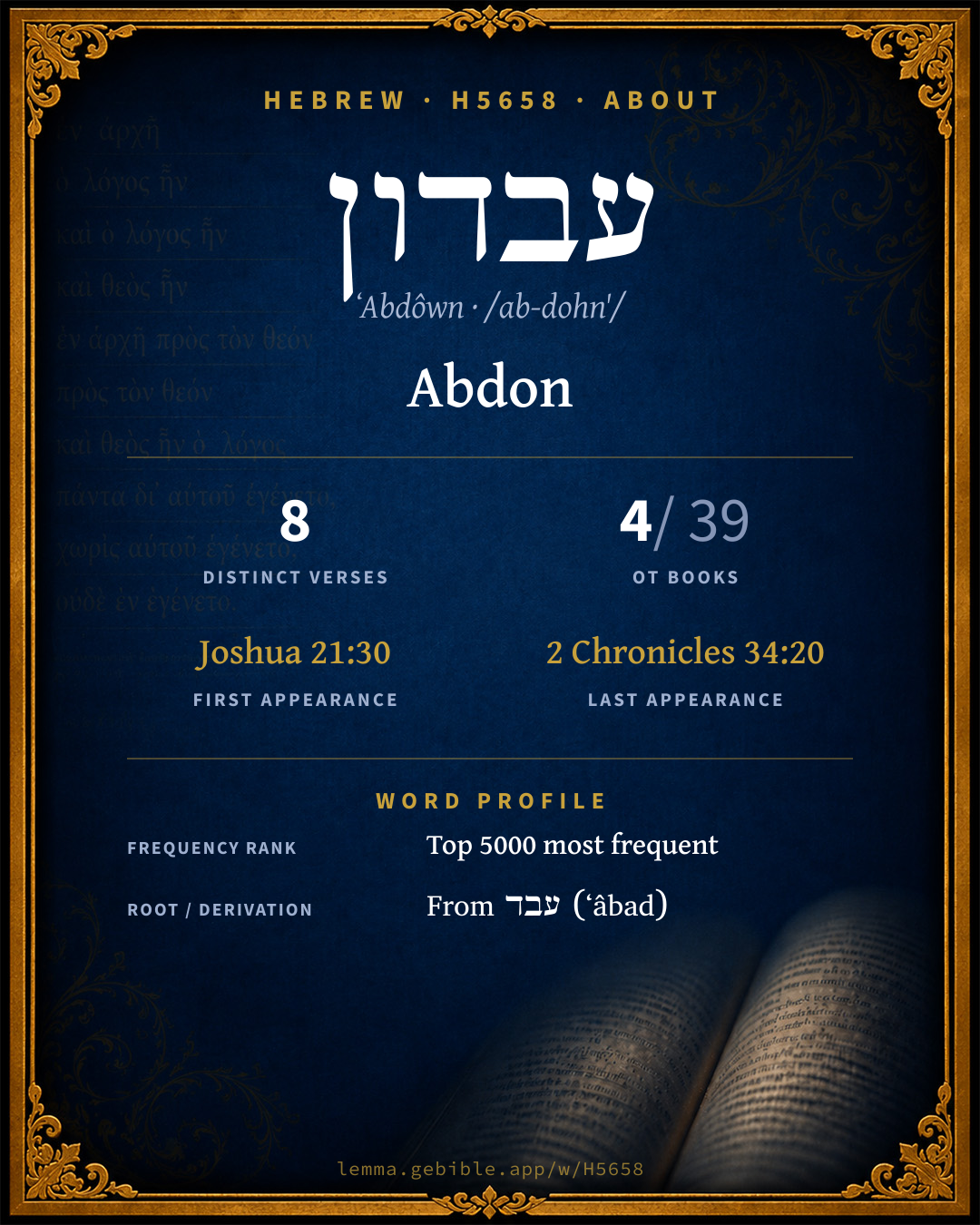
עַבְדּוֹן
Abdon
BDB lists 6 entries for ‘Abdon’ fuller range ↓
Full lexicon entry — Brown-Driver-Briggs (BDB)
From Brown-Driver-Briggs (BDB)
Where this word appears
Grammar key — what these labels mean
Part of speech
- Noun
- A naming word — a person, place, thing, or idea.
Noun type
- Proper
- A name of a specific person, place, or people (e.g. Abraham, Zion, Israel).
Every verse where H5658 appears in the Book of 2 Chronicles — 1 distinct verse. Click any verse to open its interlinear word-by-word view. Verse text shown in the World English Bible for context — . Each verse’s Hebrew form is shown with its reference; the English is not keyword-highlighted, since the data carries no word-level English alignment. Use “Compare translations” on any verse to read it across multiple English versions. This concordance covers the Hebrew Bible; Septuagint (Greek Old Testament) occurrences are not indexed here.
2 Chronicles
About this entry
At a glance — auto-summarized from this page’s data, not written by a person. Every figure links to its source below. This summary describes the numbers; it doesn’t interpret them.
עבדון — transliterated ʻAbdôwn — is a Hebrew name carrying the sense “Abdon.” More than half of its appearances fall in 1 Chronicles. It appears 8 verses across 4 books of the Hebrew Bible, among its uncommon vocabulary. Its earliest occurrence is Joshua 21:30. See 8-verse concordance and the renderings breakdown below.
Gloss history
Strong's 1890 vs modern scholarship
About this word
Strong's H5658 catalogs a Hebrew word from the Hebrew Old Testament.
These counts are not copied from any lexicon or concordance. They are computed here, from the morphology-tagged Hebrew Old Testament. What Lemma adds →
- 8
- distinct verses
- The word appears in 8 distinct verses.
- 4 / 39
- OT books
- The word appears in 4 of 39 Old Testament books.
- #2,625
- by frequency
- Top 5000 most frequent Hebrew words (rank 2,625 of 8,640 Hebrew words by occurrence).
View all 8 occurrences in the concordance →
Most concentrated in
- 1 Chronicles 4 verses 50%
- Judges 2 verses 25%
- Joshua 1 verse 13%
By section of the Old Testament
By traditional corpus
Conventional, traditional groupings — biblical authorship is debated, so this is a traditional corpus grouping, not an authorship claim. Each share is this word’s portion of its verses in that division of the Hebrew canon. Each figure is a share of the word’s 8 distinct verses.
- Writings (Ketuvim) 5 verses · 63%
- Prophets (Nevi'im) 3 verses · 38%
How translations render this word
Counts come from each version’s own published word-to-Strong’s tagging or interlinear alignment — an approximate guide to how each version renders this word, not a word-level alignment the data otherwise carries. Because each total is that version’s own tagged count, the per-version totals vary from one another and need not match the appearance or distinct-verse counts above. These counts may also differ from a printed concordance because Lemma counts each distinctly tagged rendering and does not collapse phrase taggings into a single head-word total. This is a fixed set of word-tagged versions (KJV, ASV, BSB, ULT) and does not change with the reading translation you choose elsewhere. Each version’s license is shown beside its name below (and on Sources).
- King James Version: Abdon 8×
- American Standard Version: Abdon 8×
- Berean Standard Bible: Abdon 8×
- unfoldingWord Literal Text: Abdon 6×, Was abdon 2×
King James Version Public Domain
Renders H5658 across 8 tagged occurrences — most commonly:
American Standard Version Public Domain
Renders H5658 across 8 tagged occurrences — most commonly:
Berean Standard Bible Public Domain
Renders H5658 across 8 tagged occurrences — most commonly:
unfoldingWord Literal Text CC BY-SA 4.0
Renders H5658 across 8 tagged occurrences — most commonly:
Senses in the full BDB
What do BDB’s symbols mean?
BDB uses these scholarly abbreviations:
| Symbol | Meaning |
|---|---|
| 𝔊 | the Septuagint (the ancient Greek translation, LXX) |
| 𝔙 | the Vulgate (the Latin translation) |
| 𝔖 | the Syriac version (the Peshitta) |
| 𝔗 | the Targum (the Aramaic translation) |
| ψ | the Psalms |
| √ | root (the underlying root or stem) |
| ‖ | parallel passage (a synonymous or contrasted parallel) |
| † | the dagger: every passage where the word occurs is cited |
The 4 senses and sub-senses the full Brown-Driver-Briggs lexicon distinguishes for this word, in lexicon order (not ranked by frequency), with BDB’s own verbatim wording and sub-sense lettering. Shown in Hebrew script with BDB’s own scholarly abbreviations. The condensed entry is in the Lexicon Entry tab. See also the Forms in the corpus table below.
- 1. a judge Ju 12:13, 15, 𝔊 Αβδων, A 𝔊L Λαβδω(μ); (Ew cp. בְּדָן 1 S 12:11, but read בָּרָק, v. בְּדָן supr.). e.g. Judges 12:13
- 2. a Benjamite 1 Ch 8:23, 𝔊 Αβαδων, A 𝔊L Αβδων. e.g. 1 Chronicles 8:23
- 3. son of Jehiel a Gibeonite 1 Ch 8:30; 9:36; 𝔊 Αβαλων, Σαβαδων, A Αβδων, Σαβδων, 𝔊L Αβδων. e.g. 1 Chronicles 8:30
- 4. son of Micah 2 Ch 34:20, 𝔊 Αβδοδομ, A 𝔊L Αβδων (= עַכְבּוֹר 2 K 22:12). II. n.pr.loc. Levitical city in Asher Jos 21:30; 1 Ch 6:59, 𝔊 Δαββων, Αβαραν, A 𝔊L Αβδων (20 Codd. read עַבְדֹּן Jos 19:28 for עֶבְרֹן), ʿAbde, Guérin Gal 2:37 cf. BuhlGeogr. 230. e.g. 2 Chronicles 34:20
Senses from the full Brown-Driver-Briggs lexicon (Brown, Driver, Briggs; Oxford 1906 — public domain), digitized via Sefaria, supplemented by the OpenScriptures HebrewLexicon (CC BY 4.0). Full attribution on Sources.
Word origin
Derived from עבד (ʻâbad) (H5647) — to serve.
Forms in the corpus
The 5 distinct written forms H5658 takes in the Hebrew Bible, most frequent first — each parse links to that state’s occurrences in the concordance. Hebrew forms include their vowel points and cantillation, so a single lemma takes many written forms.
| Form | Parsing | Example | Uses |
|---|---|---|---|
| עַבְדּ֑וֹן | Noun, Proper | 1 Chronicles 8:30 | 2 |
| עַבְדּ֖וֹן | Noun, Proper | 1 Chronicles 6:74 | 2 |
| עַבְדּ֥וֹן | Noun, Proper | Judges 12:13 | 2 |
| וְ/עַבְדּ֥וֹן | Noun, Proper | 1 Chronicles 8:23 | 1 |
| עַבְדּ֨וֹן | Noun, Proper | 2 Chronicles 34:20 | 1 |
Same root — word family
Other BDB entries built from the same root as H5658, grouped by Strong’s listed origin. These share a root / origin per the lexicon — not necessarily a shared meaning. Each links to that word’s own entry.
Derives from
Shares the same root
- מעבד maʻbâd H4566 work
- עבד ʻăbad H5648 to make
- עבד ʻebed H5650 servant
- עבד ʻăbâd H5652 work
- עבדה ʻăbôdâh H5656 service
- עבדה ʻăbuddâh H5657 service
- עבדות ʻabdûwth H5659 bondage
Proper names from this root
People and places named from this root — a name, not an additional meaning of the word.
- עבדא ʻAbdâʼ H5653 Abda
- עבד אדום ʻÔbêd ʼĔdôwm H5654 Obed-edom
- עבדאל ʻAbdᵉʼêl H5655 Abdeel
- עבדי ʻAbdîy H5660 Abdi
- עבדיה ʻÔbadyâh H5662 Obadiah
- עובד ʻÔwbêd H5744 Obed
- בדן Bᵉdân H917 Bedan
Compare all same-root words → Showing 4 of 16 — not the complete family. 7 of the same-root words are proper names (people or places). They share a root, not necessarily a meaning.
Bible dictionary
Public-domain dictionary articles matched to this entry by name (Abdon). A biblical name can be shared by more than one person or place, so an article may treat several.
Easton's Bible Dictionary · M. G. Easton, 1897
Servile. (1.) The son of Hillel, a Pirathonite, the tenth judge of Israel (Judg. 12:13-15). He is probably the Bedan of 1 Sam. 12:11.
(2.) The first-born of Gibeon of the tribe of Benjamin (1 Chr. 8:30; 9:36).
(3.) The son of Micah, one of those whom Josiah sent to the prophetess Huldah to ascertain from her the meaning of the recently discovered book of the law (2 Chr. 34:20). He is called Achbor in 2 Kings 22:12.
(4.) One of the "sons" of Shashak (1 Chr. 8:23).
This is the name also of a Levitical town of the Gershonites, in the tribe of Asher (Josh. 21:30; 1 Chr. 6:74). The ruins of Abdeh, some 8 miles north-east of Accho, probably mark its site.
Smith's Bible Dictionary · William Smith, 1863
(servile).
+ A judge of Israel, (Judges 12:13,(15) perhaps the same person as Bedan, in (1 Samuel 12:11) (B.C. 1233-1225). + Son of Shashak. (1 Chronicles 8:23) + First-born son of Jehiel, son of Gideon. (1 Chronicles 8:30; 9:35,36). + Son of Micah, a contemporary of Josiah, (2 Chronicles 34:20) called Achbor in (2 Kings 22:12) (B.C. 628.) + A city in the tribe if Asher, given to the Gershonites, (Joshua 21:30; 1 Chronicles 6:74) the modern Abdeh, 10 miles northeast of Accho.
Hitchcock's Bible Names Dictionary · Roswell D. Hitchcock, 1869
servant; cloud of judgment
Classic public-domain reference works; full attribution on Sources.
Septuagint verse parallels
This word appears in 7 verses that also exist in the Greek Old Testament (Septuagint), out of the 8 Hebrew verses it occurs in. You can read those verses in Greek by switching the Old Testament edition to the Septuagint.
Read these verses in the Septuagint
This is a verse-level parallel only — the same verses exist in both the Hebrew and Greek Old Testaments. No word-level Hebrew↔Greek correspondence is claimed: the data carries no such alignment, so no Greek word is shown as this Hebrew word’s translation. Coverage is not total — the Septuagint omits the deuterocanon and renumbers the Psalms, so some Hebrew verses have no direct Greek parallel.