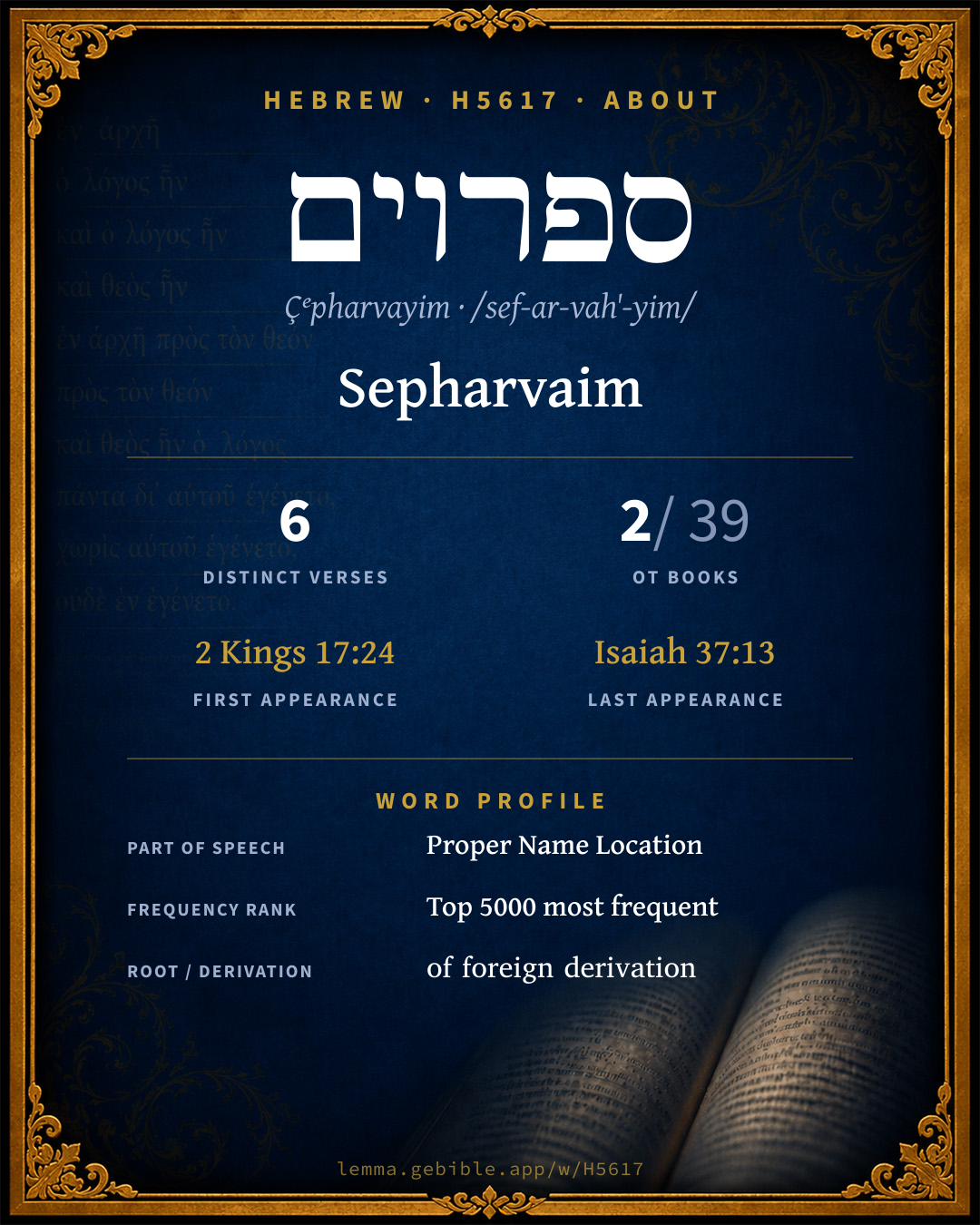
סְפַרְוַ֫יִם
Sepharvaim
BDB lists 2 entries for ‘Sepharvaim’ fuller range ↓
Full lexicon entry — Brown-Driver-Briggs (BDB)
From Brown-Driver-Briggs (BDB)
Where this word appears
Grammar key — what these labels mean
Part of speech
- Noun
- A naming word — a person, place, thing, or idea.
Noun type
- Proper
- A name of a specific person, place, or people (e.g. Abraham, Zion, Israel).
Every verse where H5617 appears in the Book of 2 Kings — 4 distinct verses. Click any verse to open its interlinear word-by-word view. Verse text shown in the World English Bible for context — . Each verse’s Hebrew form is shown with its reference; the English is not keyword-highlighted, since the data carries no word-level English alignment. Use “Compare translations” on any verse to read it across multiple English versions. This concordance covers the Hebrew Bible; Septuagint (Greek Old Testament) occurrences are not indexed here.
2 Kings
- 2 Kings 17:24 וּ/סְפַרְוַ֔יִם conj + n Proper The king of Assyria brought men from Babylon, and from Cuthah, and from Avva, and from Hamath and Sepharvaim, and placed them in the cities of Samaria instead of the children of Israel; and they possessed Samaria, and lived in the cities of it.
- 2 Kings 17:31 ספרים סְפַרְוָֽיִם n Proper n Proper and the Avvites made Nibhaz and Tartak; and the Sepharvites burnt their children in the fire to Adrammelech and Anammelech, the gods of Sepharvaim.
- 2 Kings 18:34 סְפַרְוַ֖יִם n Proper Where are the gods of Hamath, and of Arpad? where are the gods of Sepharvaim, of Hena, and Ivvah? have they delivered Samaria out of my hand?
- 2 Kings 19:13 סְפַרְוָ֑יִם n Proper Where is the king of Hamath, and the king of Arpad, and the king of the city of Sepharvaim, of Hena, and Ivvah?
About this entry
At a glance — auto-summarized from this page’s data, not written by a person. Every figure links to its source below. This summary describes the numbers; it doesn’t interpret them.
At its core, ספרוים (Çᵉpharvayim) means “Sepharvaim.” The word gravitates to 2 Kings (67%), then Isaiah. It appears 6 verses across 2 books of the Hebrew Bible, among its uncommon vocabulary. First canonically at 2 Kings 17:24, it enters the text early. Dig into 6-verse concordance and the renderings breakdown below.
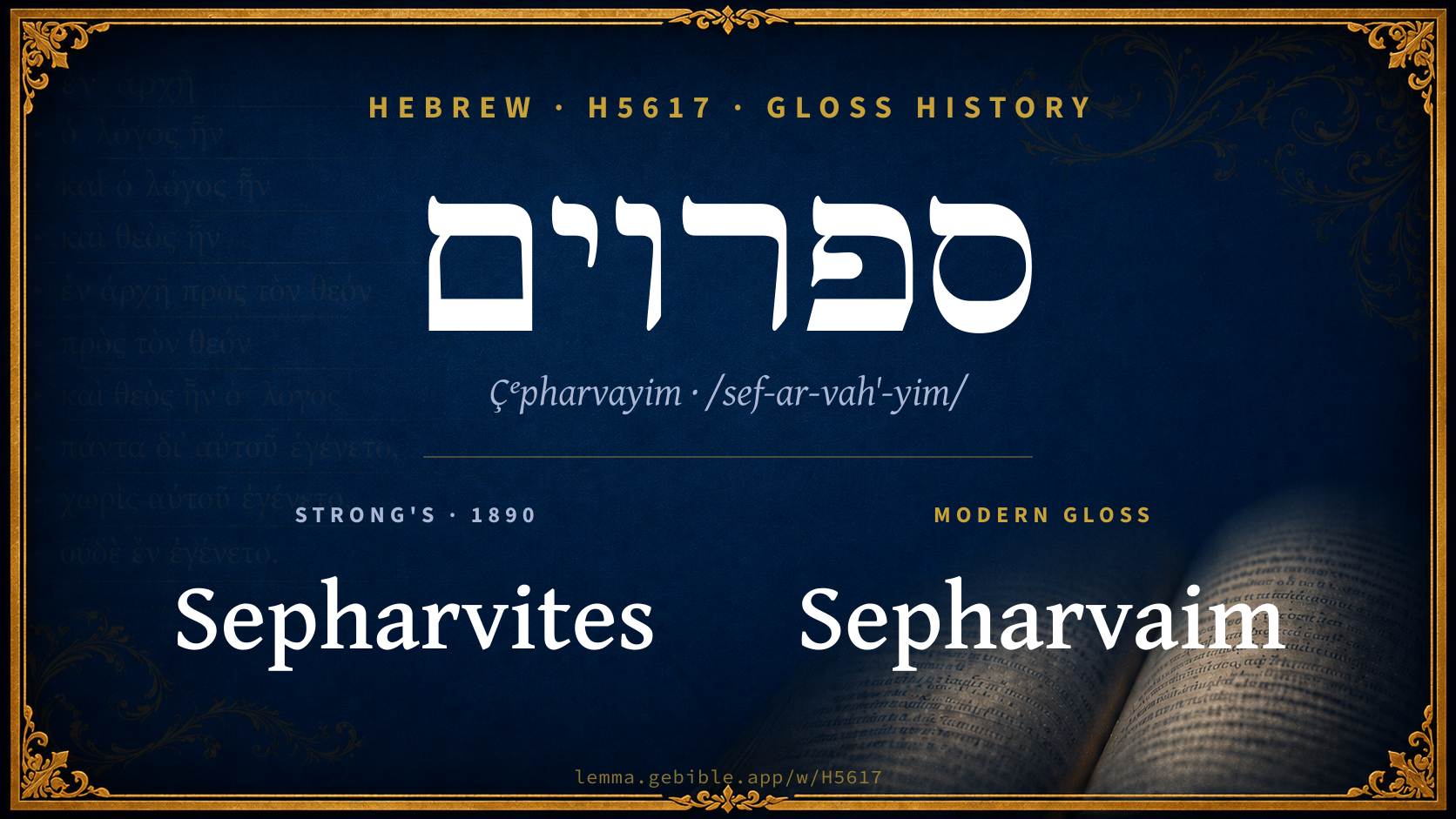
Gloss history
Strong's 1890 vs modern scholarship
About this word
Strong's H5617 catalogs a Hebrew word from the Hebrew Old Testament.
These counts are not copied from any lexicon or concordance. They are computed here, from the morphology-tagged Hebrew Old Testament. What Lemma adds →
- 6
- distinct verses
- The word appears in 6 distinct verses.
- 2 / 39
- OT books
- The word appears in 2 of 39 Old Testament books.
- #2,835
- by frequency
- Top 5000 most frequent Hebrew words (rank 2,835 of 8,640 Hebrew words by occurrence).
View all 6 occurrences in the concordance →
By traditional corpus
Conventional, traditional groupings — biblical authorship is debated, so this is a traditional corpus grouping, not an authorship claim. Each share is this word’s portion of its verses in that division of the Hebrew canon. Each figure is a share of the word’s 6 distinct verses.
- Prophets (Nevi'im) 6 verses · 100%
How translations render this word
Counts come from each version’s own published word-to-Strong’s tagging or interlinear alignment — an approximate guide to how each version renders this word, not a word-level alignment the data otherwise carries. Because each total is that version’s own tagged count, the per-version totals vary from one another and need not match the appearance or distinct-verse counts above. These counts may also differ from a printed concordance because Lemma counts each distinctly tagged rendering and does not collapse phrase taggings into a single head-word total. This is a fixed set of word-tagged versions (KJV, ASV, BSB, ULT) and does not change with the reading translation you choose elsewhere. Each version’s license is shown beside its name below (and on Sources).
- King James Version: Sepharvaim 6×
- American Standard Version: Sepharvaim 6×
- Berean Standard Bible: Sepharvaim 6×
- unfoldingWord Literal Text: Sepharvaim 5×
King James Version Public Domain
Renders H5617 across 6 tagged occurrences — most commonly:
American Standard Version Public Domain
Renders H5617 across 6 tagged occurrences — most commonly:
Berean Standard Bible Public Domain
Renders H5617 across 6 tagged occurrences — most commonly:
unfoldingWord Literal Text CC BY-SA 4.0
Renders H5617 across 6 tagged occurrences — most commonly:
Plus 1 rendering that appears only once — usually multi-word phrases or single function words the recovered tagging swept in, not distinct renderings.
Senses in BDB
The 2 senses BDB distinguishes for this word, in lexicon order (not ranked by frequency or importance). The full entry — with sub-senses — is in the Lexicon Entry tab.
- Sepharvaim = "the two Sipparas"
- a city in Syria conquered by the king of Assyria
Word origin
n.pr.loc. city conquered by king of Assyrian;—ס׳ 2 K 17:14; 18:34 = סְפַרְוָ֑יִם Is 36:19, עִיר סְפַרָוָ֑יִם 2 K 19:13 = Is 37:13; סְפַרְוָ֑יִם also 2 K 17:31b Qr (Kt. ספרים); 𝔊 Σεπφαρουαιν, Επφαρουαιμ, etc., 𝔊L Σεπφαρειμ;—usually indentif. with Sippara (on a canal), between Bagdad and Babyl., a city in two parts, Sipp. of Šamaš (mod.Abbu Habba), and Sipp. of Anunitu(m), on opp. side of canal, hence du. ס׳ = the two Sipparas, SchrCOT 2 K 17, 24, cf. Dl Par 209–212 Tiele Gesch. 88; this recently disputed, in view of mention with Hamath and other northern cities (2 K 17:24 and especially 18:34), v. Hal ZA ii. 401 ff. Di Is 36:19 Wkl Alttest. Unters. 101 Benz 2 K 17:24 al., who cp. Šabara’in, city conquered by Šalmanašarid IV (Wkl in SchrKB ii. 276); but this by no means certain.
— Brown-Driver-Briggs (Oxford 1906, public domain), digitized via Sefaria, supplemented by the OpenScriptures HebrewLexicon (CC BY 4.0). See Sources.
Origin: of foreign derivation
Forms in the corpus
The 5 distinct written forms H5617 takes in the Hebrew Bible, most frequent first — each parse links to that state’s occurrences in the concordance. Hebrew forms include their vowel points and cantillation, so a single lemma takes many written forms.
| Form | Parsing | Example | Uses |
|---|---|---|---|
| סְפַרְוָ֑יִם | Noun, Proper | 2 Kings 19:13 | 3 |
| וּ/סְפַרְוַ֔יִם | Noun, Proper | 2 Kings 17:24 | 1 |
| סְפַרְוַ֖יִם | Noun, Proper | 2 Kings 18:34 | 1 |
| סְפַרְוָֽיִם | Noun, Proper | 2 Kings 17:31 | 1 |
| ספרים | Noun, Proper | 2 Kings 17:31 | 1 |
Same root — word family
Other BDB entries built from the same root as H5617, grouped by Strong’s listed origin. These share a root / origin per the lexicon — not necessarily a shared meaning. Each links to that word’s own entry.
Proper names from this root
People and places named from this root — a name, not an additional meaning of the word.
Compare all same-root words → 1 of the same-root words is a proper name (a person or place). They share a root, not necessarily a meaning.
Bible dictionary
Public-domain dictionary articles matched to this entry by name (Sepharvaim). A biblical name can be shared by more than one person or place, so an article may treat several.
Easton's Bible Dictionary · M. G. Easton, 1897
Taken by Sargon, king of Assyria (2 Kings 17:24; 18:34; 19:13; Isa. 37:13). It was a double city, and received the common name Sepharvaim, i.e., "the two Sipparas," or "the two booktowns." The Sippara on the east bank of the Euphrates is now called Abu-Habba; that on the other bank was Accad, the old capital of Sargon I., where he established a great library. (See SARGON.) The recent discovery of cuneiform inscriptions at Tel el-Amarna in Egypt, consisting of official despatches to Pharaoh Amenophis IV. and his predecessor from their agents in Palestine, proves that in the century before the Exodus an active literary intercourse was carried on between these nations, and that the medium of the correspondence was the Babylonian language and script. (See KIRJATH-SEPHER.)
Smith's Bible Dictionary · William Smith, 1863
(the two Sipparas) is mentioned by Sennacherib in his letter to Hezekiah as a city whose king had been unable to resist the Assyrians. (2 Kings 19:13; Isaiah 37:13) comp. 2Kin 18:34 It is identified with the famous town of Sippara., on the Euphrates above Babylon, which was near the site of the modern Mosaib. The dual form indicates that there were two Sipparas, one on either side of the river. Berosus celled Sippara "a city of the sun;" and in the inscriptions it bears the same title, being called Tsipar sha Shamas, or "Sippara of the Sun"--the sun being the chief object of worship there. Comp. (2 Kings 17:31)
Hitchcock's Bible Names Dictionary · Roswell D. Hitchcock, 1869
the two books; the two scribes
Classic public-domain reference works; full attribution on Sources.
Septuagint verse parallels
This word appears in 6 verses that also exist in the Greek Old Testament (Septuagint), out of the 6 Hebrew verses it occurs in. You can read those verses in Greek by switching the Old Testament edition to the Septuagint.
Read these verses in the Septuagint
This is a verse-level parallel only — the same verses exist in both the Hebrew and Greek Old Testaments. No word-level Hebrew↔Greek correspondence is claimed: the data carries no such alignment, so no Greek word is shown as this Hebrew word’s translation. Coverage is not total — the Septuagint omits the deuterocanon and renumbers the Psalms, so some Hebrew verses have no direct Greek parallel.