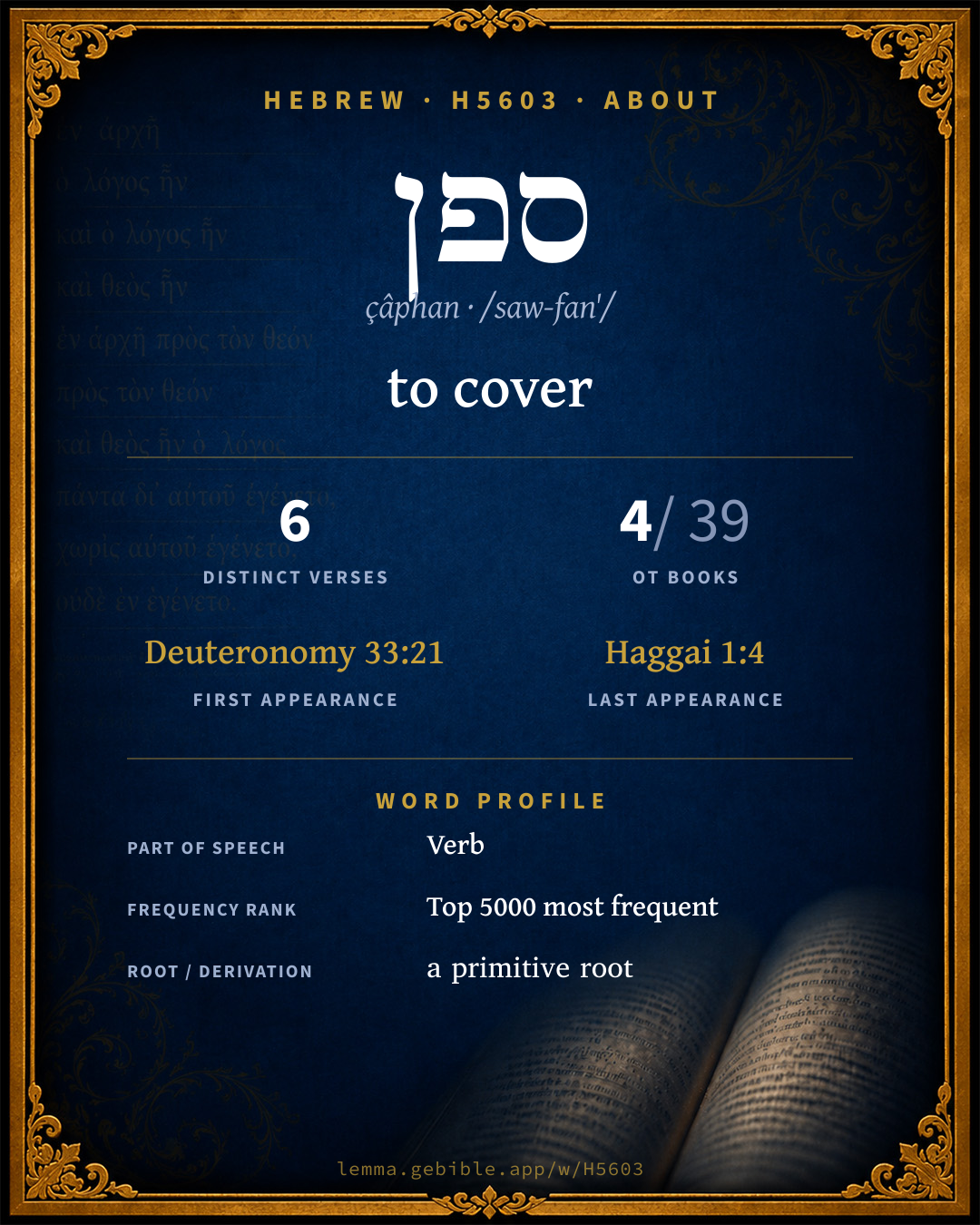
סָפַן
to cover
also: cover in, wainscotted fuller range ↓
Full lexicon entry — Brown-Driver-Briggs (BDB)
From Brown-Driver-Briggs (BDB)
Where this word appears
Grammar key — what these labels mean
Part of speech
- Verb
- An action or state-of-being word.
Stem
- Qal
- The basic, simple active stem — the plain form of the verb (“he wrote”).
Form
- Participle Passive
- A verbal adjective expressing action received (“written”).
- Sequential Imperfect
- An imperfect with prefixed waw — the standard past-narrative form (waw-consecutive imperfect).
State
- Absolute
- The independent form of a noun, not bound to a following word.
Person
- 3rd Person
- The one spoken about (“he / she / it / they”).
Gender
- Masculine
- Grammatically masculine.
Number
- Singular
- One.
- Plural
- More than one (in Hebrew, generally three or more).
Every verse where H5603 appears in the Book of Jeremiah — 1 distinct verse. Click any verse to open its interlinear word-by-word view. Verse text shown in the World English Bible for context — . Each verse’s Hebrew form is shown with its reference; the English is not keyword-highlighted, since the data carries no word-level English alignment. Use “Compare translations” on any verse to read it across multiple English versions. This concordance covers the Hebrew Bible; Septuagint (Greek Old Testament) occurrences are not indexed here.
Jeremiah
About this entry
At a glance — auto-summarized from this page’s data, not written by a person. Every figure links to its source below. This summary describes the numbers; it doesn’t interpret them.
ספן (çâphan) is a Hebrew verb most often rendered “to cover.” It clusters heavily in 1 Kings, which alone accounts for 50% of its uses. With 6 verses in 4 books, it is an uncommon word in the Hebrew Bible. First canonically at Deuteronomy 33:21, it enters the text early. Lexicons map it across 3 senses — beyond “to cover” it also covers “cover in” and “wainscotted”. For the data behind this summary, explore the sense tree and the renderings breakdown below.
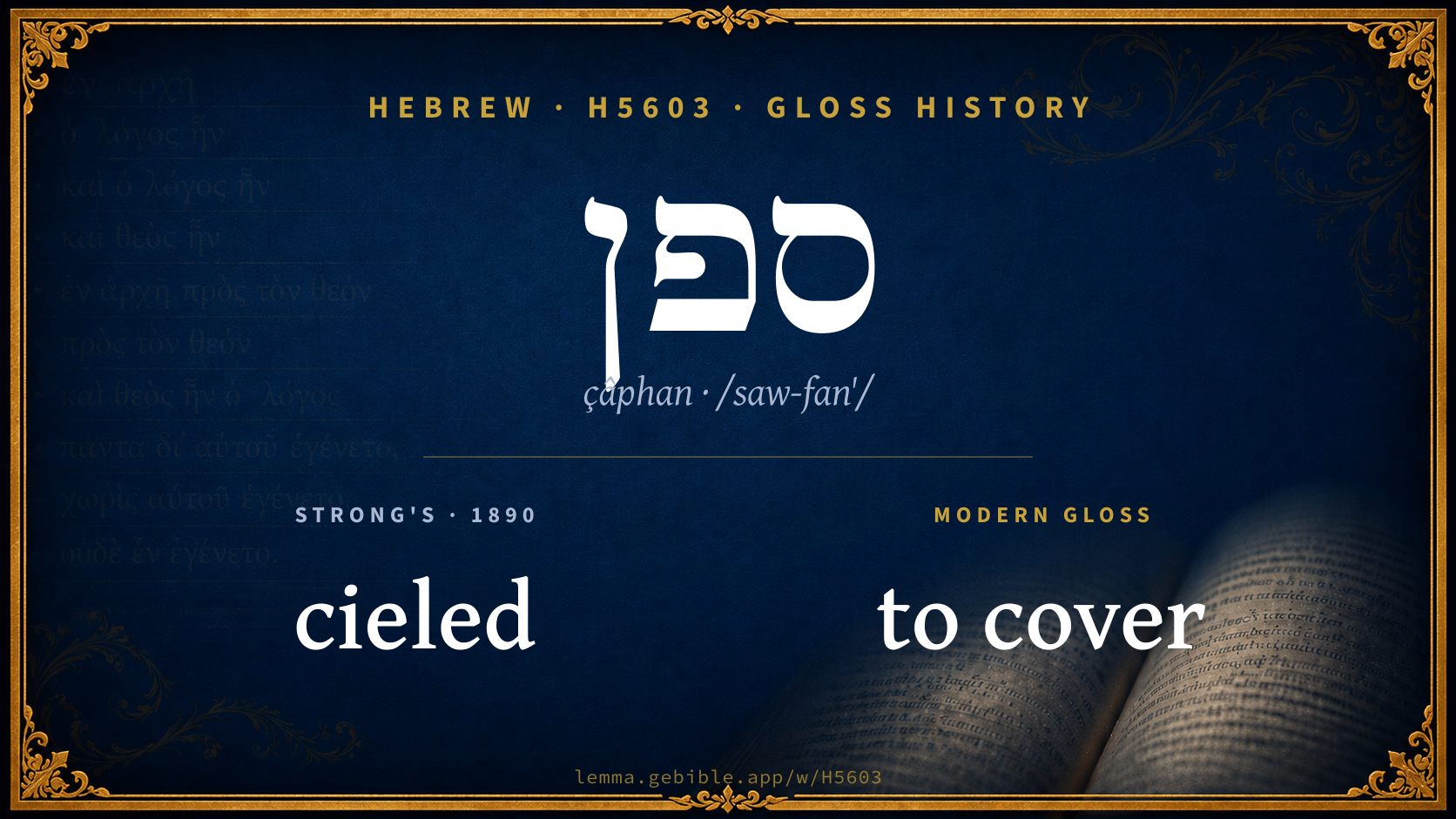
Gloss history
Strong's 1890 vs modern scholarship
About this word
Strong's H5603 catalogs a Hebrew word from the Hebrew Old Testament.
These counts are not copied from any lexicon or concordance. They are computed here, from the morphology-tagged Hebrew Old Testament. What Lemma adds →
- 6
- distinct verses
- The word appears in 6 distinct verses.
- 4 / 39
- OT books
- The word appears in 4 of 39 Old Testament books.
- #3,040
- by frequency
- Top 5000 most frequent Hebrew words (rank 3,040 of 8,640 Hebrew words by occurrence).
View all 6 occurrences in the concordance →
Most concentrated in
- 1 Kings 3 verses 50%
- Deuteronomy 1 verse 17%
- Jeremiah 1 verse 17%
By section of the Old Testament
By traditional corpus
Conventional, traditional groupings — biblical authorship is debated, so this is a traditional corpus grouping, not an authorship claim. Each share is this word’s portion of its verses in that division of the Hebrew canon. Each figure is a share of the word’s 6 distinct verses.
- Prophets (Nevi'im) 5 verses · 83%
- Torah (Pentateuch) 1 verse · 17%
How translations render this word
Counts come from each version’s own published word-to-Strong’s tagging or interlinear alignment — an approximate guide to how each version renders this word, not a word-level alignment the data otherwise carries. Because each total is that version’s own tagged count, the per-version totals vary from one another and need not match the appearance or distinct-verse counts above. These counts may also differ from a printed concordance because Lemma counts each distinctly tagged rendering and does not collapse phrase taggings into a single head-word total. This is a fixed set of word-tagged versions (KJV, ASV, BSB, ULT) and does not change with the reading translation you choose elsewhere. Each version’s license is shown beside its name below (and on Sources).
- King James Version: Was covered 2×
- American Standard Version: Was covered 2×
- Berean Standard Bible: Paneled 1×, Panels it 1×, Roofing 1×
- unfoldingWord Literal Text: Was covered 2×
King James Version Public Domain
Renders H5603 across 6 tagged occurrences — most commonly:
Plus 4 renderings that appear only once — usually multi-word phrases or single function words the recovered tagging swept in, not distinct renderings.
American Standard Version Public Domain
Renders H5603 across 6 tagged occurrences — most commonly:
Plus 4 renderings that appear only once — usually multi-word phrases or single function words the recovered tagging swept in, not distinct renderings.
Berean Standard Bible Public Domain
Renders H5603 across 6 tagged occurrences — most commonly:
unfoldingWord Literal Text CC BY-SA 4.0
Renders H5603 across 7 tagged occurrences — most commonly:
Plus 5 renderings that appear only once — usually multi-word phrases or single function words the recovered tagging swept in, not distinct renderings.
Senses in BDB
The 3 senses BDB distinguishes for this word, in lexicon order (not ranked by frequency or importance). The full entry — with sub-senses — is in the Lexicon Entry tab.
- to cover, cover in, wainscotted, covered with boards or panelling
(Qal)
- to cover in, panel
- covered, panelled (participle)
Word origin
Origin: a primitive root
Jastrow Dictionary
A second Hebrew/Aramaic lexicon for comparison, covering Aramaic and post-biblical (Talmudic, Targumic, Midrashic) usage that the biblical-Hebrew BDB does not. Matched by lemma rather than by Strong’s number, so a lemma may carry more than one Jastrow headword (shown separately below), and the entries cover usage well beyond the Bible.
סָפַן
- (cmp. צָפַן, צָפָה) [to look up to, look out for,]
- 1. to respect; to care for, mind Y. Snh. X, beg. 27ᶜ זהו שאומר ואיני סוֹפְנָהּ … that is he who says, there is a Torah, but I do not mind its authority; Y. Peah I, 16ᵇ סובלה (corr. acc.). Tosef. Sot. III, 14 ולא סְפָנוּהוּ וכ׳ (Var. סנפוהו, corr. acc.) they minded him not, because he was merely a common soldier (גּוֹלְיָיר). Sifré Deut. 33 (ref. to היום, Deut. VI, 6) שלא יהו … שאין אדם סופנה Rashi ed. Berl. a. l. (ed. סופרה, corr. acc.; Ms. 3 צוֹפְנָהּ, v. ed. Fr. note) that they be not in thy eyes like an antiquated ordinance which nobody minds; Yalk. Deut. 840 שאין הכל סוֹפְנִין אותה (not סופגין). Tosef. Keth. VII, 5 תהא מוטלת ואין כל בריה סופנה (not בריא) she will lie dead and none will care for her (to bury her); Keth. 72ᵃ ואון … סופדה … סופנה (R. Hillel quoted in Sifré l. c., ed. Fr. note צופנה) and none will mourn for her, and some say sof’nah; (Y. ib. VII, 31ᵇ bot. משגחת).—Part. pass. סָפוּן; pl. סְפוּנִים, סְפוּנִין. Ex. R. s. 20 והייתי ס׳ בפניו (some ed. בעיניו) and I enjoyed his respect. Mekh. B’shall., Vayass‘a, s. 2 וכי מה אנו ס׳ שאתם וכ׳ what is our distinction, that you murmur against us?; Yalk. Ex. 258. Tanḥ. Vayesh. 3 אתה עושה … כאלו הוא ס׳ thou wouldst treat the idolater as if he (his idolatry) was respected. Ib. אינן ס׳ לכלום are regarded as nothing (before God); a. e.—[ e.g. Deuteronomy 6:6
- 2. (b. h.) to provide, lay up; v. next w.]
סְפַן
- 1. to brighten, scour; v. Ithpe.
- to regard. Targ. II Esth. I, 12. Ib. VII, 9 (10).—3) to look out for, provide, store; (of a bird’s ovary) to be fructified. Bets. 7ᵃ ביעי דסַפְנָא מארעא eggs laid by a hen that was fecundated by friction in the dust, v. דִּכְרָא. Ḥull. 58ᵃ בדספנא מארעא if the hen was fructified by friction &c.
- 1. to be brightened, scoured. Targ. Y. Lev. VI, 21 (cmp. Tosef. Nidd. VIII, 11 הצפינן, quot. s. v. צָפוֹן I).
- 2. to be provided, laid in. Koh. R. to XI, 9 [read:] עד דאִיסְתַּפְנוּן פריטוי until the money which he owes is hatched (brought together); (Pesik. Shub., p. 164ᵇ מתפשר, v. פְּשַׁר).
סַפָּן
- (denom. of סְפִינָה) sailor, captain of a freight ship. Shebi. VIII, 5, v. בַּיָּיר. Tosef. B. Mets. IX, 14, a. e.—Pl. סַפָּנִין. Sabb. XV, 1, sq. קשר הס׳, expl. ib. 111ᵇ, v. אִיסְטְרִידָא. Kidd. IV, 14 הס׳ רובן וכ׳ sailors are mostly pious men. Y. M. Kat. III, 82ᵇ bot. איכריו וסַפָּנָיו וכ׳ (not איבריו) his farm-hands, and the sailors and camel drivers in his employment.
A Dictionary of the Targumim, the Talmud Babli and Yerushalmi, and the Midrashic Literature (Marcus Jastrow; London, Luzac, 1903) — Public Domain. Digitized via Sefaria. Digitized via Sefaria. Full attribution on Sources.
Forms in the corpus
The 5 distinct written forms H5603 takes in the Hebrew Bible, most frequent first — each parse links to that stem’s occurrences in the concordance. Hebrew forms include their vowel points and cantillation, so a single lemma takes many written forms.
| Form | Parsing | Example | Uses |
|---|---|---|---|
| וְ/סָפ֣וּן | Verb, Qal, Participle Passive, Masculine, Singular, Absolute | 1 Kings 7:7 | 2 |
| וְ/סָפֻ֣ן | Verb, Qal, Participle Passive, Masculine, Singular, Absolute | 1 Kings 7:3 | 1 |
| וַ/יִּסְפֹּ֤ן | Verb, Qal, Sequential Imperfect, 3rd Person, Masculine, Singular | 1 Kings 6:9 | 1 |
| סְפוּנִ֑ים | Verb, Qal, Participle Passive, Masculine, Plural, Absolute | Haggai 1:4 | 1 |
| סָפ֑וּן | Verb, Qal, Participle Passive, Masculine, Singular, Absolute | Deuteronomy 33:21 | 1 |
Same root — word family
Other BDB entries built from the same root as H5603, grouped by Strong’s listed origin. These share a root / origin per the lexicon — not necessarily a shared meaning. Each links to that word’s own entry.
Derived from this word
Compare all same-root words → They share a root, not necessarily a meaning.
Septuagint verse parallels
This word appears in 6 verses that also exist in the Greek Old Testament (Septuagint), out of the 6 Hebrew verses it occurs in. You can read those verses in Greek by switching the Old Testament edition to the Septuagint.
Read these verses in the Septuagint
This is a verse-level parallel only — the same verses exist in both the Hebrew and Greek Old Testaments. No word-level Hebrew↔Greek correspondence is claimed: the data carries no such alignment, so no Greek word is shown as this Hebrew word’s translation. Coverage is not total — the Septuagint omits the deuterocanon and renumbers the Psalms, so some Hebrew verses have no direct Greek parallel.