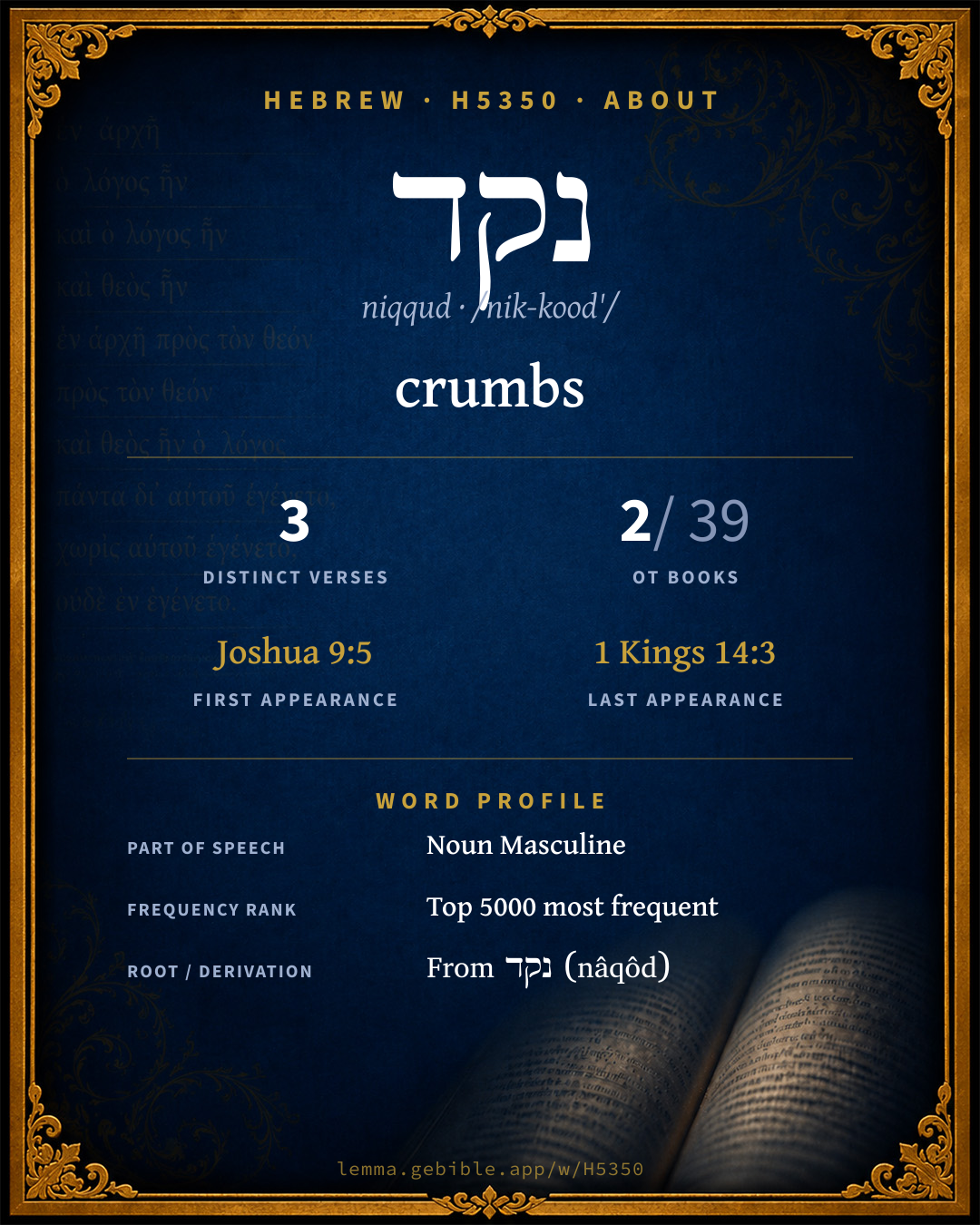
נִקּוּד
crumbs
also: crumbled thing, thing easily crumbled fuller range ↓
Full lexicon entry — Brown-Driver-Briggs (BDB)
From Brown-Driver-Briggs (BDB)
Where this word appears
Grammar key — what these labels mean
Part of speech
- Noun
- A naming word — a person, place, thing, or idea.
Noun type
- Common
- A common noun — a general class of person, place, or thing (“king,” “city,” “water”), not a specific name.
State
- Absolute
- The independent form of a noun, not bound to a following word.
Gender
- Masculine
- Grammatically masculine.
Number
- Plural
- More than one (in Hebrew, generally three or more).
Every verse where H5350 appears in the Book of Joshua — 2 distinct verses. Click any verse to open its interlinear word-by-word view. Verse text shown in the World English Bible for context — . Each verse’s Hebrew form is shown with its reference; the English is not keyword-highlighted, since the data carries no word-level English alignment. Use “Compare translations” on any verse to read it across multiple English versions. This concordance covers the Hebrew Bible; Septuagint (Greek Old Testament) occurrences are not indexed here.
Joshua
- Joshua 9:5 נִקֻּדִֽים n c mp and old and patched shoes on their feet, and old garments on them; and all the bread of their provision was dry and was become moldy.
- Joshua 9:12 נִקֻּדִֽים n c mp This our bread we took hot for our provision out of our houses on the day we came forth to go to you; but now, behold, it is dry, and is become moldy:
About this entry
At a glance — auto-summarized from this page’s data, not written by a person. Every figure links to its source below. This summary describes the numbers; it doesn’t interpret them.
נקד — transliterated niqqud — is a Hebrew noun carrying the sense “crumbs.” It is rare — just 3 verses in the entire Hebrew Bible. More than two-thirds of its appearances fall in Joshua. It first appears in Joshua 9:5. The lexical range runs to 3 senses — “crumbs” plus “crumbled thing” and “thing easily crumbled”. Each statement above links to its evidence; the full detail follows below.
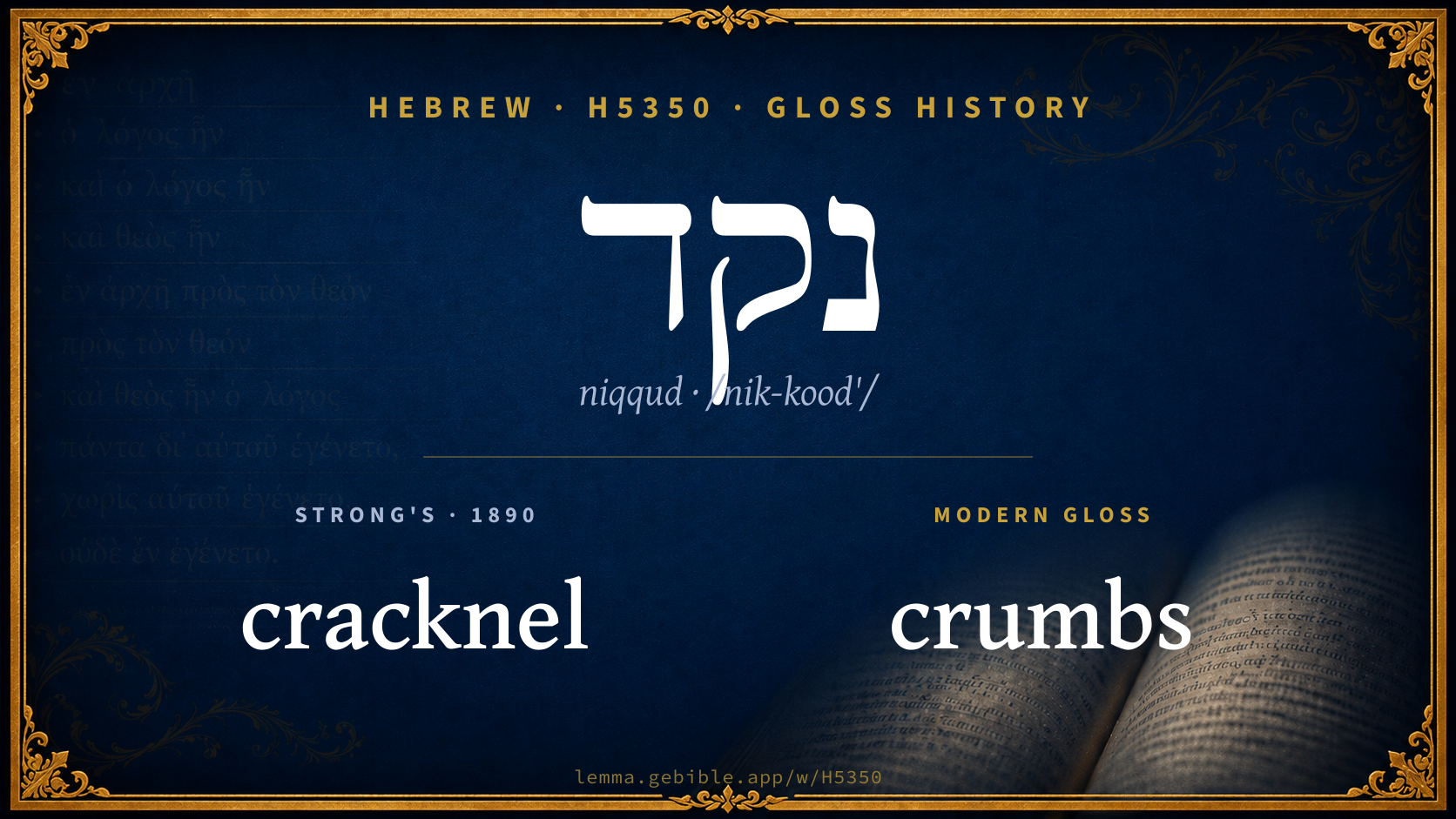
Gloss history
Strong's 1890 vs modern scholarship
About this word
Strong's H5350 catalogs a Hebrew word from the Hebrew Old Testament.
These counts are not copied from any lexicon or concordance. They are computed here, from the morphology-tagged Hebrew Old Testament. What Lemma adds →
- 3
- distinct verses
- The word appears in 3 distinct verses.
- 2 / 39
- OT books
- The word appears in 2 of 39 Old Testament books.
- #4,179
- by frequency
- Top 5000 most frequent Hebrew words (rank 4,179 of 8,640 Hebrew words by occurrence).
View all 3 occurrences in the concordance →
By traditional corpus
Conventional, traditional groupings — biblical authorship is debated, so this is a traditional corpus grouping, not an authorship claim. Each share is this word’s portion of its verses in that division of the Hebrew canon. Each figure is a share of the word’s 3 distinct verses.
- Prophets (Nevi'im) 3 verses · 100%
How translations render this word
Counts come from each version’s own published word-to-Strong’s tagging or interlinear alignment — an approximate guide to how each version renders this word, not a word-level alignment the data otherwise carries. Because each total is that version’s own tagged count, the per-version totals vary from one another and need not match the appearance or distinct-verse counts above. These counts may also differ from a printed concordance because Lemma counts each distinctly tagged rendering and does not collapse phrase taggings into a single head-word total. This is a fixed set of word-tagged versions (KJV, ASV, BSB, ULT) and does not change with the reading translation you choose elsewhere. Each version’s license is shown beside its name below (and on Sources).
- King James Version: Cracknels 1×, Is mouldy 1×, Mouldy 1×
- American Standard Version: Cakes 1×, Now behold it is dry and is become mouldy 1×, Was become mouldy 1×
- Berean Standard Bible: Moldy 2×
- unfoldingWord Literal Text: Crumbs 2×
King James Version Public Domain
Renders H5350 across 3 tagged occurrences — most commonly:
American Standard Version Public Domain
Renders H5350 across 3 tagged occurrences — most commonly:
Berean Standard Bible Public Domain
Renders H5350 across 3 tagged occurrences — most commonly:
Plus 1 rendering that appears only once — usually multi-word phrases or single function words the recovered tagging swept in, not distinct renderings.
unfoldingWord Literal Text CC BY-SA 4.0
Renders H5350 across 3 tagged occurrences — most commonly:
Plus 1 rendering that appears only once — usually multi-word phrases or single function words the recovered tagging swept in, not distinct renderings.
Senses in BDB
The 3 senses BDB distinguishes for this word, in lexicon order (not ranked by frequency or importance). The full entry — with sub-senses — is in the Lexicon Entry tab.
- crumbled thing, thing easily crumbled, crumbs
- crumbs
- apparently a kind of hard biscuit or cake
Word origin
[ נִקּוּד ] n.[m.] perh. what is crumbled or easily crumbles, crumb
— Brown-Driver-Briggs (Oxford 1906, public domain), digitized via Sefaria, supplemented by the OpenScriptures HebrewLexicon (CC BY 4.0). See Sources.
Derived from נקד (nâqôd) (H5348) — speckled.
Jastrow Dictionary
A second Hebrew/Aramaic lexicon for comparison, covering Aramaic and post-biblical (Talmudic, Targumic, Midrashic) usage that the biblical-Hebrew BDB does not. Matched by lemma rather than by Strong’s number, so a lemma may carry more than one Jastrow headword (shown separately below), and the entries cover usage well beyond the Bible.
נָקַד I
- (cmp. קָדַד) to sting, point, puncture, break through. Y. Keth. II, 26ᵇ bot. לבי נוֹקְדֵינִי my conscience stings me (I am afraid that I may have sinned); Y. Yeb. X, 11ᵃ top נוקריני (corr. acc.). Gitt. 56ᵃ (play on נ̇ק̇ד̇ימון) שנָ֗קְ֗דָ֗ה לו חמה בעבורו for his sake did the sun break through again (after being obscured); Yalk. Deut. 809; Taan. 20ᵃ Ms. M. (ed. שנקדרה). Ib. אילו לא נ׳ החמה Ms. M. (ed. נקדרה). [Ib. שלשה נקדה Ms. M. (ed. נקדמה, read, as Ab. Zar. 25ᵃ: עמדה.]—2) (Massorah) to dot, mark with diacritical points. Ab. d’R. N. ch. XXXIV, כבר נָקַדְתִּי עליהן I (Ezra) have marked these words with dots.—Part. pass. נָקיּד. Ib. נ׳ על י׳ שביניך there is a dot over the Yod of benekhah (Gen. XVI, 6). Snh. 43ᵇ למה נ׳ על לנו וכ׳ why are there dots over lanu &c. (Deut. XXIX, 28)? Pes. IX, 2 לפיכך נ׳ על וכ׳ therefore the Hé (of רחקה, Num. IX, 10) is marked &c.; a. fr. e.g. Genesis 16:6
- to be spotted. Maasr. I, 3 החרובים משיִנָּקְדוּ carobs are subject to tithes as soon as they get dark spots; Y. ib. 48ᵈ bot. משיִנָּקֵידוּ.
נָקַד II
- (dialect. interch. with נָקַר) to be clean, v. נָקַר II.
נְקַד
- v. נְקַר
A Dictionary of the Targumim, the Talmud Babli and Yerushalmi, and the Midrashic Literature (Marcus Jastrow; London, Luzac, 1903) — Public Domain. Digitized via Sefaria. Digitized via Sefaria. Full attribution on Sources.
Forms in the corpus
The 2 distinct written forms H5350 takes in the Hebrew Bible, most frequent first — each parse links to that state’s occurrences in the concordance. Hebrew forms include their vowel points and cantillation, so a single lemma takes many written forms.
| Form | Parsing | Example | Uses |
|---|---|---|---|
| נִקֻּדִֽים | Noun, Common, Masculine, Plural, Absolute | Joshua 9:5 | 2 |
| וְ/נִקֻּדִ֛ים | Noun, Common, Masculine, Plural, Absolute | 1 Kings 14:3 | 1 |
Same root — word family
Other BDB entries built from the same root as H5350, grouped by Strong’s listed origin. These share a root / origin per the lexicon — not necessarily a shared meaning. Each links to that word’s own entry.
Derives from
Shares the same root
Proper names from this root
People and places named from this root — a name, not an additional meaning of the word.
Compare all same-root words → Showing 4 of 6 — not the complete family. 2 of the same-root words are proper names (people or places). They share a root, not necessarily a meaning.
Septuagint verse parallels
This word appears in 3 verses that also exist in the Greek Old Testament (Septuagint), out of the 3 Hebrew verses it occurs in. You can read those verses in Greek by switching the Old Testament edition to the Septuagint.
Read these verses in the Septuagint
This is a verse-level parallel only — the same verses exist in both the Hebrew and Greek Old Testaments. No word-level Hebrew↔Greek correspondence is claimed: the data carries no such alignment, so no Greek word is shown as this Hebrew word’s translation. Coverage is not total — the Septuagint omits the deuterocanon and renumbers the Psalms, so some Hebrew verses have no direct Greek parallel.