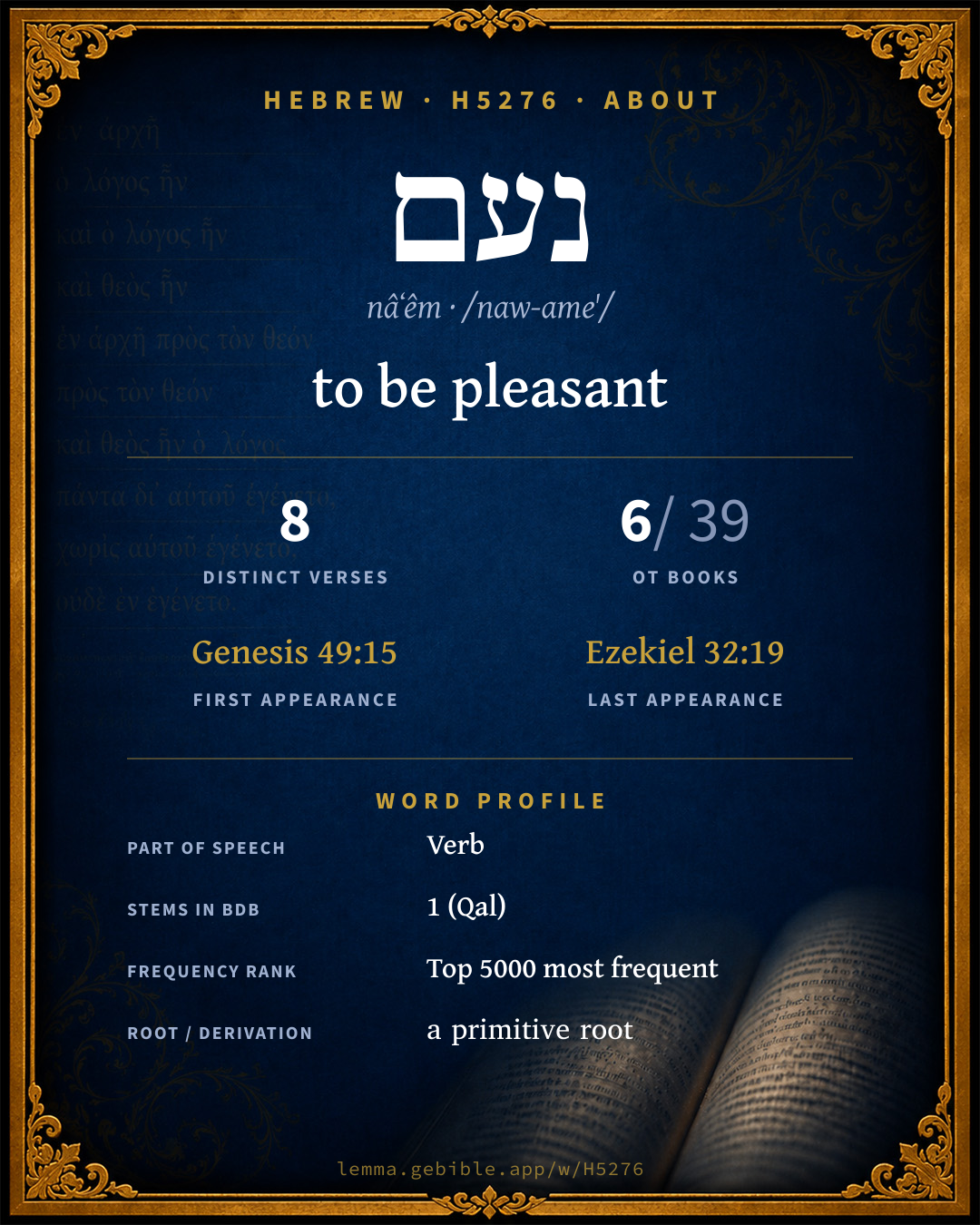
נָעֵם
to be pleasant
Full lexicon entry — Brown-Driver-Briggs (BDB)
From Brown-Driver-Briggs (BDB)
Where this word appears
Grammar key — what these labels mean
Part of speech
- Verb
- An action or state-of-being word.
Stem
- Qal
- The basic, simple active stem — the plain form of the verb (“he wrote”).
Form
- Imperfect
- An incomplete, ongoing, or future action (“he will / would write”).
- Perfect
- A completed action or state — Hebrew marks aspect (completeness) more than strict tense (“he wrote”).
Person
- 3rd Person
- The one spoken about (“he / she / it / they”).
- 2nd Person
- The one addressed (“you”).
Gender
- Masculine
- Grammatically masculine.
- Feminine
- Grammatically feminine.
- Common
- Either gender — not distinguished for this form.
Number
- Singular
- One.
- Plural
- More than one (in Hebrew, generally three or more).
Every verse where H5276 appears in the Book of Song of Solomon — 1 distinct verse. Click any verse to open its interlinear word-by-word view. Verse text shown in the World English Bible for context — . Each verse’s Hebrew form is shown with its reference; the English is not keyword-highlighted, since the data carries no word-level English alignment. Use “Compare translations” on any verse to read it across multiple English versions. This concordance covers the Hebrew Bible; Septuagint (Greek Old Testament) occurrences are not indexed here.
Song of Solomon
About this entry
At a glance — auto-summarized from this page’s data, not written by a person. Every figure links to its source below. This summary describes the numbers; it doesn’t interpret them.
The Hebrew verb נעם centers on the idea of “to be pleasant.” First canonically at Genesis 49:15, it enters the text early. It turns up in 8 verses across 6 books, an uncommon footprint. The word gravitates to Proverbs (38%), then Genesis and 2 Samuel. It clusters with מנעם, נעים and נעם under a shared root. Dig into 8-verse concordance and the renderings breakdown below.
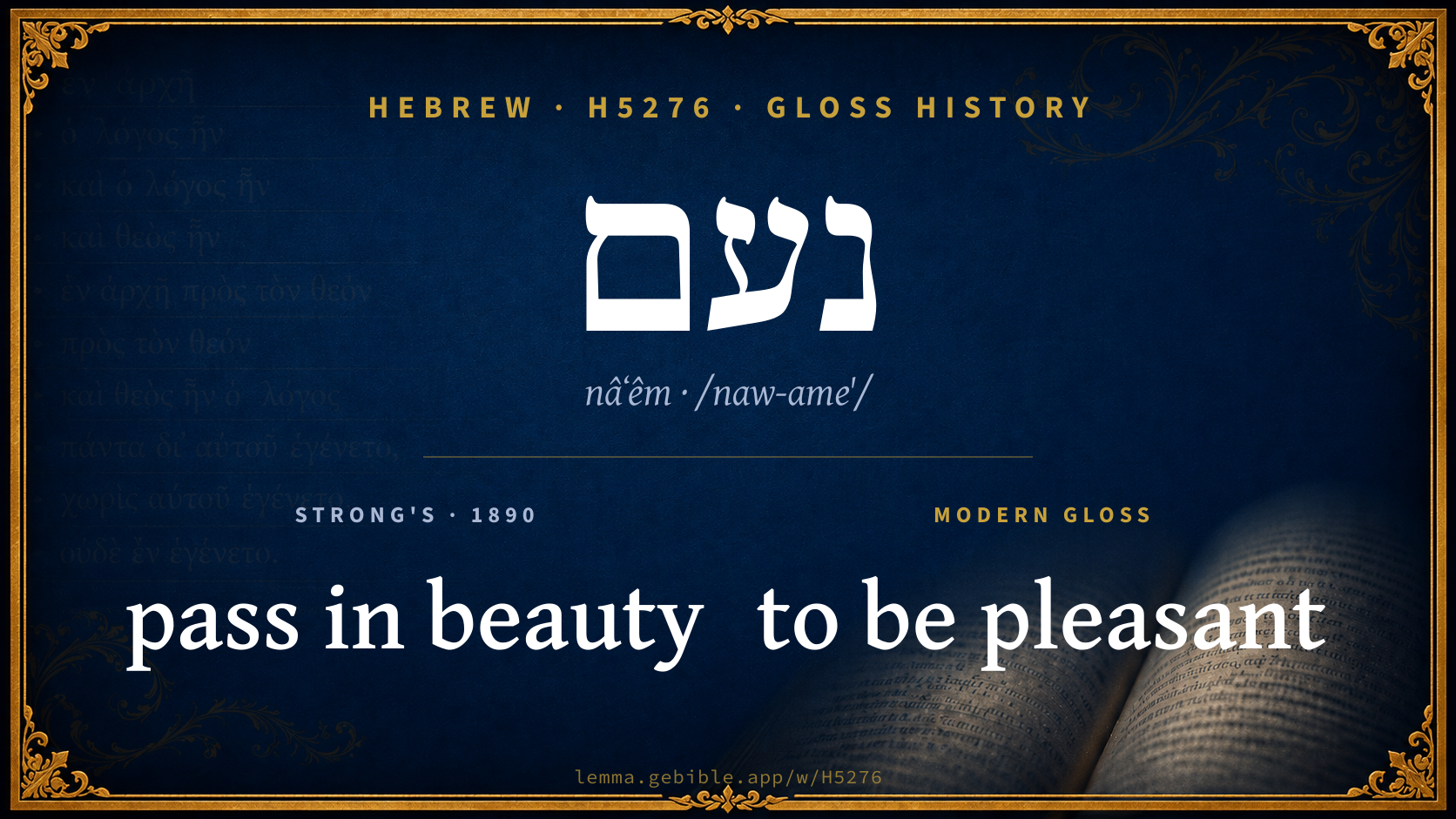
Gloss history
Strong's 1890 vs modern scholarship
About this word
Strong's H5276 catalogs a Hebrew word from the Hebrew Old Testament.
These counts are not copied from any lexicon or concordance. They are computed here, from the morphology-tagged Hebrew Old Testament. What Lemma adds →
- 8
- distinct verses
- The word appears in 8 distinct verses.
- 6 / 39
- OT books
- The word appears in 6 of 39 Old Testament books.
- #2,625
- by frequency
- Top 5000 most frequent Hebrew words (rank 2,625 of 8,640 Hebrew words by occurrence).
View all 8 occurrences in the concordance →
By section of the Old Testament
By traditional corpus
Conventional, traditional groupings — biblical authorship is debated, so this is a traditional corpus grouping, not an authorship claim. Each share is this word’s portion of its verses in that division of the Hebrew canon. Each figure is a share of the word’s 8 distinct verses.
- Writings (Ketuvim) 5 verses · 63%
- Prophets (Nevi'im) 2 verses · 25%
- Torah (Pentateuch) 1 verse · 13%
How translations render this word
Counts come from each version’s own published word-to-Strong’s tagging or interlinear alignment — an approximate guide to how each version renders this word, not a word-level alignment the data otherwise carries. Because each total is that version’s own tagged count, the per-version totals vary from one another and need not match the appearance or distinct-verse counts above. These counts may also differ from a printed concordance because Lemma counts each distinctly tagged rendering and does not collapse phrase taggings into a single head-word total. This is a fixed set of word-tagged versions (KJV, ASV, BSB, ULT) and does not change with the reading translation you choose elsewhere. Each version’s license is shown beside its name below (and on Sources).
- King James Version: Is pleasant 2×
- American Standard Version: Dost thou pass in beauty 1×, How pleasant 1×, Is pleasant 1×
- Berean Standard Bible: Do you surpass in beauty 1×, Is tasty 1×, Pleasant 1×
- unfoldingWord Literal Text: Is pleasant 2×, Will be pleasant 2×
King James Version Public Domain
Renders H5276 across 8 tagged occurrences — most commonly:
Plus 6 renderings that appear only once — usually multi-word phrases or single function words the recovered tagging swept in, not distinct renderings.
American Standard Version Public Domain
Renders H5276 across 8 tagged occurrences — most commonly:
Berean Standard Bible Public Domain
Renders H5276 across 8 tagged occurrences — most commonly:
unfoldingWord Literal Text CC BY-SA 4.0
Renders H5276 across 9 tagged occurrences — most commonly:
Plus 5 renderings that appear only once — usually multi-word phrases or single function words the recovered tagging swept in, not distinct renderings.
Senses in the full BDB
What do BDB’s symbols mean?
BDB uses these scholarly abbreviations:
| Symbol | Meaning |
|---|---|
| 𝔊 | the Septuagint (the ancient Greek translation, LXX) |
| 𝔙 | the Vulgate (the Latin translation) |
| 𝔖 | the Syriac version (the Peshitta) |
| 𝔗 | the Targum (the Aramaic translation) |
| ψ | the Psalms |
| √ | root (the underlying root or stem) |
| ‖ | parallel passage (a synonymous or contrasted parallel) |
| † | the dagger: every passage where the word occurs is cited |
The 1 sense the full Brown-Driver-Briggs lexicon distinguishes for this word, in lexicon order (not ranked by frequency), with BDB’s own verbatim wording and sub-sense lettering. Shown in Hebrew script with BDB’s own scholarly abbreviations. The condensed entry is in the Lexicon Entry tab. See also the Forms in the corpus table below.
Qal
- Pf. 3 fs. נָעֵ֑מָה Gn 49:15 (poem in J; of land); 2 ms. (of delightful friend) נָעַמְתָּ לִי מְאֹד 2 S 1:26, also (of physical beauty) מִמִּי נָעָ֑מְתָּ Ez 32:19; 2 fs. (id.) מַה־נָּעַמְתְּ Ct 7:7 how lovely art thou! (‖ מַה־יָּפִית); 3 pl., of pleasant words, נָעֵ֑מוּ ψ 141:6; Impf. 3 ms. יִנְעָ֑ם: לְנַפְשְׁךָ יִנ׳ Pr 2:10 (of knowledge); לֶחֶם סְתָרִים יִנ׳ 9:17 (‖ יִמְתָּ֑קוּ); יִנ׳ 24:25 is impers. c. ל, to them … shall be delight. e.g. Genesis 49:15
Senses from the full Brown-Driver-Briggs lexicon (Brown, Driver, Briggs; Oxford 1906 — public domain), digitized via Sefaria, supplemented by the OpenScriptures HebrewLexicon (CC BY 4.0). Full attribution on Sources.
Word origin
vb. be pleasant, delightful, lovely (Ph. נעם good Lzb324 (and many n.pr.); Arabic نَعِمَ be plentiful, easy, pleasant; أَنْعَمَ على shew gracious favour toward, often in Qor; Sab. נעם be lovely, agreeable, well Levy-OsZMG xix (1865), 178 CISiv. 19, 11, so Min. HomSüdar. Chrest. 128; Old Aramaic in n.pr. Lzb222, 324 Cook82 (נעמתי my darling [or my songs, cf. II. נ׳]); 𝔗 נָעִים pleasant,lovely, נְעִימְתָּא loveliness; PräBAS i. 46 f. cp. Ethiopic አደመ: be pleasant, = አንዐመ: );—
— Brown-Driver-Briggs (Oxford 1906, public domain), digitized via Sefaria, supplemented by the OpenScriptures HebrewLexicon (CC BY 4.0). See Sources.
Origin: a primitive root
Jastrow Dictionary
A second Hebrew/Aramaic lexicon for comparison, covering Aramaic and post-biblical (Talmudic, Targumic, Midrashic) usage that the biblical-Hebrew BDB does not. Matched by lemma rather than by Strong’s number, so a lemma may carry more than one Jastrow headword (shown separately below), and the entries cover usage well beyond the Bible.
נָעֵם
- (b. h.) to be pleasing, lovely.
- 1. same. Snh. 24ᵃ (ref. to נֹעַם Zech. XI, 7) אלו … שמַנְעִימִים זה לזה וכ׳ this refers to the scholars in Palestine who are polite to one another in discussion, opp. מחבלים. e.g. Zechariah 11:7
- 2. to sweeten the voice; to sing, accompany. Y. Shek. V, 48ᵈ bot. היה מַנְעִים את קולו וכ׳ he sweetened his voice when singing, v. נְעִימָה. Gen. R. s. 23 שהיתה מַנְעֶמֶת בתוף וכ׳ she sang to the timbrel in honor of idolatry, v. נַעֲמָה. Cant. R. to IV, 4 מי מנעים זמירותיהם וכ׳ who sweetens Israel’s songs? David &c.; a. e.
A Dictionary of the Targumim, the Talmud Babli and Yerushalmi, and the Midrashic Literature (Marcus Jastrow; London, Luzac, 1903) — Public Domain. Digitized via Sefaria. Digitized via Sefaria. Full attribution on Sources.
Forms in the corpus
The 7 distinct written forms H5276 takes in the Hebrew Bible, most frequent first — each parse links to that stem’s occurrences in the concordance. Hebrew forms include their vowel points and cantillation, so a single lemma takes many written forms.
| Form | Parsing | Example | Uses |
|---|---|---|---|
| יִנְעָֽם | Verb, Qal, Imperfect, 3rd Person, Masculine, Singular | Proverbs 2:10 | 2 |
| יִנְעָ֑ם | Verb, Qal, Imperfect, 3rd Person, Masculine, Singular | Proverbs 24:25 | 1 |
| נָעֵ֑מָה | Verb, Qal, Perfect, 3rd Person, Feminine, Singular | Genesis 49:15 | 1 |
| נָעֵֽמוּ | Verb, Qal, Perfect, 3rd Person, Common, Plural | Psalms 141:6 | 1 |
| נָעַ֥מְתָּ | Verb, Qal, Perfect, 2nd Person, Masculine, Singular | 2 Samuel 1:26 | 1 |
| נָעָ֑מְתָּ | Verb, Qal, Perfect, 2nd Person, Masculine, Singular | Ezekiel 32:19 | 1 |
| נָּעַ֔מְתְּ | Verb, Qal, Perfect, 2nd Person, Feminine, Singular | Song of Solomon 7:6 | 1 |
Same root — word family
Other BDB entries built from the same root as H5276, grouped by Strong’s listed origin. These share a root / origin per the lexicon — not necessarily a shared meaning. Each links to that word’s own entry.
Derived from this word
- מנעם manʻam H4516 delicacies
- נעים nâʻîym H5273 pleasant
- נעם nôʻam H5278 pleasantness
- נעמן naʻămân H5282 pleasantness
Proper names from this root
People and places named from this root — a name, not an additional meaning of the word.
Compare all same-root words → Showing 4 of 6 — not the complete family. 1 of the same-root words is a proper name (a person or place). They share a root, not necessarily a meaning.
Septuagint verse parallels
This word appears in 7 verses that also exist in the Greek Old Testament (Septuagint), out of the 8 Hebrew verses it occurs in. You can read those verses in Greek by switching the Old Testament edition to the Septuagint.
Read these verses in the Septuagint
This is a verse-level parallel only — the same verses exist in both the Hebrew and Greek Old Testaments. No word-level Hebrew↔Greek correspondence is claimed: the data carries no such alignment, so no Greek word is shown as this Hebrew word’s translation. Coverage is not total — the Septuagint omits the deuterocanon and renumbers the Psalms, so some Hebrew verses have no direct Greek parallel.