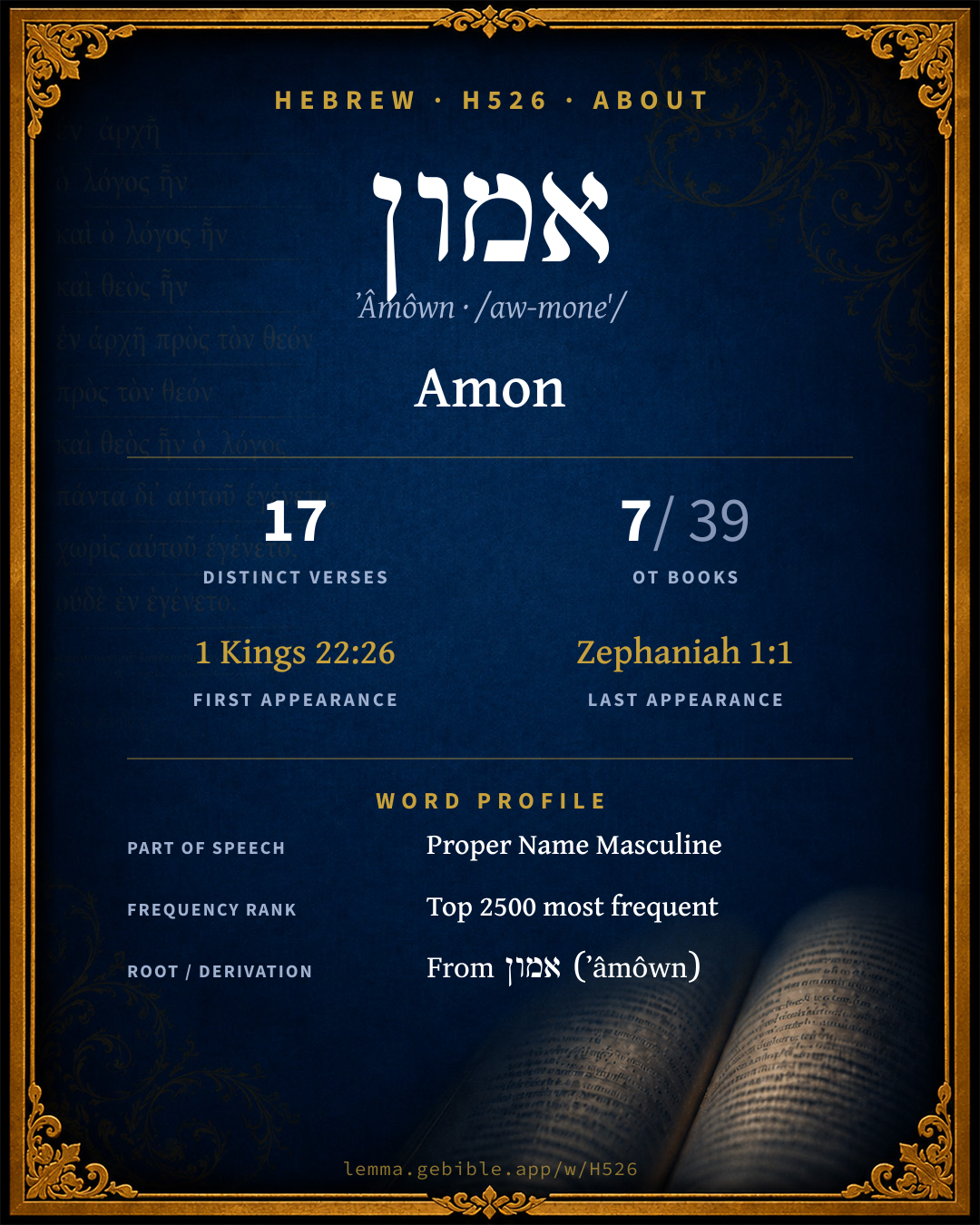
אָמוֹן
Amon
BDB lists 4 entries for ‘Amon’ fuller range ↓
Full lexicon entry — Brown-Driver-Briggs (BDB)
From Brown-Driver-Briggs (BDB)
Where this word appears
Grammar key — what these labels mean
Part of speech
- Noun
- A naming word — a person, place, thing, or idea.
Noun type
- Proper
- A name of a specific person, place, or people (e.g. Abraham, Zion, Israel).
Every verse where H526 appears in the Book of 1 Chronicles — 1 distinct verse. Click any verse to open its interlinear word-by-word view. Verse text shown in the World English Bible for context — . Each verse’s Hebrew form is shown with its reference; the English is not keyword-highlighted, since the data carries no word-level English alignment. Use “Compare translations” on any verse to read it across multiple English versions. This concordance covers the Hebrew Bible; Septuagint (Greek Old Testament) occurrences are not indexed here.
1 Chronicles
About this entry
At a glance — auto-summarized from this page’s data, not written by a person. Every figure links to its source below. This summary describes the numbers; it doesn’t interpret them.
אמון — transliterated ʼÂmôwn — is a Hebrew name carrying the sense “Amon.” Debuting at 1 Kings 22:26, it then recurs through the corpus. The Hebrew Bible uses it across 17 verses — uncommon. More than a third of its appearances fall in 2 Chronicles. See 17-verse concordance and the renderings breakdown below.
Gloss history
Strong's 1890 vs modern scholarship
About this word
Strong's H526 catalogs a Hebrew word from the Hebrew Old Testament.
These counts are not copied from any lexicon or concordance. They are computed here, from the morphology-tagged Hebrew Old Testament. What Lemma adds →
- 17
- distinct verses
- The word appears in 17 distinct verses.
- 7 / 39
- OT books
- The word appears in 7 of 39 Old Testament books.
- #1,671
- by frequency
- Top 2500 most frequent Hebrew words (rank 1,671 of 8,640 Hebrew words by occurrence).
View all 17 occurrences in the concordance →
Most concentrated in
- 2 Chronicles 6 verses 35%
- 2 Kings 5 verses 29%
- Jeremiah 2 verses 12%
By section of the Old Testament
By traditional corpus
Conventional, traditional groupings — biblical authorship is debated, so this is a traditional corpus grouping, not an authorship claim. Each share is this word’s portion of its verses in that division of the Hebrew canon. Each figure is a share of the word’s 17 distinct verses.
- Prophets (Nevi'im) 9 verses · 53%
- Writings (Ketuvim) 8 verses · 47%
How translations render this word
Counts come from each version’s own published word-to-Strong’s tagging or interlinear alignment — an approximate guide to how each version renders this word, not a word-level alignment the data otherwise carries. Because each total is that version’s own tagged count, the per-version totals vary from one another and need not match the appearance or distinct-verse counts above. These counts may also differ from a printed concordance because Lemma counts each distinctly tagged rendering and does not collapse phrase taggings into a single head-word total. This is a fixed set of word-tagged versions (KJV, ASV, BSB, ULT) and does not change with the reading translation you choose elsewhere. Each version’s license is shown beside its name below (and on Sources).
BDB lists this Strong’s number as 3 distinct words (homographs). Each count above pools all of them and is not split by sense — see the Senses section below. A low-frequency rendering may belong to a different one of those words, not the primary meaning.
- King James Version†: Amon 16×
- American Standard Version†: Amon 16×
- Berean Standard Bible†: Amon 17×
- unfoldingWord Literal Text†: Amon 16×
King James Version Public Domain
Renders H526 across 17† tagged occurrences — most commonly:
Plus 1 rendering that appears only once — usually multi-word phrases or single function words the recovered tagging swept in, not distinct renderings.
American Standard Version Public Domain
Renders H526 across 17† tagged occurrences — most commonly:
Plus 1 rendering that appears only once — usually multi-word phrases or single function words the recovered tagging swept in, not distinct renderings.
Berean Standard Bible Public Domain
Renders H526 across 17† tagged occurrences — most commonly:
unfoldingWord Literal Text CC BY-SA 4.0
Renders H526 across 17† tagged occurrences — most commonly:
Plus 1 rendering that appears only once — usually multi-word phrases or single function words the recovered tagging swept in, not distinct renderings.
Senses in the full BDB
What do BDB’s symbols mean?
BDB uses these scholarly abbreviations:
| Symbol | Meaning |
|---|---|
| 𝔊 | the Septuagint (the ancient Greek translation, LXX) |
| 𝔙 | the Vulgate (the Latin translation) |
| 𝔖 | the Syriac version (the Peshitta) |
| 𝔗 | the Targum (the Aramaic translation) |
| ψ | the Psalms |
| √ | root (the underlying root or stem) |
| ‖ | parallel passage (a synonymous or contrasted parallel) |
| † | the dagger: every passage where the word occurs is cited |
The 0 senses and sub-senses the full Brown-Driver-Briggs lexicon distinguishes for this word, in lexicon order (not ranked by frequency), with BDB’s own verbatim wording and sub-sense lettering. Shown in Hebrew script with BDB’s own scholarly abbreviations. The condensed entry is in the Lexicon Entry tab. See also the Forms in the corpus table below.
אמון I Amon, an Egyptian god Na 3
אמון II artificer, architect, master-workman, as firm and sure in his workmanship
אמון III m. (master-workman) (a) king of Judah 2 K 21
Senses from the full Brown-Driver-Briggs lexicon (Brown, Driver, Briggs; Oxford 1906 — public domain), digitized via Sefaria, supplemented by the OpenScriptures HebrewLexicon (CC BY 4.0). Full attribution on Sources.
Word origin
I. n.pr. Amon, an Egyptian god Na 3:8 Je 46:25, comp. by Greeks with Zeus (Herod. ii, 42; Diod i. 13), Ἀμμῶν. He was originally the local deity of Thebes (= נֹא, called נֹא אָמוֹן Na 3:8, cf. א׳ מִנֹּא Je 46:25), but subsequently became the supreme god of the Egyptian Pantheon, the successor of the sun-god Ra and so-called Amon Ra. He was the secret god, who hid himself and was difficult to find (Amon = concealment, hidden); v. Rawl. Hist. Anc. Egypt, i, 322 Ebers. RiHWB. Je 46:25 Spiegelberg Randglossen, 43 ff. reads נֹא אָמוֹן (as Na 3:8) for אָמוֹן נֹא, and finds in both a Thebes in the Delta. (ii. iii. אָמוֹן v. p. 54.)
II. n.m. artificer, architect, master-workman, as firm and sure in his workmanship: וָאֶהְיֶה אֶצְלוֹ אָמוֹן I was at his side architect, master-workman (𝔊 𝔖 𝔙 Ges Ew De MV RV, > foster-son AE Ki AV) Pr 8:30; יֶתֶר הָֽאָמוֹן rest of the master-workmen Je 52:15 (Hi Gf De RVm, but rest of the multitude Ges MV RV et al., אמון = המון)—1. אָמוֹן v. supr. p. 51.
III. n.pr.m. (master-workman) (a) king of Judah 2 K 21:18, 19, 23, 24, 25 1 Ch 3:14 2 Ch 33:20, 21, 22, 23 25 Je 1:2; 25:3; (b) captain of a city 1 K 22:26 2 Ch 18:25; (c) one of the line of Solomon’s servants Ne 7:59 = אָמִי Ezr 2:57.
— Brown-Driver-Briggs (Oxford 1906, public domain), digitized via Sefaria, supplemented by the OpenScriptures HebrewLexicon (CC BY 4.0). See Sources.
Derived from אמון (ʼâmôwn) (H525) — craftsman.
Jastrow Dictionary
A second Hebrew/Aramaic lexicon for comparison, covering Aramaic and post-biblical (Talmudic, Targumic, Midrashic) usage that the biblical-Hebrew BDB does not. Matched by lemma rather than by Strong’s number, so a lemma may carry more than one Jastrow headword (shown separately below), and the entries cover usage well beyond the Bible.
אָמוֹן I
- artist; (homilet.) a) = אוֹמֵן, tutor; b) = אָמוּן nursed (well-covered);guarded; c) = next w., metropolis, (great). Gen. R. s. 1.
אָמוֹן II
- 1. (b. h. No-Amon (Thebes) in Egypt. Gen. R. s. 1 (= Alexandria, the metropolis).—[
- *2. A., near Tyre. Y. Dem. II, 22ᵈ top; Tosef. Shebi. IV, 9 עמק.]
A Dictionary of the Targumim, the Talmud Babli and Yerushalmi, and the Midrashic Literature (Marcus Jastrow; London, Luzac, 1903) — Public Domain. Digitized via Sefaria. Digitized via Sefaria. Full attribution on Sources.
Forms in the corpus
The 7 distinct written forms H526 takes in the Hebrew Bible, most frequent first — each parse links to that state’s occurrences in the concordance. Hebrew forms include their vowel points and cantillation, so a single lemma takes many written forms.
| Form | Parsing | Example | Uses |
|---|---|---|---|
| אָמ֖וֹן | Noun, Proper | 2 Chronicles 33:22 | 6 |
| אָמ֣וֹן | Noun, Proper | 2 Chronicles 18:25 | 3 |
| אָמ֥וֹן | Noun, Proper | 1 Chronicles 3:14 | 3 |
| אָמ֑וֹן | Noun, Proper | 2 Chronicles 33:25 | 2 |
| אָמֹ֣ן | Noun, Proper | 1 Kings 22:26 | 1 |
| אָמֽוֹן | Noun, Proper | Nehemiah 7:59 | 1 |
| אָמוֹן֩ | Noun, Proper | Jeremiah 25:3 | 1 |
Same root — word family
Other BDB entries built from the same root as H526, grouped by Strong’s listed origin. These share a root / origin per the lexicon — not necessarily a shared meaning. Each links to that word’s own entry.
Derives from
Proper names from this root
People and places named from this root — a name, not an additional meaning of the word.
Compare all same-root words → 2 of the same-root words are proper names (people or places). They share a root, not necessarily a meaning.
Bible dictionary
Public-domain dictionary articles matched to this entry by name (Amon). A biblical name can be shared by more than one person or place, so an article may treat several.
Easton's Bible Dictionary · M. G. Easton, 1897
Builder. (1.) The governor of Samaria in the time of Ahab. The prophet Micaiah was committed to his custody (1 Kings 22:26; 2 Chr. 18:25).
(2.) The son of Manasseh, and fourteenth king of Judah. He restored idolatry, and set up the images which his father had cast down. Zephaniah (1:4; 3:4, 11) refers to the moral depravity prevailing in this king's reign.
He was assassinated (2 Kings 21:18-26: 2 Chr. 33:20-25) by his own servants, who conspired against him.
(3.) An Egyptian god, usually depicted with a human body and the head of a ram, referred to in Jer. 46:25, where the word "multitudes" in the Authorized Version is more appropriately rendered "Amon" in the Revised Version. In Nah. 3:8 the expression "populous No" of the Authorized version is rendered in the Revised Version "No-amon." Amon is identified with Ra, the sun-god of Heliopolis.
(4.) Neh. 7:59.
Smith's Bible Dictionary · William Smith, 1863
(builder).
+ One of Ahab's governors. (1 Kings 22:26; 2 Chronicles 18:25) + King of Judah, son and successor of Manasseh, reigned two years, from B.C. 642 to 640. Amon devoted himself wholly to the service of false gods, but was killed in a conspiracy, and was succeeded by his son Josiah.
Hitchcock's Bible Names Dictionary · Roswell D. Hitchcock, 1869
faithful; true
Classic public-domain reference works; full attribution on Sources.
Septuagint verse parallels
This word appears in 16 verses that also exist in the Greek Old Testament (Septuagint), out of the 17 Hebrew verses it occurs in. You can read those verses in Greek by switching the Old Testament edition to the Septuagint.
Read these verses in the Septuagint
This is a verse-level parallel only — the same verses exist in both the Hebrew and Greek Old Testaments. No word-level Hebrew↔Greek correspondence is claimed: the data carries no such alignment, so no Greek word is shown as this Hebrew word’s translation. Coverage is not total — the Septuagint omits the deuterocanon and renumbers the Psalms, so some Hebrew verses have no direct Greek parallel.