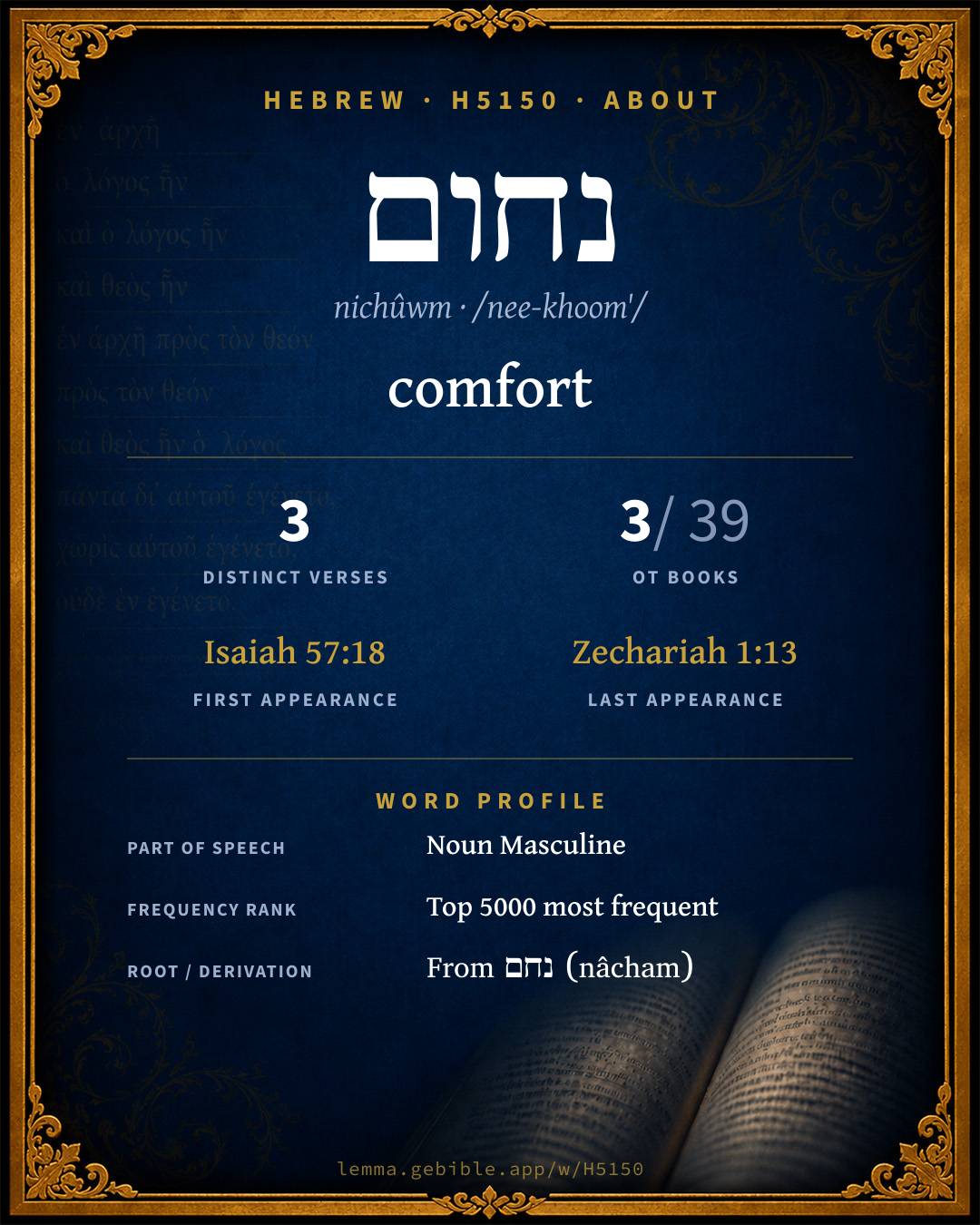
נִחוּם
comfort
‘comfort’ is one of 3 main senses fuller range ↓
Full lexicon entry — Brown-Driver-Briggs (BDB)
From Brown-Driver-Briggs (BDB)
Where this word appears
Grammar key — what these labels mean
Part of speech
- Noun
- A naming word — a person, place, thing, or idea.
Noun type
- Common
- A common noun — a general class of person, place, or thing (“king,” “city,” “water”), not a specific name.
State
- Absolute
- The independent form of a noun, not bound to a following word.
- Construct
- A noun bound to a following noun in a possessive / “of” relationship (the construct chain).
Gender
- Masculine
- Grammatically masculine.
Number
- Plural
- More than one (in Hebrew, generally three or more).
Every verse where H5150 appears in the Book of Isaiah — 1 distinct verse. Click any verse to open its interlinear word-by-word view. Verse text shown in the World English Bible for context — . Each verse’s Hebrew form is shown with its reference; the English is not keyword-highlighted, since the data carries no word-level English alignment. Use “Compare translations” on any verse to read it across multiple English versions. This concordance covers the Hebrew Bible; Septuagint (Greek Old Testament) occurrences are not indexed here.
Isaiah
About this entry
At a glance — auto-summarized from this page’s data, not written by a person. Every figure links to its source below. This summary describes the numbers; it doesn’t interpret them.
The Hebrew noun נחום centers on the idea of “comfort.” It occurs a mere 3 verses across Scripture. Isaiah dominates its distribution — 1 of 3 verses. Its earliest occurrence is Isaiah 57:18. Its meaning spans more than one sense — see its full sense range. Dig into 3-verse concordance and the renderings breakdown below.
Gloss history
Strong's 1890 vs modern scholarship
About this word
Strong's H5150 catalogs a Hebrew word from the Hebrew Old Testament.
These counts are not copied from any lexicon or concordance. They are computed here, from the morphology-tagged Hebrew Old Testament. What Lemma adds →
- 3
- distinct verses
- The word appears in 3 distinct verses.
- 3 / 39
- OT books
- The word appears in 3 of 39 Old Testament books.
- #4,179
- by frequency
- Top 5000 most frequent Hebrew words (rank 4,179 of 8,640 Hebrew words by occurrence).
View all 3 occurrences in the concordance →
By section of the Old Testament
By traditional corpus
Conventional, traditional groupings — biblical authorship is debated, so this is a traditional corpus grouping, not an authorship claim. Each share is this word’s portion of its verses in that division of the Hebrew canon. Each figure is a share of the word’s 3 distinct verses.
- Prophets (Nevi'im) 3 verses · 100%
How translations render this word
Counts come from each version’s own published word-to-Strong’s tagging or interlinear alignment — an approximate guide to how each version renders this word, not a word-level alignment the data otherwise carries. Because each total is that version’s own tagged count, the per-version totals vary from one another and need not match the appearance or distinct-verse counts above. These counts may also differ from a printed concordance because Lemma counts each distinctly tagged rendering and does not collapse phrase taggings into a single head-word total. This is a fixed set of word-tagged versions (KJV, ASV, BSB, ULT) and does not change with the reading translation you choose elsewhere. Each version’s license is shown beside its name below (and on Sources).
- King James Version: Comfortable 1×, Comforts 1×, Within me my repentings 1×
- American Standard Version: Comfortable 1×, Restore comforts 1×, Within me 1×
- Berean Standard Bible: Comfort 1×, Comforting 1×, Compassion 1×
- unfoldingWord Literal Text: Comfort 1×, Comforts 1×, Compassions 1×
King James Version Public Domain
Renders H5150 across 3 tagged occurrences — most commonly:
American Standard Version Public Domain
Renders H5150 across 3 tagged occurrences — most commonly:
Berean Standard Bible Public Domain
Renders H5150 across 3 tagged occurrences — most commonly:
unfoldingWord Literal Text CC BY-SA 4.0
Renders H5150 across 3 tagged occurrences — most commonly:
Senses in the full BDB
What do BDB’s symbols mean?
BDB uses these scholarly abbreviations:
| Symbol | Meaning |
|---|---|
| 𝔊 | the Septuagint (the ancient Greek translation, LXX) |
| 𝔙 | the Vulgate (the Latin translation) |
| 𝔖 | the Syriac version (the Peshitta) |
| 𝔗 | the Targum (the Aramaic translation) |
| ψ | the Psalms |
| √ | root (the underlying root or stem) |
| ‖ | parallel passage (a synonymous or contrasted parallel) |
| † | the dagger: every passage where the word occurs is cited |
The 2 senses and sub-senses the full Brown-Driver-Briggs lexicon distinguishes for this word, in lexicon order (not ranked by frequency), with BDB’s own verbatim wording and sub-sense lettering. Shown in Hebrew script with BDB’s own scholarly abbreviations. The condensed entry is in the Lexicon Entry tab. See also the Forms in the corpus table below.
- 1. comfort
- 2. compassion
Senses from the full Brown-Driver-Briggs lexicon (Brown, Driver, Briggs; Oxford 1906 — public domain), digitized via Sefaria, supplemented by the OpenScriptures HebrewLexicon (CC BY 4.0). Full attribution on Sources.
Word origin
Derived from נחם (nâcham) (H5162) — to comfort.
Jastrow Dictionary
A second Hebrew/Aramaic lexicon for comparison, covering Aramaic and post-biblical (Talmudic, Targumic, Midrashic) usage that the biblical-Hebrew BDB does not. Matched by lemma rather than by Strong’s number, so a lemma may carry more than one Jastrow headword (shown separately below), and the entries cover usage well beyond the Bible.
חָמַם
- (b. h.) to be warm, hot; [(of color) to be dark, red; (of taste) to be pungent, sour, bitter]. Part. חָם, q. v.
- to heat, warm, boil. Y. Ned. IV, 38ᶜ bot. לחַמֵּם בו את ידיו to warm his hands against it (the bread). Gen. R. s. 14, end מְחַמֶּמֶת הגוף keeps the body warm. Sabb. 40ᵇ ומְחַמַּמְתָּהּ וכ׳ and warms it (her hand) before the fire; a. fr.
- same. Bets. II, 5 לא יֵחֵם וכ׳ one must not prepare warm water for &c. Sabb. 40ᵃ התחילו … להָחֵם בשבת the bathers began to heat (the water) on the Sabbath; a. fr.—Part. מֵיחֵם, מֵחֵם, pl. מְחַמִּין. Ib.ᵇ; Tosef. ib. III (IV), 7 מיחם אדם וכ׳ (ed. Zuck. מייחם, read: מֵיחֵים), v. אְלוּנְטִית I; [Y. ib. XIX, 17ᵃ bot. מחמין הוא אדם (read as ib. IX, 12ᵃ bot. מְחַמֵּם הוא וכ׳].—Ib. אם מפני הסכנה מְחַמִּין לו וכ׳ if it is for the sake of averting danger to life, may we not even boil water on the Sabbath?—Bets. 22ᵃ; a. v. fr.
- to be warmed. Sabb. III, 5 (41ᵃ) בשביל שיֵחַמּוּ that they become warm; Sabb. 41ᵇ שיֵחוֹמּוּ; Tosef. ib. III (IV), 5 שׁיֵיחַמּוּ; a. e.
- same. Sabb. 134ᵇ שהוּחַמּוּ, v. חָם II. Y. Bets. II, 61ᶜ; a. fr.—B. Mets. VI, 3 הוּחַמָּה the animal was overtaken by the heat.
- to warm one’s self; to become heated. Bets. II, 5; Tosef. Sabb. l. c. Tam. I, 1. Ab. II, 10 הוי מִתְחַמֵּם וכ׳ warm thyself by the fire of the scholars (try to associate with them); a. fr.—Y. Sot. I, 16ᶜ bot. נתח׳ was heated (had pollution). Gen. R. s. 24 מִתְחַמְּמִים, מִתְחַמְּמוֹת conceived
נִחוּם
- , v. נִיחוּם
נָחוּם
- (b. h.) pr. n. m. Nahum,
- 1. N. the prophet. Pesik. Naḥ., p. 127ᵇ; a. e.
- 2. N., name of several Tannaim a. Amoraim. Peah II, 6; Naz. 56ᵇ נ׳ הלבלר.—Sabb. II, 1, a. fr. נ׳ המדי.—Taan. 21ᵃ, a. fr. נ׳ איש גם זו, v. גִּמְזוֹ.—Y. Taan. I, 64ᵇ top נ׳; (Y. Ber. IX, 14ᵃ top תנחום).—Ib. VIII, 12ᵇ bot., a. fr. נ׳ בי ר׳ סימאי; (Pes. 104ᵃ; Ab. Zar. 50ᵃ מנחם בר׳ סימאי;) Y. Meg. I, 72ᵇ bot., a. fr. נ׳ איש קדש קדשים.—Y. Bets. V, 63ᵇ R. N. brother of R. Ila; a. e.—V. Fr. M’bo, p. 116ᵃ
A Dictionary of the Targumim, the Talmud Babli and Yerushalmi, and the Midrashic Literature (Marcus Jastrow; London, Luzac, 1903) — Public Domain. Digitized via Sefaria. Digitized via Sefaria. Full attribution on Sources.
Forms in the corpus
The 3 distinct written forms H5150 takes in the Hebrew Bible, most frequent first — each parse links to that state’s occurrences in the concordance. Hebrew forms include their vowel points and cantillation, so a single lemma takes many written forms.
| Form | Parsing | Example | Uses |
|---|---|---|---|
| נִֽחֻמִ֛ים | Noun, Common, Masculine, Plural, Absolute | Isaiah 57:18 | 1 |
| נִחֻמִֽים | Noun, Common, Masculine, Plural, Absolute | Zechariah 1:13 | 1 |
| נִחוּמָֽ/י | Noun, Common, Masculine, Plural, Construct | Hosea 11:8 | 1 |
Same root — word family
Other BDB entries built from the same root as H5150, grouped by Strong’s listed origin. These share a root / origin per the lexicon — not necessarily a shared meaning. Each links to that word’s own entry.
Derives from
Shares the same root
Proper names from this root
People and places named from this root — a name, not an additional meaning of the word.
- מנחם Mᵉnachêm H4505 Menahem
- נחום Nᵉchûwm H5149 Nehum
- נחום Nachûwm H5151 Nahum
- נחם Nacham H5163 Naham
- נחמיה Nᵉchemyâh H5166 Nehemiah
- נחמני Nachămânîy H5167 Nahamani
Compare all same-root words → Showing 4 of 11 — not the complete family. 6 of the same-root words are proper names (people or places). They share a root, not necessarily a meaning.
Septuagint verse parallels
This word appears in 3 verses that also exist in the Greek Old Testament (Septuagint), out of the 3 Hebrew verses it occurs in. You can read those verses in Greek by switching the Old Testament edition to the Septuagint.
Read these verses in the Septuagint
This is a verse-level parallel only — the same verses exist in both the Hebrew and Greek Old Testaments. No word-level Hebrew↔Greek correspondence is claimed: the data carries no such alignment, so no Greek word is shown as this Hebrew word’s translation. Coverage is not total — the Septuagint omits the deuterocanon and renumbers the Psalms, so some Hebrew verses have no direct Greek parallel.