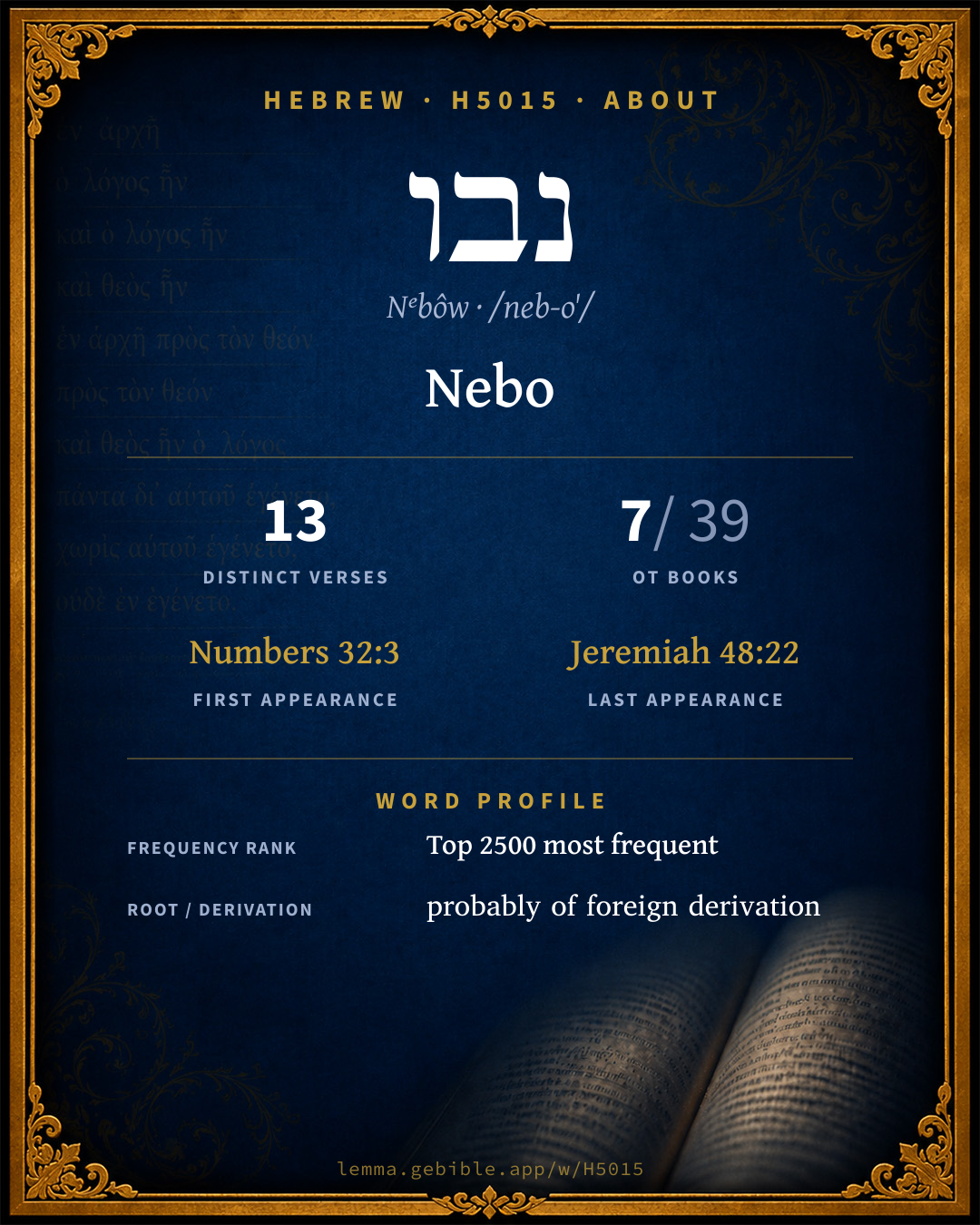
נְבוֹ
Nebo
BDB lists 5 entries for ‘Nebo’ fuller range ↓
Full lexicon entry — Brown-Driver-Briggs (BDB)
From Brown-Driver-Briggs (BDB)
Where this word appears
Grammar key — what these labels mean
Part of speech
- Noun
- A naming word — a person, place, thing, or idea.
Noun type
- Proper
- A name of a specific person, place, or people (e.g. Abraham, Zion, Israel).
Every verse where H5015 appears in the Book of Deuteronomy — 2 distinct verses. Click any verse to open its interlinear word-by-word view. Verse text shown in the World English Bible for context — . Each verse’s Hebrew form is shown with its reference; the English is not keyword-highlighted, since the data carries no word-level English alignment. Use “Compare translations” on any verse to read it across multiple English versions. This concordance covers the Hebrew Bible; Septuagint (Greek Old Testament) occurrences are not indexed here.
Deuteronomy
- Deuteronomy 32:49 נְב֗וֹ n Proper Go up into this mountain of Abarim, to Mount Nebo, which is in the land of Moab, that is over against Jericho; and see the land of Canaan, which I give to the children of Israel for a possession;
- Deuteronomy 34:1 נְב֔וֹ n Proper Moses went up from the plains of Moab to Mount Nebo, to the top of Pisgah, that is over against Jericho. Yahweh shown him all the land of Gilead, to Dan,
About this entry
At a glance — auto-summarized from this page’s data, not written by a person. Every figure links to its source below. This summary describes the numbers; it doesn’t interpret them.
נבו — transliterated Nᵉbôw — is a Hebrew name carrying the sense “Nebo.” It first appears in Numbers 32:3. With 13 verses in 7 books, it is an uncommon word in the Hebrew Bible. See 13-verse concordance and the renderings breakdown below.
Gloss history
Strong's 1890 vs modern scholarship
About this word
Strong's H5015 catalogs a Hebrew word from the Hebrew Old Testament.
These counts are not copied from any lexicon or concordance. They are computed here, from the morphology-tagged Hebrew Old Testament. What Lemma adds →
- 13
- distinct verses
- The word appears in 13 distinct verses.
- 7 / 39
- OT books
- The word appears in 7 of 39 Old Testament books.
- #2,001
- by frequency
- Top 2500 most frequent Hebrew words (rank 2,001 of 8,640 Hebrew words by occurrence).
View all 13 occurrences in the concordance →
Most concentrated in
- Numbers 3 verses 23%
- Deuteronomy 2 verses 15%
- Ezra 2 verses 15%
By section of the Old Testament
By traditional corpus
Conventional, traditional groupings — biblical authorship is debated, so this is a traditional corpus grouping, not an authorship claim. Each share is this word’s portion of its verses in that division of the Hebrew canon. Each figure is a share of the word’s 13 distinct verses.
- Torah (Pentateuch) 5 verses · 38%
- Prophets (Nevi'im) 4 verses · 31%
- Writings (Ketuvim) 4 verses · 31%
How translations render this word
Counts come from each version’s own published word-to-Strong’s tagging or interlinear alignment — an approximate guide to how each version renders this word, not a word-level alignment the data otherwise carries. Because each total is that version’s own tagged count, the per-version totals vary from one another and need not match the appearance or distinct-verse counts above. These counts may also differ from a printed concordance because Lemma counts each distinctly tagged rendering and does not collapse phrase taggings into a single head-word total. This is a fixed set of word-tagged versions (KJV, ASV, BSB, ULT) and does not change with the reading translation you choose elsewhere. Each version’s license is shown beside its name below (and on Sources).
BDB lists this Strong’s number as 2 distinct words (homographs). Each count above pools all of them and is not split by sense — see the Senses section below. A low-frequency rendering may belong to a different one of those words, not the primary meaning.
- King James Version†: Nebo 12×
- American Standard Version†: Nebo 12×
- Berean Standard Bible†: Nebo 12×
- unfoldingWord Literal Text†: Nebo 11×
King James Version Public Domain
Renders H5015 across 13† tagged occurrences — most commonly:
Plus 1 rendering that appears only once — usually multi-word phrases or single function words the recovered tagging swept in, not distinct renderings.
American Standard Version Public Domain
Renders H5015 across 13† tagged occurrences — most commonly:
Plus 1 rendering that appears only once — usually multi-word phrases or single function words the recovered tagging swept in, not distinct renderings.
Berean Standard Bible Public Domain
Renders H5015 across 13† tagged occurrences — most commonly:
Plus 1 rendering that appears only once — usually multi-word phrases or single function words the recovered tagging swept in, not distinct renderings.
unfoldingWord Literal Text CC BY-SA 4.0
Renders H5015 across 12† tagged occurrences — most commonly:
Plus 1 rendering that appears only once — usually multi-word phrases or single function words the recovered tagging swept in, not distinct renderings.
Senses in the full BDB
What do BDB’s symbols mean?
BDB uses these scholarly abbreviations:
| Symbol | Meaning |
|---|---|
| 𝔊 | the Septuagint (the ancient Greek translation, LXX) |
| 𝔙 | the Vulgate (the Latin translation) |
| 𝔖 | the Syriac version (the Peshitta) |
| 𝔗 | the Targum (the Aramaic translation) |
| ψ | the Psalms |
| √ | root (the underlying root or stem) |
| ‖ | parallel passage (a synonymous or contrasted parallel) |
| † | the dagger: every passage where the word occurs is cited |
The 3 senses and sub-senses the full Brown-Driver-Briggs lexicon distinguishes for this word, in lexicon order (not ranked by frequency), with BDB’s own verbatim wording and sub-sense lettering. Shown in Hebrew script with BDB’s own scholarly abbreviations. The condensed entry is in the Lexicon Entry tab. See also the Forms in the corpus table below.
נבו I loc. (prob. connex., at least for 2, with (Bab.) god Nebo, Nabû, cf. ii. נְבוֹ and BaeRel. 15, 89, 259
- 1.
- a. city in Moab Nu 32:3, 38 (where assigned to Reuben; both JE = נבה MI 14) Is 15:2 Je 48:1, 22 1 Ch 5:8; prob. on or near Mt. Nebo (v. infr.), cf. BuhlGeogr. 266 f. TristrMoab 338. e.g. Numbers 32:3
- b. city in Judah, בְּנֵי נ׳ Ezr 2:29 = אַנְשֵׁי נ׳ אַחֵר Ne 7:34 (the men of the other N., so disting.—si. אחר vera l, cf. Ryle—from a? or from another נֹב?), Ezr 10:43;—this נבו in Judah perhaps = נֹב 1 q.v. e.g. Ezra 2:29
- 2. mt. in Moab, where Moses dies Nu 33:47 Dt 32:49 (הַר־נְבוֹ), 34:1 (id.; all P), six miles W. of Heshbon according to Onom. (ed. Lag283). Prob. = mod. Nebâ at NE. corner of Dead Sea, SurveyE. Pal. i. 198 ff. GASmGeogr. 562 ff. BuhlGeogr. 266 f. TristrMoab 318, 338 MerrillE. of Jordan, 242 ff.—Cf. פִּסְגָּה. e.g. Numbers 33:47
נבו II div. Nebo (loan-wd. in Heb., cf. Ph. n.pr.m. נבו
Senses from the full Brown-Driver-Briggs lexicon (Brown, Driver, Briggs; Oxford 1906 — public domain), digitized via Sefaria, supplemented by the OpenScriptures HebrewLexicon (CC BY 4.0). Full attribution on Sources.
Word origin
I. n.pr.loc. (prob. connex., at least for 2, with (Bab.) god Nebo, Nabû, cf. ii. נְבוֹ and BaeRel. 15, 89, 259; yet not certain, NöZMG xiii. 1888, 470 comp. Arabic النَبَاوَةُ the height, etc.): 𝔊 Ναβαυ;—
II. n.pr.div. Nebo (loan-wd. in Heb., cf. Ph. n.pr.m. נבו; = Assyrian Nabû, SchrCOT Gloss. and Is 46:1 JastrowRel. Bab. 124 ff. JenKosmol.pass. TieleAssyrian u. Bab. Gesch. 532 f. SayRel.Bab. 112 ff. (cf. Palm. n.pr. נבוזבד, ברנבו VogPalm. No. 73), and this perhaps √ nabû, call, name, v. נבא);—Babylonian god כָּרַע בֵּל קֹרֵס נְבוֹ Is 46:1.
— Brown-Driver-Briggs (Oxford 1906, public domain), digitized via Sefaria, supplemented by the OpenScriptures HebrewLexicon (CC BY 4.0). See Sources.
Origin: probably of foreign derivation
Jastrow Dictionary
A second Hebrew/Aramaic lexicon for comparison, covering Aramaic and post-biblical (Talmudic, Targumic, Midrashic) usage that the biblical-Hebrew BDB does not. Matched by lemma rather than by Strong’s number, so a lemma may carry more than one Jastrow headword (shown separately below), and the entries cover usage well beyond the Bible.
נְבוֹ
- (b. h.)
- 1. pr. n. pl. Nebo, a town on the eastern side of the Jordan. Sot. 13ᵇ (identifying נ׳ with הר נבו).
- 2. הַר נ׳ Mount Nebo in Moab. in Moab. Ib.; a. e.
- 3. Nebo, name of an Assyro-Babylonian deity. Snh. 63ᵇ; a. e.—[Tosef. Pes. II (III), 20 נ׳ היין, נ׳ היו, v. בּוֹהֲיָין.]
A Dictionary of the Targumim, the Talmud Babli and Yerushalmi, and the Midrashic Literature (Marcus Jastrow; London, Luzac, 1903) — Public Domain. Digitized via Sefaria. Digitized via Sefaria. Full attribution on Sources.
Forms in the corpus
The 9 distinct written forms H5015 takes in the Hebrew Bible, most frequent first — each parse links to that state’s occurrences in the concordance. Hebrew forms include their vowel points and cantillation, so a single lemma takes many written forms.
| Form | Parsing | Example | Uses |
|---|---|---|---|
| נְב֔וֹ | Noun, Proper | Deuteronomy 34:1 | 3 |
| נְב֖וֹ | Noun, Proper | Ezra 2:29 | 2 |
| נְב֞וֹ | Noun, Proper | Isaiah 15:2 | 2 |
| וּ/נְב֖וֹ | Noun, Proper | Numbers 32:3 | 1 |
| נְב֑וֹ | Noun, Proper | Ezra 10:43 | 1 |
| נְב֗וֹ | Noun, Proper | Deuteronomy 32:49 | 1 |
| נְב֛וֹ | Noun, Proper | Nehemiah 7:33 | 1 |
| נְבֽוֹ | Noun, Proper | Numbers 33:47 | 1 |
| נְבוֹ֙ | Noun, Proper | Jeremiah 48:1 | 1 |
Bible dictionary
Public-domain dictionary articles matched to this entry by name (Nebo). A biblical name can be shared by more than one person or place, so an article may treat several.
Easton's Bible Dictionary · M. G. Easton, 1897
Proclaimer; prophet. (1.) A Chaldean god whose worship was introduced into Assyria by Pul (Isa. 46:1; Jer. 48:1). To this idol was dedicated the great temple whose ruins are still seen at Birs Nimrud. A statue of Nebo found at Calah, where it was set up by Pul, king of Assyria, is now in the British Museum.
(2.) A mountain in the land of Moab from which Moses looked for the first and the last time on the Promised Land (Deut. 32:49; 34:1). It has been identified with Jebel Nebah, on the eastern shore of the Dead Sea, near its northern end, and about 5 miles south-west of Heshbon. It was the summit of the ridge of Pisgah (q.v.), which was a part of the range of the "mountains of Abarim." It is about 2,643 feet in height, but from its position it commands a view of Western Palestine. Close below it are the plains of Moab, where Balaam, and afterwards Moses, saw the tents of Israel spread along.
(3.) A town on the east of Jordan which was taken possession of and rebuilt by the tribe of Reuben (Num. 32:3, 38; 1 Chr. 5:8). It was about 8 miles south of Heshbon.
(4.) The "children of Nebo" (Ezra 2:29; Neh. 7:33) were of those who returned from Babylon. It was a town in Benjamin, probably the modern Beit Nubah, about 7 miles north-west of Hebron.
Smith's Bible Dictionary · William Smith, 1863
+ A town of Reuben on the east side of Jordan. (Numbers 32:3,38) In the remarkable prophecy adopted by Isaiah, (Isaiah 15:2) and Jeremiah, (Jeremiah 48:1,26) concerning Moab, Nebo is mentioned in the same connection as before, but in the hands of Moab. Eusebius and Jerome identify it with Nobah or Kerrath, and place it eight miles South of Heshbon, where the ruins of el-Habis appear to stand at present. (Prof. Paine identifies it with some ruins on Mount Nebo, a mile south of its summit, and Dr. Robinson seems to agree with this.--ED.) + The children of Nebo returned from Babylon with Zerubbabel. (Ezra 2:29; 10:43; Nehemiah 7:33) The name occurs between Bethel and Ai and Lydda, which implies that it was situated in the territory of Benjamin to the northwest of Jerusalem. This is possibly the modern Beit-Nubah, about 12 miles northwest by west of Jerusalem, 8 from Lydda. + Nebo, which occurs both in Isaiah, (Isaiah 46:11) and Jeremiah, (Jeremiah 45:1) as the name of a Chaldean god, is a well known deity of the Babylonians and Assyrians. He was the god who presided over learning and letters. His general character corresponds to that of the Egyptian Thoth the Greek Hermes and the Latin Mercury. Astronomically he is identified with the planet nearest the sun. In Babylonia Nebo held a prominent place from an early time. The ancient town of Borsippa was especially under his protection, and the great temple here, the modern Birs-Nimrud, was dedicated to him from a very remote age. He was the tutelar god of the most important Babylonian kings, in whose names the word Nabu or Nebo appears as an element.
(prophet), Mount, the mountain from which Moses took his first and last view of the promised land. (32:41; 34:1) It is described as in the land of Moab, facing Jericho; the head or summit of a mountain called Pisgah, which again seems to have formed a portion of the general range of Abarim. (Notwithstanding the minuteness of this description, it is only recently that any one has succeeded in pointing out any spot which answers to Nebo. Tristram identifies it with a peak (Jebel Nebbah) of the Abarim or Moab mountains, about three miles southwest of Heshban (Heshbon) and about a mile and a half due west of Baal-meon. "It overlooks the mouth of the Jordan, over against Jericho," (34:1) and the gentle slopes of its sides may well answer to the "field of Zophim." (Numbers 23:14) Jebel Nebbah is 2683 feet high. It is not an isolated peak but one of a succession of bare turf-clad eminences, so linked together that the depressions between them were mere hollows rather than valleys. It commands a wide prospect. Prof. Paine, of the American Exploration Society, contends that Jebel Nebbah, the highest point of the range, is Mount Nebo, that Jebel Siaghah, the extreme headland of the hill, is Mount Pisgah, and that "the mountains of Abarim "are the cliffs west of these points, and descending toward the Dead Sea. Probably the whole mountain or range was called sometimes by the name of one peak and sometimes by that of another as is frequently the case with mountains now.--ED.)
Hitchcock's Bible Names Dictionary · Roswell D. Hitchcock, 1869
that speaks or prophesies
Classic public-domain reference works; full attribution on Sources.
Septuagint verse parallels
This word appears in 11 verses that also exist in the Greek Old Testament (Septuagint), out of the 13 Hebrew verses it occurs in. You can read those verses in Greek by switching the Old Testament edition to the Septuagint.
Read these verses in the Septuagint
This is a verse-level parallel only — the same verses exist in both the Hebrew and Greek Old Testaments. No word-level Hebrew↔Greek correspondence is claimed: the data carries no such alignment, so no Greek word is shown as this Hebrew word’s translation. Coverage is not total — the Septuagint omits the deuterocanon and renumbers the Psalms, so some Hebrew verses have no direct Greek parallel.