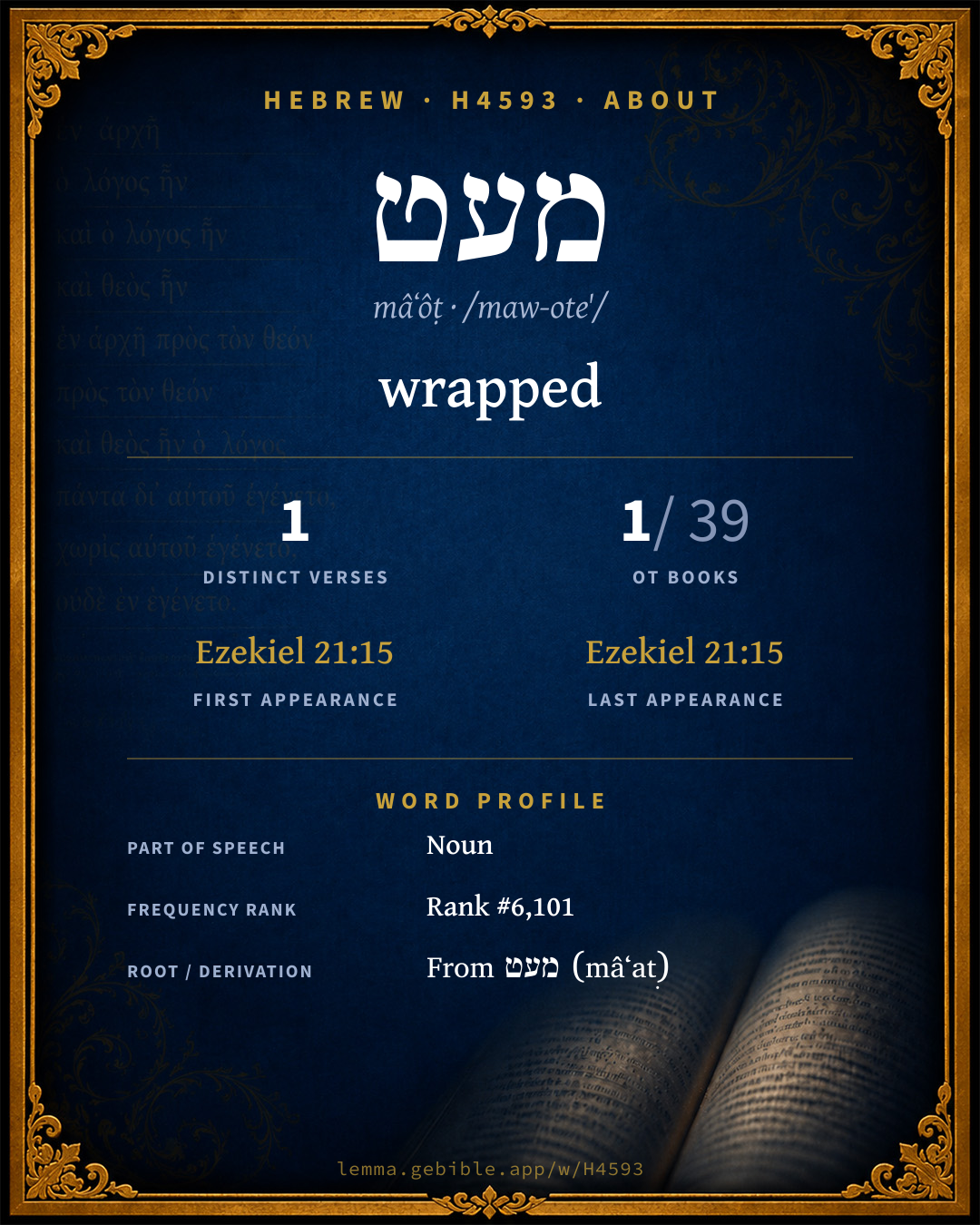
מָעֹט
wrapped
‘wrapped’ is one of 2 main senses fuller range ↓
Full lexicon entry — Brown-Driver-Briggs (BDB)
From Brown-Driver-Briggs (BDB)
Where this word appears
Grammar key — what these labels mean
Part of speech
- Adjective
- A word that describes or qualifies a noun.
State
- Absolute
- The independent form of a noun, not bound to a following word.
Gender
- Feminine
- Grammatically feminine.
Number
- Singular
- One.
Every verse where H4593 appears — 1 distinct verse across 1 book. Click any verse to open its interlinear word-by-word view. Verse text shown in the World English Bible for context — . Each verse’s Hebrew form is shown with its reference; the English is not keyword-highlighted, since the data carries no word-level English alignment. Use “Compare translations” on any verse to read it across multiple English versions. This concordance covers the Hebrew Bible; Septuagint (Greek Old Testament) occurrences are not indexed here.
Ezekiel 1 verse
About this entry
At a glance — auto-summarized from this page’s data, not written by a person. Every figure links to its source below. This summary describes the numbers; it doesn’t interpret them.
“wrapped” is the headline sense of the Hebrew noun מעט (mâʻôṭ). It occurs a mere 1 verse across Scripture. More than three-quarters of its appearances fall in Ezekiel. Its lone occurrence is Ezekiel 21:15. Its meaning spans more than one sense — see its full sense range. See the sense tree, 1-verse concordance, and the renderings breakdown below.
Gloss history
Strong's 1890 vs modern scholarship
About this word
Strong's H4593 catalogs a Hebrew word from the Hebrew Old Testament.
These counts are not copied from any lexicon or concordance. They are computed here, from the morphology-tagged Hebrew Old Testament. What Lemma adds →
- 1
- distinct verses
- The word appears in 1 distinct verse.
- 1 / 39
- OT books
- The word appears in 1 of 39 Old Testament books.
- #6,101
- by frequency
- Rank #6,101 (rank 6,101 of 8,640 Hebrew words by occurrence).
View all 1 occurrence in the concordance →
Most concentrated in
- Ezekiel 1 verse 100%
By section of the Old Testament
By traditional corpus
Conventional, traditional groupings — biblical authorship is debated, so this is a traditional corpus grouping, not an authorship claim. Each share is this word’s portion of its verses in that division of the Hebrew canon. Each figure is a share of the word’s 1 distinct verse.
- Prophets (Nevi'im) 1 verse · 100%
How translations render this word
Counts come from each version’s own published word-to-Strong’s tagging or interlinear alignment — an approximate guide to how each version renders this word, not a word-level alignment the data otherwise carries. Because each total is that version’s own tagged count, the per-version totals vary from one another and need not match the appearance or distinct-verse counts above. These counts may also differ from a printed concordance because Lemma counts each distinctly tagged rendering and does not collapse phrase taggings into a single head-word total. This is a fixed set of word-tagged versions (KJV, ASV, BSB, ULT) and does not change with the reading translation you choose elsewhere. Each version’s license is shown beside its name below (and on Sources).
BDB lists this Strong’s number as 2 distinct words (homographs). Each count above pools all of them and is not split by sense — see the Senses section below. A low-frequency rendering may belong to a different one of those words, not the primary meaning.
- King James Version†: Is wrapped up 1×
- American Standard Version†: Is pointed 1×
- Berean Standard Bible†: Is drawn 1×
- unfoldingWord Literal Text†: Is grasped 1×
King James Version Public Domain
Renders H4593 across 1† tagged occurrence — most commonly:
American Standard Version Public Domain
Renders H4593 across 1† tagged occurrence — most commonly:
Berean Standard Bible Public Domain
Renders H4593 across 1† tagged occurrence — most commonly:
unfoldingWord Literal Text CC BY-SA 4.0
Renders H4593 across 1† tagged occurrence — most commonly:
Senses in the full BDB
Hebrew verbs can shift meaning by stem (binyan): Qal is the basic action, Niphal is often passive or reflexive, Piel often intensifies or makes it factitive, and Hiphil is typically causative. The senses below are grouped under the stem BDB assigns to each.
What do BDB’s symbols mean?
BDB uses these scholarly abbreviations:
| Symbol | Meaning |
|---|---|
| 𝔊 | the Septuagint (the ancient Greek translation, LXX) |
| 𝔙 | the Vulgate (the Latin translation) |
| 𝔖 | the Syriac version (the Peshitta) |
| 𝔗 | the Targum (the Aramaic translation) |
| ψ | the Psalms |
| √ | root (the underlying root or stem) |
| ‖ | parallel passage (a synonymous or contrasted parallel) |
| † | the dagger: every passage where the word occurs is cited |
The 3 senses and sub-senses the full Brown-Driver-Briggs lexicon distinguishes for this word, in lexicon order (not ranked by frequency), with BDB’s own verbatim wording and sub-sense lettering. Shown in Hebrew script with BDB’s own scholarly abbreviations. The condensed entry is in the Lexicon Entry tab.
מעט I wrap oneself, enwrap, envelop oneself (Arabic غَطَا cover, conceal
Qal
- Pf. 3 ms. וְע׳ (consec.) Je 43:12; 3 pl. וְעָטוּ (consec.) Mi 3:7; Impf. 3 ms. יַעְטֶה Lv 13:45 + 2 times, וַיַּ֫עַט Is 59:17; 2 ms. תַּעְטֶה Ez 24:17; 3 mpl. יַעֲטוּ (Baer יַעְ׳ ψ 71:13; 109:29; 2 mpl. תַּעְטוּ Ez 24:22; Pt. act. עֹטֶה 1 S 28:14 ψ 104:2; fs. עֹטְיָה Ct 1:7;—wrap, envelop oneself with sthg. (acc., like לבשׁ): וְהוּא עֹטֶה מְעִיל 1 S 28:14 an old man ascending, and he is enwrapped in a robe; so יַע׳ הָרֹעֶה בִּגְדוֹ Je 43:12 (sim.), and וְע׳ אֶת־אֶרֶץ מִצְרַיִם v 12 he will wrap himself in the land of Egypt (use it as a robe, fig., of Nebuchadnezzar; so completely will it be in his power, Gf); so fig. of י׳, וַיַּעַט כַּמְעִיל קִנְאָה Is 59:17 (‖ לָבַשׁ), ע׳־אוֹר כַּשַּׂלְמָה ψ 104:2; of men, כְּבֶגֶד יַע׳ 109:19 (sim. ‖ לָבַשׁ v 18), וְיַע׳ כַמְעִיל בָּשְׁתָּם v 29 (‖ id.), יַע׳ חֶרְפָּה וגו׳ 71:13; c. עַל of part covered, in phrase וְעָטוּ עַל־שָׂפָם Mi 3:7 they shall envelop themselves upon their beard (cover the beard, sign of mourning or shame Che Now BenzArch. 165 NowArch. i. 195), so Ez 24:17, 22 and (of leper) Lv 13:45 (P); pt. f. עֹטְיָה Ct 1:7 as subst., one wrapping (a veil about her), i.e. a mourner; > a harlot (cf. Gn 38:14); but preferably II עטה picked lice.—וַיַּעַט etc., v. also עיט; מְעֻטָּה, v. מדט. e.g. Jeremiah 43:12
Hiphil
- Pf. 2 ms. הֶעֱטִיתָ עָלָיו בּוּשָׁה ψ 89:46 (of י׳) thou hast wrapped shame upon him (enwrapped him in shame); Impf. 3 ms. בְּרָכוֹת יַעְטֶה מוֹרֶה ψ 84:7 early rain enwrappeth (it, עֵמֶק הַבָּכָא v a) with blessings (𝔊 δώσει, as if from Arabic عطو, عَطَا iii, iv. give, cf. NeMarg. 41); read prob. also יַעֲטֵנִי Is 61:10 (for MT יְעָטָ֑נִי, v. יעט) with a robe of rightness he envelopeth me, so Brd Di RyKau Du; > Qal Pf. עָטָ֑נִי Klo CheHpt. e.g. Psalms 89:46
מעט II grasp (Arabic عطو, عَطَا i, vii. take with hands)
Qal
- Inf. abs. + Pt. act. sf. וְעֹטְךָ עָטֹה Is 22:17 he shall grasp thee forcibly, cf. GesComm. Hi Ew De CheComm. Di GuKau; > Thes RobGes BuhlLex (13) from I. עטה (he shall wrap, roll the tight together); picked lice Je 43:12 (BöttNÄ 163 𝔊 cf. Is 22:17 Ct 1:7). e.g. Isaiah 22:17
Senses from the full Brown-Driver-Briggs lexicon (Brown, Driver, Briggs; Oxford 1906 — public domain), digitized via Sefaria, supplemented by the OpenScriptures HebrewLexicon (CC BY 4.0). Full attribution on Sources.
Word origin
I. vb. wrap oneself, enwrap, envelop oneself (Arabic غَطَا cover, conceal; Aramaic ܥܛܳܐ extinguish, destroy; Assyrian eṭû, be dark, eṭûtu, darkness);—
I. vb. grasp (Arabic عطو, عَطَا i, vii. take with hands);—
— Brown-Driver-Briggs (Oxford 1906, public domain), digitized via Sefaria, supplemented by the OpenScriptures HebrewLexicon (CC BY 4.0). See Sources.
Derived from מעט (mâʻaṭ) (H4591) — to diminish.
Jastrow Dictionary
A second Hebrew/Aramaic lexicon for comparison, covering Aramaic and post-biblical (Talmudic, Targumic, Midrashic) usage that the biblical-Hebrew BDB does not. Matched by lemma rather than by Strong’s number, so a lemma may carry more than one Jastrow headword (shown separately below), and the entries cover usage well beyond the Bible.
מָעַט
- to be thin, minute.—Part. pass. מָעוּט, f. מְעוּטָה; pl. מְעוּטִים, מְעוּטִין; מְעוּטוֹת. Y. Pes. V, 32ᵃ bot.; Y. Snh. I, 18ᶜ bot. גסי רוח ומְעוּטֵי תודה big in spirit (haughty) and small in learning (of narrow capacity). Tosef. Ḥall. I, 7; a. e.—Tam. IV, 2 במעוטה at least (Talm. ed. 31ᵃ במעוטן, comment. במיעוטן on the smallest of the tables).
- 1. to diminish, reduce; to do little. Ab. IV, 10 הוי מְמַעֵט בעסק וכ׳ do less business, and busy thyself with the Law. M. Kat. 22ᵃ, v. עֵסֶק. Taan. I, 7 מְמַעֲטִין במשא וכ׳ we must reduce business transactions, building &c. Ib. IV, 6 משנכנס אב ממעטין בשמחה with the beginning of the month of Ab we must reduce rejoicing. Ḥull. 60ᵇ לכי ומַעֲטִי את עצמך go and make thyself smaller (be reduced). Snh. 17ᵃ הואיל ומִיעַטְתֶּם עצמיכם because you made yourselves small (were modest); Num. R. s. 15. Tosef. Erub. IX (VI), 15 מִיעֲטָהּ באבנים וכ׳ if he reduced the size of the gap by means of stones &c. Y. ib. VII, beg. 24ᵇ ממעטין בכלים you may use utensils for reducing the opening. Bab. ib. 77ᵇ ממעט effects the reduction, i.e. puts the two adjoining places in the legal condition of dwellings connected by a gate; a. fr.
- 2. (interpret.) to limit, qualify, exclude from the rule. Shebu. 26ᵃ היה דורש את כל התורה בריבה ומיעט interpreted the entire Law on the principle of ‘It includes and it excludes’, i.e. on the principle that if, in the Biblical text, a specification is preceded and followed by general terms, both an extension (ריבוי) and a limitation (מיעוט) must be found; e. g. ib. (ref. to Lev. V, 4) או נפש … להרע … מי׳ וכ׳ ‘or if a soul swears’, this is a general expression, ‘for bad or for good’, this limits (the sphere of the law to things which are either an advantage or a disadvantage); ‘whatsoever it be &c.’, this is again a generalization; now what does it include? All kinds of words (vows); ומאי מ׳ מ׳ וכ׳ and what does it exclude? It excludes a religious act (the vow of doing a forbidden thing or not doing a commanded thing). Sifra Tsav, ch. XV, Par. 11 אם מִיעַטְתִּים מסמיכה מרובה לא אֲמַעֲטֵם בתנופה וכ׳ if I exclude them (the gentiles) from the privilege of laying hands on the sacrifice, which has a wider sphere of application, must I not exclude them from the privilege of waving &c.?; a. fr.—Part. pass. מְמוּעָט, v. מוּעָט. e.g. Leviticus 5:4
- to do little, less. Ber. 17ᵃ שמא תאמר אני מרבה והוא מַמְעִיט lest you say, I do much good, and he but little; שנינו אחד המרבה ואחד הממעיט וכ׳ we have learned, whether one does much or little (they are equally worthy), provided one directs his heart &c.; Men. XIII, 11; a. fr.
- to be diminished, reduced. Erub. VII, 5 נ׳ התבן מעשרה וכ׳ if the pile of straw has been reduced to less than ten handbreadths. Ib. 54ᵇ; Ab. Zar. 19ᵃ מִתְמַעֵט he will become less (will decline in learning). Arakh. 30ᵇ נ׳ כספו if his value was reduced. Tosef. Sot. XIV, 10 נִתְמַעֲטוּ הימים וכ׳ the days were reduced, and the years shortened. Ib. התחילו הגוים להתרבות וישראל להִתְמעֵט the nations began to grow and the Israelites to be reduced (in rank). Pesik. R. s. 14 נִתְמַעֲטָה ידו he became reduced in fortune. Midr. Till. to Ps. XII, end נפשם מִתְמַעֶטֶת עליהם their soul within them shrinks, i.e. they feel jealous and angry; Yalk. ib. 659; Lev. R. s. 32, beg. מתמענת (corr. acc.). Sifra l. c. נִתְמַעֶטֶת תנופה the sphere of the act of waving is the smaller one; נִתְמַעֲטָה סמיכה the laying on of hands has the smaller sphere; a. fr.—Erub. 80ᵇ מאי נתמעט נתמטמט ‘it was reduced’ (Mish. ib. VII, 7) means, it was reduced to atoms, v. מִטְמֵט.—B. Mets. 71ᵃ נכסיו מִתְמַעֲטִין, v. מוּט h.—Tosef. Mikv. VI (VII), 14 מִתְמַעֲטִין, v. מָעַךְ.
מְעַט I
- Pa. מַעֵט same, to reduce; to exclude. Yoma 74ᵃ למַעוּטֵי מאי … למַ׳ וכ׳ this ‘none but’ is to exclude what (whom)?… It excludes the king; Shebu. 31ᵃ Ms. M. (ed. לאפוקי); a. fr.
- to be reduced; to be excluded. Erub. 79ᵇ דא׳ מאיתמול when its size was reduced the day before; a. e.
מְעַט II
- preced.) a little, little. Ab. I, 15 אמור מ׳ ועשה הרבה promise little and do much. Sabb. 31ᵇ (ref. to Koh. VII, 16) הא מ׳ לירשע but a little wrong one may do?; a. e.—V. מוּעָט. e.g. Ecclesiastes 7:16
A Dictionary of the Targumim, the Talmud Babli and Yerushalmi, and the Midrashic Literature (Marcus Jastrow; London, Luzac, 1903) — Public Domain. Digitized via Sefaria. Digitized via Sefaria. Full attribution on Sources.
Same root — word family
Other BDB entries built from the same root as H4593, grouped by Strong’s listed origin. These share a root / origin per the lexicon — not necessarily a shared meaning. Each links to that word’s own entry.
Derives from
Shares the same root
Compare all same-root words → They share a root, not necessarily a meaning.
Septuagint verse parallels
This word appears in 1 verse that also exists in the Greek Old Testament (Septuagint), out of the 1 Hebrew verse it occurs in. You can read those verses in Greek by switching the Old Testament edition to the Septuagint.
Read these verses in the Septuagint
This is a verse-level parallel only — the same verses exist in both the Hebrew and Greek Old Testaments. No word-level Hebrew↔Greek correspondence is claimed: the data carries no such alignment, so no Greek word is shown as this Hebrew word’s translation. Coverage is not total — the Septuagint omits the deuterocanon and renumbers the Psalms, so some Hebrew verses have no direct Greek parallel.