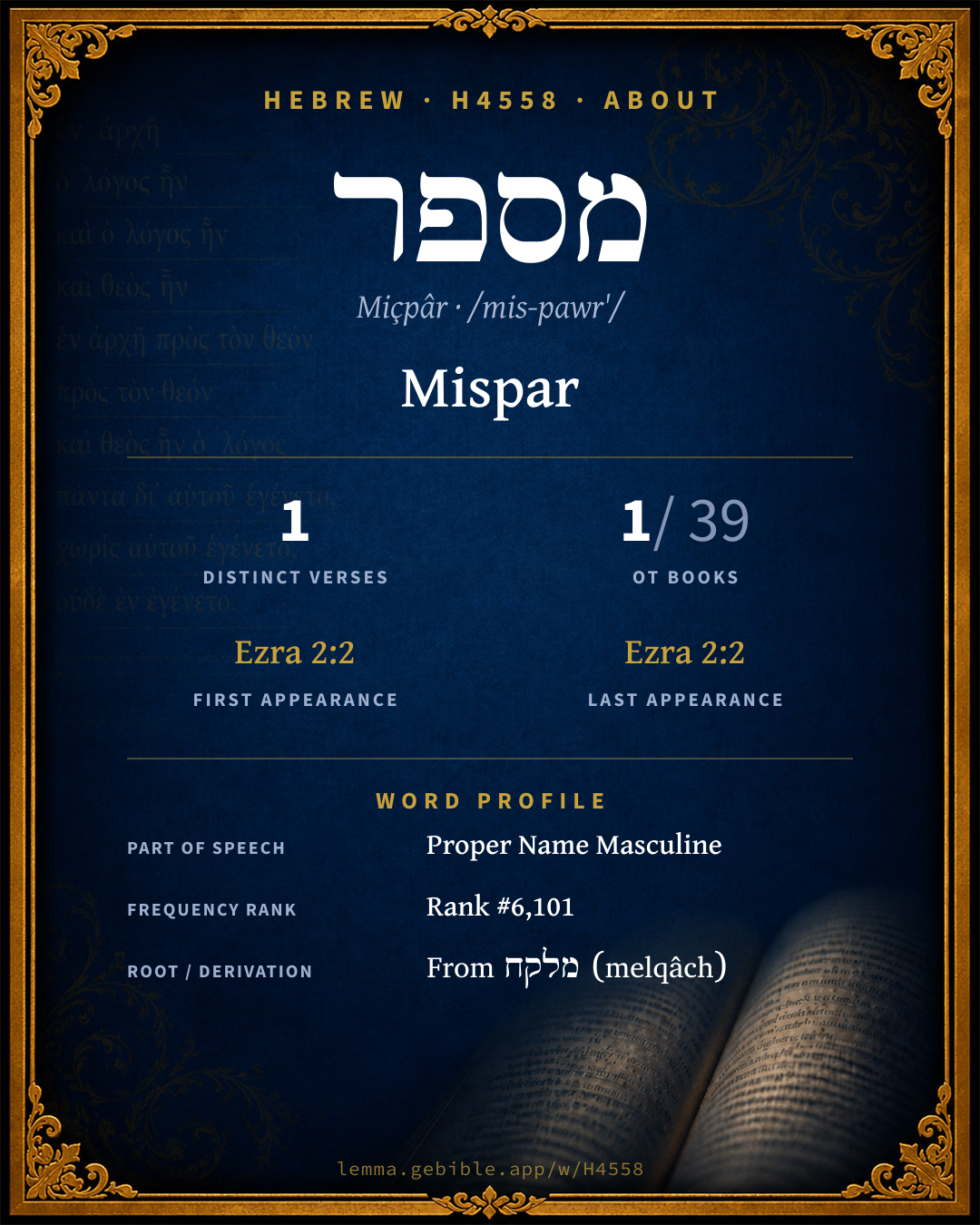
מִסְפָּר
Mispar
BDB lists 2 entries for ‘Mispar’ fuller range ↓
Full lexicon entry — Brown-Driver-Briggs (BDB)
From Brown-Driver-Briggs (BDB)
Where this word appears
Grammar key — what these labels mean
Part of speech
- Noun
- A naming word — a person, place, thing, or idea.
Noun type
- Proper
- A name of a specific person, place, or people (e.g. Abraham, Zion, Israel).
Every verse where H4558 appears — 1 distinct verse across 1 book. Click any verse to open its interlinear word-by-word view. Verse text shown in the World English Bible for context — . Each verse’s Hebrew form is shown with its reference; the English is not keyword-highlighted, since the data carries no word-level English alignment. Use “Compare translations” on any verse to read it across multiple English versions. This concordance covers the Hebrew Bible; Septuagint (Greek Old Testament) occurrences are not indexed here.
Ezra 1 verse
About this entry
At a glance — auto-summarized from this page’s data, not written by a person. Every figure links to its source below. This summary describes the numbers; it doesn’t interpret them.
At its core, מספר (Miçpâr) means “Mispar.” The Hebrew Bible uses it only 1 verse. Its uses cluster heavily in Ezra (100% of all occurrences). Its lone occurrence is Ezra 2:2. Dig into 1-verse concordance and the renderings breakdown below.
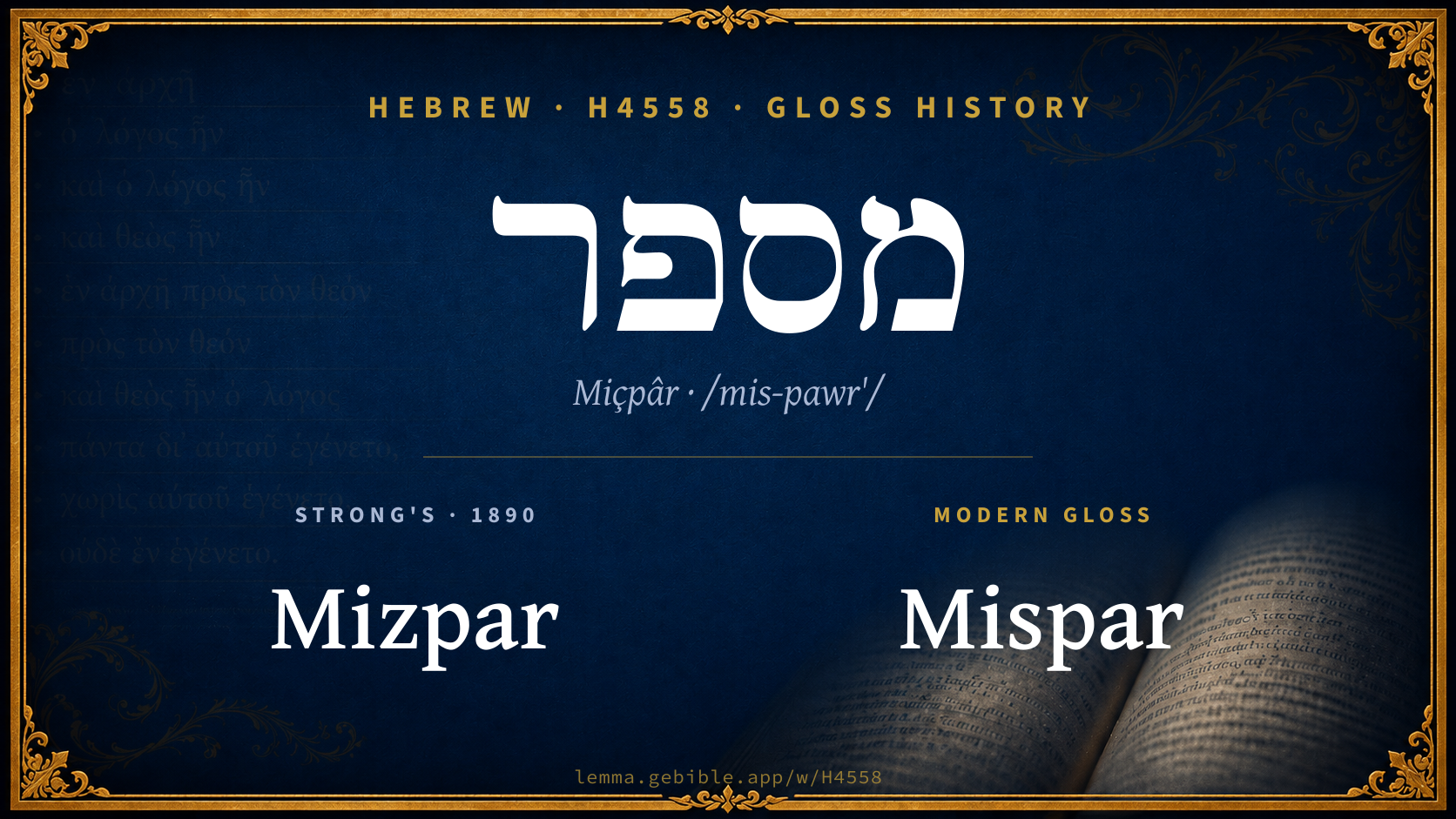
Gloss history
Strong's 1890 vs modern scholarship
About this word
Strong's H4558 catalogs a Hebrew word from the Hebrew Old Testament.
These counts are not copied from any lexicon or concordance. They are computed here, from the morphology-tagged Hebrew Old Testament. What Lemma adds →
- 1
- distinct verses
- The word appears in 1 distinct verse.
- 1 / 39
- OT books
- The word appears in 1 of 39 Old Testament books.
- #6,101
- by frequency
- Rank #6,101 (rank 6,101 of 8,640 Hebrew words by occurrence).
View all 1 occurrence in the concordance →
Most concentrated in
- Ezra 1 verse 100%
By section of the Old Testament
By traditional corpus
Conventional, traditional groupings — biblical authorship is debated, so this is a traditional corpus grouping, not an authorship claim. Each share is this word’s portion of its verses in that division of the Hebrew canon. Each figure is a share of the word’s 1 distinct verse.
- Writings (Ketuvim) 1 verse · 100%
How translations render this word
Counts come from each version’s own published word-to-Strong’s tagging or interlinear alignment — an approximate guide to how each version renders this word, not a word-level alignment the data otherwise carries. Because each total is that version’s own tagged count, the per-version totals vary from one another and need not match the appearance or distinct-verse counts above. These counts may also differ from a printed concordance because Lemma counts each distinctly tagged rendering and does not collapse phrase taggings into a single head-word total. This is a fixed set of word-tagged versions (KJV, ASV, BSB, ULT) and does not change with the reading translation you choose elsewhere. Each version’s license is shown beside its name below (and on Sources).
BDB lists this Strong’s number as 2 distinct words (homographs). Each count above pools all of them and is not split by sense — see the Senses section below. A low-frequency rendering may belong to a different one of those words, not the primary meaning.
- King James Version†: Mispar 1×
- American Standard Version†: Mispar 1×
- Berean Standard Bible†: Mispar 1×
- unfoldingWord Literal Text†: Mispar 1×
King James Version Public Domain
Renders H4558 across 1† tagged occurrence — most commonly:
American Standard Version Public Domain
Renders H4558 across 1† tagged occurrence — most commonly:
Berean Standard Bible Public Domain
Renders H4558 across 1† tagged occurrence — most commonly:
unfoldingWord Literal Text CC BY-SA 4.0
Renders H4558 across 1† tagged occurrence — most commonly:
Senses in the full BDB
What do BDB’s symbols mean?
BDB uses these scholarly abbreviations:
| Symbol | Meaning |
|---|---|
| 𝔊 | the Septuagint (the ancient Greek translation, LXX) |
| 𝔙 | the Vulgate (the Latin translation) |
| 𝔖 | the Syriac version (the Peshitta) |
| 𝔗 | the Targum (the Aramaic translation) |
| ψ | the Psalms |
| √ | root (the underlying root or stem) |
| ‖ | parallel passage (a synonymous or contrasted parallel) |
| † | the dagger: every passage where the word occurs is cited |
The 3 senses and sub-senses the full Brown-Driver-Briggs lexicon distinguishes for this word, in lexicon order (not ranked by frequency), with BDB’s own verbatim wording and sub-sense lettering. Shown in Hebrew script with BDB’s own scholarly abbreviations. The condensed entry is in the Lexicon Entry tab.
מספר I
- 1.
- a. number, Ju 7:6 the number of those lapping, מִס׳ לַכּוֹכָבִים ψ 147:4, + often (37 times PH); לֹא עָלָה הַמִּסְפָּר בְּמִסְפַּר דִּבְרֵי וגו׳ 1 Ch 27:24 (read בְּסֵפֶר) the number did not come up into (was not recorded in) the book of the daily doings, etc.; redund. after num., †2 S 21:20 twenty-four (in) number; אֵין מ׳ it was (they were) innumerable Gn 41:49 (E), c. לְ Ju 6:5; 7:12; 1 Ch 22:16; 2 Ch 12:3, לִתְבוּנָתוֹ אֵין מ׳ ψ 147:5 (of י׳); abs. Je 2:32 Jb 21:33; Ct 6:8; †עַד־אֵין מ׳ = id., Jb 5:9; 9:10 ψ 40:13, וְאֵין לָהֶם מ׳ Je 46:23; לְאֵין מ׳ †1 Ch 22:4; וְאֵין מ׳ †ψ 104:25; 105:34 Jo 1:6; הֲיֵשׁ מ׳ לִגְדוּדָיו Jb 25:3 can his bands be numbered? without אֵין = numerable, i.e. few, וִיהִי מְתָיו מ׳ Dt 33:6 but let his men be few, יָמִים מ׳ Nu 9:20, מ׳ alone Is 10:19, usually in combin., מְתֵי מ׳ = a few men Gn 34:30 (J), Dt 4:27; Je 44:28; 1 Ch 16:19 ψ 105:12, אַנְשֵׁי מ׳ Ez 12:16; so שְׁנוֹת מ׳ Jb 16:22; adv. phr. מִסְפַּר יְמֵי חַיֵּיהֶם Ec 2:3 = during all their lives, cf. 5:17; 6:12; = appointed (normal) number, מ׳ יָמֶיךָ אֲמַלֵּא Ex 23:26 (E). e.g. Judges 7:6
- b. c. prep. בְּ: מְעַט בְּמ׳ Ez 5:3 few in number; בְּמ׳ by (exact) count, tale 2 S 2:15; Dt 25:2; 1 Ch 9:28(×2), so prob. Ez 20:37 read בְּמִסְפַּר 𝔊 Toy for MT מָסֹרֶת; in (prescribed) number Nu 29:18 + 6 times Nu 29 (P), Ezr 3:4; = according to (proportioned to) the number of Lv 25:15(×2) + often; לְמִס׳ according to number Ju 21:23; Jos 4:5, 8 (JE) Nu 14:29 (P) Ez 4:5; 1 Ch 27:1; כְּמִס׳ = id., 1 K 18:31; Nu 15:12(×2) (P); so מ׳ alone (adv. acc.) Ex 16:16 (P) Jb 1:5; Je 2:28; 11:13.—Nu 23:10b read מִי סָפַר, cf. v a, so 𝔊 Di SoKau. e.g. Ezekiel 5:3
- 2. recounting, relation, מִסְפַּר הַחֲלוֹם Ju 7:15 the recounting of the dream. e.g. Judges 7:15
מספר II m. a returned exile Ezr 2
Senses from the full Brown-Driver-Briggs lexicon (Brown, Driver, Briggs; Oxford 1906 — public domain), digitized via Sefaria, supplemented by the OpenScriptures HebrewLexicon (CC BY 4.0). Full attribution on Sources.
Word origin
II. n.m. 1 Ch 27:24 number, tale>;—abs. מ׳ Gn 34:30 +; cstr. מִסְפַּר Ex 16:16 +; sf. מִסְפַּרְכֶם Nu 14:29, מִסְפָּרָם Ju 21:23 +; pl. cstr. מִסְפְּרֵי 1 Ch 12:23;—
III. n.pr.m. a returned exile Ezr 2:2 (𝔊 Μαλσαρ, A 𝔊L Μασφσαρ), = מִסְפֶּ֫רֶת Ne 7:7 (𝔊 Μασφεραν, א Μασφαραδ, A Μαασφαραθ, 𝔊L Μασφαρ).
— Brown-Driver-Briggs (Oxford 1906, public domain), digitized via Sefaria, supplemented by the OpenScriptures HebrewLexicon (CC BY 4.0). See Sources.
Derived from מלקח (melqâch) (H4457) — snuffers.
Jastrow Dictionary
A second Hebrew/Aramaic lexicon for comparison, covering Aramaic and post-biblical (Talmudic, Targumic, Midrashic) usage that the biblical-Hebrew BDB does not. Matched by lemma rather than by Strong’s number, so a lemma may carry more than one Jastrow headword (shown separately below), and the entries cover usage well beyond the Bible.
מִסְפָּר
- number, count. Cant. R. to VI, 9 (ref. to II Sam. XXIV, 9) מ׳ זה המנין וכ׳ mispar means counting, mifḳad, summing up. Pesik. R. s. 11 היו מ׳ they were a limited number; שלא במ׳ innumerable; a. fr. e.g. 2 Samuel 24:9
מַסְפָּר
- (סְפַר) tool for cutting hair, razor, scissors. Targ. O. Num. VI, 5. Targ. Ez. V, 1 (not מִסְ׳); a. e.—Snh. 96ᵃ הבו לי מ׳ (Ms. F. מַסְפַּרְתָּא) give me a razor; ib. ויהבו ליה מספרתא; Yalk. Is. 276 מספרא.
סָפַר
- (b. h.) [to cut; to mark,]
- 1. to write; to count. Y. Kil. VII, end, 31ᵃ יִסְפּוֹר he (who is in possession of property bought from an oppressor, v. אַנָּס) must count (settle with the original owner according to rules, v. גוֹרְדְּיָינִי), opp. יחזיר he must return the property; ib. יִסְפֹּר (or יְסַפֵּר Pi.). Kidd. 30ᵃ שהיו סוֹפְרִים, v. סוֹפֵר. Nidd. 69ᵃ סוֹפַרְתָּן למנין וכ׳ she counts them in with the requisite number of seven days. Ib. 31ᵃ יושב וסוֹפֵר וכ׳ sits and records the copulations &c. Men. 65ᵇ, v. סְפִירָה; a. v. fr.—[Sifré Deut. 33 סופרה; read: סופנה, v. סָפַן.]—Part. pass. סָפוּר, q. v.
- 2. to cut, shear, v. infra.
- to be counted. Bekh. 45ᵃ שנִסְפֶּרֶת ע"ג היד when the additional finger is counted (is in a line) with the others; Yalk. Sam. 156.
- 1. to cut, shear. Sot. 49ᵇ, a. fr. מְסַפֵּר קומי, v. קוֹמִי I. Ib. התירו (לו)לסַפֵּר וכ׳ they allowed him to cut his hair in gentile fashion, because of his connections with royalty. Sifra Aḥăré, Par. 9, ch. XIII תִּסְפּוֹר, v. קוֹמִי I. Tosef. Bets. III, 19 אין מְסַפְּרִין הירק וכ׳ you must not no trim vegetables with the clipper (on the Holy Day) &c.; a. fr.
- 2. to tell, speak, count. Y. Kil. l. c., v. supra. Gen. R. s. 78 (ref. to אברם in place of אברהם, Neh. IX, 7) סיפור הוא מְסַפֵּר וכ׳ he states a historical fact, saying &c. Y. Ber. IX, beg. 12ᵈ אם בא אדם לסַפֵּר וכ׳ if one were to undertake to count the mighty deeds of the Lord, he would be ruined (ref. to Job XXXVII, 20); המספר בשבחו וכ׳ he who tells the praise of the Lord more than is becoming. Ib. מכאן … אסור לסַפֵּר וכ׳ beyond that (which has been adopted in ritual prayers) one must not tell &c. Arakh. 16ᵃ לעולם אל יְסַפֵּר אדם בטובתו וכ׳ man should not count up his neighbor’s good qualities, for he may be induced to speak of his shortcomings; B. Bath. 164ᵇ. Sot. 42ᵃ מְספְּרֵי לשון הרע gossipers. Snh. 38ᵇ בלשון ארמי סי׳ spoke Aramæan; a. v. fr.—Ib. 52ᵇ סי׳ הימנו if he (the scholar) holds conversation with him. e.g. Nehemiah 9:7
- to have one’s hair cut. Ab. Zar. II, 2 אין מִסְתַּפְּרִין מהן וכ׳ you must not have your hair cut by them in any place (on account of danger to life). Tosef. ib. III, 5 ישראל המִסְתַּפֵּר וכ׳ if an Israelite has his hair cut by a gentile, he must look into the mirror; Ab. Zar. 29ᵃ; a. fr.
סְפַר
- 1. to count, mark, write, v. סַפְרָא I. I.
- 2. to shear, v. infra.
- to cut, shear, shave. Targ. Job I, 20 (Ms. סְפַר Pe.). Targ. Y. Lev. XIII, 33 (not יַסְפֵּר); ib. XIV, 8, sq. (h. text גלח); a. fr.—Lev. R. s. 28, end יתיב ומְסַפֵּר ליה (Haman) sat down and cut his (Mordecai’s) hair; ib. מן דחסל (מן) מְסַפְּרָא ליה when he had done cutting his hair; a. fr.—Part. pass. מְסַפֵּר. Ib. אית בר נש … ולא מ׳ is there a man who putts the royal crown on his head without having his hair cut?; Esth. R. to VI, 10.
סַפָּר
- (preced. wds.)
- 1. (v. סֵפֶר) Bible teacher. Y. Maasr. III, 50ᵈ בית … טובלין לס׳ ולמַשְׁנֶה (not ולא למש׳) school houses for Bible and Talmud make fruits ṭebel for the Bible teacher and for the Talmud teacher. [Perh. to be read: סָפַר Chald. form.]
- 2. hair-cutter, barber. Sabb. I, 2 לא ישב אדם לפני הס׳ וכ׳ one must not sit down for the hair-cutter near Minḥah time beforesaying the prayer. Shebi. VIII, 5; a. e.—Pl. סַפָּרִים, סַפָּרִין. Kel. XIII, 1 זוג של ס׳ the barbers’ scissors. Sabb. 9ᵇ. v. מַעֲפוֹרֶת; a. e.
סַפָּר ²
- , hair-cutter. Targ. II Esth. VI, 12.—Lev. R. s. 28, end; Esth. R. to VI, 10. Lev. R. s. 14, end לית ס׳ דמספר לגרמיה no hair-cutter can cut his own hair (i.e. the female sperm begets the male embryo and vice versa); a. e.
סְפָר
- (סָפַר) [mark, march,] boundary, border district. Yeb. 48ᵇ עיר הסמוכה לס׳ a town near the boundary. Sot. 42ᵃ פעמים מדבר עמו אחת בס׳ וכ׳ the priest addressed the people twice, once on the border line (before entering the enemy’s land) and once before the battle. Tosef. Erub. IV (III), 5 באו … הסמוכות לס׳ if the enemy invades towns near the boundary (of Palestine); Y. ib. IV, 21ᵈ bot.; Bab. ib. 45ᵃ. Ib. ובבל כעיר הסמוכה לס׳ וכ׳ and Babylonia is (as regards the duty of defence) like a town near the boundary, which was interpreted to mean Neharde‘a. Num. R. s. 16 מה ראה לישב לו על הס׳ וכ׳ what reason had he (Amalek) to settle on the border, on the way of the entrance of the Israelites into the land?; a. e.—Pi. סְפָרִים, constr. סִפְרֵי. Y. Ḥall. II, 58ᵇ bot. ס׳ א"י Palestinian districts, ס׳ חוצה לארץ foreign districts (conquered by Israelites).
סְפַר ²
- constr. סְפַר, same; ס׳ יַמָּא sea-district. Targ. O. Gen. XLIX, 13 (h. text חֹף); a. fr.—Pl. סַפְרַיָּא, constr. סַפְרֵי. Targ. Y. ib.—[Targ. Y. Lev. XIII, 45 ספריא, some ed., v. סָפְדָּא.]
סָפֵר
- (preced. wds.) = סְפִירָה, counting. Naz. VII, 3 (54ᵃ) ימי סְפֵרוֹ (comment. סְפֵירוֹ; Y. ed. ספורו) the days which the cured leper has to count (Lev. XIV, 8); Y. ib. 56ᶜ bot. ספירו. e.g. Leviticus 14:8
סֵפֶר
- preced. wds.) letter, document, book. Erub. 15ᵇ; Gitt. 21ᵇ; Succ. 24ᵇ, v. סְפִירָה. Eduy. I, 12, a. fr. ס׳ כתובה the formula of a Kethubah. Y. Sot. IX, end, 24ᶜ משמת ר"א נגנז ס׳ החכמה with the death of R. El. a book of wisdom disappeared; Bab. Sot. 49ᵇ נגנז ס׳ תורה; Tosef. ib. XV, 3 בטל ס׳ תורה. Gen. R. s. 24 סִפְרוֹ של אה"ר the book of Adam (the destinies of humanity); Ex. R. s. 40; Lev. R. s. 15 beg.; a. fr.—Esp. a Biblical book. B. Bath. 15ᵃ ירמיה כתב ספרו וס׳ מלכים וכ׳ Jeremiah wrote his book (the prophecies of Jerem.) and the Book of Kings and the Lamentations. Ib. 14ᵇ משה כתב ספרו וכ׳ Moses wrote his own book, and the Section of Balaam (the chapters on B., Num. XXII, 2—XXIV, 25) and Job; Y. Sot. V, end, 20ᵈ; a. v. fr.—ס׳ תורה (abbrev. ס"ת) (or ס׳ only) the Pentateuch in a scroll. Ab. Zar. 18ᵃ כרכוהו בס"ת וכ׳ they wrapped him up in the scroll &c. Sabb. 116ᵃ ס"ת שנמחק a scroll of the Pentateuch the writing of which is effaced; Yad. III, 5 ס׳ שנמחק; a. v. fr.—Kel. XV, 6, a. e. ס׳ העזרה the Pentateuch kept in the Temple court, v. עֲזָרָה.—ס׳ הוא, ס׳ זעטוטים &c., v. respective determinants.—בֵּית סֵ׳, בֵּית הַסֵּ׳ the school in which the Bible is taught, secondary school, contrad. to בית תלמוד Talmud school. Y. Maasr. III, 50ᵈ, v. סַפָּר 1. Midr. Till. to XCII, 16 שתולים … אלו התינוקות שבבית הס׳ ‘planted in the house of the Lord’ (ib. 14), that means the children at school; a. fr.—Pl. סְפָרִים, constr. סִפְרֵי, סִיפְ׳. Ex. R. s. 41 זריז בכ"ד ס׳ well-versed in the twenty-four books of the Scripture. Sabb. 116ᵃ (ס׳ צדוקים) ס׳ מינים heretical books, v. מִין III. Snh. 68ᵃ שתי … כשני ס׳ תורה וכ׳ my two arms which are like two rolled up scrolls of the Torah, a. v. fr.—Ch. סִפְרָא, constr. סֵפֶר. e.g. Numbers 22:2
סָפַר ²
- = h. סוֹפֵר,
- 1. scribe, writer of documents; copyist. Targ. Jer. XXXVI, 20, sq.; a. fr.—Ab. Zar. 9ᵃ, v. בַּצִּירָא, Ib. 10ᵃ, v. דַּוְקָנָא. Ḥull. 64ᵇ, sq. פסיק להו ס׳ וכ׳ the copyist (of the Scriptures) divides them into two words. Y. Succ. II, 53ᵃ top סַפְרָה דגופתא the scribe of Gufta; a. fr.
- 2. scholar, teacher. Targ. Is. III, 2 (h. text נביא); ib. IX, 14. Targ. O. Gen. XLIX, 10 (h. text מחקק); a. fr.—Gen. R. s. 70, end אית ס׳ דלית וכ׳ is there a teacher that has no pupils?, i.e. I (Laban) learned trickery from you (Jacob).—Esp. Bible teacher. Y. Ḥag. I, 76ᶜ, a. e., v. מַתְנְיָין; a. fr.—ס׳ מתא, v. סוֹפֵר.—Pl. סַפְרַיָּא, סַפְרַיָּיא, סַפְרִין, סַפְרֵי. Targ. Y. I Gen. XLIX, 10. Targ. I Sam. X, 15 (h. text נביאים); a. fr.—Sot. IX, 5 (49ᵃ), v. חַכִּימָא. Midr. Till. to Ps. XCI, 6 מפקיד לס׳ וכ׳ ordered the school teachers to let the children go free (during the summer) from the fourth to the ninth hour of the day; Lam. R. to I, 3; Num. R. s. 12 לסַפְרַיָּה; a. fr.
A Dictionary of the Targumim, the Talmud Babli and Yerushalmi, and the Midrashic Literature (Marcus Jastrow; London, Luzac, 1903) — Public Domain. Digitized via Sefaria. Digitized via Sefaria. Full attribution on Sources.
Bible dictionary
Public-domain dictionary articles matched to this entry by name (Mispar). A biblical name can be shared by more than one person or place, so an article may treat several.
Hitchcock's Bible Names Dictionary · Roswell D. Hitchcock, 1869
Mispereth, numbering; showing; increase of tribute
Classic public-domain reference works; full attribution on Sources.
Septuagint verse parallels
This word appears in 1 verse that also exists in the Greek Old Testament (Septuagint), out of the 1 Hebrew verse it occurs in. You can read those verses in Greek by switching the Old Testament edition to the Septuagint.
Read these verses in the Septuagint
This is a verse-level parallel only — the same verses exist in both the Hebrew and Greek Old Testaments. No word-level Hebrew↔Greek correspondence is claimed: the data carries no such alignment, so no Greek word is shown as this Hebrew word’s translation. Coverage is not total — the Septuagint omits the deuterocanon and renumbers the Psalms, so some Hebrew verses have no direct Greek parallel.