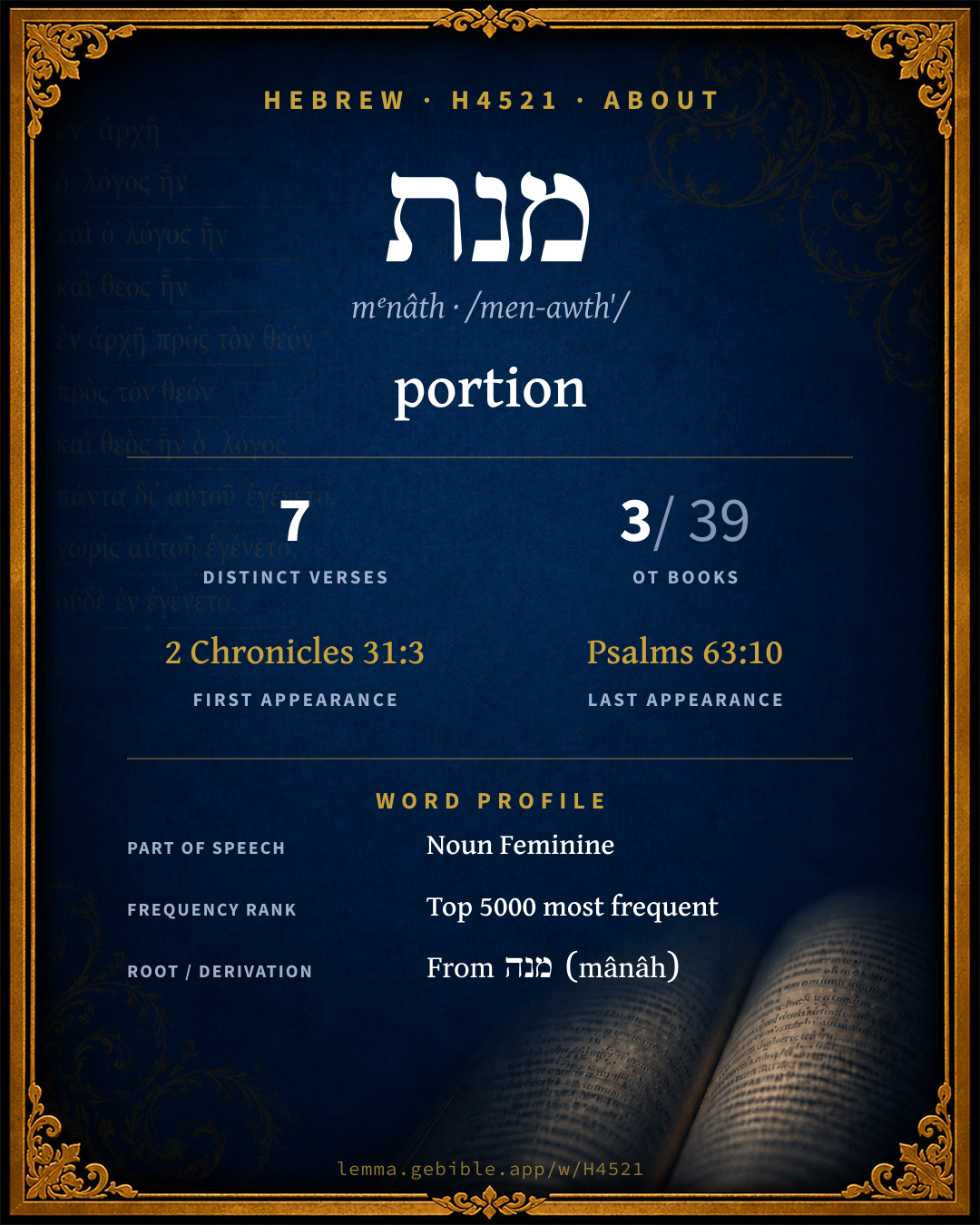
מְנָת
portion
Full lexicon entry — Brown-Driver-Briggs (BDB)
From Brown-Driver-Briggs (BDB)
Where this word appears
Grammar key — what these labels mean
Part of speech
- Noun
- A naming word — a person, place, thing, or idea.
Noun type
- Common
- A common noun — a general class of person, place, or thing (“king,” “city,” “water”), not a specific name.
State
- Construct
- A noun bound to a following noun in a possessive / “of” relationship (the construct chain).
Gender
- Feminine
- Grammatically feminine.
Number
- Plural
- More than one (in Hebrew, generally three or more).
- Singular
- One.
Every verse where H4521 appears in the Book of Nehemiah — 3 distinct verses. Click any verse to open its interlinear word-by-word view. Verse text shown in the World English Bible for context — . Each verse’s Hebrew form is shown with its reference; the English is not keyword-highlighted, since the data carries no word-level English alignment. Use “Compare translations” on any verse to read it across multiple English versions. This concordance covers the Hebrew Bible; Septuagint (Greek Old Testament) occurrences are not indexed here.
Nehemiah
- Nehemiah 12:44 מְנָא֣וֹת n c fp cs On that day were men appointed over the chambers for the treasures, for the heave-offerings, for the first fruits, and for the tithes, to gather into them, according to the fields of the cities, the portions appointed by the law for the priests and Levites: for Judah rejoiced for the priests and for the Levites who waited.
- Nehemiah 12:47 מְנָי֛וֹת n c fp cs All Israel in the days of Zerubbabel, and in the days of Nehemiah, gave the portions of the singers and the porters, as every day required: and they set apart [that which was] for the Levites; and the Levites set apart [that which was] for the sons of Aaron.
- Nehemiah 13:10 מְנָי֥וֹת n c fp cs I perceived that the portions of the Levites had not been given them; so that the Levites and the singers, who did the work, were fled everyone to his field.
About this entry
At a glance — auto-summarized from this page’s data, not written by a person. Every figure links to its source below. This summary describes the numbers; it doesn’t interpret them.
At its core, מנת (mᵉnâth) means “portion.” Scripture first uses it in 2 Chronicles 31:3. Spanning 7 verses in 3 books, it ranks among the uncommon words of the Hebrew Bible. Its uses concentrate in Nehemiah (43% of all occurrences). From the same root come מנה, מנא and מנה. Each statement above links to its evidence; the full detail follows below.
Gloss history
Strong's 1890 vs modern scholarship
About this word
Strong's H4521 catalogs a Hebrew word from the Hebrew Old Testament.
These counts are not copied from any lexicon or concordance. They are computed here, from the morphology-tagged Hebrew Old Testament. What Lemma adds →
- 7
- distinct verses
- The word appears in 7 distinct verses.
- 3 / 39
- OT books
- The word appears in 3 of 39 Old Testament books.
- #2,835
- by frequency
- Top 5000 most frequent Hebrew words (rank 2,835 of 8,640 Hebrew words by occurrence).
View all 7 occurrences in the concordance →
Most concentrated in
- Nehemiah 3 verses 43%
- 2 Chronicles 2 verses 29%
- Psalms 2 verses 29%
By section of the Old Testament
By traditional corpus
Conventional, traditional groupings — biblical authorship is debated, so this is a traditional corpus grouping, not an authorship claim. Each share is this word’s portion of its verses in that division of the Hebrew canon. Each figure is a share of the word’s 7 distinct verses.
- Writings (Ketuvim) 7 verses · 100%
How translations render this word
Counts come from each version’s own published word-to-Strong’s tagging or interlinear alignment — an approximate guide to how each version renders this word, not a word-level alignment the data otherwise carries. Because each total is that version’s own tagged count, the per-version totals vary from one another and need not match the appearance or distinct-verse counts above. These counts may also differ from a printed concordance because Lemma counts each distinctly tagged rendering and does not collapse phrase taggings into a single head-word total. This is a fixed set of word-tagged versions (KJV, ASV, BSB, ULT) and does not change with the reading translation you choose elsewhere. Each version’s license is shown beside its name below (and on Sources).
- King James Version: Portions 3×, Portion 2×
- American Standard Version: Portions 3×
- Berean Standard Bible: Portion 2×
- unfoldingWord Literal Text: Portion of 4×, Portions of 3×
King James Version Public Domain
Renders H4521 across 7 tagged occurrences — most commonly:
Plus 2 renderings that appear only once — usually multi-word phrases or single function words the recovered tagging swept in, not distinct renderings.
American Standard Version Public Domain
Renders H4521 across 7 tagged occurrences — most commonly:
Plus 4 renderings that appear only once — usually multi-word phrases or single function words the recovered tagging swept in, not distinct renderings.
Berean Standard Bible Public Domain
Renders H4521 across 8 tagged occurrences — most commonly:
Plus 6 renderings that appear only once — usually multi-word phrases or single function words the recovered tagging swept in, not distinct renderings.
unfoldingWord Literal Text CC BY-SA 4.0
Renders H4521 across 7 tagged occurrences — most commonly:
Senses in BDB
The 1 sense BDB distinguishes for this word, in lexicon order (not ranked by frequency or importance). The full entry — with sub-senses — is in the Lexicon Entry tab.
- portion
Word origin
n.f. portion (= מָנָה, chiefly late; on form cf. Ges§ 95 n. LagBN 81, 150);—cstr. מְנָ֫ת 2 Ch 31:3 + 5 times; Pl. cstr. מְנָאוֹת Ne 12:44; מְנָיוֹת Ne 12:47; 13:10;—portion of king, for sacrifice, 2 Ch 31:3; of priest v 4; also Ne 12:44 מְנָאוֹת הַתּוֹרָה לַכּ׳; of Levites 13:10; of singers 12:47; fig. מְנָת כּוֹסָם ψ 11:6 (of judgment of wicked), cf. מ׳ שֻׁעָלִים ψ 63:11; so מְנָֽת־מִדַּיִךְ Je 13:25 portion of thy measure=thine allotted portion; read also מְנָתוֹ(-הּ) for מִנֵּ֑הוּ ψ 68:24 (so Ol Dy Bi Che We); in good sense, י׳ מְנָת חֶלְקִי וְכוֹסִי ψ 16:5 י׳ is the portion of my lot and my cup.
— Brown-Driver-Briggs (Oxford 1906, public domain), digitized via Sefaria, supplemented by the OpenScriptures HebrewLexicon (CC BY 4.0). See Sources.
Derived from מנה (mânâh) (H4487) — to count.
Jastrow Dictionary
A second Hebrew/Aramaic lexicon for comparison, covering Aramaic and post-biblical (Talmudic, Targumic, Midrashic) usage that the biblical-Hebrew BDB does not. Matched by lemma rather than by Strong’s number, so a lemma may carry more than one Jastrow headword (shown separately below), and the entries cover usage well beyond the Bible.
מְנָת
- 1. portion, share. B. Bath. 12ᵃ מ׳ בכרם וכ׳ I sell thee a portion of my vineyard.—מְנַת המלך the king’s share (annona). Ned. 62ᵇ; B. Bath. 8ᵃ, v. מִנְדָּה. Ab. Zar. 71ᵃ הפס עלי מ׳ מלך settle for me the annona (in kind or money).
- 2. appointment; בִּמְנַת, עַל מְנַת (abbrev. ע"מ) on condition that, for the sake of. Tosef. Dem. VI, 13 ואם התנה עמו במ׳ כן ed. Zuck. (Var. … מתחלה ע"מ לעשות כן) but if he originally had made that agreement (of dividing the profits) with him. Ib. VII, 3 ע"מ שהמעשרות שלי with the condition that the tithes be mine. Y. B. Mets. V, 10ᵇ bot. במ׳ לעלות לו וכ׳ with the condition that he will give him (as his share) one new-born animal or one crop of wool. Ab. I, 3, v. עֶבֶד. Tosef. Snh. XI, 2 יודע אני וע"מ כן אני עושה I know (the nature of the offence and its penalty), and on that condition I am committing it; Mekh. Mishp. s. 20 יודע אני ע"מ כן (read: וע"מ). Kidd. 6ᵇ מתנה ע"מ להחזיר a present made with the condition that it shall be returned (possession for the time being); a. v. fr.—Ab. Zar. 37ᵃ, a. fr. כל האומר ע"מ … מעכשיו דמי if a man says ‘on condition’, it is to be considered as if he had said ‘from now’, i.e. the stipulated transaction takes retrospective effect when the condition is fulfilled.—B. Bath. X, 8 (175ᵇ) על מְנָתוֹ הלוהו Ar. (ed. אמונתו, v. אֱמוּנָה) he extended the loan to him (the friend) on the condition which he (the guarantor) offered.
מְנַת
- Targ. II Sam. VI, 19 (ed. Wil. מָנָתָא).—B. Bath. 167ᵃ (in a contract) מנת ראובן ושמעון אַחֵי the share of Reuben and Simeon the brothers. B. Kam. 113ᵇ מ׳ דמלכא = מנת המלך, v. preced. B. Mets. 109ᵇ מ׳ דילך thy share. Yeb. 37ᵇ; a. e.—על מ׳, v. preced. Targ. Y. II, Gen. XLIV, 18 ע"מ מיעבד וכ׳ even if it must be done against the will &c.—Pl. מַנְוָותָא. Targ. II Esth. II, 9.
A Dictionary of the Targumim, the Talmud Babli and Yerushalmi, and the Midrashic Literature (Marcus Jastrow; London, Luzac, 1903) — Public Domain. Digitized via Sefaria. Digitized via Sefaria. Full attribution on Sources.
Forms in the corpus
The 7 distinct written forms H4521 takes in the Hebrew Bible, most frequent first — each parse links to that state’s occurrences in the concordance. Hebrew forms include their vowel points and cantillation, so a single lemma takes many written forms.
| Form | Parsing | Example | Uses |
|---|---|---|---|
| וּ/מְנָת֩ | Noun, Common, Feminine, Singular, Construct | 2 Chronicles 31:3 | 1 |
| מְנָ֖ת | Noun, Common, Feminine, Singular, Construct | Psalms 63:10 | 1 |
| מְנָ֣ת | Noun, Common, Feminine, Singular, Construct | Psalms 11:6 | 1 |
| מְנָ֥ת | Noun, Common, Feminine, Singular, Construct | 2 Chronicles 31:4 | 1 |
| מְנָא֣וֹת | Noun, Common, Feminine, Plural, Construct | Nehemiah 12:44 | 1 |
| מְנָי֛וֹת | Noun, Common, Feminine, Plural, Construct | Nehemiah 12:47 | 1 |
| מְנָי֥וֹת | Noun, Common, Feminine, Plural, Construct | Nehemiah 13:10 | 1 |
Same root — word family
Other BDB entries built from the same root as H4521, grouped by Strong’s listed origin. These share a root / origin per the lexicon — not necessarily a shared meaning. Each links to that word’s own entry.
Derives from
Shares the same root
Proper names from this root
People and places named from this root — a name, not an additional meaning of the word.
Compare all same-root words → Showing 4 of 8 — not the complete family. 2 of the same-root words are proper names (people or places). They share a root, not necessarily a meaning.
Septuagint verse parallels
This word appears in 4 verses that also exist in the Greek Old Testament (Septuagint), out of the 7 Hebrew verses it occurs in. You can read those verses in Greek by switching the Old Testament edition to the Septuagint.
Read these verses in the Septuagint
This is a verse-level parallel only — the same verses exist in both the Hebrew and Greek Old Testaments. No word-level Hebrew↔Greek correspondence is claimed: the data carries no such alignment, so no Greek word is shown as this Hebrew word’s translation. Coverage is not total — the Septuagint omits the deuterocanon and renumbers the Psalms, so some Hebrew verses have no direct Greek parallel.