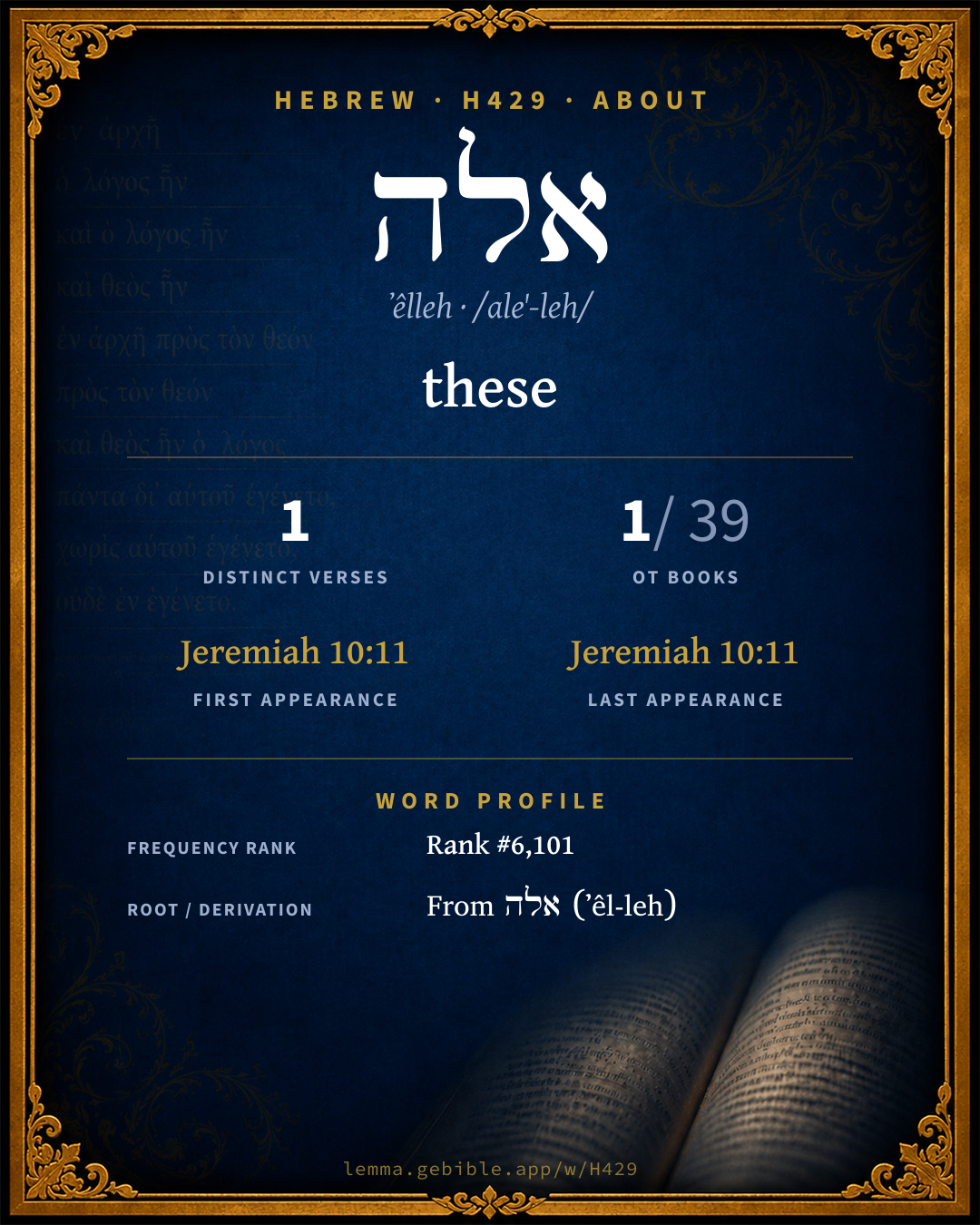
אֵלֶּה
these
Full lexicon entry — Brown-Driver-Briggs (BDB)
From Brown-Driver-Briggs (BDB)
Where this word appears
Grammar key — what these labels mean
Part of speech
- Pronoun
- A word standing in for a noun (“he,” “this,” “who”).
Gender
- Common
- Either gender — not distinguished for this form.
Number
- Plural
- More than one (in Hebrew, generally three or more).
Every verse where H429 appears — 1 distinct verse across 1 book. Click any verse to open its interlinear word-by-word view. Verse text shown in the World English Bible for context — . Each verse’s Hebrew form is shown with its reference; the English is not keyword-highlighted, since the data carries no word-level English alignment. Use “Compare translations” on any verse to read it across multiple English versions. This concordance covers the Hebrew Bible; Septuagint (Greek Old Testament) occurrences are not indexed here.
Jeremiah 1 verse
About this entry
At a glance — auto-summarized from this page’s data, not written by a person. Every figure links to its source below. This summary describes the numbers; it doesn’t interpret them.
אלה (ʼêlleh) is a Hebrew word most often rendered “these.” It occurs a mere 1 verse across Scripture. It clusters heavily in Jeremiah, which alone accounts for 100% of its uses. Scripture uses it exactly once, at Jeremiah 10:11. The sections below give every sense, occurrence, and version rendering.
Gloss history
Strong's 1890 vs modern scholarship
About this word
Strong's H429 catalogs a Hebrew word from the Hebrew Old Testament.
These counts are not copied from any lexicon or concordance. They are computed here, from the morphology-tagged Hebrew Old Testament. What Lemma adds →
- 1
- distinct verses
- The word appears in 1 distinct verse.
- 1 / 39
- OT books
- The word appears in 1 of 39 Old Testament books.
- #6,101
- by frequency
- Rank #6,101 (rank 6,101 of 8,640 Hebrew words by occurrence).
View all 1 occurrence in the concordance →
Most concentrated in
- Jeremiah 1 verse 100%
By section of the Old Testament
By traditional corpus
Conventional, traditional groupings — biblical authorship is debated, so this is a traditional corpus grouping, not an authorship claim. Each share is this word’s portion of its verses in that division of the Hebrew canon. Each figure is a share of the word’s 1 distinct verse.
- Prophets (Nevi'im) 1 verse · 100%
How translations render this word
Counts come from each version’s own published word-to-Strong’s tagging or interlinear alignment — an approximate guide to how each version renders this word, not a word-level alignment the data otherwise carries. Because each total is that version’s own tagged count, the per-version totals vary from one another and need not match the appearance or distinct-verse counts above. These counts may also differ from a printed concordance because Lemma counts each distinctly tagged rendering and does not collapse phrase taggings into a single head-word total. This is a fixed set of word-tagged versions (KJV, ASV, BSB, ULT) and does not change with the reading translation you choose elsewhere. Each version’s license is shown beside its name below (and on Sources).
- King James Version: These 1×
- American Standard Version: The 1×
- Berean Standard Bible: These 2×
- unfoldingWord Literal Text: These 1×
King James Version Public Domain
Renders H429 across 1 tagged occurrence — most commonly:
American Standard Version Public Domain
Renders H429 across 1 tagged occurrence — most commonly:
Berean Standard Bible Public Domain
Renders H429 across 2 tagged occurrences — most commonly:
unfoldingWord Literal Text CC BY-SA 4.0
Renders H429 across 1 tagged occurrence — most commonly:
Senses in the full BDB
What do BDB’s symbols mean?
BDB uses these scholarly abbreviations:
| Symbol | Meaning |
|---|---|
| 𝔊 | the Septuagint (the ancient Greek translation, LXX) |
| 𝔙 | the Vulgate (the Latin translation) |
| 𝔖 | the Syriac version (the Peshitta) |
| 𝔗 | the Targum (the Aramaic translation) |
| ψ | the Psalms |
| √ | root (the underlying root or stem) |
| ‖ | parallel passage (a synonymous or contrasted parallel) |
| † | the dagger: every passage where the word occurs is cited |
The 4 senses and sub-senses the full Brown-Driver-Briggs lexicon distinguishes for this word, in lexicon order (not ranked by frequency), with BDB’s own verbatim wording and sub-sense lettering. Shown in Hebrew script with BDB’s own scholarly abbreviations. The condensed entry is in the Lexicon Entry tab.
- a. Gn 2:4 & often: in appos. to a subst. with a pron. suff. (always without the art.) Ex 9:14 (read with Hi. אֵלֶּה בְּךָ for אֶל־לִבֵּךָ) 10:1 אֹתֹתַי אֵלֶּה these my signs, 11:8 Dt 11:18 1 K 8:59; 10:8; 22:23 2 K 1:13 Je 31:21 Ezr 2:65 Ne 6:14; in the genit. 2 K 6:20 Is 47:9 Dt 18:12 ψ 15:5; and after כל Gn 14:3 + often Standing alone in a neuter sense, these things (rare in best prose, & not very common in poetry), with עָשָׂה Dt 18:12; 22:5; 25:16 2 S 23:17, 22 ψ 15:5 +; with other vbs. Ezr 9:1 Is 44:21; 47:7 Je 13:22 Ho 14:10 ψ 42:5; 50:21; 107:43 Jb 8:2; with אֶת־ Nu 15:13 Is 48:14; with כָּל־ Ju 13:23 Is 66:2 +; v. also some of the cases with preps. sub d. אלה may point indifferently to what follows, Gn 6:9; 10:1; 25:7, 12, 13 ψ 42:5; or to what has preceded, Gn 9:19; 10:20, 31, 32; 25:4 Lv 21:14; 22:22 ψ 15:5; = such as these (τοιαῦτα), ψ 73:12 Jb 18:21. e.g. Genesis 2:4
- b. repeated, אלה … ואלה, these … those Dt 27:12, 13 Jos 8:22 Is 49:12 (3 times) ψ 20:8 +. e.g. Deuteronomy 27:12
- c. with art. (only after a subst. determined by art. (except Gn 21:29 Jos 17:9 עָרִים הָאֵלֶּה read הֶעָרִים, cf. 17:12; 19:8, 16, 31, 48, etc. Ez 42:9)) הָאֵלֶּה Gn 15:1 +. e.g. Genesis 21:29
- d. with preps.: בְּאֵלָּה Lv 25:54; 26:23 1 K 22:11 (7 times), בָּאֵלֶּה †1 S 16:10; 17:39; לְאֵלֶּה Lv 11:24 (4 times), לָאֵלֶּה 1 K 22:17 (5 times); מֵאֵלֶּה Gn 9:19 (16 times); עַד אֵלֶּה Lv 26:18; עַל־אֵלָּה on account of these things Is 57:6; 64:11 Je 5:9 al.; כְּאֵלֶּה †Jb 16:2 Je 10:16 = 51:19, כָּאֵלֶּה †Gn 27:46 Lv 10:19 (things like these, so Is 66:8 Je 18:13) Nu 28:24 P (cf. Ez 45:25) 2 K 25:17 = Je 52:22, כְּמוֹ־אֵלֶּה †Jb 12:3. e.g. Leviticus 25:54
Senses from the full Brown-Driver-Briggs lexicon (Brown, Driver, Briggs; Oxford 1906 — public domain), digitized via Sefaria, supplemented by the OpenScriptures HebrewLexicon (CC BY 4.0). Full attribution on Sources.
Word origin
(أُولَى, እሉ: እላ: Rabb. אֵלּוּ, Aramaic אִלֵּין, & compd. with ܗܳܐ and ܐܰܝ in ܗܳܠܶܝܢ, ܐܰܝܠܶܝܢ ) pr.pl.m. & f. these, in usage the pl. of זֶה.
— Brown-Driver-Briggs (Oxford 1906, public domain), digitized via Sefaria, supplemented by the OpenScriptures HebrewLexicon (CC BY 4.0). See Sources.
Derived from אלה (ʼêl-leh) (H428) — these.
Jastrow Dictionary
A second Hebrew/Aramaic lexicon for comparison, covering Aramaic and post-biblical (Talmudic, Targumic, Midrashic) usage that the biblical-Hebrew BDB does not. Matched by lemma rather than by Strong’s number, so a lemma may carry more than one Jastrow headword (shown separately below), and the entries cover usage well beyond the Bible.
אָלָה
- to curse, v. אלי.
אָלָה ²
- imprecation, curse. Sot. II, 5 (17ᵃ); a. fr.—Pl. אָלוֹת. Ib. a. e.
אֵלֶּה
- c. pl. (b. h.; v. preced.) these, those (cmp. הרי). Ex. R. s. 30 v’elleh (and this) adds to the preceding (continues), elleh (these) restricts. V. אֵלּוּ.
אֵלָה
- v. preced. ws.) terebinth. Shebi. VII, 5.
אלה
- Sabb. 90ᵃ Ar., v. אֵילָא 3.
אַלָּה
- Josh. XXIV, 26; v. אַלָּתָא) [pointed, prominent] e.g. Joshua 24:26
- 1. lance, fork. Kel. XVI, 8 חפוי הא׳, v. חִפּוּי. Pes. 57ᵃ אוי לי מֵאַלָּתָן woe to me (I am afraid) of their fork (weapon). Sabb. VI, 3 (63ᵃ) ed. (Ms. אלא); Y. ibid. 8ᵇ (expl. דייקרן).
- 2. sign-pole, used in the barn as a mark. Ib.; Y. Maasr. I, 49ᵃ bot.; Tosef. Ter. III, 11 משתיעקר הא׳ (ed. Zuck. משיתעשר, corr. acc.) as soon as the sign-pole (fork) is removed (indicating that the grain is ready for use and priestly gifts).
אֱלָהּ
- (= h. אֱלוֹהַּ) God. Dan. III, 28; a. fr.—Targ. O. Deut. XXXIII, 26; a. fr.—Lev. R. s. 5, end את אלה רב Ar. (ed. אלוה). Y. B. Mets. II, 8ᶜ אלההון דיהודאי the God of the Jews. Y. Snh. X, 28ᵇ.—Pl. (also plur. majest.) אֱלָהִין. Dan. II, 11; a. e.—אֱלָהַיָּא. Jer. X, 11. Targ. Ps. CXXXVI, 2 אלהי אלהיא the God of gods. [Gen. R. s. 26 כומריא גנבו א׳ וכ׳ (read אלהון) when priests rob—who would swear by their god?] Ib. (ref. to Gen. VI, 2).—Lev. R. s. 33 תמן קריין … אֱלָהַיָּיא there (in Rome) they call their kings gods. e.g. Daniel 3:28
אלי I
- to curse. Sifré Num. 18 (ref. to Num. XVIII, 21) לאלה שיהו אָלִין בה וכ׳ ‘as a curse’ means that people shall curse by her (pointing to her), ‘may happen unto thee what happened to …’. e.g. Numbers 18:21
A Dictionary of the Targumim, the Talmud Babli and Yerushalmi, and the Midrashic Literature (Marcus Jastrow; London, Luzac, 1903) — Public Domain. Digitized via Sefaria. Digitized via Sefaria. Full attribution on Sources.
Septuagint verse parallels
This word appears in 1 verse that also exists in the Greek Old Testament (Septuagint), out of the 1 Hebrew verse it occurs in. You can read those verses in Greek by switching the Old Testament edition to the Septuagint.
Read these verses in the Septuagint
This is a verse-level parallel only — the same verses exist in both the Hebrew and Greek Old Testaments. No word-level Hebrew↔Greek correspondence is claimed: the data carries no such alignment, so no Greek word is shown as this Hebrew word’s translation. Coverage is not total — the Septuagint omits the deuterocanon and renumbers the Psalms, so some Hebrew verses have no direct Greek parallel.