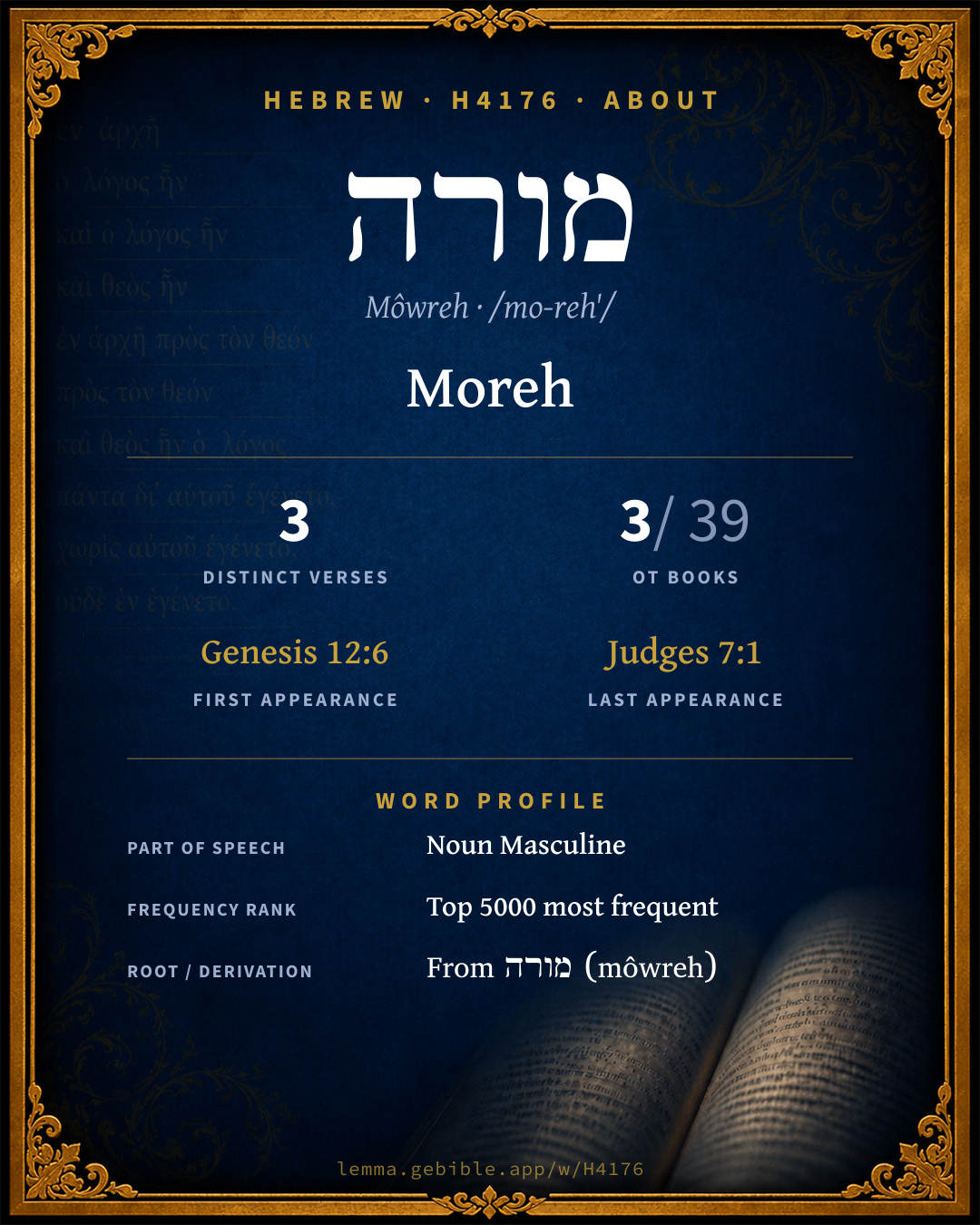
מוֹרֶה
Moreh
BDB lists 3 entries for ‘Moreh’ fuller range ↓
Full lexicon entry — Brown-Driver-Briggs (BDB)
From Brown-Driver-Briggs (BDB)
Where this word appears
Grammar key — what these labels mean
Part of speech
- Noun
- A naming word — a person, place, thing, or idea.
Noun type
- Proper
- A name of a specific person, place, or people (e.g. Abraham, Zion, Israel).
Every verse where H4176 appears in the Book of Deuteronomy — 1 distinct verse. Click any verse to open its interlinear word-by-word view. Verse text shown in the World English Bible for context — . Each verse’s Hebrew form is shown with its reference; the English is not keyword-highlighted, since the data carries no word-level English alignment. Use “Compare translations” on any verse to read it across multiple English versions. This concordance covers the Hebrew Bible; Septuagint (Greek Old Testament) occurrences are not indexed here.
Deuteronomy
About this entry
At a glance — auto-summarized from this page’s data, not written by a person. Every figure links to its source below. This summary describes the numbers; it doesn’t interpret them.
“Moreh” is the headline sense of the Hebrew name מורה (Môwreh). It is rare — just 3 verses in the entire Hebrew Bible. It concentrates in Genesis, which alone accounts for 33% of its uses. First canonically at Genesis 12:6, it enters the text early. See 3-verse concordance and the renderings breakdown below.
Gloss history
Strong's 1890 vs modern scholarship
About this word
Strong's H4176 catalogs a Hebrew word from the Hebrew Old Testament.
These counts are not copied from any lexicon or concordance. They are computed here, from the morphology-tagged Hebrew Old Testament. What Lemma adds →
- 3
- distinct verses
- The word appears in 3 distinct verses.
- 3 / 39
- OT books
- The word appears in 3 of 39 Old Testament books.
- #4,179
- by frequency
- Top 5000 most frequent Hebrew words (rank 4,179 of 8,640 Hebrew words by occurrence).
View all 3 occurrences in the concordance →
Most concentrated in
- Genesis 1 verse 33%
- Deuteronomy 1 verse 33%
- Judges 1 verse 33%
By section of the Old Testament
By traditional corpus
Conventional, traditional groupings — biblical authorship is debated, so this is a traditional corpus grouping, not an authorship claim. Each share is this word’s portion of its verses in that division of the Hebrew canon. Each figure is a share of the word’s 3 distinct verses.
- Torah (Pentateuch) 2 verses · 67%
- Prophets (Nevi'im) 1 verse · 33%
How translations render this word
Counts come from each version’s own published word-to-Strong’s tagging or interlinear alignment — an approximate guide to how each version renders this word, not a word-level alignment the data otherwise carries. Because each total is that version’s own tagged count, the per-version totals vary from one another and need not match the appearance or distinct-verse counts above. These counts may also differ from a printed concordance because Lemma counts each distinctly tagged rendering and does not collapse phrase taggings into a single head-word total. This is a fixed set of word-tagged versions (KJV, ASV, BSB, ULT) and does not change with the reading translation you choose elsewhere. Each version’s license is shown beside its name below (and on Sources).
BDB lists this Strong’s number as 2 distinct words (homographs). Each count above pools all of them and is not split by sense — see the Senses section below. A low-frequency rendering may belong to a different one of those words, not the primary meaning.
- King James Version†: Moreh 3×
- American Standard Version†: Moreh 2×
- Berean Standard Bible†: Moreh 3×
- unfoldingWord Literal Text†: Moreh 3×
King James Version Public Domain
Renders H4176 across 3† tagged occurrences — most commonly:
American Standard Version Public Domain
Renders H4176 across 3† tagged occurrences — most commonly:
Plus 1 rendering that appears only once — usually multi-word phrases or single function words the recovered tagging swept in, not distinct renderings.
Berean Standard Bible Public Domain
Renders H4176 across 3† tagged occurrences — most commonly:
unfoldingWord Literal Text CC BY-SA 4.0
Renders H4176 across 3† tagged occurrences — most commonly:
Senses in BDB
The 3 senses BDB distinguishes for this word, in lexicon order (not ranked by frequency or importance). The full entry — with sub-senses — is in the Lexicon Entry tab.
- Moreh = "teacher"
- the oak tree at Shechem where Abram stopped when he first entered Canaan; close to the mountains of Ebal and Gerizim
- the hill in the valley of Jezreel at which the Midianites were camped when Gideon attacked them
Word origin
I. n.m. ψ 84:7 (early) rain (cf. יוֹרֶה);—Jo 2:23 (‖ גֶּשֶׁם, מַלְקוֹשׁ) v 23 (del. We), ψ 84:7.
II. n.m. Is 30, 20 teacher;—abs. in אֵלוֹן מוֹרֶה Gn 12:6 (J) = אֵלוֹנֵי מֹרֶה Dt 11:30 (Sam 𝔊 אֵלוֹן), the teacher’s terebinth (see אֵלוֹן) near Shechem; cf. גִּבְעַת הַמּוֹרֶה Ju 7:1 teacher’s hill near the plain of Jezreel, prob. Little Hermon, Nebî Daḥî BdPal. 244; the terebinth being a holy tree from which divine teaching was given, and the hill of the teacher the seat of a holy place whence divine teaching was given; see also (of God) Jb 36:22; here belong prob. likewise מוֹרָ֑י Pr 5:13, and מוֹרֶיךָ Is 30:20(×2).
— Brown-Driver-Briggs (Oxford 1906, public domain), digitized via Sefaria, supplemented by the OpenScriptures HebrewLexicon (CC BY 4.0). See Sources.
Derived from מורה (môwreh) (H4175) — rain.
Jastrow Dictionary
A second Hebrew/Aramaic lexicon for comparison, covering Aramaic and post-biblical (Talmudic, Targumic, Midrashic) usage that the biblical-Hebrew BDB does not. Matched by lemma rather than by Strong’s number, so a lemma may carry more than one Jastrow headword (shown separately below), and the entries cover usage well beyond the Bible.
מוֹרָא II
- (μωρά) stupid, foolish. Lam. R. introd. (R. Simeon) (play on מוראה, Zeph. III, 1) [read:] ל"י הוא שכן בל"י קורין לשוטיתא מ׳ it is a Greek expression, for in Greek they call a foolish woman mora; Yalk. Zeph. 567 מירה (corr. acc.). Midr. Till. to Ps. IX, 21 (play on מורה, ib.) הכנס בהן … שכן בל"י … מ׳ let folly enter into their hearts, for in Greek they call a fool mora (= מוֹרוֹס). e.g. Zephaniah 3:1
מוּרָה
- myrrh, v. מוּרָא.
מוֹרָה I
- (b. h.; = מערה, of Phoenician origin, v. Wellh. Text d. B. Sam., p. 146, sq.) razor. Naz. IX, 5; Midr. Sam. ch. II מה מ׳ האמור(ה) וכ׳ as the word morah which is used in connection with Samson (Jud. XIII, 5) intimates that he shall be a nazarite, so also &c. (I Sam. I, 11); v. next w.—Num. R. s. 10 why is the razor (תער) called morah? שאין השער מתיירא וכ׳ for the hair is afraid of nothing but the razor (v. מוֹרָא); v. Midr. Sam. l. c. e.g. Judges 13:5
מוֹרָה II
- (cmp. מָרוּת) authority. Naz. IX, 5 והלא אין מ׳ אלא של בו"ד does not this morah (I Sam. I, 11, v. Targ.) mean, ‘the authority of man (shall not come upon his head)’? שכבר היה עליו מ׳ של בו"ד (Var. מורא) the authority of man was obviously upon him (I Sam. XVI, 2); Midr. Sam. ch. II (corr. acc.). e.g. 1 Samuel 1:11
מוֹרָה III
- stupid, v. מוֹרָא II.
מוֹרֶה I
- , part. Hif. of יָרָה; v. next w.
מוֹרֶה II
- rebellious.—Pl. מוֹרִים. Tanḥ. Ḥuck. 9 (ref. to המרים, Num. XX, 10) מהו המ׳ … המ׳ סרבנים what does this hammorim mean? There are several explanations of it: hamm. means ‘trouble-some’; המ׳ שוטין וכ׳ hammorim means ‘fools’, for in the sea towns they call fools morim (v. מוֹרוֹס); ויש אומרים המ׳ שמורים את מלמדיהן and some say, hamm. means those who presume to teach their teachers; (or) המורים חצים וכ׳ those who shoot arrows (with ref. to I Sam. XXXI, 3); v. יָרָה; Num. R. s. 19. e.g. Numbers 20:10
מוֹרֶה III
- (μωρέ, vocat. of μωρός, v. next art.) fool! Pesik. Shimʿu. p. 118ᵇ למלך … אל תהי קורא לבני מ׳ like to a king who gave his son in charge of a pedagogue and said, never call my son fool; מה הדין לישנא מ׳ כהדין … מורוס what does this moré mean?—As in Greek they call a fool moros; Yalk. Jer. 265; Yalk. Num. 764 לִּבְנִי מורים … (corr. acc.).
A Dictionary of the Targumim, the Talmud Babli and Yerushalmi, and the Midrashic Literature (Marcus Jastrow; London, Luzac, 1903) — Public Domain. Digitized via Sefaria. Digitized via Sefaria. Full attribution on Sources.
Forms in the corpus
The 3 distinct written forms H4176 takes in the Hebrew Bible, most frequent first — each parse links to that state’s occurrences in the concordance. Hebrew forms include their vowel points and cantillation, so a single lemma takes many written forms.
| Form | Parsing | Example | Uses |
|---|---|---|---|
| הַ/מּוֹרֶ֖ה | Noun, Proper | Judges 7:1 | 1 |
| מֹרֶֽה | Noun, Proper | Deuteronomy 11:30 | 1 |
| מוֹרֶ֑ה | Noun, Proper | Genesis 12:6 | 1 |
Bible dictionary
Public-domain dictionary articles matched to this entry by name (Moreh). A biblical name can be shared by more than one person or place, so an article may treat several.
Easton's Bible Dictionary · M. G. Easton, 1897
An archer, teacher; fruitful. (1.) A Canaanite probably who inhabited the district south of Shechem, between Mounts Ebal and Gerizim, and gave his name to the "plain" there (Gen. 12:6). Here at this "plain," or rather (R.V.) "oak," of Moreh, Abraham built his first altar in the land of Palestine; and here the Lord appeared unto him. He afterwards left this plain and moved southward, and pitched his tent between Bethel on the west and Hai on the east (Gen. 12:7, 8).
Smith's Bible Dictionary · William Smith, 1863
(teacher).
+ The plain or plains (or, as it should rather be rendered, the oak or oaks) of Moreh. The oak of Moreh was the first recorded halting-place of Abram after his entrance into the land of Canaan. (Genesis 12:6) It was at the "place of Shechem," ch. (Genesis 12:6) close to the mountains of Ebal and Gerizim. (11:30) + The hill of Moreh, at the foot of which the Midianites and Amalekites were encamped before Gideon's attack upon them. (Judges 7:1) It lay in the valley of Jezreel, rather on the north side of the valley, and north also of the eminence on which Gideon's little band of heroes was clustered. These conditions are most accurately fulfilled if we assume Jebel ed-Duhy, the "Little Hermon" of the modern travellers, 1815 feet above the Mediterranean, to be Moreh, the Ain-Jalood to be the spring of Harod, and Gideon's position to have been on the northeast slope of Jebel Fukua (Mount Gilboa), between the village of Nuris and the last-mentioned spring.
Hitchcock's Bible Names Dictionary · Roswell D. Hitchcock, 1869
stretching
Classic public-domain reference works; full attribution on Sources.
Septuagint verse parallels
This word appears in 3 verses that also exist in the Greek Old Testament (Septuagint), out of the 3 Hebrew verses it occurs in. You can read those verses in Greek by switching the Old Testament edition to the Septuagint.
Read these verses in the Septuagint
This is a verse-level parallel only — the same verses exist in both the Hebrew and Greek Old Testaments. No word-level Hebrew↔Greek correspondence is claimed: the data carries no such alignment, so no Greek word is shown as this Hebrew word’s translation. Coverage is not total — the Septuagint omits the deuterocanon and renumbers the Psalms, so some Hebrew verses have no direct Greek parallel.