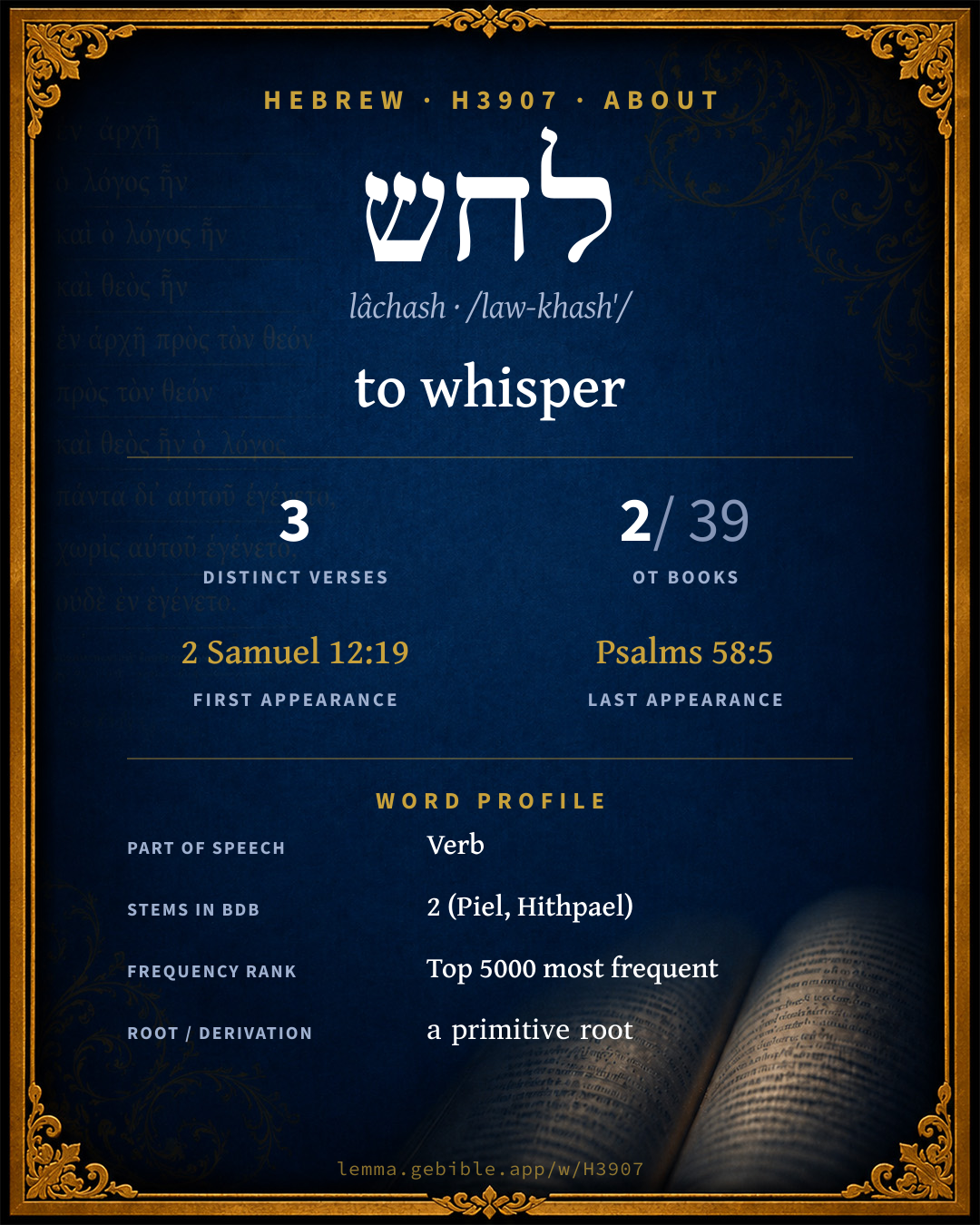
לָחַשׁ
to whisper
also: charm, conjure fuller range ↓
Full lexicon entry — Brown-Driver-Briggs (BDB)
From Brown-Driver-Briggs (BDB)
Where this word appears
See every Hithpael verb in the Hebrew Bible →
Grammar key — what these labels mean
Part of speech
- Verb
- An action or state-of-being word.
Stem
- Piel
- An intensive or resultative active stem.
- Hithpael
- The reflexive or reciprocal stem (the subject acts on itself).
Form
- Participle Active
- A verbal adjective expressing ongoing or characteristic action (“writing / one who writes”).
- Imperfect
- An incomplete, ongoing, or future action (“he will / would write”).
State
- Absolute
- The independent form of a noun, not bound to a following word.
Person
- 3rd Person
- The one spoken about (“he / she / it / they”).
Gender
- Masculine
- Grammatically masculine.
Number
- Plural
- More than one (in Hebrew, generally three or more).
1 verse where H3907 appears in the Hithpael stem in the Book of Psalms. Filtered view — show all forms. Click any verse to open its interlinear word-by-word view. Verse text shown in the World English Bible for context — . Each verse’s Hebrew form is shown with its reference; the English is not keyword-highlighted, since the data carries no word-level English alignment. Use “Compare translations” on any verse to read it across multiple English versions. This concordance covers the Hebrew Bible; Septuagint (Greek Old Testament) occurrences are not indexed here.
Psalms
About this entry
At a glance — auto-summarized from this page’s data, not written by a person. Every figure links to its source below. This summary describes the numbers; it doesn’t interpret them.
The Hebrew verb לחש centers on the idea of “to whisper.” It is rare — just 3 verses in the entire Hebrew Bible. The word gravitates to Psalms (67%), then 2 Samuel. Its earliest occurrence is 2 Samuel 12:19. As a verb its force shifts by stem, across 2 stems (Piel, Hithpael, and more). Dig into 3-verse concordance and the renderings breakdown below.
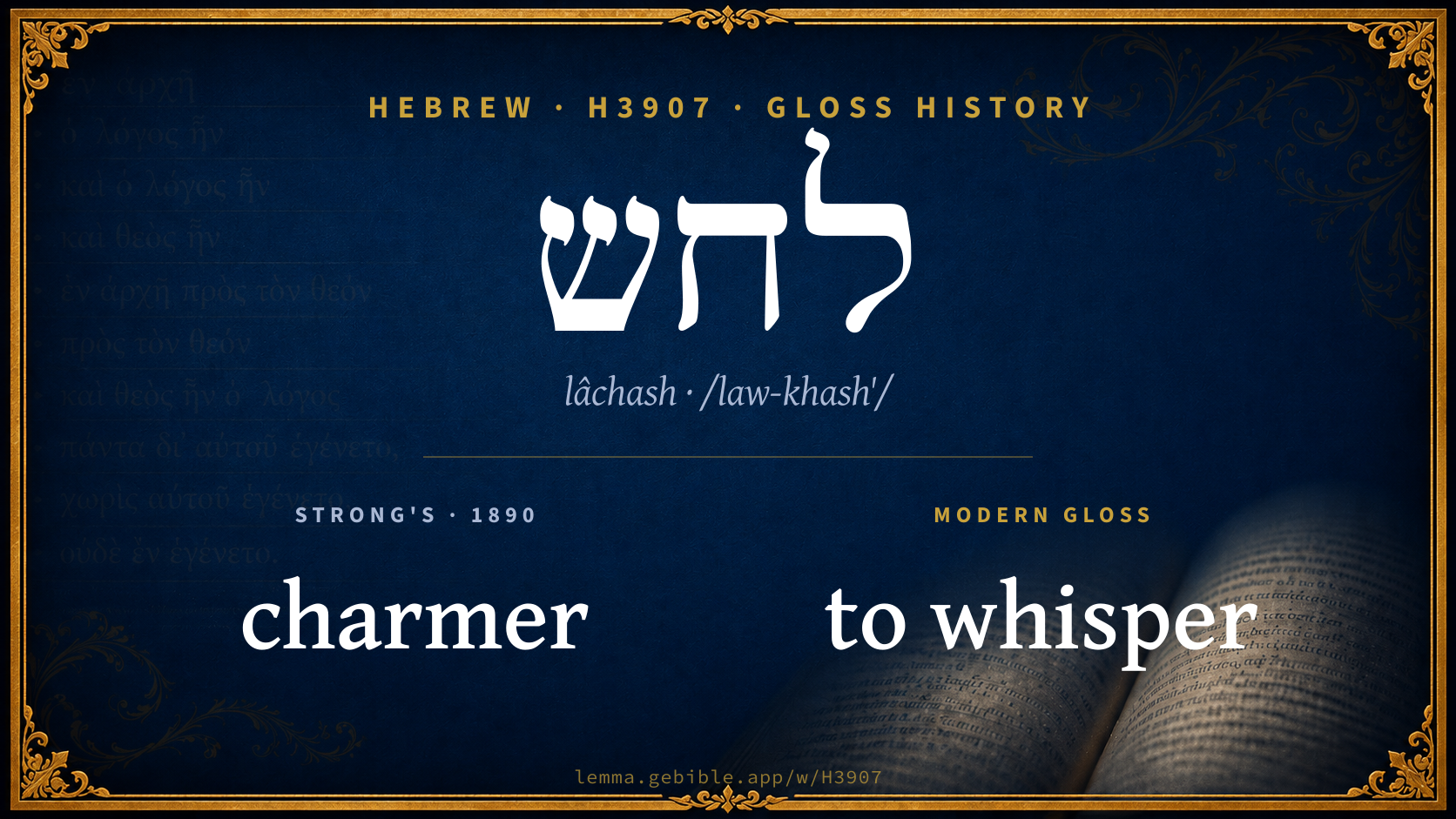
Gloss history
Strong's 1890 vs modern scholarship
About this word
Strong's H3907 catalogs a Hebrew word from the Hebrew Old Testament.
These counts are not copied from any lexicon or concordance. They are computed here, from the morphology-tagged Hebrew Old Testament. What Lemma adds →
- 3
- distinct verses
- The word appears in 3 distinct verses.
- 2 / 39
- OT books
- The word appears in 2 of 39 Old Testament books.
- #4,179
- by frequency
- Top 5000 most frequent Hebrew words (rank 4,179 of 8,640 Hebrew words by occurrence).
View all 3 occurrences in the concordance →
By traditional corpus
Conventional, traditional groupings — biblical authorship is debated, so this is a traditional corpus grouping, not an authorship claim. Each share is this word’s portion of its verses in that division of the Hebrew canon. Each figure is a share of the word’s 3 distinct verses.
- Writings (Ketuvim) 2 verses · 67%
- Prophets (Nevi'im) 1 verse · 33%
How translations render this word
Counts come from each version’s own published word-to-Strong’s tagging or interlinear alignment — an approximate guide to how each version renders this word, not a word-level alignment the data otherwise carries. Because each total is that version’s own tagged count, the per-version totals vary from one another and need not match the appearance or distinct-verse counts above. These counts may also differ from a printed concordance because Lemma counts each distinctly tagged rendering and does not collapse phrase taggings into a single head-word total. This is a fixed set of word-tagged versions (KJV, ASV, BSB, ULT) and does not change with the reading translation you choose elsewhere. Each version’s license is shown beside its name below (and on Sources).
- King James Version: Charmers 1×, Whisper 1×, Whispered 1×
- American Standard Version: Charmers 1×, Were whispering 1×, Whisper 1×
- Berean Standard Bible: Charmer 1×, Were whispering to one another 1×, Whisper 1×
- unfoldingWord Literal Text: Charmers 1×, Were whispering together 1×, Whisper 1×
King James Version Public Domain
Renders H3907 across 3 tagged occurrences — most commonly:
American Standard Version Public Domain
Renders H3907 across 3 tagged occurrences — most commonly:
Berean Standard Bible Public Domain
Renders H3907 across 3 tagged occurrences — most commonly:
unfoldingWord Literal Text CC BY-SA 4.0
Renders H3907 across 3 tagged occurrences — most commonly:
Senses in the full BDB
Hebrew verbs can shift meaning by stem (binyan): Qal is the basic action, Niphal is often passive or reflexive, Piel often intensifies or makes it factitive, and Hiphil is typically causative. The senses below are grouped under the stem BDB assigns to each. This entry also uses Hithpael (reflexive or reciprocal).
What do BDB’s symbols mean?
BDB uses these scholarly abbreviations:
| Symbol | Meaning |
|---|---|
| 𝔊 | the Septuagint (the ancient Greek translation, LXX) |
| 𝔙 | the Vulgate (the Latin translation) |
| 𝔖 | the Syriac version (the Peshitta) |
| 𝔗 | the Targum (the Aramaic translation) |
| ψ | the Psalms |
| √ | root (the underlying root or stem) |
| ‖ | parallel passage (a synonymous or contrasted parallel) |
| † | the dagger: every passage where the word occurs is cited |
The 2 senses and sub-senses the full Brown-Driver-Briggs lexicon distinguishes for this word, in lexicon order (not ranked by frequency), with BDB’s own verbatim wording and sub-sense lettering. Shown in Hebrew script with BDB’s own scholarly abbreviations. The condensed entry is in the Lexicon Entry tab. See also the Forms in the corpus table below.
Piel
- . voice of whisperers (i.e. serpent-charmers)
Hithpael
- . whisper together
Senses from the full Brown-Driver-Briggs lexicon (Brown, Driver, Briggs; Oxford 1906 — public domain), digitized via Sefaria, supplemented by the OpenScriptures HebrewLexicon (CC BY 4.0). Full attribution on Sources.
Word origin
[ לָחַשׁ ] vb. whisper, charm
— Brown-Driver-Briggs (Oxford 1906, public domain), digitized via Sefaria, supplemented by the OpenScriptures HebrewLexicon (CC BY 4.0). See Sources.
Origin: a primitive root
Jastrow Dictionary
A second Hebrew/Aramaic lexicon for comparison, covering Aramaic and post-biblical (Talmudic, Targumic, Midrashic) usage that the biblical-Hebrew BDB does not. Matched by lemma rather than by Strong’s number, so a lemma may carry more than one Jastrow headword (shown separately below), and the entries cover usage well beyond the Bible.
לָחַשׁ I
- (cmp. לָחַךְ, לָהַט) [to lick,] to flame, glow (of coals), opp. עָמַם. Pes. 75ᵇ (ref. to גחלי אש, Lev. XVI, 12) גחלי יכול עוממות … הא כיצד מביא מן הלוֹחֲשׁוֹת by gaḥălé I might understand dying coals, …; by esh I might understand a flame; … how is it now (that it reads גחלי אש)? He takes from among the glowing coals; Y. Yoma II, end, 42ᵃ; Sifra Aḥăré, Par. 2, ch. III; a. e. e.g. Leviticus 16:12
לָחַשׁ II
- to whisper. Ber. 22ᵃ לְחָשָׁהּ לר׳ וכ׳ said it in a whisper to R. A.—Esp. to whisper an incantation, to charm. Snh. X, 1 (90ᵃ) הלוֹחֵשׁ על המכה וכ׳ he who mumbles over a wound reciting the verse (Ex. XV, 26) &c. Ib. 101ᵃ לוֹחֲשִׁין לחישת וכ׳ you may whisper a charm over bites of serpents and scorpions on the Sabbath; [Rashi: charm serpents &c. to make them innocuous]. Y. Sabb. XIV, 14ᶜ bot. לוחשין לעין וכ׳ you may cure by charm a sore eye &c.; a. v. fr. e.g. Exodus 15:26
- same,
- 1. to whisper, hiss (of the serpent); to inform. Tanḥ. Vaëra 4 (ref. to Ber. V, 1, v. כְּרִיכָה) מה הנחש מְלַחֵשׁ והירג אף המלכות מְלַחֶשֶׁת וכ׳ as the serpent hisses and kills, so does the (Roman) government hiss (inform) and kill; [read:] הוא נותן את האדם בבית האסורין והוא מלחש עליו והורגו the same (officer) puts a man in prison and the same informs against him and puts him to death; Ex. R. s. 9.—Tanḥ. Balak 14 מְלַחֲשִׁין אחריו ברוך שם וכ׳ they (the demons) repeat after him in a low voice, Blessed be the name &c.; Num. R. s. 20; a. e.—Trnsf. to incite, mislead. Ber. 7ᵇ; Meg. 6ᵇ ואם לִחֶשְׁךָ אדם לומר וכ׳ and if one mislead thee saying &c.; Gitt. 23ᵇ. Num. R. s. 4 מי לחשך שהוציא וכ׳ who told thee that the Lord discharged the first-born (in disgrace) &c.?—[Erub. 91ᵃ מי לחשך, read הלכה כר"ש, as ib. 74ᵃ, v. Rabb. D. S. a. l. note 90.]
- (with ל) to be hissed at, be incited. Koh. R. to X, 11 אין הנחש … אא"כ נ׳ לו וכ׳ no serpent bites unless it is set on from above; ואין המלכות … אא"כ נ׳ לה מלעיל nor does government persecute a man, unless it is set on from above.
לְחַשׁ
- , to whisper, charm. Targ. Y. Gen. XI, 28.—Y. Sot. I, 16ᵈ bot. כל … מִילְחוֹשׁ לעיינה תיתי תִילְחוֹשִׁי let any woman that knows how to cure a sore eye by charm, come forth and charm for me. Ib. עבדי גרמיך לַחֲשָׁה ליה וכ׳ act as if you were charming to him and you may spit into his eye; Num. R. s. 9; Lev. R. s. 9.—Y. Sabb. XIV, 14ᵈ bot., a. e., v. יֵשׁוּ. Yoma 82ᵇ, v. infra; a. fr.
- same. Targ. II Sam. XII, 19.—Y. Ber. I, 3ᶜ bot. גחנין ומְלַחֲשִׁין bending and whispering (a prayer).
- 1. to be whispered to, be relieved by a whispered charm. Yoma 82ᵇ [read:] לחושו לה … לחשו לה ואִילְּחִישָׁא whisper to her that to-day is the Day of Atonement. They did whisper to her and she was relieved (of her morbid appetite); [Ms. O. ואילחיש and the embryo in her womb was quieted; v. Rabb. D. S. a. l. notes 10 a. 20].
- 2. to listen. B. Mets. 59ᵃ [read] ותִילְּחִישׁ and listen, v. גּוּץ.
לַחַשׁ
- preced.) whisper.—בל׳ in a low voice. Erub. 54ᵃ היה שונה בל׳ was in the habit of studying in a low voice; (ib. 53ᵇ bot. גריס בלחישה). Ḥag. 14ᵃ (ref. to לחש, Is. III, 3) זה שמוסרין לו סתרי תורה שניתנין בל׳ (v. Ms. M. in Rabb. D. S. a. l. a. Rashi to Is. l. c.) that is he to whom are handed over the secrets of the Law which are communicated in a low voice (cmp. Gen. R. s. 3, beg.); a. e. e.g. Isaiah 3:3
A Dictionary of the Targumim, the Talmud Babli and Yerushalmi, and the Midrashic Literature (Marcus Jastrow; London, Luzac, 1903) — Public Domain. Digitized via Sefaria. Digitized via Sefaria. Full attribution on Sources.
Forms in the corpus
The 3 distinct written forms H3907 takes in the Hebrew Bible, most frequent first — each parse links to that stem’s occurrences in the concordance. Hebrew forms include their vowel points and cantillation, so a single lemma takes many written forms.
| Form | Parsing | Example | Uses |
|---|---|---|---|
| יִ֭תְלַחֲשׁוּ | Verb, Hithpael, Imperfect, 3rd Person, Masculine, Plural | Psalms 41:7 | 1 |
| מְלַחֲשִׁ֑ים | Verb, Piel, Participle Active, Masculine, Plural, Absolute | Psalms 58:5 | 1 |
| מִֽתְלַחֲשִׁ֔ים | Verb, Hithpael, Participle Active, Masculine, Plural, Absolute | 2 Samuel 12:19 | 1 |
Same root — word family
Other BDB entries built from the same root as H3907, grouped by Strong’s listed origin. These share a root / origin per the lexicon — not necessarily a shared meaning. Each links to that word’s own entry.
Derived from this word
Proper names from this root
People and places named from this root — a name, not an additional meaning of the word.
Compare all same-root words → 1 of the same-root words is a proper name (a person or place). They share a root, not necessarily a meaning.
Septuagint verse parallels
This word appears in 3 verses that also exist in the Greek Old Testament (Septuagint), out of the 3 Hebrew verses it occurs in. You can read those verses in Greek by switching the Old Testament edition to the Septuagint.
Read these verses in the Septuagint
This is a verse-level parallel only — the same verses exist in both the Hebrew and Greek Old Testaments. No word-level Hebrew↔Greek correspondence is claimed: the data carries no such alignment, so no Greek word is shown as this Hebrew word’s translation. Coverage is not total — the Septuagint omits the deuterocanon and renumbers the Psalms, so some Hebrew verses have no direct Greek parallel.