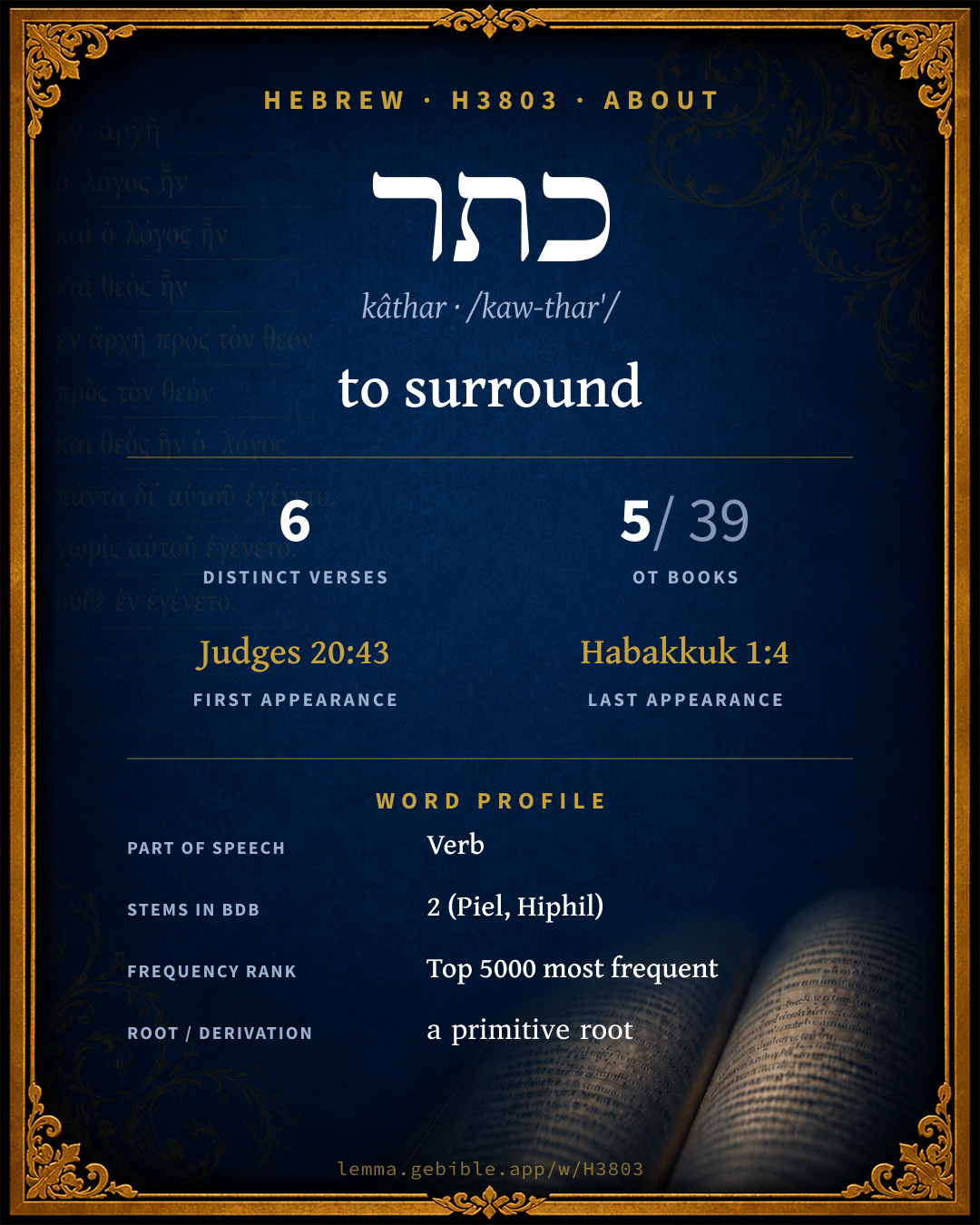
כָּתַר
to surround
‘to surround’ is one of 3 main senses fuller range ↓
Full lexicon entry — Brown-Driver-Briggs (BDB)
From Brown-Driver-Briggs (BDB)
Where this word appears
Grammar key — what these labels mean
Part of speech
- Verb
- An action or state-of-being word.
Stem
- Hiphil
- The causative active stem (“he caused / brought about”).
- Piel
- An intensive or resultative active stem.
Form
- Imperfect
- An incomplete, ongoing, or future action (“he will / would write”).
- Participle Active
- A verbal adjective expressing ongoing or characteristic action (“writing / one who writes”).
- Perfect
- A completed action or state — Hebrew marks aspect (completeness) more than strict tense (“he wrote”).
- Imperative
- A direct command (“write!”).
State
- Absolute
- The independent form of a noun, not bound to a following word.
Person
- 3rd Person
- The one spoken about (“he / she / it / they”).
- 2nd Person
- The one addressed (“you”).
Gender
- Masculine
- Grammatically masculine.
- Common
- Either gender — not distinguished for this form.
Number
- Plural
- More than one (in Hebrew, generally three or more).
- Singular
- One.
Every verse where H3803 appears in the Book of Habakkuk — 1 distinct verse. Click any verse to open its interlinear word-by-word view. Verse text shown in the World English Bible for context — . Each verse’s Hebrew form is shown with its reference; the English is not keyword-highlighted, since the data carries no word-level English alignment. Use “Compare translations” on any verse to read it across multiple English versions. This concordance covers the Hebrew Bible; Septuagint (Greek Old Testament) occurrences are not indexed here.
Habakkuk
About this entry
At a glance — auto-summarized from this page’s data, not written by a person. Every figure links to its source below. This summary describes the numbers; it doesn’t interpret them.
“to surround” is the headline sense of the Hebrew verb כתר (kâthar). Scripture first uses it in Judges 20:43. With 6 verses in 5 books, it is an uncommon word in the Hebrew Bible. It concentrates in Psalms, which alone accounts for 33% of its uses. The verb spans 2 stems, from Piel to Hiphil. The sections below give every sense, occurrence, and version rendering.
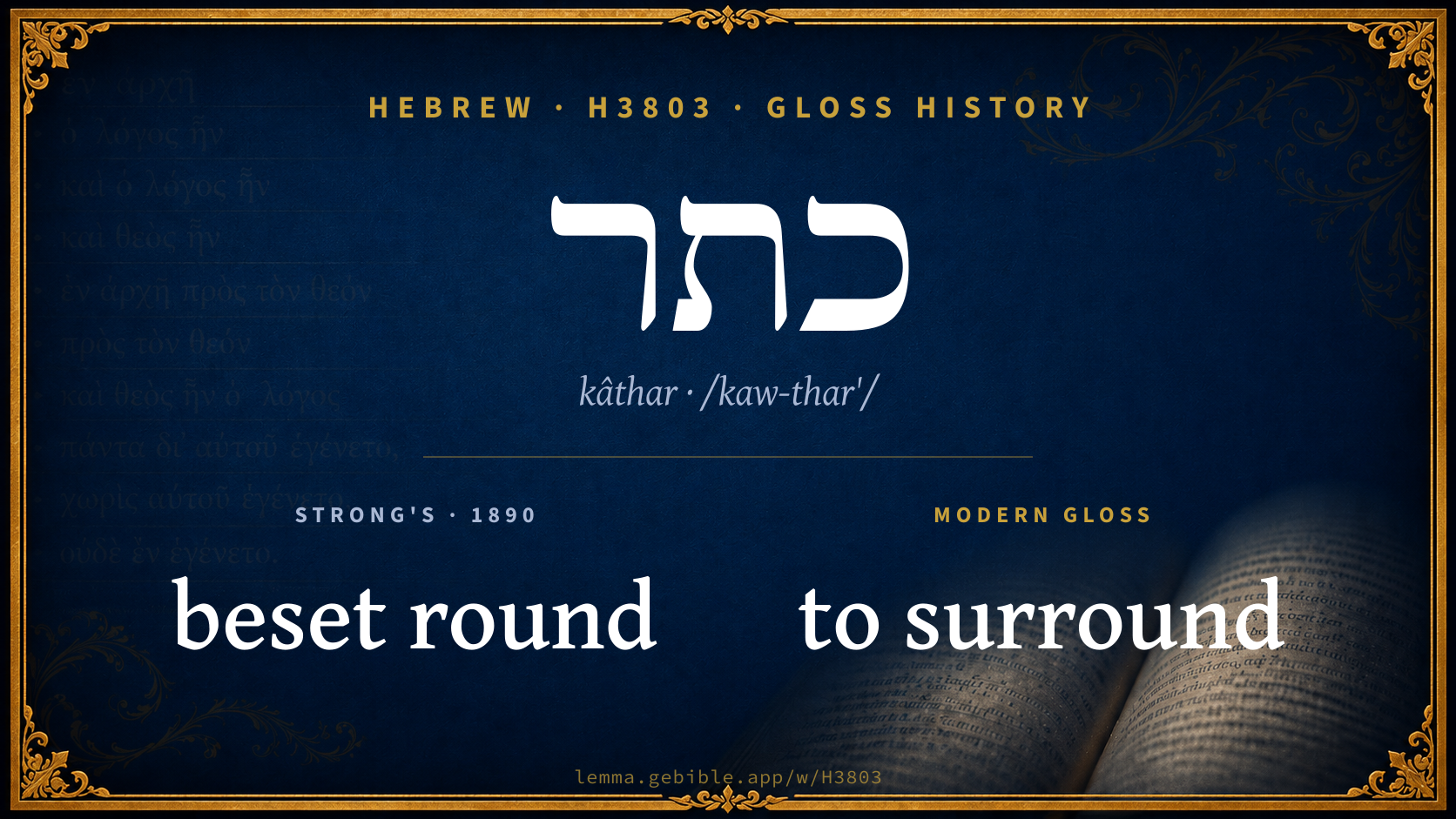
Gloss history
Strong's 1890 vs modern scholarship
About this word
Strong's H3803 catalogs a Hebrew word from the Hebrew Old Testament.
These counts are not copied from any lexicon or concordance. They are computed here, from the morphology-tagged Hebrew Old Testament. What Lemma adds →
- 6
- distinct verses
- The word appears in 6 distinct verses.
- 5 / 39
- OT books
- The word appears in 5 of 39 Old Testament books.
- #3,040
- by frequency
- Top 5000 most frequent Hebrew words (rank 3,040 of 8,640 Hebrew words by occurrence).
View all 6 occurrences in the concordance →
By section of the Old Testament
By traditional corpus
Conventional, traditional groupings — biblical authorship is debated, so this is a traditional corpus grouping, not an authorship claim. Each share is this word’s portion of its verses in that division of the Hebrew canon. Each figure is a share of the word’s 6 distinct verses.
- Writings (Ketuvim) 4 verses · 67%
- Prophets (Nevi'im) 2 verses · 33%
How translations render this word
Counts come from each version’s own published word-to-Strong’s tagging or interlinear alignment — an approximate guide to how each version renders this word, not a word-level alignment the data otherwise carries. Because each total is that version’s own tagged count, the per-version totals vary from one another and need not match the appearance or distinct-verse counts above. These counts may also differ from a printed concordance because Lemma counts each distinctly tagged rendering and does not collapse phrase taggings into a single head-word total. This is a fixed set of word-tagged versions (KJV, ASV, BSB, ULT) and does not change with the reading translation you choose elsewhere. Each version’s license is shown beside its name below (and on Sources).
- King James Version: Are crowned 1×, Doth compass 1×, Have beset me round 1×
- American Standard Version: Are crowned 1×, Doth compass 1×, Have beset me round 1×
- Berean Standard Bible: Are crowned 1×, Bear 1×, Encircle me 1×
- unfoldingWord Literal Text: Be patient 1×, Encircle me 1×, Surrounds 1×
King James Version Public Domain
Renders H3803 across 7 tagged occurrences — most commonly:
American Standard Version Public Domain
Renders H3803 across 7 tagged occurrences — most commonly:
Berean Standard Bible Public Domain
Renders H3803 across 6 tagged occurrences — most commonly:
unfoldingWord Literal Text CC BY-SA 4.0
Renders H3803 across 6 tagged occurrences — most commonly:
Senses in the full BDB
Hebrew verbs can shift meaning by stem (binyan): Qal is the basic action, Niphal is often passive or reflexive, Piel often intensifies or makes it factitive, and Hiphil is typically causative. The senses below are grouped under the stem BDB assigns to each.
What do BDB’s symbols mean?
BDB uses these scholarly abbreviations:
| Symbol | Meaning |
|---|---|
| 𝔊 | the Septuagint (the ancient Greek translation, LXX) |
| 𝔙 | the Vulgate (the Latin translation) |
| 𝔖 | the Syriac version (the Peshitta) |
| 𝔗 | the Targum (the Aramaic translation) |
| ψ | the Psalms |
| √ | root (the underlying root or stem) |
| ‖ | parallel passage (a synonymous or contrasted parallel) |
| † | the dagger: every passage where the word occurs is cited |
The 2 senses and sub-senses the full Brown-Driver-Briggs lexicon distinguishes for this word, in lexicon order (not ranked by frequency), with BDB’s own verbatim wording and sub-sense lettering. Shown in Hebrew script with BDB’s own scholarly abbreviations. The condensed entry is in the Lexicon Entry tab. See also the Forms in the corpus table below.
Piel
- Pf. 3 pl. כִּתְּרוּ Ju 20:43 of surrounding an enemy; sf. כִּתְּרוּנִי ψ 22:13 (in fig.; ‖ סְבָבוּנִי); Imv. כַּתַּר־לִי Jb 36:2 wait, I pray (as in Aramaic) e.g. Judges 20:43
Hiphil
- Impf. 3 mpl. בִּי יַכְתִּרוּ צַדִּיקִים ψ 142:8 dub., throw out crowns (Ges§ 53 g), i.e. appear with crowns (denom. from כֶּתֶר; but this very late—only in Est.); fig. for triumph, because of me; but Gr Che יִתְפָּֽאֲרוּ (v. I. פאר); יַכְתִּרוּ דָ֑עַת Pr 14:18 dub., Thes De al. throw out knowledge as a crown, make knowledge their crown (denom. from כֶּתֶר; but v. supr.), Now, encompass knowledge, i.e. posses it (‖ נָֽחֲלוּ); sense good, but meaning of כ׳ without ‖. Pt. מַכְתִּיר surrounding (as Pi.) Hb 1:4 (c. acc. of enemy). e.g. Psalms 142:8
Senses from the full Brown-Driver-Briggs lexicon (Brown, Driver, Briggs; Oxford 1906 — public domain), digitized via Sefaria, supplemented by the OpenScriptures HebrewLexicon (CC BY 4.0). Full attribution on Sources.
Word origin
vb. surround (in Pi.), (Aramaic כַּתַּר Pa., wait, hope for; ܟܰܬܰܪ Pa. wait, await, remain; i.e. perhaps surround expectantly, v. Jb 36:2 infr.)—
— Brown-Driver-Briggs (Oxford 1906, public domain), digitized via Sefaria, supplemented by the OpenScriptures HebrewLexicon (CC BY 4.0). See Sources.
Origin: a primitive root
Jastrow Dictionary
A second Hebrew/Aramaic lexicon for comparison, covering Aramaic and post-biblical (Talmudic, Targumic, Midrashic) usage that the biblical-Hebrew BDB does not. Matched by lemma rather than by Strong’s number, so a lemma may carry more than one Jastrow headword (shown separately below), and the entries cover usage well beyond the Bible.
כָּתַר
- (b. h.) to knot, tie, join closely.—Denom. כֶּתֶר, כּוֹתֶרֶת.
- (denom. of כֶּתֶר) to tie a wreath, to offer a crown. Lev. R. s. 24 העליונים מַכְתִּירִין להקב"ה וכ׳ the angels wreathe three ‘holies’ to the Lord (Is. VI, 3); Yalk. ib. 603 העליונים מַכְתִּירִים לפני וכ׳; Yalk. Is. 272 מה"ש מכתירין ג׳ קדושות.—Erub. 53ᵇ (in enigmatic speech) נתייעץ במַכְתַּיר he took counsel with the crown-maker (him who ordains the scholars, the Nasi).—[Tanḥ. Ki Thissa 6 שהכתיר, read: שהבחיר, as Pesik. Shek., p. 15ᵇ.]—Part. pass. מוּכְתָּר adorned, distinguished. Meg. 12ᵇ (in being called Jehudi, Esth. II, 5) מרדכי מ׳ בנימוסו היה (כעדי) (v. Rabb. D. S. a. l. note 300) Mordecai was intended to be described as adorned with his faith (as with an ornament), i.e. Jehudi is meant not as a gentile noun but as an epithet of religious devotion (than whom no better Jew was found). e.g. Isaiah 6:3
כְּתַר
- Pa. כַּתֵּר (preced.) [to turn around, cmp. יָחַל,] to wait upon, hope for. Targ. Job XXXVI, 2 Bxt. (ed. אמתין). Targ. Is. XLII, 4 (h. text יחל). Ib. LI, 5 יִכְתְּרוּן ed. Wil. (oth. ed. יַכְתִּי׳, Af.).
- same, v. supra.—Part. pass. מַכְתַּר made to wait, dependent upon. Targ. Mic. V, 6 (h. text יְיַחֵל).
כֶּתֶר
- preced.) garland, crown. Ḥull. 60ᵇ the Moon said אפשר … בכ׳ אחד is it possible for two kings to use the same crown (to occupy an equal rank)? Ex. R. s. 1 כִּתְרוֹ של פרעה Pharaoh’s crown. Sabb. 104ᵃ (play on letters כ̇ ל̇) וקושר לך כ̇' ל̇עוה"ב and he will wreathe a crown for thee in the world to come; a. fr.—Pl. כְּתָרִים. Ab. IV, 13 שלשה כ׳ הן … על גביהין there are three crowns, the crown of the Law (learning) …, but the crown of a good name rises above all of them. Sabb. 88ᵃ; a. fr.—Ib. 89ᵃ; Men. 29ᵇ קושר כ׳ לאותיות providing certain letters with crownlets (v. זִיּוּן).
כְּתַר ²
- Targ. Is. LXII, 3. Targ. Jer. XLVIII, 9; a. e.—Pl. כִּתְרַיָּא. Targ. Is. III, 23 (ed. Wil. כִּתָּרַיָּא).
A Dictionary of the Targumim, the Talmud Babli and Yerushalmi, and the Midrashic Literature (Marcus Jastrow; London, Luzac, 1903) — Public Domain. Digitized via Sefaria. Digitized via Sefaria. Full attribution on Sources.
Forms in the corpus
The 6 distinct written forms H3803 takes in the Hebrew Bible, most frequent first — each parse links to that stem’s occurrences in the concordance. Hebrew forms include their vowel points and cantillation, so a single lemma takes many written forms.
| Form | Parsing | Example | Uses |
|---|---|---|---|
| יַכְתִּ֣רוּ | Verb, Hiphil, Imperfect, 3rd Person, Masculine, Plural | Psalms 142:7 | 1 |
| יַכְתִּ֥רוּ | Verb, Hiphil, Imperfect, 3rd Person, Masculine, Plural | Proverbs 14:18 | 1 |
| כִּתְּר֤וּ | Verb, Piel, Perfect, 3rd Person, Common, Plural | Judges 20:43 | 1 |
| כִּתְּרֽוּ/נִי | Verb, Piel, Perfect, 3rd Person, Common, Plural | Psalms 22:12 | 1 |
| כַּתַּר | Verb, Piel, Imperative, 2nd Person, Masculine, Singular | Job 36:2 | 1 |
| מַכְתִּ֣יר | Verb, Hiphil, Participle Active, Masculine, Singular, Absolute | Habakkuk 1:4 | 1 |
Same root — word family
Other BDB entries built from the same root as H3803, grouped by Strong’s listed origin. These share a root / origin per the lexicon — not necessarily a shared meaning. Each links to that word’s own entry.
Derived from this word
Compare all same-root words → They share a root, not necessarily a meaning.
Septuagint verse parallels
This word appears in 5 verses that also exist in the Greek Old Testament (Septuagint), out of the 6 Hebrew verses it occurs in. You can read those verses in Greek by switching the Old Testament edition to the Septuagint.
Read these verses in the Septuagint
This is a verse-level parallel only — the same verses exist in both the Hebrew and Greek Old Testaments. No word-level Hebrew↔Greek correspondence is claimed: the data carries no such alignment, so no Greek word is shown as this Hebrew word’s translation. Coverage is not total — the Septuagint omits the deuterocanon and renumbers the Psalms, so some Hebrew verses have no direct Greek parallel.