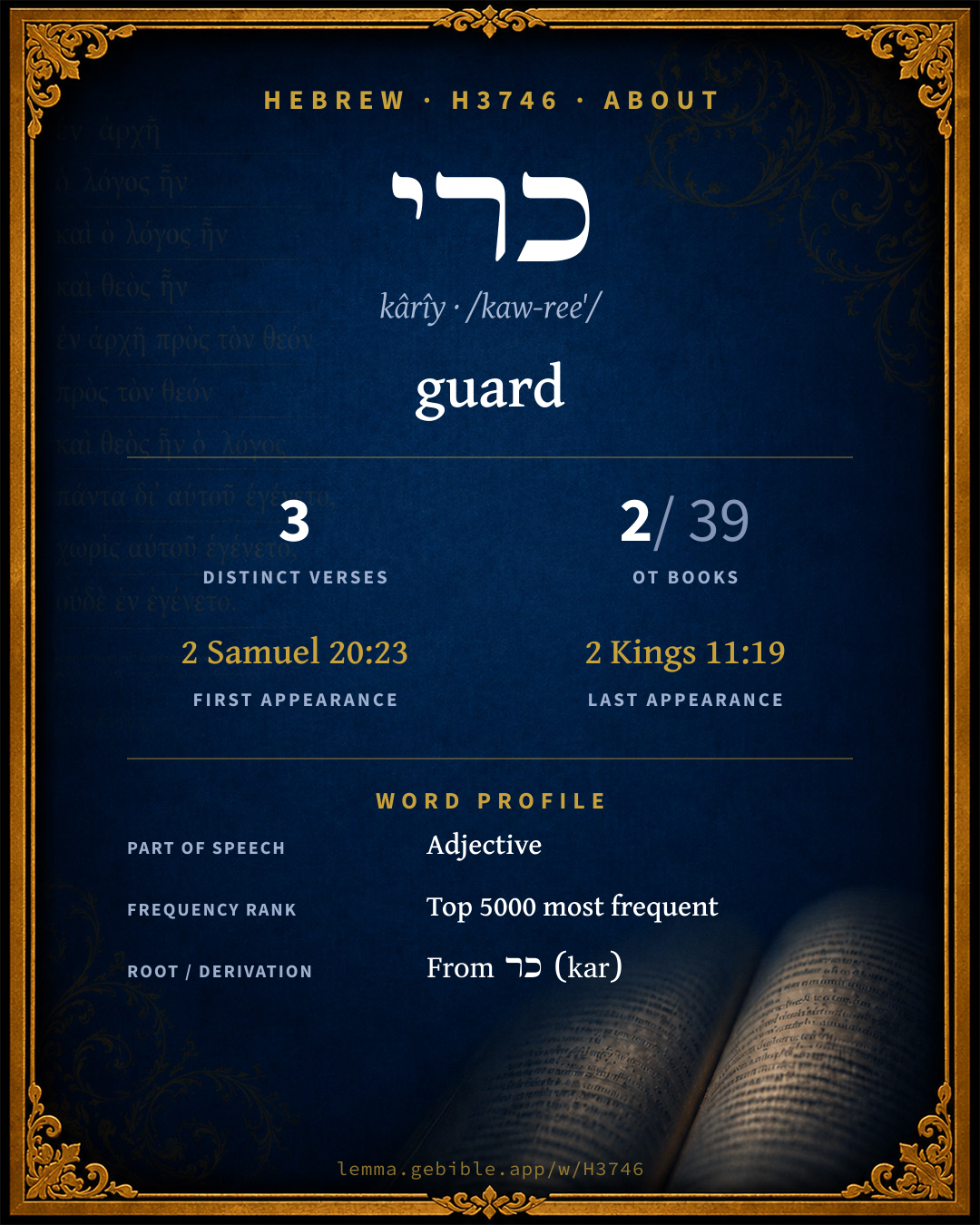
כָּרִי
guard
Full lexicon entry — Brown-Driver-Briggs (BDB)
From Brown-Driver-Briggs (BDB)
Where this word appears
Grammar key — what these labels mean
Noun type
- Gentilic
- A noun naming a member of a people, tribe, or region of origin (e.g. an Israelite, a Moabite).
- Proper
- A name of a specific person, place, or people (e.g. Abraham, Zion, Israel).
State
- Absolute
- The independent form of a noun, not bound to a following word.
Gender
- Masculine
- Grammatically masculine.
Number
- Singular
- One.
Every verse where H3746 appears in the Book of 2 Samuel — 1 distinct verse. Click any verse to open its interlinear word-by-word view. Verse text shown in the World English Bible for context — . Each verse’s Hebrew form is shown with its reference; the English is not keyword-highlighted, since the data carries no word-level English alignment. Use “Compare translations” on any verse to read it across multiple English versions. This concordance covers the Hebrew Bible; Septuagint (Greek Old Testament) occurrences are not indexed here.
2 Samuel
About this entry
At a glance — auto-summarized from this page’s data, not written by a person. Every figure links to its source below. This summary describes the numbers; it doesn’t interpret them.
At its core, כרי (kârîy) means “guard.” It occurs a mere 3 verses across Scripture. The word gravitates to 2 Kings (67%), then 2 Samuel. Scripture first uses it in 2 Samuel 20:23. It shares a root with כר and כרה. Dig into 3-verse concordance and the renderings breakdown below.
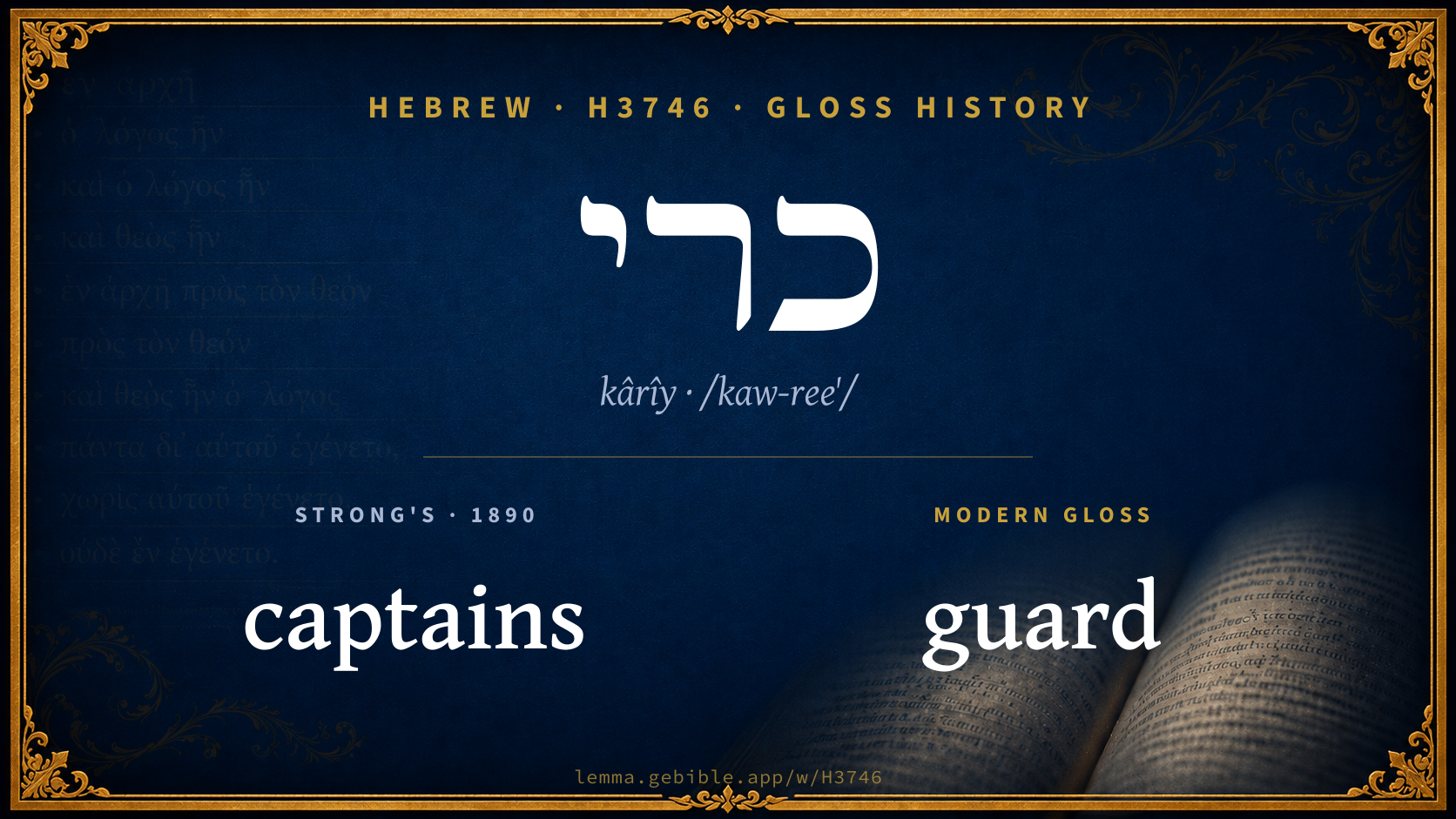
Gloss history
Strong's 1890 vs modern scholarship
About this word
Strong's H3746 catalogs a Hebrew word from the Hebrew Old Testament.
These counts are not copied from any lexicon or concordance. They are computed here, from the morphology-tagged Hebrew Old Testament. What Lemma adds →
- 3
- distinct verses
- The word appears in 3 distinct verses.
- 2 / 39
- OT books
- The word appears in 2 of 39 Old Testament books.
- #4,179
- by frequency
- Top 5000 most frequent Hebrew words (rank 4,179 of 8,640 Hebrew words by occurrence).
View all 3 occurrences in the concordance →
By traditional corpus
Conventional, traditional groupings — biblical authorship is debated, so this is a traditional corpus grouping, not an authorship claim. Each share is this word’s portion of its verses in that division of the Hebrew canon. Each figure is a share of the word’s 3 distinct verses.
- Prophets (Nevi'im) 3 verses · 100%
How translations render this word
Counts come from each version’s own published word-to-Strong’s tagging or interlinear alignment — an approximate guide to how each version renders this word, not a word-level alignment the data otherwise carries. Because each total is that version’s own tagged count, the per-version totals vary from one another and need not match the appearance or distinct-verse counts above. These counts may also differ from a printed concordance because Lemma counts each distinctly tagged rendering and does not collapse phrase taggings into a single head-word total. This is a fixed set of word-tagged versions (KJV, ASV, BSB, ULT) and does not change with the reading translation you choose elsewhere. Each version’s license is shown beside its name below (and on Sources).
- King James Version: Captains 2×
- American Standard Version: Captains 2×, Carites 2×
- Berean Standard Bible: Carites 2×
- unfoldingWord Literal Text: Carite 2×
King James Version Public Domain
Renders H3746 across 2 tagged occurrences — most commonly:
Not rendered by a distinct English word in 1 further occurrence.
American Standard Version Public Domain
Renders H3746 across 4 tagged occurrences — most commonly:
Berean Standard Bible Public Domain
Renders H3746 across 3 tagged occurrences — most commonly:
Plus 1 rendering that appears only once — usually multi-word phrases or single function words the recovered tagging swept in, not distinct renderings.
unfoldingWord Literal Text CC BY-SA 4.0
Renders H3746 across 2 tagged occurrences — most commonly:
Senses in BDB
The 1 sense BDB distinguishes for this word, in lexicon order (not ranked by frequency or importance). The full entry — with sub-senses — is in the Lexicon Entry tab.
- a group of foreign mercenary soldiers serving as a bodyguard for king David; also executioners
Word origin
כָּרִי adj.gent. prob. = Carian, only c. art. as subst. coll. Carians, name given to foreign body-guard of king
— Brown-Driver-Briggs (Oxford 1906, public domain), digitized via Sefaria, supplemented by the OpenScriptures HebrewLexicon (CC BY 4.0). See Sources.
Derived from כר (kar) (H3733) — howdah.
Jastrow Dictionary
A second Hebrew/Aramaic lexicon for comparison, covering Aramaic and post-biblical (Talmudic, Targumic, Midrashic) usage that the biblical-Hebrew BDB does not. Matched by lemma rather than by Strong’s number, so a lemma may carry more than one Jastrow headword (shown separately below), and the entries cover usage well beyond the Bible.
כרי
- (b. h.) [to round, heap, cave,]
- 1. to dig. Mekh. Mishp., N’zikin, s. 11 כּוֹרֶה מנין how am I to know that he who digs a pit is responsible?—B. Kam. 51ᵃ כורה אחר כורה one who digs after another one, i.e. who completes the pit to its legal size. Succ. 53ᵃ; Macc. 11ᵃ בשעה שכ׳ דוד וכ׳ when David dug for the foundations; a. fr.—Part. pass. כָּרוּי, f. כְּרוּיָה hollowed out. Kel. III, 5, a. e., v. חִידּוּק a. בָּרָה.
- 2. to sit in a circle, v. infra.
- 1. to heap, pile. Gen. R. s. 100 (ref. to כריתי, Gen. L, 5) הרבה ממון תַּכְרֶה עליה much money shalt thou pile up (give me) for it (the grave); (some ed. הכרה Jacob piled up in settling with Esau). Ib. הִכְרֵתִי (corr. הִכְרֵיתִי); v. כְּרִי; Pesik. R. s. 1 וכל ממון שהיה לו ה׳ וכ׳ (not מסר לו) and he (Jacob) piled up whatever money he had to place it before Esau &c. e.g. Genesis 50:5
- 2. to invite to a banquet;
- 3. (with play on כרת) to excise, to destroy. Snh. 20ᵃ; Yalk. Sam. 142 (ref. to להברות, II Sam. III, 35, where Raba had before him a K’thib. להכרות) כתיב להכרות … בתחלה להַכְרוֹתוֹ וכ׳ it is written l’hakhroth (to entertain) and read l’habroth (v. בָּרָה): originally they came with the intention of destroying him (for the murder of Abner), and finally (when convinced of his innocence) they came to comfort him; [Yalk. Ms. to Sam. l. c., quoted in Rabb. D. S. Snh. l. c. note 9: כתיב לִבְרוֹת וקרינן להַבְרוֹת בתחלה לברות וכ׳ it is written libroth (to pierce, cmp. Ez. XXIII, 47), and we read l’habroth &c.]. e.g. 2 Samuel 3:35
כְּרֵי
- , to dig, bore. Targ. O. Ex. XXI, 33 יִכְרֵי ed. Berl. (oth. ed. יִכְרֶה). Targ. Ps. XL, 7; a. e.—B. Kam. 51ᵃ אמרי ליה זיל כְּרֵי לן ואזל כְּרָא להו (some ed. כָּרָה hebr.) they said to him, go and dig for us, and he went and dug &c. Ib. 48ᵃ כמאן דכַרְיֵיה דמי he is as responsible as if he had dug it. Succ. 53ᵇ בְּרִינָן פורתא וכ׳ we bore only a little and there comes water; a. e.—*Taan. 24ᵃ דהוה כָּרֵיא בהוצא that he was boring a hole in the fence (v. Rabb. D. S. a. l. note for Var. lect.).—[כרי to be narrow, distressed, part. כְּרִי, כַּרְיָא, pl. כְּרִין, v. כְּרַהּ]
כְּרִי
- (preced.) heap, pile. Ex. R. s. 31 (ref. to כריתי, Gen. L, 5, v. כָּרָה) נטל … ועשה אותו כ׳ he (Jacob) took all the money he possessed and made a pile of it; כ׳ של דינרין וכ׳ a pile of denars have I given to Esau. Tosef. Ter. III, 17. Ter. III, 5. Y. ib. I, 40ᵇ bot. הבקיר כֶּרְיוֹ (not כריי) if a man renounced possession of his pile (store) of grain. Ib. IV, 42ᵈ top לפטור את כִּירְיוֹ to discharge the duty of T’rumah for his entire store. Y. Gitt. VII, 48ᶜ bot. תרם את כִּירְייוֹ if he gave T’rumah for his store; a. fr.—Pl. כְּרָיִים. Y. Shek. III, end, 47ᶜ אילו שני כ׳ וכ׳ if it were a case of two piles for which a person had discharged T’rumah &c. e.g. Genesis 50:5
A Dictionary of the Targumim, the Talmud Babli and Yerushalmi, and the Midrashic Literature (Marcus Jastrow; London, Luzac, 1903) — Public Domain. Digitized via Sefaria. Digitized via Sefaria. Full attribution on Sources.
Forms in the corpus
The 3 distinct written forms H3746 takes in the Hebrew Bible, most frequent first — each parse links to that state’s occurrences in the concordance. Hebrew forms include their vowel points and cantillation, so a single lemma takes many written forms.
| Form | Parsing | Example | Uses |
|---|---|---|---|
| ה/כרי | Noun, Gentilic, Masculine, Singular, Absolute | 2 Samuel 20:23 | 1 |
| הַ/כָּרִ֨י | Noun, Proper | 2 Kings 11:19 | 1 |
| לַ/כָּרִי֙ | Noun, Gentilic, Masculine, Singular, Absolute | 2 Kings 11:4 | 1 |
Same root — word family
Other BDB entries built from the same root as H3746, grouped by Strong’s listed origin. These share a root / origin per the lexicon — not necessarily a shared meaning. Each links to that word’s own entry.
Derives from
Shares the same root
Compare all same-root words → They share a root, not necessarily a meaning.
Septuagint verse parallels
This word appears in 3 verses that also exist in the Greek Old Testament (Septuagint), out of the 3 Hebrew verses it occurs in. You can read those verses in Greek by switching the Old Testament edition to the Septuagint.
Read these verses in the Septuagint
This is a verse-level parallel only — the same verses exist in both the Hebrew and Greek Old Testaments. No word-level Hebrew↔Greek correspondence is claimed: the data carries no such alignment, so no Greek word is shown as this Hebrew word’s translation. Coverage is not total — the Septuagint omits the deuterocanon and renumbers the Psalms, so some Hebrew verses have no direct Greek parallel.