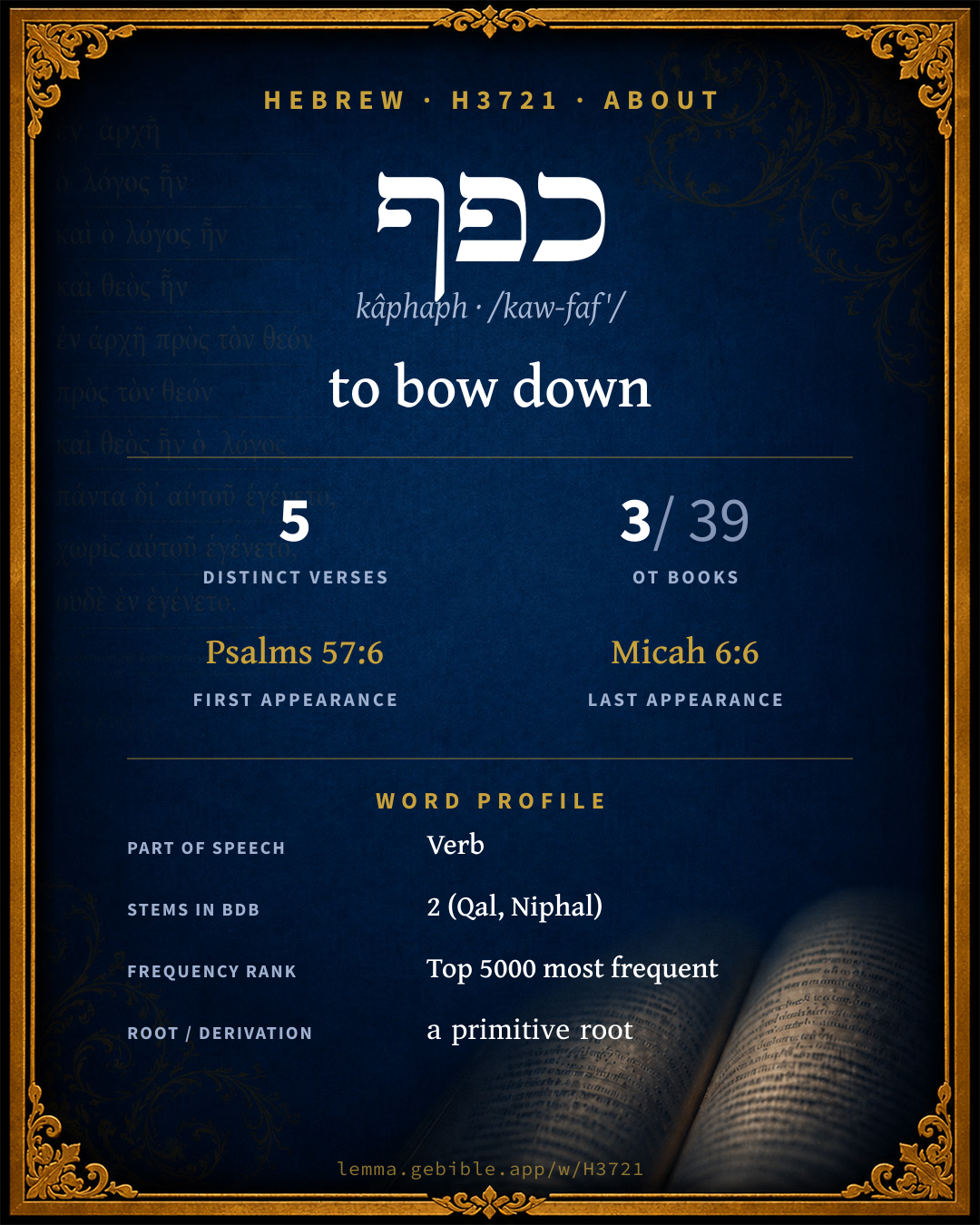
כָּפַף
to bow down
‘to bow down’ is one of 3 main senses fuller range ↓
Full lexicon entry — Brown-Driver-Briggs (BDB)
From Brown-Driver-Briggs (BDB)
Where this word appears
See every Qal verb in the Hebrew Bible →
Grammar key — what these labels mean
Part of speech
- Verb
- An action or state-of-being word.
Stem
- Qal
- The basic, simple active stem — the plain form of the verb (“he wrote”).
- Niphal
- Usually the simple passive or reflexive of the Qal (“he was written”).
Form
- Participle Passive
- A verbal adjective expressing action received (“written”).
- Infinitive Construct
- A bound verbal noun, frequently with prepositions (“to write / in writing”).
- Imperfect
- An incomplete, ongoing, or future action (“he will / would write”).
- Perfect
- A completed action or state — Hebrew marks aspect (completeness) more than strict tense (“he wrote”).
State
- Absolute
- The independent form of a noun, not bound to a following word.
Person
- 1st Person
- The speaker (“I / we”).
- 3rd Person
- The one spoken about (“he / she / it / they”).
Gender
- Masculine
- Grammatically masculine.
- Common
- Either gender — not distinguished for this form.
Number
- Plural
- More than one (in Hebrew, generally three or more).
- Singular
- One.
1 distinct verse where H3721 appears in the Niphal stem, across 1 book. Filtered view — show all forms. Click any verse to open its interlinear word-by-word view. Verse text shown in the World English Bible for context — . Each verse’s Hebrew form is shown with its reference; the English is not keyword-highlighted, since the data carries no word-level English alignment. Use “Compare translations” on any verse to read it across multiple English versions. This concordance covers the Hebrew Bible; Septuagint (Greek Old Testament) occurrences are not indexed here.
Micah 1 verse
About this entry
At a glance — auto-summarized from this page’s data, not written by a person. Every figure links to its source below. This summary describes the numbers; it doesn’t interpret them.
“to bow down” is the headline sense of the Hebrew verb כפף (kâphaph). It occurs a mere 5 verses across Scripture. More than half of its appearances fall in Psalms. First canonically at Psalms 57:6, it enters the text early. The verb spans 2 stems, from Qal to Niphal. See the sense tree, 5-verse concordance, and the renderings breakdown below.
Gloss history
Strong's 1890 vs modern scholarship
About this word
Strong's H3721 catalogs a Hebrew word from the Hebrew Old Testament.
These counts are not copied from any lexicon or concordance. They are computed here, from the morphology-tagged Hebrew Old Testament. What Lemma adds →
- 5
- distinct verses
- The word appears in 5 distinct verses.
- 3 / 39
- OT books
- The word appears in 3 of 39 Old Testament books.
- #3,337
- by frequency
- Top 5000 most frequent Hebrew words (rank 3,337 of 8,640 Hebrew words by occurrence).
View all 5 occurrences in the concordance →
By section of the Old Testament
By traditional corpus
Conventional, traditional groupings — biblical authorship is debated, so this is a traditional corpus grouping, not an authorship claim. Each share is this word’s portion of its verses in that division of the Hebrew canon. Each figure is a share of the word’s 5 distinct verses.
- Writings (Ketuvim) 3 verses · 60%
- Prophets (Nevi'im) 2 verses · 40%
How translations render this word
Counts come from each version’s own published word-to-Strong’s tagging or interlinear alignment — an approximate guide to how each version renders this word, not a word-level alignment the data otherwise carries. Because each total is that version’s own tagged count, the per-version totals vary from one another and need not match the appearance or distinct-verse counts above. These counts may also differ from a printed concordance because Lemma counts each distinctly tagged rendering and does not collapse phrase taggings into a single head-word total. This is a fixed set of word-tagged versions (KJV, ASV, BSB, ULT) and does not change with the reading translation you choose elsewhere. Each version’s license is shown beside its name below (and on Sources).
- King James Version: All those that be bowed down 1×, Are bowed down 1×, Bow 1×
- American Standard Version: All those that are bowed down 1×, Bow 1×, Is bowed down 1×
- Berean Standard Bible: Are bowed down 1×, Are weighed down 1×, Bow 1×
- unfoldingWord Literal Text: Bow 1×, Bow down 1×, Bows down 1×
King James Version Public Domain
Renders H3721 across 5 tagged occurrences — most commonly:
American Standard Version Public Domain
Renders H3721 across 5 tagged occurrences — most commonly:
Berean Standard Bible Public Domain
Renders H3721 across 5 tagged occurrences — most commonly:
unfoldingWord Literal Text CC BY-SA 4.0
Renders H3721 across 5 tagged occurrences — most commonly:
Senses in the full BDB
Hebrew verbs can shift meaning by stem (binyan): Qal is the basic action, Niphal is often passive or reflexive, Piel often intensifies or makes it factitive, and Hiphil is typically causative. The senses below are grouped under the stem BDB assigns to each.
What do BDB’s symbols mean?
BDB uses these scholarly abbreviations:
| Symbol | Meaning |
|---|---|
| 𝔊 | the Septuagint (the ancient Greek translation, LXX) |
| 𝔙 | the Vulgate (the Latin translation) |
| 𝔖 | the Syriac version (the Peshitta) |
| 𝔗 | the Targum (the Aramaic translation) |
| ψ | the Psalms |
| √ | root (the underlying root or stem) |
| ‖ | parallel passage (a synonymous or contrasted parallel) |
| † | the dagger: every passage where the word occurs is cited |
The 2 senses and sub-senses the full Brown-Driver-Briggs lexicon distinguishes for this word, in lexicon order (not ranked by frequency), with BDB’s own verbatim wording and sub-sense lettering. Shown in Hebrew script with BDB’s own scholarly abbreviations. The condensed entry is in the Lexicon Entry tab. See also the Forms in the corpus table below.
Qal
- Pf. כ׳ נַפְשִׁי ψ 57:7 my soul is bowed down; Inf. cstr. (trans.) לָכֹף כְּאַגְמֹן רֹאשׁוֹ Is 58:5 to bend down, like a rush, his head. Pt. pass. (הַ)כְּפוּפִים those bowed down, in distress, humiliation, etc., ψ 145:14; 146:8. e.g. Psalms 57:7
Niphal
- Impf. 1 s. אִכַּף לֵאלֹהֵי מָרוֹם Mi 6:6 with what shall I bow myself (in worship) toward the high God? e.g. Micah 6:6
Senses from the full Brown-Driver-Briggs lexicon (Brown, Driver, Briggs; Oxford 1906 — public domain), digitized via Sefaria, supplemented by the OpenScriptures HebrewLexicon (CC BY 4.0). Full attribution on Sources.
Word origin
vb. bend, bend down, be bent, bowed (NH bend, overturn, Assyrian kapâpu, bend, bow, DlHWB 347; Arabic كَفَّ fell a seam, also turn back, avert, كُفَّةٌ selvage, كِفَافٌ circuit, rim; Aramaic כְּפַף, ܟܰܦ bend, curve; Palm. כפתא niche, from כפף curve according to VogNo. 70, p. 50);—
— Brown-Driver-Briggs (Oxford 1906, public domain), digitized via Sefaria, supplemented by the OpenScriptures HebrewLexicon (CC BY 4.0). See Sources.
Origin: a primitive root
Jastrow Dictionary
A second Hebrew/Aramaic lexicon for comparison, covering Aramaic and post-biblical (Talmudic, Targumic, Midrashic) usage that the biblical-Hebrew BDB does not. Matched by lemma rather than by Strong’s number, so a lemma may carry more than one Jastrow headword (shown separately below), and the entries cover usage well beyond the Bible.
כָּפַף
- (b. h.)
- 1. to bend, curve. Gen. R. s. 87, end כּוֹפֶפֶת אני את קומתך … כְּפוּפִים (Potiphar’s wife said to Joseph) I shall bend thy proud stature (humiliate thee with slave labor); said he, The Lord erects those who are bowed down. B. Kam. 55ᵇ הכּוֹפֵף … בפני וכ׳ he who bends his neighbor’s grain stalks before the fire (so as to make them catch fire). Num. R. s. 6, beg. נביא כופף ידיו וכ׳ the prophet must bend his hands and feet to sit before (surrender his power to) the high priest; (Y. Hor. III, 48ᵇ bot. מְכַפֵּת). Cant. R. beg. לָכוֹף אזניך וכ׳ to bend thy ear and listen; a. fr.—Part. pass. כָּפוּף, f. כְּפוּפָה, pl. כְּפוּפִים, כְּפוּפִין; כְּפוּפוֹת. Sabb. 17ᵃ היה הלל כ׳ ויושב וכ׳ Hillel sat bent (in submission) before Shammai. Gen. R. l. c., v. supra. R. Hash. III, 4 בשל זכרים כ׳ with bent horns of rams. Yalk. Ex. 276 דווים וכ׳ suffering and humbled (v. סָגַף, סָחַף); a. fr.—Esp. the curved letters כ, נ, פ, צ, opp. פשוט the straight-lined, the shape of the final letters. Sabb. 104ᵃ (symbolization of letters) נו"ן כ׳ … נ̇אמן כ׳ וכ׳ Nun bent, Nun straightened, faithful when bent (in distress), faithful when straightened (raised up) &c. Ib. 103ᵇ כ׳ פשוטין וכ׳ that one must not write the curved letters straightened &c.
- 2. to bend, force, conquer. Y. Snh. I, 18ᵃ bot. מומחה שכ׳ ודן an authorized judge that forced (the law requiring three judges) and judged singly. Y. Yeb. XII, 12ᶜ ר׳ יצחק כ׳ R. J. forced (the law requiring three judges for ḥălitsah); ib. הא רבן כ׳ it was our teacher who did it. Keth. 4ᵇ אין לָכוֹף וכ׳ … no husband dares force his wife (in mourning) to paint &c. Num. R. s. 14 (play on כף) זה אברהם שכַּף את יצרו וכ׳ (some ed. שכפף) that refers to Abraham who conquered his inclinations &c.
- 3. to invert, upset. Y. Ber. III, 6ᵃ top גרמתני לכוֹפְפָהּ thou didst cause me to upset it (the divine image), v. כָּפָה; (M. Kat. 15ᵇ ובעונותיכם הפכתיה). Y. l. c. מטות כְּפוּפוֹת = כְּפוּיוֹת, v. כָּפָה; a. fr.—[Num. R. s. 10 כפפתו אימו, read כפתתו, v. כָּפַת.—Sabb. 106ᵃ הסיט כפוף Ar., ed. כָּפוּל, v. סיט.]
- 4. to bend one’s self upon, to take pains (cmp. כְּפַל). Cant. R. to I, 17 כפפתי לעקור וכ׳ I took pains to destroy the passion for idolatry.
- to be bent. Pesik. R. s. 28 [read:] עד שנִכְפְּפָה קומתם וכ׳ so that their statures were bent under their load. Arakh. 19ᵃ שרביט שאינו נכפף a staff (of gold or silver) which cannot be bent. Num. R. s. 5, end נִכְפְּפָה היריעה וכ׳ the curtain around the Ark was bent aside (prob. to be read נכפלה). B. Kam. 61ᵃ בנִכְפֶּפֶת when the fire is diverted from its course through the wind; (oth. opin.: when the fire is subdued (low) and creeping over the plants on the ground), opp. קולחת or קודחת. Cant. R. to I, 17. Pesik. R. s. 14 שתי השערות נִכְפָּפוֹת (not … פים) the two hairs (on the neck) are bent, opp. נזקפות; a. e.
כְּפַף
- , ch. same,
- 1. to bend. Targ. Job XL, 17, v. כְּפַן I. Targ. Ez. XVII, 7 כָּפַת (h. text כפנה, v. כָּפַן). Targ. II Esth. I, 5 כַּף אילנא וכ׳ bent tree to tree and made arches. Targ. Is. LVIII, 5; a. e.—Part. pass. כָּפִיף, f. כְּפִיפָא, pl. כְּפִיפִין. Ib.—Targ. II Esth. V, 1. Targ. Is. LX, 14.
- 2. to invert. M. Kat. 25ᵃ כף כדא וכ׳ inverted a pitcher on the ground and placed thereon &c.
- same. Targ. Ezek. XVII, 6. Ib. 7 כַּפַּת some ed., v. supra.
A Dictionary of the Targumim, the Talmud Babli and Yerushalmi, and the Midrashic Literature (Marcus Jastrow; London, Luzac, 1903) — Public Domain. Digitized via Sefaria. Digitized via Sefaria. Full attribution on Sources.
Forms in the corpus
The 5 distinct written forms H3721 takes in the Hebrew Bible, most frequent first — each parse links to that stem’s occurrences in the concordance. Hebrew forms include their vowel points and cantillation, so a single lemma takes many written forms.
| Form | Parsing | Example | Uses |
|---|---|---|---|
| אִכַּ֖ף | Verb, Niphal, Imperfect, 1st Person, Common, Singular | Micah 6:6 | 1 |
| הֲ/לָ/כֹ֨ף | Verb, Qal, Infinitive Construct | Isaiah 58:5 | 1 |
| הַ/כְּפוּפִֽים | Verb, Qal, Participle Passive, Masculine, Plural, Absolute | Psalms 145:14 | 1 |
| כְּפוּפִ֑ים | Verb, Qal, Participle Passive, Masculine, Plural, Absolute | Psalms 146:8 | 1 |
| כָּפַ֪ף | Verb, Qal, Perfect, 3rd Person, Masculine, Singular | Psalms 57:6 | 1 |
Same root — word family
Other BDB entries built from the same root as H3721, grouped by Strong’s listed origin. These share a root / origin per the lexicon — not necessarily a shared meaning. Each links to that word’s own entry.
Derived from this word
Compare all same-root words → They share a root, not necessarily a meaning.
Septuagint verse parallels
This word appears in 4 verses that also exist in the Greek Old Testament (Septuagint), out of the 5 Hebrew verses it occurs in. You can read those verses in Greek by switching the Old Testament edition to the Septuagint.
Read these verses in the Septuagint
This is a verse-level parallel only — the same verses exist in both the Hebrew and Greek Old Testaments. No word-level Hebrew↔Greek correspondence is claimed: the data carries no such alignment, so no Greek word is shown as this Hebrew word’s translation. Coverage is not total — the Septuagint omits the deuterocanon and renumbers the Psalms, so some Hebrew verses have no direct Greek parallel.