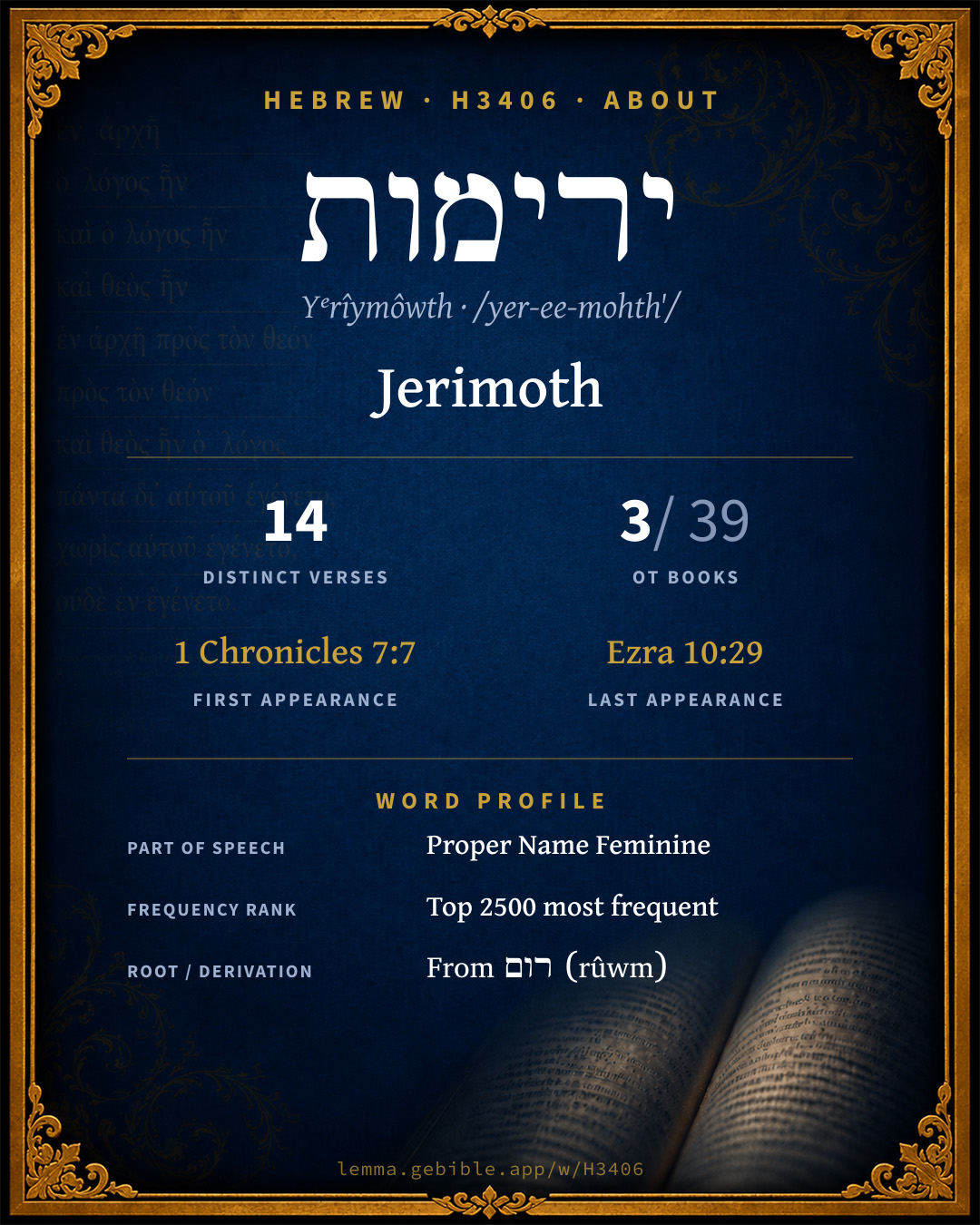
יְרֵימוֹת
Jerimoth
BDB lists 10 entries for ‘Jerimoth’ fuller range ↓
Full lexicon entry — Brown-Driver-Briggs (BDB)
From Brown-Driver-Briggs (BDB)
Where this word appears
Grammar key — what these labels mean
Part of speech
- Noun
- A naming word — a person, place, thing, or idea.
Noun type
- Proper
- A name of a specific person, place, or people (e.g. Abraham, Zion, Israel).
Every verse where H3406 appears in the Book of 1 Chronicles — 9 distinct verses. Click any verse to open its interlinear word-by-word view. Verse text shown in the World English Bible for context — . Each verse’s Hebrew form is shown with its reference; the English is not keyword-highlighted, since the data carries no word-level English alignment. Use “Compare translations” on any verse to read it across multiple English versions. This concordance covers the Hebrew Bible; Septuagint (Greek Old Testament) occurrences are not indexed here.
1 Chronicles
- 1 Chronicles 7:7 וִ/ירִימ֨וֹת conj + n Proper The sons of Bela: Ezbon, and Uzzi, and Uzziel, and Jerimoth, and Iri, five; heads of fathers' houses, mighty men of valor; and they were reckoned by genealogy twenty-two thousand thirty-four.
- 1 Chronicles 7:8 וִ/ירֵמ֣וֹת conj + n Proper The sons of Becher: Zemirah, and Joash, and Eliezer, and Elioenai, and Omri, and Jeremoth, and Abijah, and Anathoth, and Alemeth. All these were the sons of Becher.
- 1 Chronicles 8:14 וִ/ירֵמֽוֹת conj + n Proper and Ahio, Shashak, and Jeremoth,
- 1 Chronicles 12:5 וִ/ירִימוֹת֙ conj + n Proper Eluzai, and Jerimoth, and Bealiah, and Shemariah, and Shephatiah the Haruphite,
- 1 Chronicles 23:23 וִ/ירֵמ֖וֹת conj + n Proper The sons of Mushi: Mahli, and Eder, and Jeremoth, three.
- 1 Chronicles 24:30 וִ/ירִימ֑וֹת conj + n Proper The sons of Mushi: Mahli, and Eder, and Jerimoth. These were the sons of the Levites after their fathers' houses.
- 1 Chronicles 25:4 וִֽ/ירִימ֜וֹת conj + n Proper Of Heman; the sons of Heman: Bukkiah, Mattaniah, Uzziel, Shebuel, and Jerimoth, Hananiah, Hanani, Eliathah, Giddalti, and Romamti-ezer, Joshbekashah, Mallothi, Hothir, Mahazioth.
- 1 Chronicles 25:22 לִֽ/ירֵמ֔וֹת prep + n Proper for the fifteenth to Jeremoth, his sons and his brothers, twelve:
- 1 Chronicles 27:19 יְרִימ֖וֹת n Proper of Zebulun, Ishmaiah the son of Obadiah: of Naphtali, Jeremoth the son of Azriel:
About this entry
At a glance — auto-summarized from this page’s data, not written by a person. Every figure links to its source below. This summary describes the numbers; it doesn’t interpret them.
The Hebrew name ירימות centers on the idea of “Jerimoth.” The word gravitates to 1 Chronicles (64%), then Ezra and 2 Chronicles. It appears 14 verses across 3 books of the Hebrew Bible, among its uncommon vocabulary. Debuting at 1 Chronicles 7:7, it then recurs through the corpus. For the data behind this summary, explore 14-verse concordance and the renderings breakdown below.
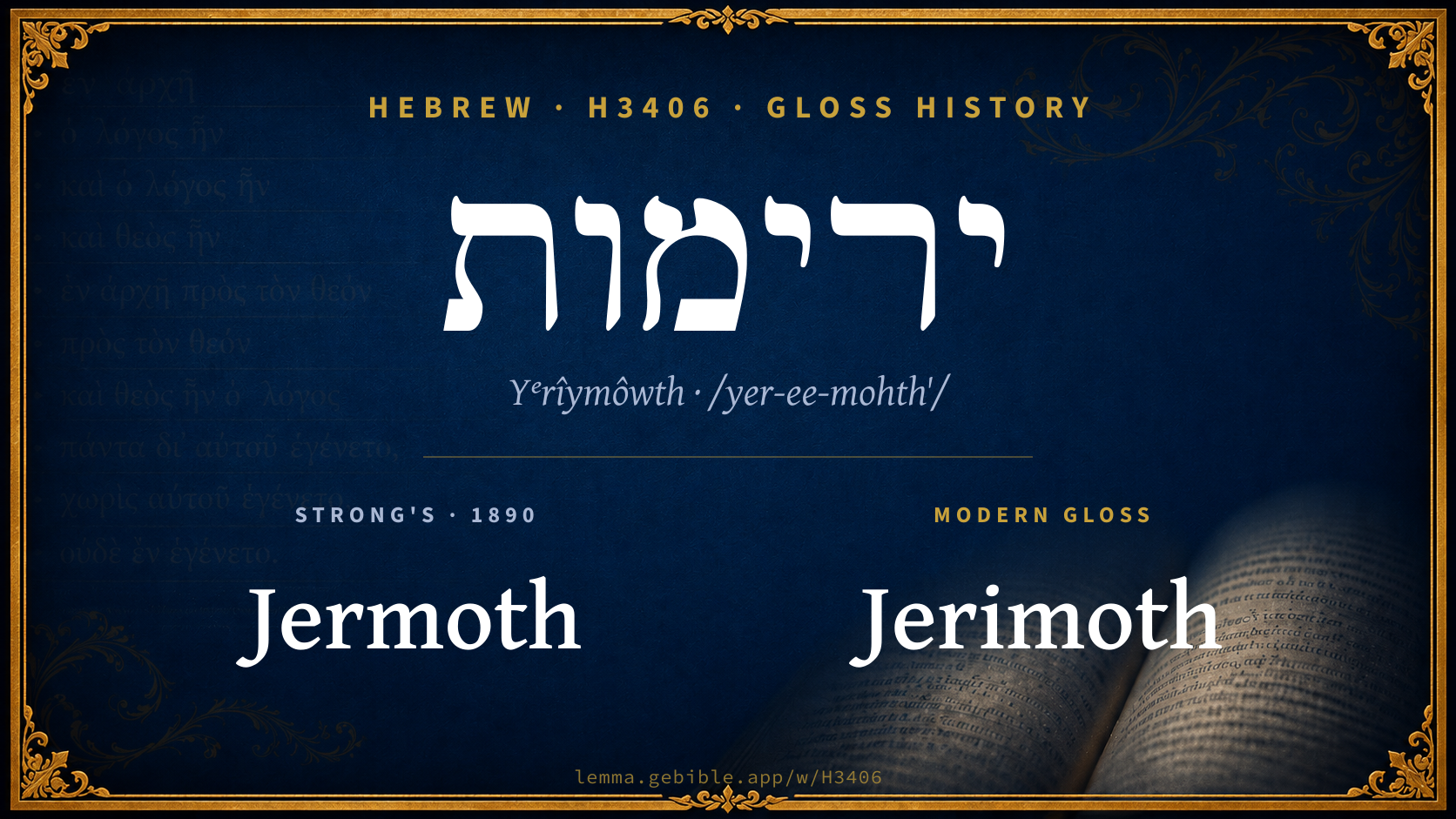
Gloss history
Strong's 1890 vs modern scholarship
About this word
Strong's H3406 catalogs a Hebrew word from the Hebrew Old Testament.
These counts are not copied from any lexicon or concordance. They are computed here, from the morphology-tagged Hebrew Old Testament. What Lemma adds →
- 14
- distinct verses
- The word appears in 14 distinct verses.
- 3 / 39
- OT books
- The word appears in 3 of 39 Old Testament books.
- #1,836
- by frequency
- Top 2500 most frequent Hebrew words (rank 1,836 of 8,640 Hebrew words by occurrence).
View all 14 occurrences in the concordance →
Most concentrated in
- 1 Chronicles 9 verses 64%
- Ezra 3 verses 21%
- 2 Chronicles 2 verses 14%
By section of the Old Testament
By traditional corpus
Conventional, traditional groupings — biblical authorship is debated, so this is a traditional corpus grouping, not an authorship claim. Each share is this word’s portion of its verses in that division of the Hebrew canon. Each figure is a share of the word’s 14 distinct verses.
- Writings (Ketuvim) 14 verses · 100%
How translations render this word
Counts come from each version’s own published word-to-Strong’s tagging or interlinear alignment — an approximate guide to how each version renders this word, not a word-level alignment the data otherwise carries. Because each total is that version’s own tagged count, the per-version totals vary from one another and need not match the appearance or distinct-verse counts above. These counts may also differ from a printed concordance because Lemma counts each distinctly tagged rendering and does not collapse phrase taggings into a single head-word total. This is a fixed set of word-tagged versions (KJV, ASV, BSB, ULT) and does not change with the reading translation you choose elsewhere. Each version’s license is shown beside its name below (and on Sources).
- King James Version: Jerimoth 8×, Jeremoth 5×
- American Standard Version: Jeremoth 7×, Jerimoth 6×
- Berean Standard Bible: Jeremoth 7×, Jerimoth 7×
- unfoldingWord Literal Text: Jerimoth 9×, Jeremoth 5×
King James Version Public Domain
Renders H3406 across 13 tagged occurrences — most commonly:
American Standard Version Public Domain
Renders H3406 across 13 tagged occurrences — most commonly:
Berean Standard Bible Public Domain
Renders H3406 across 14 tagged occurrences — most commonly:
unfoldingWord Literal Text CC BY-SA 4.0
Renders H3406 across 14 tagged occurrences — most commonly:
16 senses and sub-senses in the full BDB
What do BDB’s symbols mean?
BDB uses these scholarly abbreviations:
| Symbol | Meaning |
|---|---|
| 𝔊 | the Septuagint (the ancient Greek translation, LXX) |
| 𝔙 | the Vulgate (the Latin translation) |
| 𝔖 | the Syriac version (the Peshitta) |
| 𝔗 | the Targum (the Aramaic translation) |
| ψ | the Psalms |
| √ | root (the underlying root or stem) |
| ‖ | parallel passage (a synonymous or contrasted parallel) |
| † | the dagger: every passage where the word occurs is cited |
The 16 senses and sub-senses the full Brown-Driver-Briggs lexicon distinguishes for this word, in lexicon order (not ranked by frequency), with BDB’s own verbatim wording and sub-sense lettering. Shown in Hebrew script with BDB’s own scholarly abbreviations. The condensed entry is in the Lexicon Entry tab. See also the Forms in the corpus table below.
- 1. Benjamites:
- a. יְרִימוֹת 1 Ch 7:7. e.g. 1 Chronicles 7:7
- b. יְרֵימוֹת 1 Ch 7:8. e.g. 1 Chronicles 7:8
- c. יְרֵמוֹת 1 Ch 8:14. e.g. 1 Chronicles 8:14
- 2. Levites:
- a. יְרֵמוֹת 1 Ch 23:23. e.g. 1 Chronicles 23:23
- b. id. 1 Ch 25:22 = e.g. 1 Chronicles 25:22
- c. יְרִימוֹת 24:30. e.g. 1 Chronicles 24:30
- d. יְרִימוֹת 1 Ch 25:4. e.g. 1 Chronicles 25:4
- e. id. 2 Ch 31:13. e.g. 2 Chronicles 31:13
- 3. id. Naphtalite 1 Ch 27:19. e.g. 1 Chronicles 27:19
- 4. id. son of David and father of Rehoboam’s wife 2 Ch 11:18. e.g. 2 Chronicles 11:18
- 5. יְרֵמוֹת, men who had strange wives:
- a. Ezr 10:26, 𝔊 Ιερειμοιθ (-μωθ). e.g. Ezra 10:26
- b. Ezr 10:27, 𝔊 Αμων, א Αρμων, A Ιαρμωθ, 𝔊L Ιεριμωθ. e.g. Ezra 10:27
- c. Ezr 10:29 Kt (Qr וְרָמוֹת), 𝔊 Μημων, A Ρημωθ, 𝔊L Αριμωθ. e.g. Ezra 10:29
Senses from the full Brown-Driver-Briggs lexicon (Brown, Driver, Briggs; Oxford 1906 — public domain), digitized via Sefaria, supplemented by the OpenScriptures HebrewLexicon (CC BY 4.0). Full attribution on Sources.
Word origin
n.pr.m. 𝔊 Αρειμωθ, Ιεριμουθ, etc.;—
— Brown-Driver-Briggs (Oxford 1906, public domain), digitized via Sefaria, supplemented by the OpenScriptures HebrewLexicon (CC BY 4.0). See Sources.
Derived from רום (rûwm) (H7311) — to rise.
Forms in the corpus
The 13 distinct written forms H3406 takes in the Hebrew Bible, most frequent first — each parse links to that state’s occurrences in the concordance. Hebrew forms include their vowel points and cantillation, so a single lemma takes many written forms.
| Form | Parsing | Example | Uses |
|---|---|---|---|
| וִ/ירֵמ֖וֹת | Noun, Proper | Ezra 10:26 | 2 |
| יְרִימ֖וֹת | Noun, Proper | 1 Chronicles 27:19 | 2 |
| וְ/רָמֽוֹת | Noun, Proper | Ezra 10:29 | 1 |
| וִ/ירִימ֑וֹת | Noun, Proper | 1 Chronicles 24:30 | 1 |
| וִ/ירִימ֨וֹת | Noun, Proper | 1 Chronicles 7:7 | 1 |
| וִ/ירִימוֹת֙ | Noun, Proper | 1 Chronicles 12:5 | 1 |
| וִ/ירֵמ֣וֹת | Noun, Proper | 1 Chronicles 7:8 | 1 |
| וִ/ירֵמֽוֹת | Noun, Proper | 1 Chronicles 8:14 | 1 |
| וִֽ/ירִימ֜וֹת | Noun, Proper | 1 Chronicles 25:4 | 1 |
| וִֽ/ירִימ֤וֹת | Noun, Proper | 2 Chronicles 31:13 | 1 |
| וִֽ/ירֵמ֔וֹת | Noun, Proper | Ezra 10:27 | 1 |
| ירמות | Noun, Proper | Ezra 10:29 | 1 |
| לִֽ/ירֵמ֔וֹת | Noun, Proper | 1 Chronicles 25:22 | 1 |
Same root — word family
Other BDB entries built from the same root as H3406, grouped by Strong’s listed origin. These share a root / origin per the lexicon — not necessarily a shared meaning. Each links to that word’s own entry.
Derives from
Shares the same root
- מרום mârôwm H4791 height
- רום rûwm H7312 haughtiness
- רום rûwm H7313 to rise
- רום rôwm H7315 on high
- רמה râmâh H7413 high place
- רמות râmûwth H7419 height
- תרומה tᵉrûwmâh H8641 offering
Proper names from this root
People and places named from this root — a name, not an additional meaning of the word.
- ירמות Yarmûwth H3412 Jarmuth
- ירמי Yᵉrêmay H3413 Jeremai
- ירמיה Yirmᵉyâh H3414 Jeremiah
- מרמות Mᵉrêmôwth H4822 Meremoth
- רומה Rûwmâh H7316 height
- רוממתי עזר Rôwmamtîy ʻEzer H7320 Romamti-ezer
- רם Râm H7410 Ram
- רמיה Ramyâh H7422 Ramiah
Compare all same-root words → Showing 4 of 17 — not the complete family. 8 of the same-root words are proper names (people or places). They share a root, not necessarily a meaning.
Bible dictionary
Public-domain dictionary articles matched to this entry by name (Jerimoth). A biblical name can be shared by more than one person or place, so an article may treat several.
Easton's Bible Dictionary · M. G. Easton, 1897
Heights. (1.) One of the sons of Bela (1 Chr. 7:7).
(2.) 1 Chr. 24:30, a Merarite Levite.
(3.) A Benjamite slinger who joined David at Ziklag (1 Chr. 12:5).
(4.) A Levitical musician under Heman his father (1 Chr. 25:4).
(5.) 1 Chr. 27:19, ruler of Naphtali.
(6.) One of David's sons (2 Chr. 11:18).
(7.) A Levite, one of the overseers of the temple offerings (2 Chr. 31:13) in the reign of Hezekiah.
Smith's Bible Dictionary · William Smith, 1863
(heights).
+ Son or descendant of Bela. (1 Chronicles 7:7) He is perhaps the same as + who joined David at Ziklag. (1 Chronicles 12:5) (B.C. 1055.) + A son of Beecher, (1 Chronicles 7:8) and head of a Benjamite house. + Son of Mushi, the son of Merari. (1 Chronicles 24:30) + Son of Heman, head of fifteenth ward of musicians. (1 Chronicles 25:4,22) (B.C. 1014.) + Son of Zariel, ruler of the tribe of Naphtali in the reign of David. (1 Chronicles 27:19) + Son of King David, whose daughter Mahalath was one of the wives of Rehoboam, her cousin Abihail being the other. (2 Chronicles 11:18) (B.C. before 1014.) + A Levite in the reign of Hezekiah. (2 Chronicles 31:13) (B.C. 726.)
Hitchcock's Bible Names Dictionary · Roswell D. Hitchcock, 1869
he that fears or rejects death
Classic public-domain reference works; full attribution on Sources.
Septuagint verse parallels
This word appears in 14 verses that also exist in the Greek Old Testament (Septuagint), out of the 14 Hebrew verses it occurs in. You can read those verses in Greek by switching the Old Testament edition to the Septuagint.
Read these verses in the Septuagint
This is a verse-level parallel only — the same verses exist in both the Hebrew and Greek Old Testaments. No word-level Hebrew↔Greek correspondence is claimed: the data carries no such alignment, so no Greek word is shown as this Hebrew word’s translation. Coverage is not total — the Septuagint omits the deuterocanon and renumbers the Psalms, so some Hebrew verses have no direct Greek parallel.