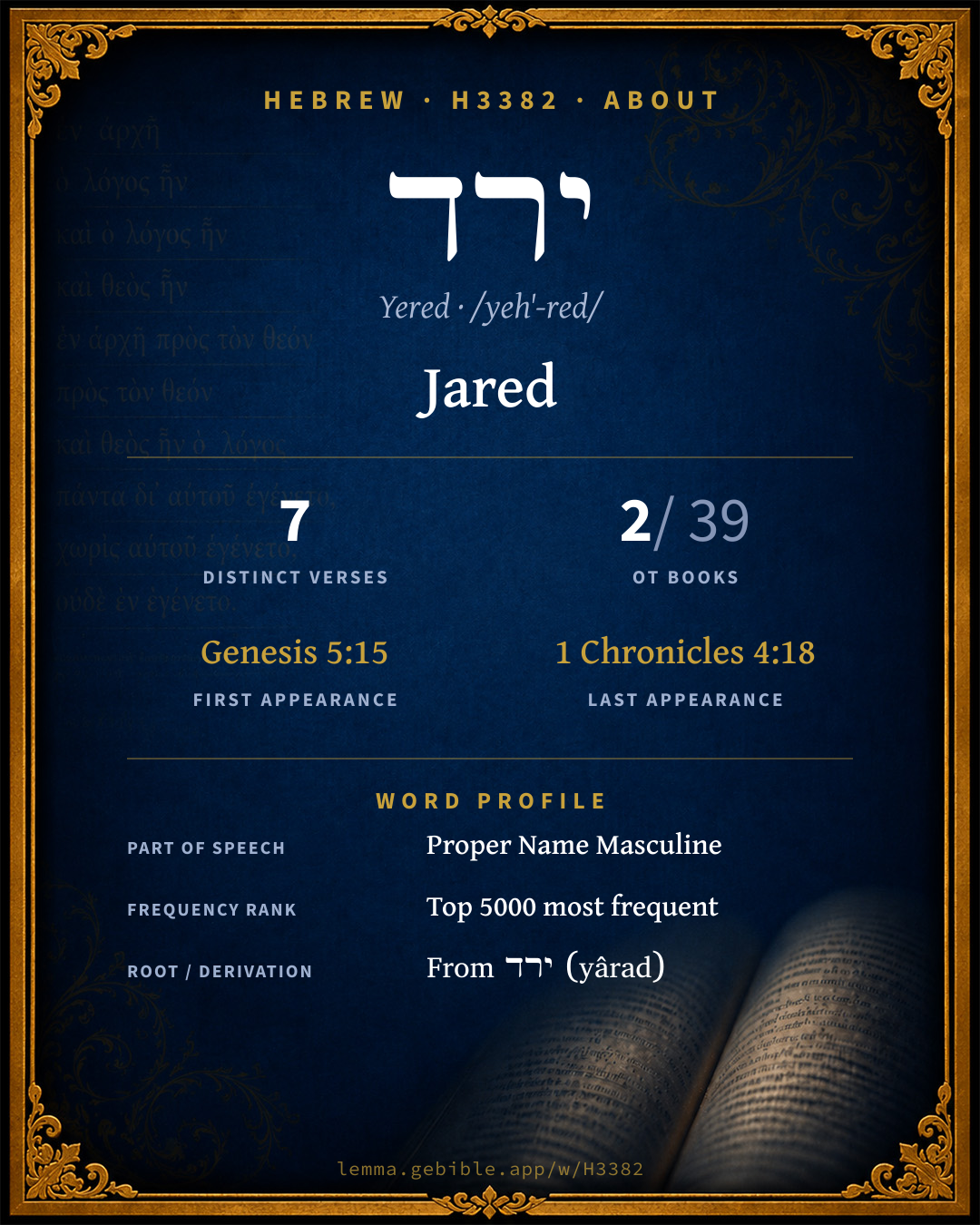
יֶ֫רֶד
Jared
BDB lists 3 entries for ‘Jared’ fuller range ↓
Full lexicon entry — Brown-Driver-Briggs (BDB)
From Brown-Driver-Briggs (BDB)
Where this word appears
Grammar key — what these labels mean
Part of speech
- Noun
- A naming word — a person, place, thing, or idea.
Noun type
- Proper
- A name of a specific person, place, or people (e.g. Abraham, Zion, Israel).
Every verse where H3382 appears in the Book of Genesis — 5 distinct verses. Click any verse to open its interlinear word-by-word view. Verse text shown in the World English Bible for context — . Each verse’s Hebrew form is shown with its reference; the English is not keyword-highlighted, since the data carries no word-level English alignment. Use “Compare translations” on any verse to read it across multiple English versions. This concordance covers the Hebrew Bible; Septuagint (Greek Old Testament) occurrences are not indexed here.
Genesis
- Genesis 5:15 יָֽרֶד n Proper Mahalalel lived sixty-five years, and became the father of Jared.
- Genesis 5:16 יֶ֔רֶד n Proper Mahalalel lived after he became the father of Jared eight hundred thirty years, and became the father of sons and daughters.
- Genesis 5:18 יֶ֕רֶד n Proper Jared lived one hundred sixty-two years, and became the father of Enoch.
- Genesis 5:19 יֶ֗רֶד n Proper Jared lived after he became the father of Enoch eight hundred years, and became the father of sons and daughters.
- Genesis 5:20 יֶ֔רֶד n Proper All the days of Jared were nine hundred sixty-two years, then he died.
About this entry
At a glance — auto-summarized from this page’s data, not written by a person. Every figure links to its source below. This summary describes the numbers; it doesn’t interpret them.
The Hebrew name ירד centers on the idea of “Jared.” Genesis dominates its distribution — 5 of 7 verses. The Hebrew Bible uses it across 7 verses — uncommon. First canonically at Genesis 5:15, it enters the text early. For the data behind this summary, explore 7-verse concordance and the renderings breakdown below.
Gloss history
Strong's 1890 vs modern scholarship
About this word
Strong's H3382 catalogs a Hebrew word from the Hebrew Old Testament.
These counts are not copied from any lexicon or concordance. They are computed here, from the morphology-tagged Hebrew Old Testament. What Lemma adds →
- 7
- distinct verses
- The word appears in 7 distinct verses.
- 2 / 39
- OT books
- The word appears in 2 of 39 Old Testament books.
- #2,835
- by frequency
- Top 5000 most frequent Hebrew words (rank 2,835 of 8,640 Hebrew words by occurrence).
View all 7 occurrences in the concordance →
Most concentrated in
- Genesis 5 verses 71%
- 1 Chronicles 2 verses 29%
By section of the Old Testament
By traditional corpus
Conventional, traditional groupings — biblical authorship is debated, so this is a traditional corpus grouping, not an authorship claim. Each share is this word’s portion of its verses in that division of the Hebrew canon. Each figure is a share of the word’s 7 distinct verses.
- Torah (Pentateuch) 5 verses · 71%
- Writings (Ketuvim) 2 verses · 29%
How translations render this word
Counts come from each version’s own published word-to-Strong’s tagging or interlinear alignment — an approximate guide to how each version renders this word, not a word-level alignment the data otherwise carries. Because each total is that version’s own tagged count, the per-version totals vary from one another and need not match the appearance or distinct-verse counts above. These counts may also differ from a printed concordance because Lemma counts each distinctly tagged rendering and does not collapse phrase taggings into a single head-word total. This is a fixed set of word-tagged versions (KJV, ASV, BSB, ULT) and does not change with the reading translation you choose elsewhere. Each version’s license is shown beside its name below (and on Sources).
- King James Version: Jared 5×, Jered 2×
- American Standard Version: Jared 6×
- Berean Standard Bible: Jared 6×
- unfoldingWord Literal Text: Jared 6×
King James Version Public Domain
Renders H3382 across 7 tagged occurrences — most commonly:
American Standard Version Public Domain
Renders H3382 across 7 tagged occurrences — most commonly:
Plus 1 rendering that appears only once — usually multi-word phrases or single function words the recovered tagging swept in, not distinct renderings.
Berean Standard Bible Public Domain
Renders H3382 across 7 tagged occurrences — most commonly:
Plus 1 rendering that appears only once — usually multi-word phrases or single function words the recovered tagging swept in, not distinct renderings.
unfoldingWord Literal Text CC BY-SA 4.0
Renders H3382 across 7 tagged occurrences — most commonly:
Plus 1 rendering that appears only once — usually multi-word phrases or single function words the recovered tagging swept in, not distinct renderings.
Senses in the full BDB
What do BDB’s symbols mean?
BDB uses these scholarly abbreviations:
| Symbol | Meaning |
|---|---|
| 𝔊 | the Septuagint (the ancient Greek translation, LXX) |
| 𝔙 | the Vulgate (the Latin translation) |
| 𝔖 | the Syriac version (the Peshitta) |
| 𝔗 | the Targum (the Aramaic translation) |
| ψ | the Psalms |
| √ | root (the underlying root or stem) |
| ‖ | parallel passage (a synonymous or contrasted parallel) |
| † | the dagger: every passage where the word occurs is cited |
The 2 senses and sub-senses the full Brown-Driver-Briggs lexicon distinguishes for this word, in lexicon order (not ranked by frequency), with BDB’s own verbatim wording and sub-sense lettering. Shown in Hebrew script with BDB’s own scholarly abbreviations. The condensed entry is in the Lexicon Entry tab. See also the Forms in the corpus table below.
- 1. son of Mehallʾēl, fourth generation from Seth Gn 5:16, 18, 19, 20; יָ֑רֶד v 15 1 Ch 1:2; 𝔊 Ιαρεδ (v. LagBN 77). e.g. Genesis 5:16
- 2. יֶרֶד man of Judah 1 Ch 4:18; 𝔊 id. e.g. 1 Chronicles 4:18
Senses from the full Brown-Driver-Briggs lexicon (Brown, Driver, Briggs; Oxford 1906 — public domain), digitized via Sefaria, supplemented by the OpenScriptures HebrewLexicon (CC BY 4.0). Full attribution on Sources.
Word origin
Derived from ירד (yârad) (H3381) — to go down.
Jastrow Dictionary
A second Hebrew/Aramaic lexicon for comparison, covering Aramaic and post-biblical (Talmudic, Targumic, Midrashic) usage that the biblical-Hebrew BDB does not. Matched by lemma rather than by Strong’s number, so a lemma may carry more than one Jastrow headword (shown separately below), and the entries cover usage well beyond the Bible.
יָרַד
- (b. h.) to move about, run; esp. to go down; י׳ ל־ to enter; י׳ מ־ to leave. Tanḥ. B’ḥuck. 5 (ref. to וירדתי, Jud. XI, 37) וכי … יוֹרֵד על ההרים … עולים להרים does one go down on the mountains, do not men go up to &c.?; ib. הניחני ואֵרֵד אצל ב"ד (ed. Bub. 7 ואלך) give me leave that I may go down to the court-house; Yalk. Jud. 67. Men. 109ᵇ מה זה שלא י׳ לה כך when this one (Shimei) who was not permitted to enter into it (the office) became so jealous, היוֹרֵד לה וכ׳ how much more so is he who once has entered it (and is to be ousted). Ib. כל האומר לי לֵירֵד ממנה וכ׳ whoever would ask me to resign it (the office), I would throw at him &c.—Taan. 8ᵇ יָרְדוּ גשמים it rains. Ib. 8ᵃ אין גשמים יוֹרְדִים וכ׳ the rain falls only for the sake of the men of faith. Cant. R. to I, 2ᵇ מה מים יורדין וכ׳ as the water (rain) comes down in drops.—י׳ לנכסי to take possession of, seize, administer property. B. Mets. 38ᵇ היוֹרֵד לנ׳ שבוים he who takes possession of the property of captives. Tosef. Keth. VIII, 2, sq.; a. fr.—י׳ מנכסיו to be compelled to leave an estate, to become poor (cmp. B. Mets. 38ᵇ היוֹרֵד לנ׳ שבוים he who takes possession of the property of captives. Tosef. Keth. VIII, 2, sq.; a. fr.—י׳ מנכסיו to be compelled to leave an estate, to become poor (cmp. דִּלְדִּל). Gen. R. s. 71; Lam. R. to III, 4; Ned. 64ᵇ; a. fr.—(קרבן) עוֹלֶה ויוֹרֵד a sacrifice of higher or lesser value according to pecuniary conditions (Lev. V, 6—11). Shebu. 21ᵃ. Hor. II, 7 (9ᵃ); a. fr.—[For other idiomatic uses, v. עָלָה.]—Part. pass. יָרוּד q. v. e.g. Judges 11:37
- to let down, bring down; to lower. Taan. 8ᵃ בשעה שהשמים … מִלְּהוֹרִיד וכ׳ ed. (Ms. M., v. Rabb. D. S. a. l.) when the heavens are locked up so as not to let down rain. Lev. R. s. 1 ירד שה׳ את התורה Moses is surnamed Yered (I Chr. IV, 18) because he brought down the Law; שה׳ את חשכינה וכ׳ he caused the Divine Presence to come down &c. Y. Ber. IV, 7ᵈ top לא הוֹרִידוּ אותו מגדולתו they did not remove him from his position. Sot. 13ᵇ (ref. to Gen. XXXIX, 1) א"ת הוּרַד אלא הוֹרִיד שה׳ וכ׳ read not ‘he was brought down’, but ‘he did bring down’, for he (Joseph) was the cause of the removal of the astronomers of Pharaoh from their positions.—Y. B. Kam. IV, 4ᵇ top הוֹרִידָן מנכסיהן he drove them out of their estates (cmp. Bab. B. Kam. 38ᵃ); a. v. fr.—ה׳ לנכסי (v. supra) to appoint as administrator. B. Mets. 38ᵇ מוֹרִידִין קרוב לנ׳ שבוי we may appoint a relative (presumptive heir) an administrator of the estate of a captive; a. fr.—לא מעלה ולא מוריד neither raises nor lowers, i.e. has no effect or influence. Ḥull. 45ᵇ. Gitt. 52ᵃ, a. e. דברי חלומות לא מעלין ולא מוֹרִידִין dreams must not be regarded. Men. V, 6, a. e. מעלה ומוריד moves upward and downward.—[Tosef. Par. IX (VIII), 6 שהוא מוריד, v. מוֹרִיר.]—מעלין … ולא מורידין, v. עָלָה. e.g. 1 Chronicles 4:18
A Dictionary of the Targumim, the Talmud Babli and Yerushalmi, and the Midrashic Literature (Marcus Jastrow; London, Luzac, 1903) — Public Domain. Digitized via Sefaria. Digitized via Sefaria. Full attribution on Sources.
Forms in the corpus
The 5 distinct written forms H3382 takes in the Hebrew Bible, most frequent first — each parse links to that state’s occurrences in the concordance. Hebrew forms include their vowel points and cantillation, so a single lemma takes many written forms.
| Form | Parsing | Example | Uses |
|---|---|---|---|
| יֶ֔רֶד | Noun, Proper | Genesis 5:16 | 2 |
| יָֽרֶד | Noun, Proper | Genesis 5:15 | 2 |
| יֶ֕רֶד | Noun, Proper | Genesis 5:18 | 1 |
| יֶ֗רֶד | Noun, Proper | Genesis 5:19 | 1 |
| יֶ֨רֶד | Noun, Proper | 1 Chronicles 4:18 | 1 |
Same root — word family
Other BDB entries built from the same root as H3382, grouped by Strong’s listed origin. These share a root / origin per the lexicon — not necessarily a shared meaning. Each links to that word’s own entry.
Derives from
Shares the same root
Proper names from this root
People and places named from this root — a name, not an additional meaning of the word.
Compare all same-root words → Showing 4 of 5 — not the complete family. 2 of the same-root words are proper names (people or places). They share a root, not necessarily a meaning.
Bible dictionary
Public-domain dictionary articles matched to this entry by name (Jared). A biblical name can be shared by more than one person or place, so an article may treat several.
Easton's Bible Dictionary · M. G. Easton, 1897
Descent. (1.) The fourth antediluvian patriarch in descent from Seth (Gen. 5:15-20; Luke 3:37), the father of Enoch; called Jered in 1 Chr. 1:2.
(2.) A son of Ezra probably (1 Chr. 4:18).
Smith's Bible Dictionary · William Smith, 1863
(descent), one of the antediluvian patriarchs, and further of Enoch (Genesis 5:15,16,18-20; Luke 3:37) In the lists of Chronicles the name is given in the Authorized Version Jered.
Hitchcock's Bible Names Dictionary · Roswell D. Hitchcock, 1869
a ruling; commanding; coming down
Classic public-domain reference works; full attribution on Sources.
Septuagint verse parallels
This word appears in 7 verses that also exist in the Greek Old Testament (Septuagint), out of the 7 Hebrew verses it occurs in. You can read those verses in Greek by switching the Old Testament edition to the Septuagint.
Read these verses in the Septuagint
This is a verse-level parallel only — the same verses exist in both the Hebrew and Greek Old Testaments. No word-level Hebrew↔Greek correspondence is claimed: the data carries no such alignment, so no Greek word is shown as this Hebrew word’s translation. Coverage is not total — the Septuagint omits the deuterocanon and renumbers the Psalms, so some Hebrew verses have no direct Greek parallel.