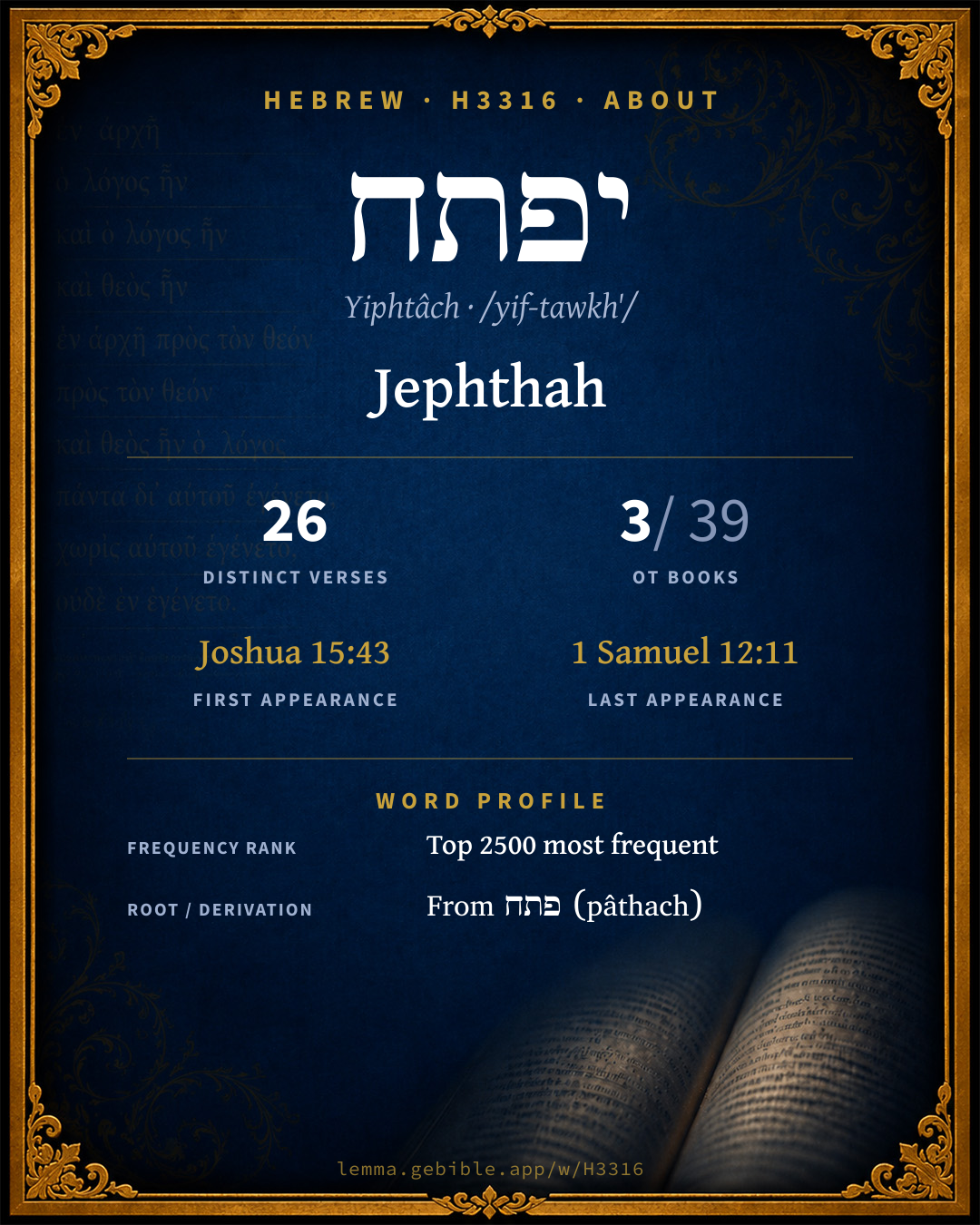
יִפְתָּח
Jephthah
BDB lists 3 entries for ‘Jephthah’ fuller range ↓
Full lexicon entry — Brown-Driver-Briggs (BDB)
From Brown-Driver-Briggs (BDB)
Where this word appears
Grammar key — what these labels mean
Part of speech
- Noun
- A naming word — a person, place, thing, or idea.
Noun type
- Proper
- A name of a specific person, place, or people (e.g. Abraham, Zion, Israel).
Every verse where H3316 appears in the Book of Joshua — 1 distinct verse. Click any verse to open its interlinear word-by-word view. Verse text shown in the World English Bible for context — . Each verse’s Hebrew form is shown with its reference; the English is not keyword-highlighted, since the data carries no word-level English alignment. Use “Compare translations” on any verse to read it across multiple English versions. This concordance covers the Hebrew Bible; Septuagint (Greek Old Testament) occurrences are not indexed here.
Joshua
About this entry
At a glance — auto-summarized from this page’s data, not written by a person. Every figure links to its source below. This summary describes the numbers; it doesn’t interpret them.
“Jephthah” is the headline sense of the Hebrew name יפתח (Yiphtâch). It clusters heavily in Judges, which alone accounts for 92% of its uses. It turns up in 26 verses across 3 books, a moderately common footprint. First canonically at Joshua 15:43, it enters the text early. See 26-verse concordance and the renderings breakdown below.
Gloss history
Strong's 1890 vs modern scholarship
About this word
Strong's H3316 catalogs a Hebrew word from the Hebrew Old Testament.
These counts are not copied from any lexicon or concordance. They are computed here, from the morphology-tagged Hebrew Old Testament. What Lemma adds →
- 26
- distinct verses
- The word appears in 26 distinct verses.
- 3 / 39
- OT books
- The word appears in 3 of 39 Old Testament books.
- #1,139
- by frequency
- Top 2500 most frequent Hebrew words (rank 1,139 of 8,640 Hebrew words by occurrence).
View all 26 occurrences in the concordance →
By section of the Old Testament
By traditional corpus
Conventional, traditional groupings — biblical authorship is debated, so this is a traditional corpus grouping, not an authorship claim. Each share is this word’s portion of its verses in that division of the Hebrew canon. Each figure is a share of the word’s 26 distinct verses.
- Prophets (Nevi'im) 26 verses · 100%
How translations render this word
Counts come from each version’s own published word-to-Strong’s tagging or interlinear alignment — an approximate guide to how each version renders this word, not a word-level alignment the data otherwise carries. Because each total is that version’s own tagged count, the per-version totals vary from one another and need not match the appearance or distinct-verse counts above. These counts may also differ from a printed concordance because Lemma counts each distinctly tagged rendering and does not collapse phrase taggings into a single head-word total. This is a fixed set of word-tagged versions (KJV, ASV, BSB, ULT) and does not change with the reading translation you choose elsewhere. Each version’s license is shown beside its name below (and on Sources).
BDB lists this Strong’s number as 2 distinct words (homographs). Each count above pools all of them and is not split by sense — see the Senses section below. A low-frequency rendering may belong to a different one of those words, not the primary meaning.
- King James Version†: Jephthah 26×
- American Standard Version†: Jephthah 25×
- Berean Standard Bible†: Jephthah 21×
- unfoldingWord Literal Text†: Jephthah 28×
King James Version Public Domain
Renders H3316 across 30† tagged occurrences — most commonly:
Plus 4 renderings that appear only once — usually multi-word phrases or single function words the recovered tagging swept in, not distinct renderings.
American Standard Version Public Domain
Renders H3316 across 30† tagged occurrences — most commonly:
Plus 5 renderings that appear only once — usually multi-word phrases or single function words the recovered tagging swept in, not distinct renderings.
Berean Standard Bible Public Domain
Renders H3316 across 28† tagged occurrences — most commonly:
Plus 7 renderings that appear only once — usually multi-word phrases or single function words the recovered tagging swept in, not distinct renderings. Not rendered by a distinct English word in 2 further occurrences.
unfoldingWord Literal Text CC BY-SA 4.0
Renders H3316 across 30† tagged occurrences — most commonly:
Plus 2 renderings that appear only once — usually multi-word phrases or single function words the recovered tagging swept in, not distinct renderings.
Senses in the full BDB
What do BDB’s symbols mean?
BDB uses these scholarly abbreviations:
| Symbol | Meaning |
|---|---|
| 𝔊 | the Septuagint (the ancient Greek translation, LXX) |
| 𝔙 | the Vulgate (the Latin translation) |
| 𝔖 | the Syriac version (the Peshitta) |
| 𝔗 | the Targum (the Aramaic translation) |
| ψ | the Psalms |
| √ | root (the underlying root or stem) |
| ‖ | parallel passage (a synonymous or contrasted parallel) |
| † | the dagger: every passage where the word occurs is cited |
The 2 senses and sub-senses the full Brown-Driver-Briggs lexicon distinguishes for this word, in lexicon order (not ranked by frequency), with BDB’s own verbatim wording and sub-sense lettering. Shown in Hebrew script with BDB’s own scholarly abbreviations. The condensed entry is in the Lexicon Entry tab. See also the Forms in the corpus table below.
- 1. m. Jephthah, Ιεφθαε (he [God] openeth);—Ju 11:1(×2) + 26 times 11, 12, 1 S 12:11. e.g. Judges 11:1
- 2. loc. in the שְׁפֵלָה Jos 15:43 (P), A 𝔊L Ιεφθα. e.g. Joshua 15:43
Senses from the full Brown-Driver-Briggs lexicon (Brown, Driver, Briggs; Oxford 1906 — public domain), digitized via Sefaria, supplemented by the OpenScriptures HebrewLexicon (CC BY 4.0). Full attribution on Sources.
Word origin
Derived from פתח (pâthach) (H6605) — to open.
Jastrow Dictionary
A second Hebrew/Aramaic lexicon for comparison, covering Aramaic and post-biblical (Talmudic, Targumic, Midrashic) usage that the biblical-Hebrew BDB does not. Matched by lemma rather than by Strong’s number, so a lemma may carry more than one Jastrow headword (shown separately below), and the entries cover usage well beyond the Bible.
יִפְתָּח
- (b. h.) pr. n. m. Jephthah, the Judge. R. Hash. 25ᵇ י׳ בדורו כשמואל וכ׳ the authority of a J. in his days must be respected as that of a Samuel in his; Tosef. ib. II (I), 3 בית דינו של י׳. Gen. R. s. 60; a. fr.
A Dictionary of the Targumim, the Talmud Babli and Yerushalmi, and the Midrashic Literature (Marcus Jastrow; London, Luzac, 1903) — Public Domain. Digitized via Sefaria. Digitized via Sefaria. Full attribution on Sources.
Forms in the corpus
The 15 distinct written forms H3316 takes in the Hebrew Bible, most frequent first — each parse links to that state’s occurrences in the concordance. Hebrew forms include their vowel points and cantillation, so a single lemma takes many written forms.
| Form | Parsing | Example | Uses |
|---|---|---|---|
| יִפְתָּח֙ | Noun, Proper | Judges 11:3 | 9 |
| יִפְתָּ֑ח | Noun, Proper | Judges 11:10 | 3 |
| יִפְתָּ֖ח | Noun, Proper | 1 Samuel 12:11 | 3 |
| יִפְתָּ֗ח | Noun, Proper | Judges 11:2 | 3 |
| יִפְתָּ֛ח | Noun, Proper | Judges 11:32 | 2 |
| וְ/יִפְתָּ֣ח | Noun, Proper | Judges 11:1 | 1 |
| וְ/יִפְתָּ֥ח | Noun, Proper | Joshua 15:43 | 1 |
| יִפְתָּ֔ח | Noun, Proper | Judges 11:28 | 1 |
| יִפְתָּ֜ח | Noun, Proper | Judges 11:9 | 1 |
| יִפְתָּ֣ח | Noun, Proper | Judges 11:34 | 1 |
| יִפְתָּ֥ח | Noun, Proper | Judges 11:30 | 1 |
| יִפְתָּ֧ח | Noun, Proper | Judges 11:11 | 1 |
| יִפְתָּֽח | Noun, Proper | Judges 11:1 | 1 |
| לְ/יִפְתָּ֔ח | Noun, Proper | Judges 11:6 | 1 |
| לְ/יִפְתָּ֜ח | Noun, Proper | Judges 12:1 | 1 |
Same root — word family
Other BDB entries built from the same root as H3316, grouped by Strong’s listed origin. These share a root / origin per the lexicon — not necessarily a shared meaning. Each links to that word’s own entry.
Derives from
Shares the same root
- מפתח maphtêach H4668 key
- מפתח miphtâch H4669 opening
- פתוח pittûwach H6603 engraving
- פתח pᵉthach H6606 to open
- פתח pethach H6607 doorway
- פתח pêthach H6608 opening
- פתחה pᵉthichâh H6609 sword
- פתחון pithchôwn H6610 opening
Proper names from this root
People and places named from this root — a name, not an additional meaning of the word.
- יפתחאל Yiphtach-ʼêl H3317 Jiphthah-el
- נפתוח Nephtôwach H5318 Nephtoah
- פתחיה Pᵉthachyâh H6611 Pethahiah
- Ιεφθαε Iephtháe G2422 Jephthah
Compare all same-root words → Showing 4 of 14 — not the complete family. 4 of the same-root words are proper names (people or places). They share a root, not necessarily a meaning.
Bible dictionary
Public-domain dictionary articles matched to this entry by name (Jephthah). A biblical name can be shared by more than one person or place, so an article may treat several.
Easton's Bible Dictionary · M. G. Easton, 1897
Whom God sets free, or the breaker through, a "mighty man of valour" who delivered Israel from the oppression of the Ammonites (Judg. 11:1-33), and judged Israel six years (12:7). He has been described as "a wild, daring, Gilead mountaineer, a sort of warrior Elijah." After forty-five years of comparative quiet Israel again apostatized, and in "process of time the children of Ammon made war against Israel" (11:5). In their distress the elders of Gilead went to fetch Jephthah out of the land of Tob, to which he had fled when driven out wrongfully by his brothers from his father's inheritance (2), and the people made him their head and captain. The "elders of Gilead" in their extremity summoned him to their aid, and he at once undertook the conduct of the war against Ammon. Twice he sent an embassy to the king of Ammon, but in vain. War was inevitable. The people obeyed his summons, and "the spirit of the Lord came upon him." Before engaging in war he vowed that if successful he would offer as a "burnt-offering" whatever would come out of the door of his house first to meet him on his return. The defeat of the Ammonites was complete. "He smote them from Aroer, even till thou come to Minnith, even twenty cities, and unto the plain of the vineyards [Heb. Abel Keramim], with a very great slaughter" (Judg. 11:33). The men of Ephraim regarded themselves as insulted in not having been called by Jephthah to go with him to war against Ammon. This led to a war between the men of Gilead and Ephraim (12:4), in which many of the Ephraimites perished. (See SHIBBOLETH.) "Then died Jephthah the Gileadite, and was buried in one of the cities of Gilead" (7).
Smith's Bible Dictionary · William Smith, 1863
(whom God sets free), A judge about B.C. 1143-1137. His history is contained in (Judges 11:1; Judges 12:8) He was a Gileadite, the son of Gilead and a concubine. Driven by the legitimate sons from his father's inheritance, he went to Tob and became the head of a company of freebooters in a debatable land probably belonging to Ammon. (2 Samuel 10:6) (This land was east of Jordan and southeast of Gilead, and bordered on the desert of Arabia.--ED.) His fame as a bold and successful captain was carried back to his native Gilead; and when the time was ripe for throwing off the yoke of Ammon, Jephthah consented to become the captain of the Gileadite bands, on the condition, solemnly ratified before the Lord in Mizpeh, that int he event of his success against Ammon he should still remain as their acknowledged head. Vowing his vow unto God, (Judges 11:31) that he would offer up as a burn offering whatsoever should come out to meet him if successful, he went forth to battle. The Ammonites were routed with great slaughter; but as the conqueror returned to Mizpeh there came out to meet him his daughter, his only child, with timbrels and dancing. The father is heart-stricken; but the maiden asks only for a respite of two months in which to prepare for death. When that time was ended she returned to her father, who "did with her according to his vow." The tribe of Ephraim challenged Jephthah's right to go to war as he had done, without their concurrence, against Ammon. He first defeated them, then intercepted the fugitives at the fords of Jordan, and there put forty-two thousand men to the sword. He judged Israel six years, and died. It is generally conjectured that his jurisdiction was limited to the transjordanic region. That the daughter of Jephthah was really offered up to God in sacrifice is a conclusion which it seems impossible to avoid. (But there is no word of approval, as if such a sacrifice was acceptable to God. Josephus well says that "the sacrifice was neither sanctioned by the Mosaic ritual nor acceptable to God." The vow and the fulfillment were the mistaken conceptions of a rude chieftain, not acts pleasing to God.--ED.)
Classic public-domain reference works; full attribution on Sources.
Septuagint verse parallels
This word appears in 26 verses that also exist in the Greek Old Testament (Septuagint), out of the 26 Hebrew verses it occurs in. You can read those verses in Greek by switching the Old Testament edition to the Septuagint.
Read these verses in the Septuagint
This is a verse-level parallel only — the same verses exist in both the Hebrew and Greek Old Testaments. No word-level Hebrew↔Greek correspondence is claimed: the data carries no such alignment, so no Greek word is shown as this Hebrew word’s translation. Coverage is not total — the Septuagint omits the deuterocanon and renumbers the Psalms, so some Hebrew verses have no direct Greek parallel.