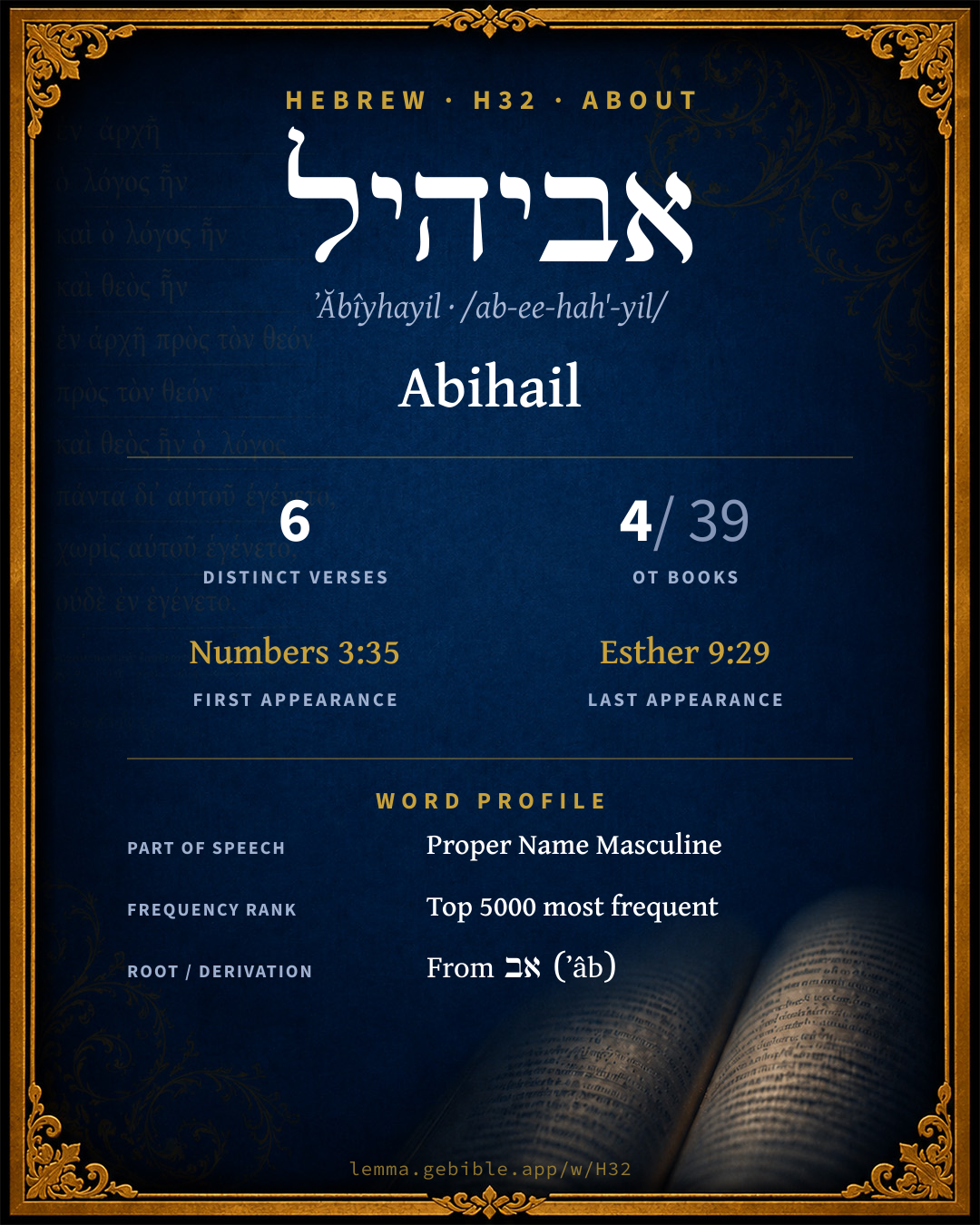
אֲבִיחַ֫יִל
Abihail
BDB lists 6 entries for ‘Abihail’ fuller range ↓
Full lexicon entry — Brown-Driver-Briggs (BDB)
From Brown-Driver-Briggs (BDB)
Where this word appears
Grammar key — what these labels mean
Part of speech
- Noun
- A naming word — a person, place, thing, or idea.
Noun type
- Proper
- A name of a specific person, place, or people (e.g. Abraham, Zion, Israel).
Every verse where H32 appears in the Book of 1 Chronicles — 2 distinct verses. Click any verse to open its interlinear word-by-word view. Verse text shown in the World English Bible for context — . Each verse’s Hebrew form is shown with its reference; the English is not keyword-highlighted, since the data carries no word-level English alignment. Use “Compare translations” on any verse to read it across multiple English versions. This concordance covers the Hebrew Bible; Septuagint (Greek Old Testament) occurrences are not indexed here.
1 Chronicles
- 1 Chronicles 2:29 אֲבִיהָ֑יִל n Proper The name of the wife of Abishur was Abihail; and she bore him Ahban, and Molid.
- 1 Chronicles 5:14 אֲבִיחַ֗יִל n Proper These were the sons of Abihail, the son of Huri, the son of Jaroah, the son of Gilead, the son of Michael, the son of Jeshishai, the son of Jahdo, the son of Buz;
About this entry
At a glance — auto-summarized from this page’s data, not written by a person. Every figure links to its source below. This summary describes the numbers; it doesn’t interpret them.
“Abihail” is the headline sense of the Hebrew name אביהיל (ʼĂbîyhayil). Its earliest occurrence is Numbers 3:35. It turns up in 6 verses across 4 books, an uncommon footprint. It concentrates in 1 Chronicles, which alone accounts for 33% of its uses. See 6-verse concordance and the renderings breakdown below.
Gloss history
Strong's 1890 vs modern scholarship
About this word
Strong's H32 catalogs a Hebrew word from the Hebrew Old Testament.
These counts are not copied from any lexicon or concordance. They are computed here, from the morphology-tagged Hebrew Old Testament. What Lemma adds →
- 6
- distinct verses
- The word appears in 6 distinct verses.
- 4 / 39
- OT books
- The word appears in 4 of 39 Old Testament books.
- #3,040
- by frequency
- Top 5000 most frequent Hebrew words (rank 3,040 of 8,640 Hebrew words by occurrence).
View all 6 occurrences in the concordance →
Most concentrated in
- 1 Chronicles 2 verses 33%
- Esther 2 verses 33%
- Numbers 1 verse 17%
By section of the Old Testament
By traditional corpus
Conventional, traditional groupings — biblical authorship is debated, so this is a traditional corpus grouping, not an authorship claim. Each share is this word’s portion of its verses in that division of the Hebrew canon. Each figure is a share of the word’s 6 distinct verses.
- Writings (Ketuvim) 5 verses · 83%
- Torah (Pentateuch) 1 verse · 17%
How translations render this word
Counts come from each version’s own published word-to-Strong’s tagging or interlinear alignment — an approximate guide to how each version renders this word, not a word-level alignment the data otherwise carries. Because each total is that version’s own tagged count, the per-version totals vary from one another and need not match the appearance or distinct-verse counts above. These counts may also differ from a printed concordance because Lemma counts each distinctly tagged rendering and does not collapse phrase taggings into a single head-word total. This is a fixed set of word-tagged versions (KJV, ASV, BSB, ULT) and does not change with the reading translation you choose elsewhere. Each version’s license is shown beside its name below (and on Sources).
BDB lists this Strong’s number as 2 distinct words (homographs). Each count above pools all of them and is not split by sense — see the Senses section below. A low-frequency rendering may belong to a different one of those words, not the primary meaning.
- King James Version†: Abihail 5×
- American Standard Version†: Abihail 5×
- Berean Standard Bible†: Abihail 6×
- unfoldingWord Literal Text†: Abihail 5×
King James Version Public Domain
Renders H32 across 6† tagged occurrences — most commonly:
Plus 1 rendering that appears only once — usually multi-word phrases or single function words the recovered tagging swept in, not distinct renderings.
American Standard Version Public Domain
Renders H32 across 6† tagged occurrences — most commonly:
Plus 1 rendering that appears only once — usually multi-word phrases or single function words the recovered tagging swept in, not distinct renderings.
Berean Standard Bible Public Domain
Renders H32 across 6† tagged occurrences — most commonly:
unfoldingWord Literal Text CC BY-SA 4.0
Renders H32 across 6† tagged occurrences — most commonly:
Plus 1 rendering that appears only once — usually multi-word phrases or single function words the recovered tagging swept in, not distinct renderings.
Senses in the full BDB
What do BDB’s symbols mean?
BDB uses these scholarly abbreviations:
| Symbol | Meaning |
|---|---|
| 𝔊 | the Septuagint (the ancient Greek translation, LXX) |
| 𝔙 | the Vulgate (the Latin translation) |
| 𝔖 | the Syriac version (the Peshitta) |
| 𝔗 | the Targum (the Aramaic translation) |
| ψ | the Psalms |
| √ | root (the underlying root or stem) |
| ‖ | parallel passage (a synonymous or contrasted parallel) |
| † | the dagger: every passage where the word occurs is cited |
The 5 senses and sub-senses the full Brown-Driver-Briggs lexicon distinguishes for this word, in lexicon order (not ranked by frequency), with BDB’s own verbatim wording and sub-sense lettering. Shown in Hebrew script with BDB’s own scholarly abbreviations. The condensed entry is in the Lexicon Entry tab. See also the Forms in the corpus table below.
- 1. a Levite Nu 3:35. e.g. Numbers 3:35
- 2. a Gadite 1 Ch 5:14. e.g. 1 Chronicles 5:14
- 3. father of Esther Est 2:15; 9:29. e.g. Esther 2:15
- 4. wife of Abishur 1 Ch 2:29. e.g. 1 Chronicles 2:29
- 5. wife of Rehoboam 2 Ch 11:18. e.g. 2 Chronicles 11:18
Senses from the full Brown-Driver-Briggs lexicon (Brown, Driver, Briggs; Oxford 1906 — public domain), digitized via Sefaria, supplemented by the OpenScriptures HebrewLexicon (CC BY 4.0). Full attribution on Sources.
Word origin
I. n.pr.m. & f. (my father is might, Sab. אבחיל HalMA 234)—prob. = אֲבִיהַיִל 2 Ch 11:18, אֲבִיהָ֑יִל 1 Ch 2:29—
I. v. אֲבִיחַיִל sub II. אבה.
— Brown-Driver-Briggs (Oxford 1906, public domain), digitized via Sefaria, supplemented by the OpenScriptures HebrewLexicon (CC BY 4.0). See Sources.
Derived from אב (ʼâb) (H1) — father.
Forms in the corpus
The 6 distinct written forms H32 takes in the Hebrew Bible, most frequent first — each parse links to that state’s occurrences in the concordance. Hebrew forms include their vowel points and cantillation, so a single lemma takes many written forms.
| Form | Parsing | Example | Uses |
|---|---|---|---|
| אֲבִיהַ֕יִל | Noun, Proper | 2 Chronicles 11:18 | 1 |
| אֲבִיהָ֑יִל | Noun, Proper | 1 Chronicles 2:29 | 1 |
| אֲבִיחַ֗יִל | Noun, Proper | 1 Chronicles 5:14 | 1 |
| אֲבִיחַ֛יִל | Noun, Proper | Esther 9:29 | 1 |
| אֲבִיחַ֣יִל | Noun, Proper | Esther 2:15 | 1 |
| אֲבִיחָ֑יִל | Noun, Proper | Numbers 3:35 | 1 |
Same root — word family
Other BDB entries built from the same root as H32, grouped by Strong’s listed origin. These share a root / origin per the lexicon — not necessarily a shared meaning. Each links to that word’s own entry.
Derives from
Shares the same root
Proper names from this root
People and places named from this root — a name, not an additional meaning of the word.
- אבי ʼĂbîy H21 Abi
- אביאל ʼĂbîyʼêl H22 Abiel
- אביאסף ʼĂbîyʼâçâph H23 Abiasaph
- אבי גבעון ʼĂbîy Gibʻôwn H25 father of Gibeon
- אביגיל ʼĂbîygayil H26 Abigail
- אבידן ʼĂbîydân H27 Abidan
- אבידע ʼĂbîydâʻ H28 Abida
- אביה ʼĂbîyâh H29 Abijah
- אביהוא ʼĂbîyhûwʼ H30 Abihu
- אביהוד ʼĂbîyhûwd H31 Ahihud
- אביטוב ʼĂbîyṭûwb H36 Abitub
- אביטל ʼĂbîyṭâl H37 Abital
- אבים ʼĂbîyâm H38 Abijam
- אבימאל ʼĂbîymâʼêl H39 Abimael
- אבימלך ʼĂbîymelek H40 Abimelech
- אבינדב ʼĂbîynâdâb H41 Abinadab
- אבינעם ʼĂbîynôʻam H42 Abinoam
- אביעזר ʼĂbîyʻezer H44 Abiezer
- אביעלבון ʼĂbîy-ʻalbôwn H45 Abialbon
- אבירם ʼĂbîyrâm H48 Abiram
- אבישג ʼĂbîyshag H49 Abishag
- אבישוע ʼĂbîyshûwaʻ H50 Abishua
- אבישור ʼĂbîyshûwr H51 Abishur
- אבישי ʼĂbîyshay H52 Abishai
+6 more proper names from this root (not shown).
Compare all same-root words → Showing 4 of 34 — not the complete family. 30 of the same-root words are proper names (people or places). They share a root, not necessarily a meaning.
Bible dictionary
Public-domain dictionary articles matched to this entry by name (Abihail). A biblical name can be shared by more than one person or place, so an article may treat several.
Easton's Bible Dictionary · M. G. Easton, 1897
Father of might. (1.) Num. 3:35. (2.) 1 Chr. 2:29. (3.) 1 Chr. 5:14.
(4.) The second wife of King Rehoboam (2 Chr. 11:18), a descendant of Eliab, David's eldest brother.
(5.) The father of Esther and uncle of Mordecai (Esther 2:15).
Smith's Bible Dictionary · William Smith, 1863
(father of, i.e. possessing, strength).
+ Father of Zuriel, chief of the Levitical father of Merari, a contemporary of Moses. (Numbers 3:35) (B.C. 1490.) + Wife of Abishur. (1 Chronicles 2:29) + Son of Huri, of the tribe of Gad. (1 Chronicles 5:14) + Wife of Rehoboam. She is called the daughter, i.e. descendant, of Eliab, the elder brother of David. (2 Chronicles 11:18) (B.C. 972.) + Father of Esther and uncle of Mordecai. (Esther 2:15; 9:29)
Hitchcock's Bible Names Dictionary · Roswell D. Hitchcock, 1869
the father of strength
Classic public-domain reference works; full attribution on Sources.
Septuagint verse parallels
This word appears in 6 verses that also exist in the Greek Old Testament (Septuagint), out of the 6 Hebrew verses it occurs in. You can read those verses in Greek by switching the Old Testament edition to the Septuagint.
Read these verses in the Septuagint
This is a verse-level parallel only — the same verses exist in both the Hebrew and Greek Old Testaments. No word-level Hebrew↔Greek correspondence is claimed: the data carries no such alignment, so no Greek word is shown as this Hebrew word’s translation. Coverage is not total — the Septuagint omits the deuterocanon and renumbers the Psalms, so some Hebrew verses have no direct Greek parallel.