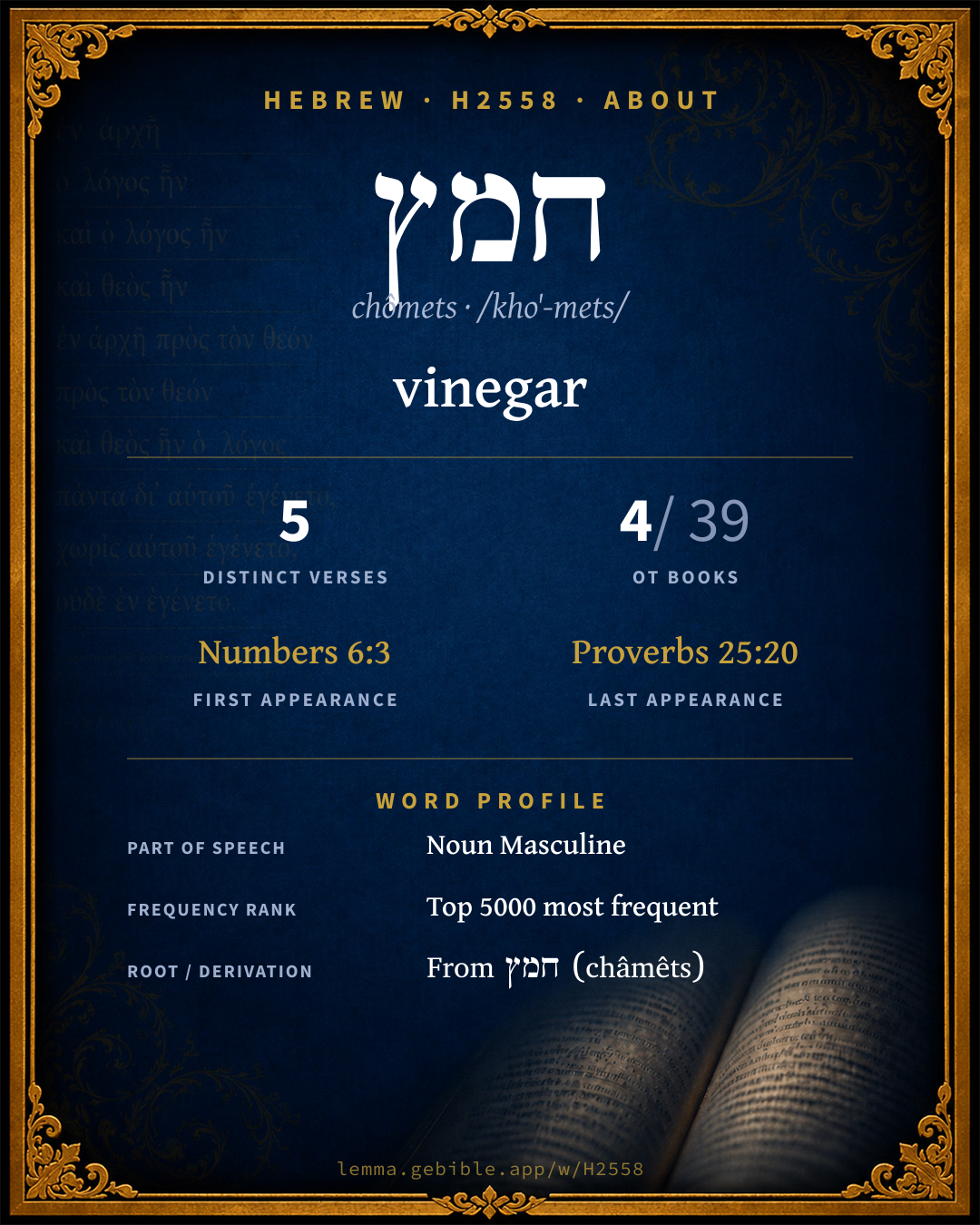
חֹ֫מֶץ
vinegar
Full lexicon entry — Brown-Driver-Briggs (BDB)
From Brown-Driver-Briggs (BDB)
Where this word appears
See every Absolute-state word in the Hebrew Bible →
Grammar key — what these labels mean
Part of speech
- Noun
- A naming word — a person, place, thing, or idea.
Noun type
- Common
- A common noun — a general class of person, place, or thing (“king,” “city,” “water”), not a specific name.
State
- Absolute
- The independent form of a noun, not bound to a following word.
- Construct
- A noun bound to a following noun in a possessive / “of” relationship (the construct chain).
Gender
- Masculine
- Grammatically masculine.
Number
- Singular
- One.
1 distinct verse where H2558 appears in the Construct state, across 1 book. Filtered view — show all forms. Click any verse to open its interlinear word-by-word view. Verse text shown in the World English Bible for context — . Each verse’s Hebrew form is shown with its reference; the English is not keyword-highlighted, since the data carries no word-level English alignment. Use “Compare translations” on any verse to read it across multiple English versions. This concordance covers the Hebrew Bible; Septuagint (Greek Old Testament) occurrences are not indexed here.
Numbers 1 verse
About this entry
At a glance — auto-summarized from this page’s data, not written by a person. Every figure links to its source below. This summary describes the numbers; it doesn’t interpret them.
The Hebrew noun חמץ centers on the idea of “vinegar.” It is rare — just 5 verses in the entire Hebrew Bible. Proverbs dominates its distribution — 2 of 5 verses. Its earliest occurrence is Numbers 6:3. Sharing its root, it stands alongside חמץ, חמוץ and חמיץ. For the data behind this summary, explore the sense tree and the renderings breakdown below.
Gloss history
Strong's 1890 vs modern scholarship
About this word
Strong's H2558 catalogs a Hebrew word from the Hebrew Old Testament.
These counts are not copied from any lexicon or concordance. They are computed here, from the morphology-tagged Hebrew Old Testament. What Lemma adds →
- 5
- distinct verses
- The word appears in 5 distinct verses.
- 4 / 39
- OT books
- The word appears in 4 of 39 Old Testament books.
- #3,040
- by frequency
- Top 5000 most frequent Hebrew words (rank 3,040 of 8,640 Hebrew words by occurrence).
View all 5 occurrences in the concordance →
By section of the Old Testament
By traditional corpus
Conventional, traditional groupings — biblical authorship is debated, so this is a traditional corpus grouping, not an authorship claim. Each share is this word’s portion of its verses in that division of the Hebrew canon. Each figure is a share of the word’s 5 distinct verses.
- Writings (Ketuvim) 4 verses · 80%
- Torah (Pentateuch) 1 verse · 20%
How translations render this word
Counts come from each version’s own published word-to-Strong’s tagging or interlinear alignment — an approximate guide to how each version renders this word, not a word-level alignment the data otherwise carries. Because each total is that version’s own tagged count, the per-version totals vary from one another and need not match the appearance or distinct-verse counts above. These counts may also differ from a printed concordance because Lemma counts each distinctly tagged rendering and does not collapse phrase taggings into a single head-word total. This is a fixed set of word-tagged versions (KJV, ASV, BSB, ULT) and does not change with the reading translation you choose elsewhere. Each version’s license is shown beside its name below (and on Sources).
- King James Version: Vinegar 4×
- American Standard Version: Vinegar 4×
- Berean Standard Bible: Gave me vinegar 1×, Like vinegar 1×, Or vinegar 1×
- unfoldingWord Literal Text: Vinegar 3×, Vinegar of 2×
King James Version Public Domain
Renders H2558 across 6 tagged occurrences — most commonly:
Plus 2 renderings that appear only once — usually multi-word phrases or single function words the recovered tagging swept in, not distinct renderings.
American Standard Version Public Domain
Renders H2558 across 6 tagged occurrences — most commonly:
Plus 2 renderings that appear only once — usually multi-word phrases or single function words the recovered tagging swept in, not distinct renderings.
Berean Standard Bible Public Domain
Renders H2558 across 5 tagged occurrences — most commonly:
Not rendered by a distinct English word in 1 further occurrence.
unfoldingWord Literal Text CC BY-SA 4.0
Renders H2558 across 6 tagged occurrences — most commonly:
Plus 1 rendering that appears only once — usually multi-word phrases or single function words the recovered tagging swept in, not distinct renderings.
Senses in BDB
The 1 sense BDB distinguishes for this word, in lexicon order (not ranked by frequency or importance). The full entry — with sub-senses — is in the Lexicon Entry tab.
- vinegar
Word origin
n.m. vinegar—ח׳ abs. Pr 10:26 + 3 times; cstr. Nu 6:3(×2);—a common condiment Ru 2:14, forbidden to Nazirite (ח׳ יין and ח׳ שֵׁכָר) Nu 6:3(×2) (P), offered (in cruelty) to a thirsty man ψ 69:22 (fig. for harshness, lack of sympathy); in sim. of sluggard כַּחֹמֶץ לַשִּׁנַּיִם Pr 10:26, ח׳ עַל־נָ֑תֶר Pr 25:20 vinegar on nitre (sim. of merry songs for the heavy-hearted).
— Brown-Driver-Briggs (Oxford 1906, public domain), digitized via Sefaria, supplemented by the OpenScriptures HebrewLexicon (CC BY 4.0). See Sources.
Derived from חמץ (châmêts) (H2556) — to be sour.
Jastrow Dictionary
A second Hebrew/Aramaic lexicon for comparison, covering Aramaic and post-biblical (Talmudic, Targumic, Midrashic) usage that the biblical-Hebrew BDB does not. Matched by lemma rather than by Strong’s number, so a lemma may carry more than one Jastrow headword (shown separately below), and the entries cover usage well beyond the Bible.
חָמַץ
- [to be hot,] to do violence, to wrong. Snh. 35ᵃ (ref. to Is. I, 17) אשרו חָמוּץ ולא חוֹמֵץ right the oppressed, but not the oppressor (listen to the complainant first); Yoma 39ᵇ e.g. Isaiah 1:17
חָמֵץ I
- v. preced.) [to be hot,] to ferment, be sour. Ad. Zar. 68ᵇ מי גרם לה שתֶּחְמַץ וכ׳ what was the cause that it (the dough) became leavened (rose) in one hour?
- to cause leavening. Ib.ᵃ ראויה לחַמֵּץ וכ׳ Ms. M. (ed. לחַמֵּעַ) fit to leaven with it many other doughs. Ib. וחִימְּצוּ; Orl. II, 11 נצטרפו וחִמְּצוּ (Y. ed. הצטרפו וחִימֵּיצוּ) and the two combined produced the required leavening, Ib. 9 וחִמְּצָהּ (Y. ed. וחִימֵּיצָהּ; Ab. Zar. l. c. והֶחְמִיצָהּ) and it made the dough rise. Orl. II 6 כל המְחַמֵּץ whatever is used for producing fermentation; a. fr.—Trnsf. to mature, to continue a case over night, to reserve judgment. Snh. 35ᵃ (ref. to Is. I, 17, v. preced.) אשרו דיין שמְחַמֵּץ את וכ׳ Ms. K. (ed. אשרי, v. Rabb. D. S. a. l. note 20) praise the judge (in capital cases) who reserves his judgment (over night); Yalk. Is. 257. e.g. Isaiah 1:17
- 1. same. Pes. 40ᵃ מי פירות אינן מַחְמִיצִין juice of fruits produces no leavening (in the ritual sense). Ab. Zar. 68ᵃ כדי להחמיץ (Orl. II, 8 לחַמֵּץ) enough to leaven the dough. Mekh. Bo s. 10 שאור שהוא מַחְמִיץ לאחרים leaven which is used for leavening other doughs; a. fr.—Trnsf. to procrastinate. Ib. s. 9 (play on המַצּוֹת, Ex. XII, 17) כדרך … אין מַחְמִיצִין את המִצְוָה as well as you must not allow the matsah to become sour, so you must not allow the mitsvah (religious act) to become sour by postponement; Yalk. Ex. 201. e.g. Exodus 12:17
- 2. to turn sour, to ferment. Ab. Zar. 68ᵇ ראויה להַחְמִיץ וכ׳ (Ms. M. לחמע) is likely to ferment in two hours. Nidd. IX, 7 מי רגלים שהֶחְמִיצוּ urin which ferments.—Trnsf. to degenerate, become wicked. R. Hash. 3ᵇ קודם שה׳ before he (the Persian King) changed for the worse.
- to become sour (חָמֵץ). Pes. 28ᵇ; 43ᵃ נ׳ מאליו became sour of itself (not through a leavening means).
חֲמַץ
- (preced. wds.)
- 1. to be hot, (of color) red, v. חִימּוּצָא, חִימּוּצָתָא.
- 2. to be sour, salty &c.
- to put to shame. Targ. Prov. X, 1 (h. text תוגת), v. חִימּוּצָא.
- 1. same. Ib. XXV, 8; XXVIII, 7 (Ms. same. Ib. XXV, 8; XXVIII, 7 (Ms. Pa.; h. text הכלים).
- 2. to degenerate. R. Hash. 4ᵃ מנלן דא׳ what evidence have we that he became wicked?, v. preced.
חָמֵץ II
- preced. wds.) leavened bread, anything containing leavened substance (of the five species of grain, v. Ḥall. I, 1, sq.). Pes. I, 1, v. בָּדַק. Ib. II, 2 ח׳ של עכ"ום וכ׳ ḥamets belonging to a gentile over which the Passover passed (which existed during the Passover week). Ib. 3 על חֲמֵצוֹ (trad. pronunc. חֶמְצוֹ as if fr. חֵמֶץ) on ḥ. belonging to him. Y. Shebi. VIII, 38ᵇ bot. חֲמֵיצָן של וכ׳ ḥ. belonging to Samaritans; Y. Ab. Zar. V, 44ᵈ bot. אכל חמצין (read: חֲמֵיצָן) ate their (the Samaritans’) ḥ. (immediately after Passover); a. v. fr.—Pl. חֲמֵצִים, חֲמֵצין salads, v. חוּמְצָן.
חֲמָץ
- (Gr. Ἔμεσα, Ἔμισσα) Ḥămâts, Emesa (mod. Hums) a city of Syria on the Eastern bank of the Orontes. Gen. R. s. 37; Y. Meg. I, 71ᵇ bot. (expl. צמרי, Gen. X, 18).—Y. Kil. IX, 32ᶜ bot.; Y. Keth. XII, 35ᵇ bot. ימא דח׳ the Lake of E. (an artificial bay made under Diocletian); Midr. Till. to Ps. XXIV ימא דחמין (corr. acc.).—Denom. חֲמָצָאֵי, חוֹמְצָאֵי m. pl. inhabitants of Emesa. Targ. Y. Gen. X, 18; Targ. I Chr. I, 16. e.g. Genesis 10:18
A Dictionary of the Targumim, the Talmud Babli and Yerushalmi, and the Midrashic Literature (Marcus Jastrow; London, Luzac, 1903) — Public Domain. Digitized via Sefaria. Digitized via Sefaria. Full attribution on Sources.
Forms in the corpus
The 6 distinct written forms H2558 takes in the Hebrew Bible, most frequent first — each parse links to that state’s occurrences in the concordance. Hebrew forms include their vowel points and cantillation, so a single lemma takes many written forms.
| Form | Parsing | Example | Uses |
|---|---|---|---|
| בַּ/חֹ֑מֶץ | Noun, Common, Masculine, Singular, Absolute | Ruth 2:14 | 1 |
| וְ/חֹ֥מֶץ | Noun, Common, Masculine, Singular, Construct | Numbers 6:3 | 1 |
| חֹ֣מֶץ | Noun, Common, Masculine, Singular, Absolute | Proverbs 25:20 | 1 |
| חֹ֥מֶץ | Noun, Common, Masculine, Singular, Construct | Numbers 6:3 | 1 |
| חֹֽמֶץ | Noun, Common, Masculine, Singular, Absolute | Psalms 69:21 | 1 |
| כַּ/חֹ֤מֶץ | Noun, Common, Masculine, Singular, Absolute | Proverbs 10:26 | 1 |
Same root — word family
Other BDB entries built from the same root as H2558, grouped by Strong’s listed origin. These share a root / origin per the lexicon — not necessarily a shared meaning. Each links to that word’s own entry.
Derives from
Shares the same root
Compare all same-root words → Showing 4 of 5 — not the complete family. They share a root, not necessarily a meaning.
Septuagint verse parallels
This word appears in 4 verses that also exist in the Greek Old Testament (Septuagint), out of the 5 Hebrew verses it occurs in. You can read those verses in Greek by switching the Old Testament edition to the Septuagint.
Read these verses in the Septuagint
This is a verse-level parallel only — the same verses exist in both the Hebrew and Greek Old Testaments. No word-level Hebrew↔Greek correspondence is claimed: the data carries no such alignment, so no Greek word is shown as this Hebrew word’s translation. Coverage is not total — the Septuagint omits the deuterocanon and renumbers the Psalms, so some Hebrew verses have no direct Greek parallel.