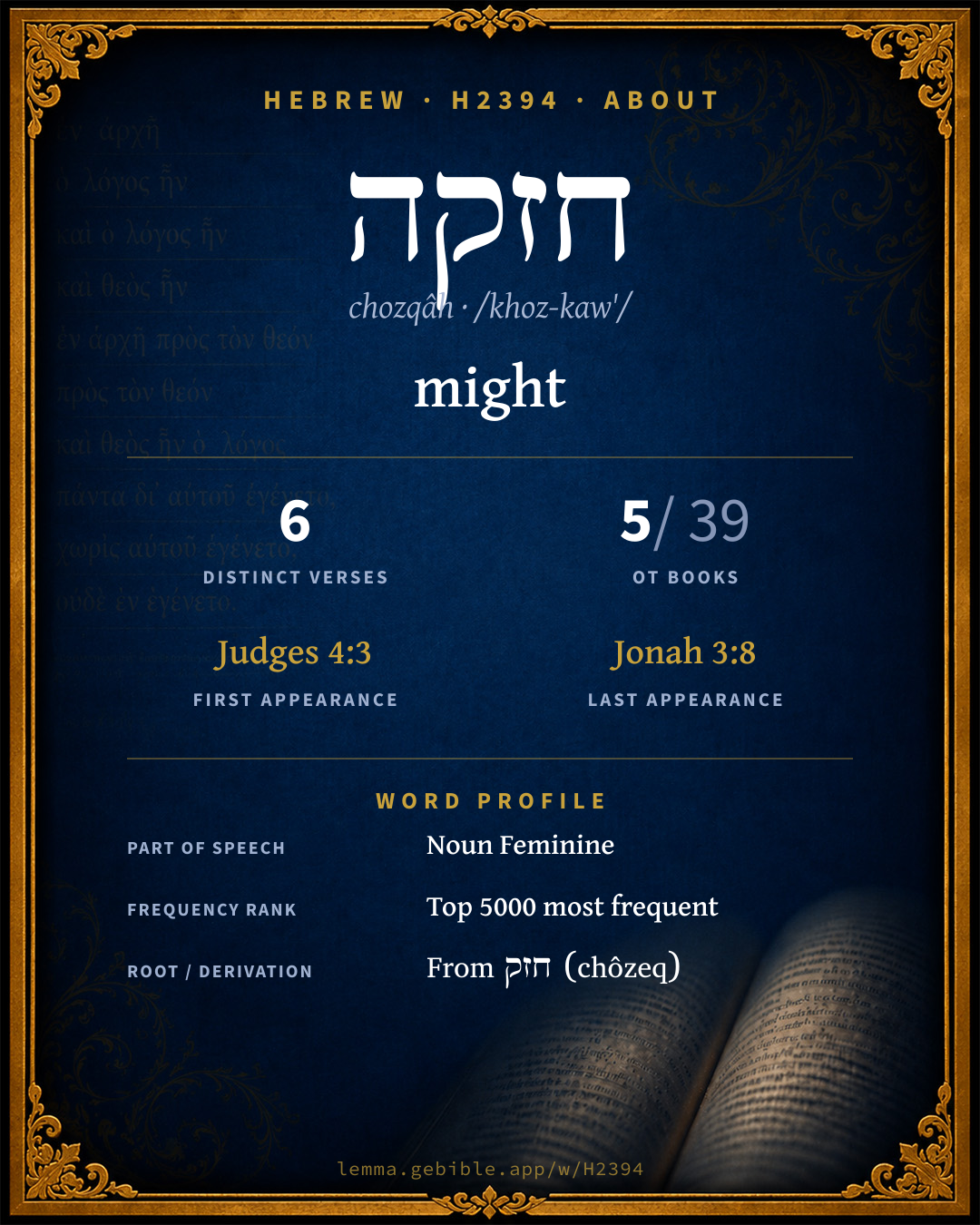
חׇזְקָה
might
Full lexicon entry — Brown-Driver-Briggs (BDB)
From Brown-Driver-Briggs (BDB)
Where this word appears
Grammar key — what these labels mean
Noun type
- Common
- A common noun — a general class of person, place, or thing (“king,” “city,” “water”), not a specific name.
Stem
- Qal
- The basic, simple active stem — the plain form of the verb (“he wrote”).
Form
- Infinitive Construct
- A bound verbal noun, frequently with prepositions (“to write / in writing”).
State
- Absolute
- The independent form of a noun, not bound to a following word.
Gender
- Feminine
- Grammatically feminine.
Number
- Singular
- One.
Every verse where H2394 appears in the Book of 2 Kings — 1 distinct verse. Click any verse to open its interlinear word-by-word view. Verse text shown in the World English Bible for context — . Each verse’s Hebrew form is shown with its reference; the English is not keyword-highlighted, since the data carries no word-level English alignment. Use “Compare translations” on any verse to read it across multiple English versions. This concordance covers the Hebrew Bible; Septuagint (Greek Old Testament) occurrences are not indexed here.
2 Kings
About this entry
At a glance — auto-summarized from this page’s data, not written by a person. Every figure links to its source below. This summary describes the numbers; it doesn’t interpret them.
חזקה — transliterated chozqâh — is a Hebrew noun carrying the sense “might.” Debuting at Judges 4:3, it then recurs through the corpus. It appears 6 verses across 5 books of the Hebrew Bible, among its uncommon vocabulary. More than a third of its appearances fall in Judges. See the sense tree, 6-verse concordance, and the renderings breakdown below.
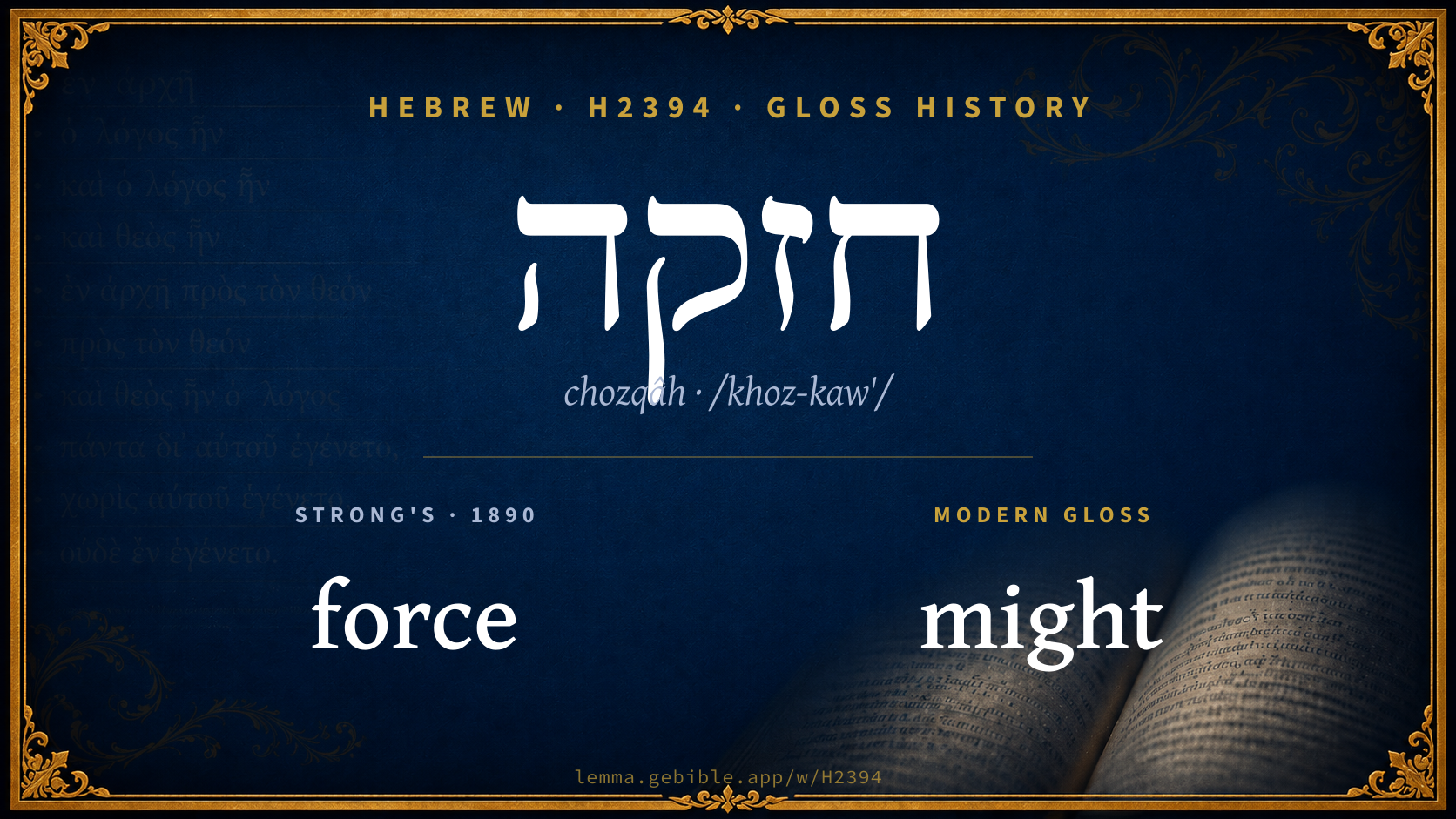
Gloss history
Strong's 1890 vs modern scholarship
About this word
Strong's H2394 catalogs a Hebrew word from the Hebrew Old Testament.
These counts are not copied from any lexicon or concordance. They are computed here, from the morphology-tagged Hebrew Old Testament. What Lemma adds →
- 6
- distinct verses
- The word appears in 6 distinct verses.
- 5 / 39
- OT books
- The word appears in 5 of 39 Old Testament books.
- #3,040
- by frequency
- Top 5000 most frequent Hebrew words (rank 3,040 of 8,640 Hebrew words by occurrence).
View all 6 occurrences in the concordance →
By section of the Old Testament
By traditional corpus
Conventional, traditional groupings — biblical authorship is debated, so this is a traditional corpus grouping, not an authorship claim. Each share is this word’s portion of its verses in that division of the Hebrew canon. Each figure is a share of the word’s 6 distinct verses.
- Prophets (Nevi'im) 6 verses · 100%
How translations render this word
Counts come from each version’s own published word-to-Strong’s tagging or interlinear alignment — an approximate guide to how each version renders this word, not a word-level alignment the data otherwise carries. Because each total is that version’s own tagged count, the per-version totals vary from one another and need not match the appearance or distinct-verse counts above. These counts may also differ from a printed concordance because Lemma counts each distinctly tagged rendering and does not collapse phrase taggings into a single head-word total. This is a fixed set of word-tagged versions (KJV, ASV, BSB, ULT) and does not change with the reading translation you choose elsewhere. Each version’s license is shown beside its name below (and on Sources).
- King James Version: Force 2×
- American Standard Version: Force 1×, He mightily 1×, I will take it by force 1×
- Berean Standard Bible: Earnestly 1×, Force 1×, Had harshly 1×
- unfoldingWord Literal Text: Strength 2×
King James Version Public Domain
Renders H2394 across 6 tagged occurrences — most commonly:
Plus 4 renderings that appear only once — usually multi-word phrases or single function words the recovered tagging swept in, not distinct renderings.
American Standard Version Public Domain
Renders H2394 across 6 tagged occurrences — most commonly:
Berean Standard Bible Public Domain
Renders H2394 across 4 tagged occurrences — most commonly:
Not rendered by a distinct English word in 1 further occurrence.
unfoldingWord Literal Text CC BY-SA 4.0
Renders H2394 across 7 tagged occurrences — most commonly:
Plus 5 renderings that appear only once — usually multi-word phrases or single function words the recovered tagging swept in, not distinct renderings.
Senses in BDB
The 1 sense BDB distinguishes for this word, in lexicon order (not ranked by frequency or importance). The full entry — with sub-senses — is in the Lexicon Entry tab.
- force, might, strength, violence
Word origin
חָזְקָה n.f. strength, force, violence
— Brown-Driver-Briggs (Oxford 1906, public domain), digitized via Sefaria, supplemented by the OpenScriptures HebrewLexicon (CC BY 4.0). See Sources.
Derived from חזק (chôzeq) (H2392) — strength.
Jastrow Dictionary
A second Hebrew/Aramaic lexicon for comparison, covering Aramaic and post-biblical (Talmudic, Targumic, Midrashic) usage that the biblical-Hebrew BDB does not. Matched by lemma rather than by Strong’s number, so a lemma may carry more than one Jastrow headword (shown separately below), and the entries cover usage well beyond the Bible.
חֲזָקָה
- (חָזַק)
- 1. taking hold. Y. M. Kat. III, 83ᶜ top (ref. to II Sam. I, 11) אין ח׳ וכ׳ taking hold (of a garment to rend it in mourning) means no less than a hand-breadth of it. e.g. 2 Samuel 1:11
- 2. (law) taking posssession, posession, usucaption; claim based on undisturbed possession during a legally fixed period. B. Bath. III, 1 חֶזְקַת הבתים וכ׳ the legal period of undisturbed possession (in order to give a title) is for houses … three years. Ib. 29ᵇ (in Chald. diction) אכלית שני ח׳ I had the undisturbed usufruct for the period prescribed by law. Ib. 36ᵃ עבדים יש להם ח׳ does the law of possession apply to slaves?—Ib. אין להם ח׳ לאלתר וכ׳ present possession gives no title (as is the case with inanimate movable chattel), but a possession of three years does. Ib. III, 2 שלש ארצות לח׳ there are in Palestine three districts with different usages of possession. Ib. 3 כל ח׳ שאין וכ׳ possession without a plea (of purchase or any other mode of legal acquisition) gives no title; a. v. fr.
- 3. presumption, presumptive continuance of an actual condition until evidence of a change is produced; legal status. Ḥull. 9ᵃ בהמה בחייה בחֶזְקַת איסור וכ׳ the anima l when alive, has the status of a forbidden object (v. אֵבֶר), until you ascertain by what means it has been ritually slaughtered; when it is slaughtered הרי היא בח׳ היתר וכ׳ it has the status of a permitted object, until you find out how it became forbidden. Gitt. III, 3 בחזקת שהוא קיים under the presumption that her husband (though sick or old when the messenger was deputed) is alive. Keth. 75ᵇ ח׳ דגופא a presumption as regards physical condition, ח׳ דממונא the fact of possession against which the claimant has to produce satisfactory evidence. Ib. ח׳ אין אדם שותה וכ׳ the presumption is that no man drinks out of a cup without examining (that none will marry without having ascertained the woman’s physical condition). Yeb. 31ᵇ top חזקת בר שטיא the legal status of an insane person’s property; a. v. fr.—Pl. חֲזָקוֹת. Kidd. 80ᵃ סוקלין … מלקין על הח׳ we execute punishment on the basis of actual facts (though not provable by legal evidence, e.g. man and wife and children living together and treating each other as such, are legally considered as being one family), v. חָזַק Hof.—Y. Ḥall. IV, 60ᵃ bot. לח׳ with reference to the local usages of usucaption (Gitt. III, 2, v. supra); a. e.
A Dictionary of the Targumim, the Talmud Babli and Yerushalmi, and the Midrashic Literature (Marcus Jastrow; London, Luzac, 1903) — Public Domain. Digitized via Sefaria. Digitized via Sefaria. Full attribution on Sources.
Forms in the corpus
The 6 distinct written forms H2394 takes in the Hebrew Bible, most frequent first — each parse links to that state’s occurrences in the concordance. Hebrew forms include their vowel points and cantillation, so a single lemma takes many written forms.
| Form | Parsing | Example | Uses |
|---|---|---|---|
| בְ/חָזְקָֽה | Noun, Common, Feminine, Singular, Absolute | 1 Samuel 2:16 | 1 |
| בְּ/חָזְקָ֑ה | Noun, Common, Feminine, Singular, Absolute | Jonah 3:8 | 1 |
| בְּ/חָזְקָ֖ה | Noun, Common, Feminine, Singular, Absolute | Judges 4:3 | 1 |
| בְּ/חָזְקָֽה | Noun, Common, Feminine, Singular, Absolute | Judges 8:1 | 1 |
| וּ/בְ/חָזְקָ֛ה | Noun, Common, Feminine, Singular, Absolute | Ezekiel 34:4 | 1 |
| לְ/חָזְקָֽה | Verb, Qal, Infinitive Construct | 2 Kings 12:12 | 1 |
Septuagint verse parallels
This word appears in 6 verses that also exist in the Greek Old Testament (Septuagint), out of the 6 Hebrew verses it occurs in. You can read those verses in Greek by switching the Old Testament edition to the Septuagint.
Read these verses in the Septuagint
This is a verse-level parallel only — the same verses exist in both the Hebrew and Greek Old Testaments. No word-level Hebrew↔Greek correspondence is claimed: the data carries no such alignment, so no Greek word is shown as this Hebrew word’s translation. Coverage is not total — the Septuagint omits the deuterocanon and renumbers the Psalms, so some Hebrew verses have no direct Greek parallel.