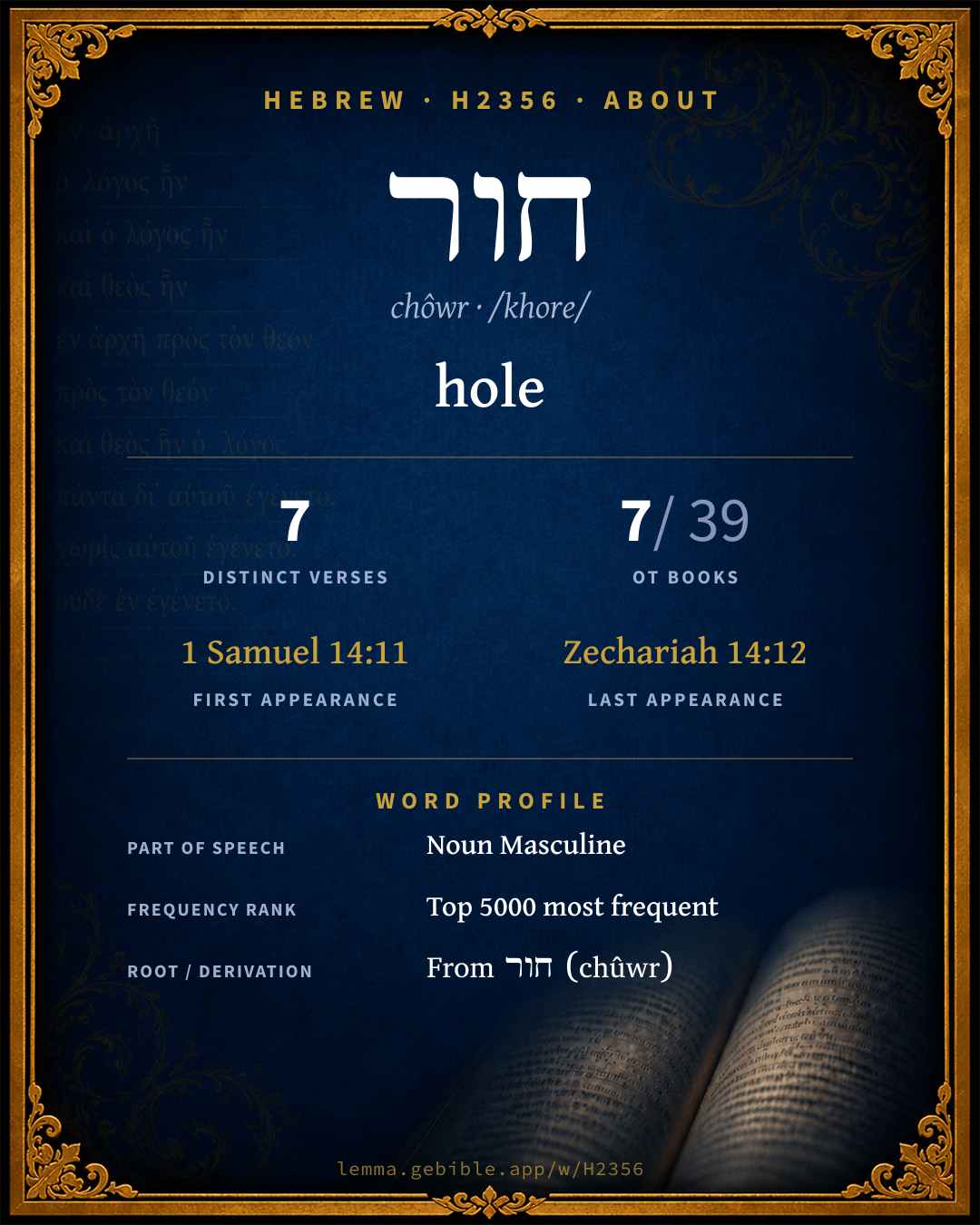
חֹר
hole
Full lexicon entry — Brown-Driver-Briggs (BDB)
From Brown-Driver-Briggs (BDB)
Where this word appears
Grammar key — what these labels mean
Part of speech
- Noun
- A naming word — a person, place, thing, or idea.
Noun type
- Common
- A common noun — a general class of person, place, or thing (“king,” “city,” “water”), not a specific name.
State
- Absolute
- The independent form of a noun, not bound to a following word.
- Construct
- A noun bound to a following noun in a possessive / “of” relationship (the construct chain).
Gender
- Masculine
- Grammatically masculine.
Number
- Singular
- One.
- Plural
- More than one (in Hebrew, generally three or more).
Every verse where H2356 appears in the Book of 1 Samuel — 1 distinct verse. Click any verse to open its interlinear word-by-word view. Verse text shown in the World English Bible for context — . Each verse’s Hebrew form is shown with its reference; the English is not keyword-highlighted, since the data carries no word-level English alignment. Use “Compare translations” on any verse to read it across multiple English versions. This concordance covers the Hebrew Bible; Septuagint (Greek Old Testament) occurrences are not indexed here.
1 Samuel
About this entry
At a glance — auto-summarized from this page’s data, not written by a person. Every figure links to its source below. This summary describes the numbers; it doesn’t interpret them.
“hole” is the headline sense of the Hebrew noun חור (chôwr). Scripture first uses it in 1 Samuel 14:11. It appears 7 verses across 7 books of the Hebrew Bible, among its uncommon vocabulary. It shares a root with חור, חר הגדגד and חרי. The sections below give every sense, occurrence, and version rendering.
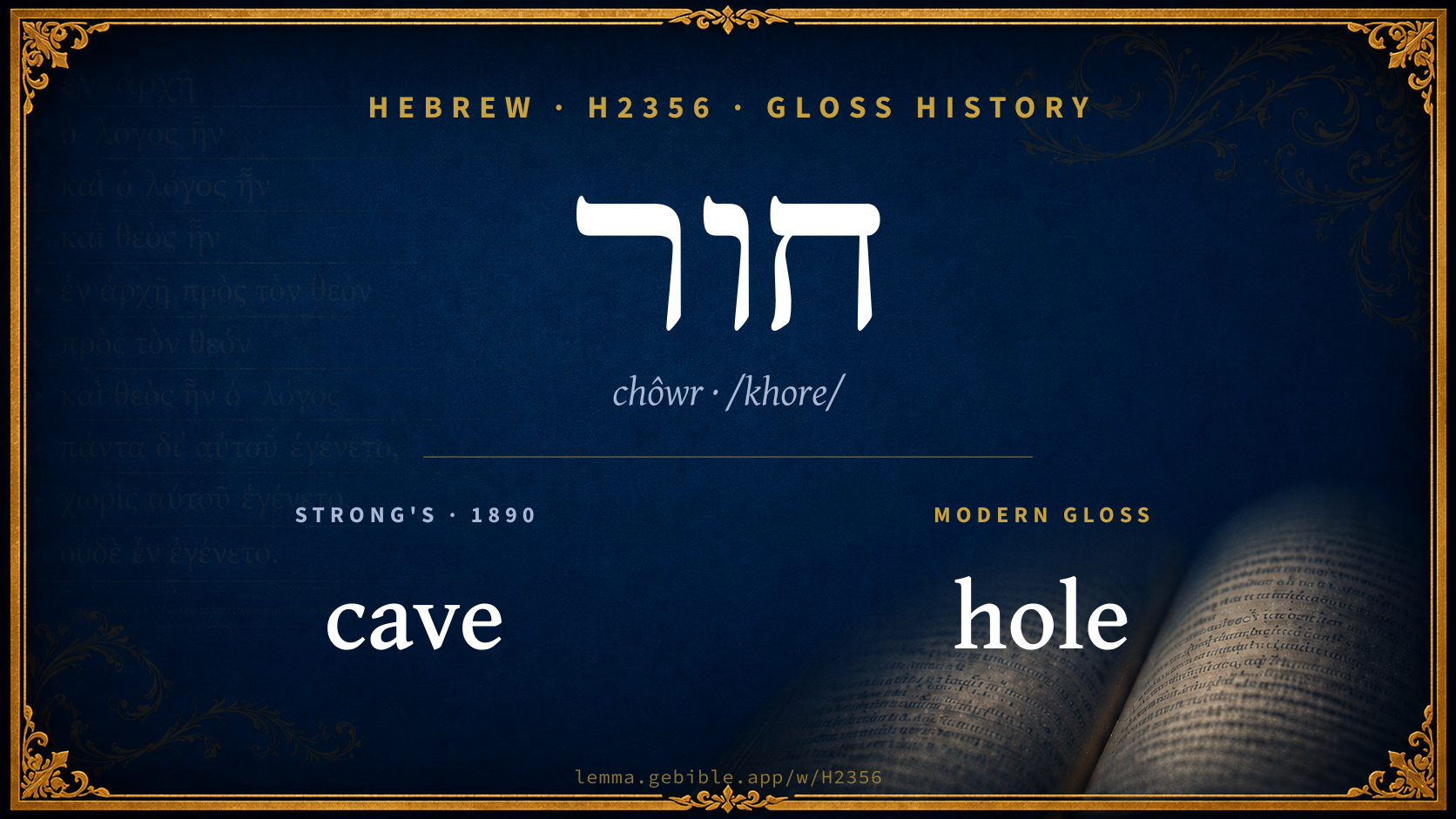
Gloss history
Strong's 1890 vs modern scholarship
About this word
Strong's H2356 catalogs a Hebrew word from the Hebrew Old Testament.
These counts are not copied from any lexicon or concordance. They are computed here, from the morphology-tagged Hebrew Old Testament. What Lemma adds →
- 7
- distinct verses
- The word appears in 7 distinct verses.
- 7 / 39
- OT books
- The word appears in 7 of 39 Old Testament books.
- #2,835
- by frequency
- Top 5000 most frequent Hebrew words (rank 2,835 of 8,640 Hebrew words by occurrence).
View all 7 occurrences in the concordance →
By section of the Old Testament
By traditional corpus
Conventional, traditional groupings — biblical authorship is debated, so this is a traditional corpus grouping, not an authorship claim. Each share is this word’s portion of its verses in that division of the Hebrew canon. Each figure is a share of the word’s 7 distinct verses.
- Prophets (Nevi'im) 5 verses · 71%
- Writings (Ketuvim) 2 verses · 29%
How translations render this word
Counts come from each version’s own published word-to-Strong’s tagging or interlinear alignment — an approximate guide to how each version renders this word, not a word-level alignment the data otherwise carries. Because each total is that version’s own tagged count, the per-version totals vary from one another and need not match the appearance or distinct-verse counts above. These counts may also differ from a printed concordance because Lemma counts each distinctly tagged rendering and does not collapse phrase taggings into a single head-word total. This is a fixed set of word-tagged versions (KJV, ASV, BSB, ULT) and does not change with the reading translation you choose elsewhere. Each version’s license is shown beside its name below (and on Sources).
BDB lists this Strong’s number as 5 distinct words (homographs). Each count above pools all of them and is not split by sense — see the Senses section below. A low-frequency rendering may belong to a different one of those words, not the primary meaning.
- King James Version†: Hole 3×, Holes 3×
- American Standard Version†: Hole 3×, Holes 2×
- Berean Standard Bible†: Hole 2×, Holes 2×
- unfoldingWord Literal Text†: Hole 3×
King James Version Public Domain
Renders H2356 across 7† tagged occurrences — most commonly:
Plus 1 rendering that appears only once — usually multi-word phrases or single function words the recovered tagging swept in, not distinct renderings.
American Standard Version Public Domain
Renders H2356 across 7† tagged occurrences — most commonly:
Plus 2 renderings that appear only once — usually multi-word phrases or single function words the recovered tagging swept in, not distinct renderings.
Berean Standard Bible Public Domain
Renders H2356 across 7† tagged occurrences — most commonly:
Plus 3 renderings that appear only once — usually multi-word phrases or single function words the recovered tagging swept in, not distinct renderings.
unfoldingWord Literal Text CC BY-SA 4.0
Renders H2356 across 7† tagged occurrences — most commonly:
Plus 4 renderings that appear only once — usually multi-word phrases or single function words the recovered tagging swept in, not distinct renderings.
Senses in the full BDB
What do BDB’s symbols mean?
BDB uses these scholarly abbreviations:
| Symbol | Meaning |
|---|---|
| 𝔊 | the Septuagint (the ancient Greek translation, LXX) |
| 𝔙 | the Vulgate (the Latin translation) |
| 𝔖 | the Syriac version (the Peshitta) |
| 𝔗 | the Targum (the Aramaic translation) |
| ψ | the Psalms |
| √ | root (the underlying root or stem) |
| ‖ | parallel passage (a synonymous or contrasted parallel) |
| † | the dagger: every passage where the word occurs is cited |
The 0 senses and sub-senses the full Brown-Driver-Briggs lexicon distinguishes for this word, in lexicon order (not ranked by frequency), with BDB’s own verbatim wording and sub-sense lettering. Shown in Hebrew script with BDB’s own scholarly abbreviations. The condensed entry is in the Lexicon Entry tab. See also the Forms in the corpus table below.
חור I [m.] hollow, only in חֹר הַגִּדְגָּ֑ד Nu 33
חור II (חוֹרִים) v. sub II., III. חרר.
חור III [m.] hole
Senses from the full Brown-Driver-Briggs lexicon (Brown, Driver, Briggs; Oxford 1906 — public domain), digitized via Sefaria, supplemented by the OpenScriptures HebrewLexicon (CC BY 4.0). Full attribution on Sources.
Word origin
I. n.[m.] hollow, only in חֹר הַגִּדְגָּ֑ד Nu 33:32 hollow of Gidgad (v. Di); v. p. 151.
I. (חוֹרִים) v. sub II., III. חרר.
II. v. ii. חור; ii, iii חֹר, חֻר v. ii, iii חרר.
III. n.m. 1 K 21:8 noble, late, especially Neh., v. DrIntr. 519 n. (v. LagBN 32) cf. NöZMG lvii (1903), 416.—only pl. חֹרִים 1 K 21:8 + 6 times, חוֹרִים Ec 10:17, Ne 6:17 + 3 times; sf. חֹרֶיהָ Is 34:12;—nobles in Naboth’s city 1 K 21:8, 11; nobles of Judah, חֹרֵי יְהוּדָה 6:17; 13:17 Je 27:20; 39:6 Ne 6:17; 13:17, הח׳ והסגנים (in Jerusalem) Ne 2:16; 4:8, 13; 5:7; 7:5, Ec 10:17, of Edom Is 34:12.—i. חֹר, v. ii. חור.
IV. n.[m.] hole;—abs. חֹר 2 K 12:10 Ez 8:7 (del. Co B etc.), חוֹר Ct 5:4, חֹרִים 1 S 14:11; cstr. חֹרֵי Jb 30:6; sf. חֹרָיו Na 2:13, חֹרֵיהֶן Zc 14:12;—hole in lid of chest 2 K 12:10 (made by boring, נקב), in door Ct 5:4; in wall Ez 8:7 (v. supra); = eye-socket עיניו תִּמַּקְנָה בְּח׳ Zc 14:12 (plague of enemies of Jerusalem); holes as hiding-places for men 1 S 14:11, so also 13:6 Ew We Dr (for MT חוחים), dwelling of outcast people חרי עָפָר Jb 30:6; of dens of lions Na 2:13.—i. חֹר, v. ii. חור.
— Brown-Driver-Briggs (Oxford 1906, public domain), digitized via Sefaria, supplemented by the OpenScriptures HebrewLexicon (CC BY 4.0). See Sources.
Derived from חור (chûwr) (H2352) — hole.
Jastrow Dictionary
A second Hebrew/Aramaic lexicon for comparison, covering Aramaic and post-biblical (Talmudic, Targumic, Midrashic) usage that the biblical-Hebrew BDB does not. Matched by lemma rather than by Strong’s number, so a lemma may carry more than one Jastrow headword (shown separately below), and the entries cover usage well beyond the Bible.
חָוַר
- to perforate; to be transparent, white, clear.
- to make clear, evident. Mekh. Mishp., N’zikin, s. 13 (ref. to Deut. XXII, 17) מְחַוְּורִין … כשמלה they must make the fact as clear as a (white) sheet. Gen. R. s. 98 (ref. to כבס, ib. XLIX, 11) שהוא מְחַוֵּור וכ׳ he will make clear to them the words of the Law; שהוא מח׳ להם טעיותיהם he will prove to them their errors; a. e.—Part. pass. מְחוּוָּר clear, proved, evident. Y. Shek. III, end, 47ᶜ מ׳ שבכולן the clearest of all the quoted Biblical evidences. Gen. R. s. 47, end; Y. Ab. Zar. I, 39ᵈ top מ׳ שבכולן the least doubtful of all. Y. Succ. V, beg. 55ᵃ משם שאינו מח׳ because the use of the flute is not clearly stated in the Law. Y. Ter. II, 41ᶜ bot. זה אחד … שהן מְחוּוָּרִין וכ׳ this is one of the three interpretations (of the Rabbis) which are clearly indicated in the Bible text. Y. Erub. III, 21ᵃ bot. הגיעוך סוף … שאינן מח׳ thou must finally admit that the law of Sabbath limits finds no proof in the Biblical words. Y. Ber. II, 5ᵃ bot. הגיעוך סוף מלאכות תפלה שאינן מח׳ מד"ת ed. Lehm. (oth. ed. corr. acc.) thou must admit that for labors permitted or forbidden during prayer no support is to be found in &c.; a. fr. e.g. Deuteronomy 22:17
- to be made clear. Y. Keth. IV, 28ᶜ top (ref. to Deut. XXII, 17) עד שיִתְחַוְּורוּ וכ׳ the facts must be as clear &c., v. supra. e.g. Deuteronomy 22:17
חֲוַר
- 1. to be white, to shine. Targ. Joel I, 7. Targ. O. Gen. XLIX, 12 יְחִוְּרַן ed. Berl. (ed. Lsb. יַחְוְרָן, oth. ed. יְחַוְּ׳). Targ. Is. I, 18 (some ed. Pa.); a. e.—Keth. 61ᵇ top דחֲוַור אפיה that he looked pale. B. Kam. 69ᵃ כי היכי דנִיחֲוַור טפי that it may appear still more white (glistening from a distance). Naz. 39ᵃ, sq. חַוְורִין עיקבי נימהון the lower ends of dyed hair are white (which proves that the growth comes from beneath); a. fr.
- 2. (of eyes) to be bright, to look with gratification. Targ. Prov. XXIII, 33. Ib. XVII, 24 חָיְירָן Ms. (ed. חדיין, v. חדי). [Ib. IV, 25, emend. by Luzzatto Oheb Ger p. 108, v., however, אוֹר I ch.]—Kidd. 39ᵃ לא חַוְורִיתוּ you do not see clearly (the law is not clear to you).
- 1. to whiten, wash, cleanse. Targ. II Sam. XIX, 25; a. fr.—B. Mets. 60ᵇ חַוְּורֵיה וכ׳, v. דְּקַן. Ḥull. 95ᵇ top מְחַוֵּור, v. חֲלַל II. [Y. Taan. IV, 69ᵇ bot. מרוח, read מְחַוֵּר or מִחְוַר to wash.]—Part. pass. מְחַוַּור, f. מְחַוְּוָרא blanched. Targ. Y. Ex. IV, 6.
- 2. to make evident, to prove. Gen. R. s. 27 דמְחַוֵּור וכ׳ which will prove it better; Yalk. Koh. 968.—מְחַוַּורְתָּא it is proven, obvious. Ḥull. 117ᵃ. Pes. 55ᵇ; a. fr.
- to make white. B. Kam. 85ᵇ ואַחְוְורֵיה לבשריה and it (the corrodent) made his skin look white (like a leper’s; Var. v. Rabb. D. S. a. l.). B. Mets. 58ᵇ באַחְוְורֵי אפי (they guard against) whitening faces (putting persons to shame); Yalk. Ex. 349.
חָוַּר
- , v. חִיוַּר
חוּר I
- (cmp. preced. wds.) to bore. Sabb. 103ᵃ חָר חורתא he bored a hole.
חוֹר I
- preced. wds.)
- 1. hole, cavity. Pes. 8ᵃ ח׳ שבין אדם לחבירו a cave between two residences of neighbors.—Sabb. 52ᵇ מחט שניטל חוּרָהּ (Ms. M. חוּדְדָהּ, Ms. O. חֲרָרָהּ, some ed. חוּדָּהּ) a needle whose eye is broken off; ib. 123ᵃ חֲרָרָהּ (Ms. M. חוּדָּהּ); Kel. XIII, 5 חֲרִירָהּ; Tosef. Kel. B. Mets. III, 9 חודה.—Pl. חוֹרִין. Pes. l. c. Ib. חוֹרֵי בית וכ׳ the upper and the lower holes in the wall; a. fr.
- 2. ant’s store, v. חוֹרָר. [Pesik. Shor p. 74ᵇ חורין דדהב, v. חַזּוּר.] [Y. Maasr. V, end, 52ᵃ חור אחד, v. זוּר II.]
חוֹר II
- (b. h.), pl. חוֹרִין [white garments,] freedom; בֶּן ח׳, בַּת ח׳ free, freed, opp. to slave. Gitt. IV, 4 ועושה … בן ח׳ and he must declare him free. Ib. 5 חציו עבד וחציו בן ח׳ half a slave and half a freedman; a. fr.—Pl. בְּנֵי ח׳. B. Kam. I, 3 עדים ב׳ ח׳ וכ׳ witnesses who are freemen and of the Jewish faith. Esth. R. to I, 6 (expl. חוּר ib.) בגדים שב׳ ח׳ וכ׳ garments which freemen wear; a. fr.—(נכסים) בני ח׳ free (not mortgaged) property, opp. משועבדים. B. Kam. 8ᵇ; a. fr. [Bibl. Hebr. חוֹרִים, חֹרִים noblemen
חוּר III
- (b. h.) pr. n. m. Hur, the husband of Miriam. Mekh. B’shall., Amalek 1. Pesik. R. s. 12. Ex. R. s. 48 (grandfather of Bezaleel); a. fr.
A Dictionary of the Targumim, the Talmud Babli and Yerushalmi, and the Midrashic Literature (Marcus Jastrow; London, Luzac, 1903) — Public Domain. Digitized via Sefaria. Digitized via Sefaria. Full attribution on Sources.
Forms in the corpus
The 7 distinct written forms H2356 takes in the Hebrew Bible, most frequent first — each parse links to that state’s occurrences in the concordance. Hebrew forms include their vowel points and cantillation, so a single lemma takes many written forms.
| Form | Parsing | Example | Uses |
|---|---|---|---|
| בְ/חֹֽרֵי/הֶ֔ן | Noun, Common, Masculine, Plural, Construct | Zechariah 14:12 | 1 |
| הַ/חֹ֔ר | Noun, Common, Masculine, Singular, Absolute | Song of Solomon 5:4 | 1 |
| הַ/חֹרִ֖ים | Noun, Common, Masculine, Plural, Absolute | 1 Samuel 14:11 | 1 |
| חֹ֖ר | Noun, Common, Masculine, Singular, Absolute | 2 Kings 12:9 | 1 |
| חֹר | Noun, Common, Masculine, Singular, Absolute | Ezekiel 8:7 | 1 |
| חֹרֵ֖י | Noun, Common, Masculine, Plural, Construct | Job 30:6 | 1 |
| חֹרָ֔י/ו | Noun, Common, Masculine, Plural, Construct | Nahum 2:12 | 1 |
Same root — word family
Other BDB entries built from the same root as H2356, grouped by Strong’s listed origin. These share a root / origin per the lexicon — not necessarily a shared meaning. Each links to that word’s own entry.
Derives from
Proper names from this root
People and places named from this root — a name, not an additional meaning of the word.
Compare all same-root words → Showing 4 of 5 — not the complete family. 3 of the same-root words are proper names (people or places). They share a root, not necessarily a meaning.
Septuagint verse parallels
This word appears in 7 verses that also exist in the Greek Old Testament (Septuagint), out of the 7 Hebrew verses it occurs in. You can read those verses in Greek by switching the Old Testament edition to the Septuagint.
Read these verses in the Septuagint
This is a verse-level parallel only — the same verses exist in both the Hebrew and Greek Old Testaments. No word-level Hebrew↔Greek correspondence is claimed: the data carries no such alignment, so no Greek word is shown as this Hebrew word’s translation. Coverage is not total — the Septuagint omits the deuterocanon and renumbers the Psalms, so some Hebrew verses have no direct Greek parallel.