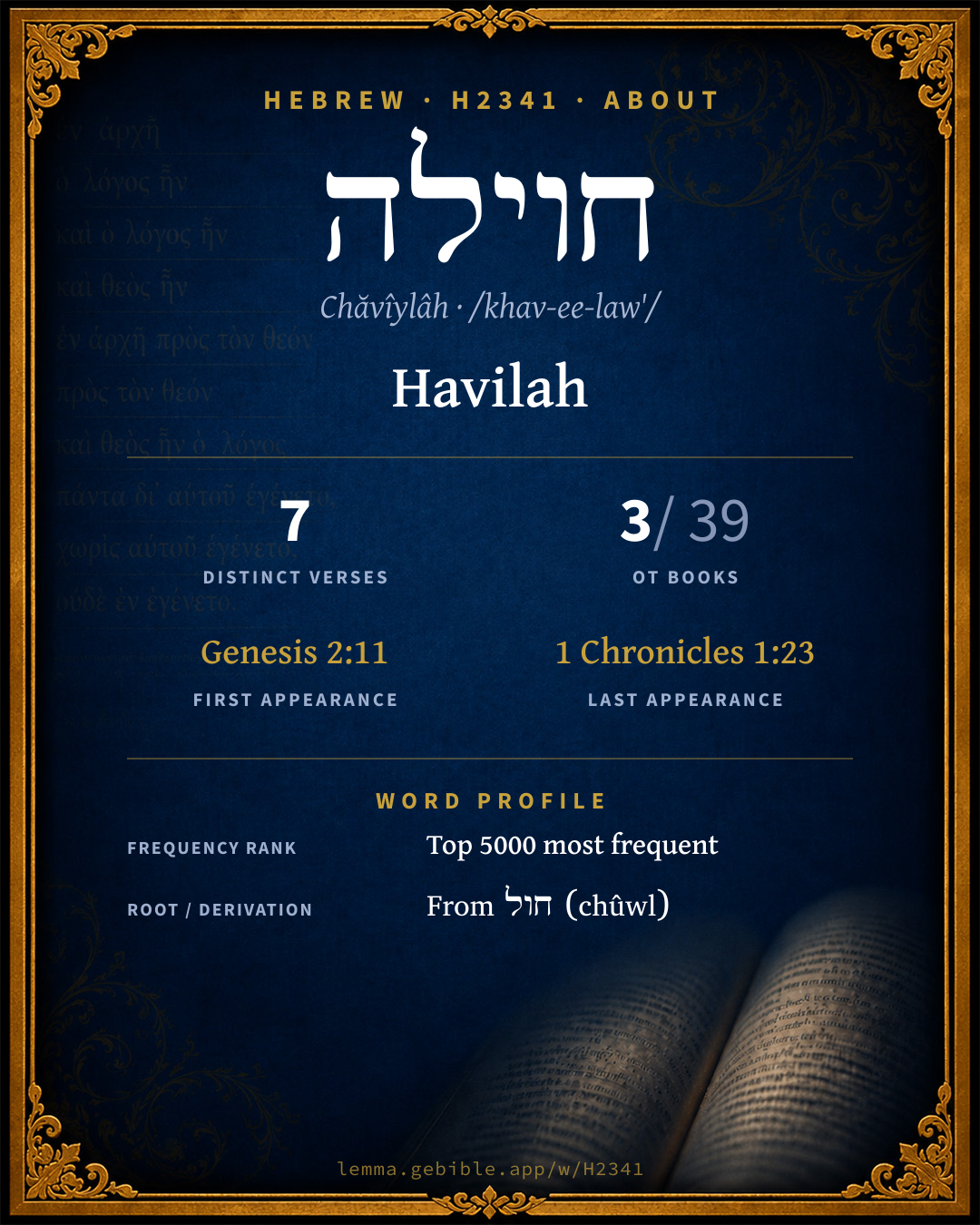
חֲוִילָה
Havilah
BDB lists 5 entries for ‘Havilah’ fuller range ↓
Full lexicon entry — Brown-Driver-Briggs (BDB)
From Brown-Driver-Briggs (BDB)
Where this word appears
Grammar key — what these labels mean
Part of speech
- Noun
- A naming word — a person, place, thing, or idea.
Noun type
- Proper
- A name of a specific person, place, or people (e.g. Abraham, Zion, Israel).
Every verse where H2341 appears in the Book of Genesis — 4 distinct verses. Click any verse to open its interlinear word-by-word view. Verse text shown in the World English Bible for context — . Each verse’s Hebrew form is shown with its reference; the English is not keyword-highlighted, since the data carries no word-level English alignment. Use “Compare translations” on any verse to read it across multiple English versions. This concordance covers the Hebrew Bible; Septuagint (Greek Old Testament) occurrences are not indexed here.
Genesis
- Genesis 2:11 הַֽ/חֲוִילָ֔ה ptcl def.art + n Proper The name of the first is Pishon: this is the one which flows through the whole land of Havilah, where there is gold;
- Genesis 10:7 וַֽ/חֲוִילָ֔ה conj + n Proper The sons of Cush: Seba, Havilah, Sabtah, Raamah, and Sabteca. The sons of Raamah: Sheba and Dedan.
- Genesis 10:29 חֲוִילָ֖ה n Proper Ophir, Havilah, and Jobab. All these were the sons of Joktan.
- Genesis 25:18 מֵֽ/חֲוִילָ֜ה prep + n Proper They lived from Havilah to Shur that is before Egypt, as you go toward Assyria. He lived opposite all his relatives.
About this entry
At a glance — auto-summarized from this page’s data, not written by a person. Every figure links to its source below. This summary describes the numbers; it doesn’t interpret them.
חוילה (Chăvîylâh) is a Hebrew name most often rendered “Havilah.” It clusters heavily in Genesis, which alone accounts for 57% of its uses. With 7 verses in 3 books, it is an uncommon word in the Hebrew Bible. It first appears in Genesis 2:11. For the data behind this summary, explore 7-verse concordance and the renderings breakdown below.
Gloss history
Strong's 1890 vs modern scholarship
About this word
Strong's H2341 catalogs a Hebrew word from the Hebrew Old Testament.
These counts are not copied from any lexicon or concordance. They are computed here, from the morphology-tagged Hebrew Old Testament. What Lemma adds →
- 7
- distinct verses
- The word appears in 7 distinct verses.
- 3 / 39
- OT books
- The word appears in 3 of 39 Old Testament books.
- #2,835
- by frequency
- Top 5000 most frequent Hebrew words (rank 2,835 of 8,640 Hebrew words by occurrence).
View all 7 occurrences in the concordance →
Most concentrated in
- Genesis 4 verses 57%
- 1 Chronicles 2 verses 29%
- 1 Samuel 1 verse 14%
By section of the Old Testament
By traditional corpus
Conventional, traditional groupings — biblical authorship is debated, so this is a traditional corpus grouping, not an authorship claim. Each share is this word’s portion of its verses in that division of the Hebrew canon. Each figure is a share of the word’s 7 distinct verses.
- Torah (Pentateuch) 4 verses · 57%
- Writings (Ketuvim) 2 verses · 29%
- Prophets (Nevi'im) 1 verse · 14%
How translations render this word
Counts come from each version’s own published word-to-Strong’s tagging or interlinear alignment — an approximate guide to how each version renders this word, not a word-level alignment the data otherwise carries. Because each total is that version’s own tagged count, the per-version totals vary from one another and need not match the appearance or distinct-verse counts above. These counts may also differ from a printed concordance because Lemma counts each distinctly tagged rendering and does not collapse phrase taggings into a single head-word total. This is a fixed set of word-tagged versions (KJV, ASV, BSB, ULT) and does not change with the reading translation you choose elsewhere. Each version’s license is shown beside its name below (and on Sources).
- King James Version: Havilah 7×
- American Standard Version: Havilah 7×
- Berean Standard Bible: Havilah 7×
- unfoldingWord Literal Text: Havilah 7×
King James Version Public Domain
Renders H2341 across 7 tagged occurrences — most commonly:
American Standard Version Public Domain
Renders H2341 across 7 tagged occurrences — most commonly:
Berean Standard Bible Public Domain
Renders H2341 across 7 tagged occurrences — most commonly:
unfoldingWord Literal Text CC BY-SA 4.0
Renders H2341 across 7 tagged occurrences — most commonly:
Senses in BDB
The 5 senses BDB distinguishes for this word, in lexicon order (not ranked by frequency or importance). The full entry — with sub-senses — is in the Lexicon Entry tab.
- Havilah = "circle"
- a part of Eden through which flowed the river Pison (Araxes)…
- a district in Arabia of the Ishmaelites named from the 2nd son of Cush…
- a son of Cush (noun proper masculine)
- a son of Joktan (noun proper masculine)
Word origin
n.pr.terr. (√ dub. DlPa 12 suggests חוֹל sand-land, dunes, as Heb. popular etym., MV11 give it as actual etym.; StaThLZ Apr. 28, 1894, 235 compares this, as well as חוֹל sand, with Arabic وَحَلٌ soft mud, [damp sand])—אֶרֶץ הַחֲוִילָה Gn 2:11 (surrounded or bordered—סבב—by river Pishon; noted for excellent gold, bdellium and shoham-stone); elsewhere without art. חֲוִילָה 10:7 = 1 Ch 1:9 as a ‘son’ of Cush (between סְבָא and סַבְתָּה); but also as a ‘son’ of יָקְטָן, a descendant of Shem Gn 10:29 = 1 Ch 1:23 (between אוֹפִיר and יוֹבָב); מֵח׳ עַד־שׁוּר Gn 25:18 said of limits of Ishmaelitish territory; cf. same limits of Amalek 1 S 15:7 (but dub.; We reads טֵילָם, cf. v 4 and vid. Dr; GlaserSkizze ii, 326 reads חֲכִילָה as 23:19; 26:1, 3).—Most have supposed several regions named ח׳ to be indicated in these passages:—e.g. Thes 1. Arabian shore of Pers. Gulf Gn 10:29 etc. 2. Ethiopian coast Gn 10:7 etc. 3. India Gn 2:11 (regarded as indef. extension of 1). Di Gn 10:7 distinguishes 1 and 2 either as quite distinct, or as different settlements of one great people, and (on Gn 2:14) thinks that כל ארץ ח׳ Gn 2:11 implies vague extension eastward. DlPa 12 ff. 57 ff. identif. ח׳ in all passages with NE. part of Syrian desert, so E. MeyerGesch. Alterth. i. 224; GlaserSkizze ii. 323 ff. with central and NE. Arabia. The question is still undecided.
— Brown-Driver-Briggs (Oxford 1906, public domain), digitized via Sefaria, supplemented by the OpenScriptures HebrewLexicon (CC BY 4.0). See Sources.
Derived from חול (chûwl) (H2342) — to writhe.
Forms in the corpus
The 6 distinct written forms H2341 takes in the Hebrew Bible, most frequent first — each parse links to that state’s occurrences in the concordance. Hebrew forms include their vowel points and cantillation, so a single lemma takes many written forms.
| Form | Parsing | Example | Uses |
|---|---|---|---|
| חֲוִילָ֖ה | Noun, Proper | Genesis 10:29 | 2 |
| הַֽ/חֲוִילָ֔ה | Noun, Proper | Genesis 2:11 | 1 |
| וַ/חֲוִילָ֔ה | Noun, Proper | 1 Chronicles 1:9 | 1 |
| וַֽ/חֲוִילָ֔ה | Noun, Proper | Genesis 10:7 | 1 |
| מֵֽ/חֲוִילָה֙ | Noun, Proper | 1 Samuel 15:7 | 1 |
| מֵֽ/חֲוִילָ֜ה | Noun, Proper | Genesis 25:18 | 1 |
Same root — word family
Other BDB entries built from the same root as H2341, grouped by Strong’s listed origin. These share a root / origin per the lexicon — not necessarily a shared meaning. Each links to that word’s own entry.
Derives from
Shares the same root
- חול chôwl H2344 sand
- חיל chîyl H2427 anguish
- חיל chayil H2428 strength
- חלה châlâh H2470 to be sick
- מחול mâchôwl H4234 dance
Proper names from this root
People and places named from this root — a name, not an additional meaning of the word.
Compare all same-root words → Showing 4 of 9 — not the complete family. 2 of the same-root words are proper names (people or places). They share a root, not necessarily a meaning.
Bible dictionary
Public-domain dictionary articles matched to this entry by name (Havilah). A biblical name can be shared by more than one person or place, so an article may treat several.
Easton's Bible Dictionary · M. G. Easton, 1897
The sand region. (1.) A land mentioned in Gen. 2:11 rich in gold and bdellium and onyx stone. The question as to the locality of this region has given rise to a great diversity of opinion. It may perhaps be identified with the sandy tract which skirts Babylonia along the whole of its western border, stretching from the lower Euphrates to the mountains of Edom.
(2.) A district in Arabia-Felix. It is uncertain whether the tribe gave its name to this region or derived its name from it, and whether it was originally a Cushite (Gen. 10:7) or a Joktanite tribe (10:29; comp. 25:18), or whether there were both a Cushite and a Joktanite Havilah. It is the opinion of Kalisch, however, that Havilah "in both instances designates the same country, extending at least from the Persian to the Arabian Gulf, and on account of its vast extent easily divided into two distinct parts." This opinion may be well vindicated.
(3.) One of the sons of Cush (Gen. 10:7).
(4.) A son of Joktan (Gen. 10:29; 1 Chr. 1:23).
Smith's Bible Dictionary · William Smith, 1863
(Genesis 2:11)
+ A part of Eden through which flowed the river Pison (Araxes). It was probably the Grecian Colchis, in the northeast corner of Asia Minor, near the Caspian Sea. + A district in Arabia Felix, (Genesis 10:7) named from the second son of Cush; probably the district of Kualan, in the northwestern part of Yemen.
(circle).
+ A son of Cush. (Genesis 10:7) + A son of Joktan. (Genesis 10:29)
Hitchcock's Bible Names Dictionary · Roswell D. Hitchcock, 1869
that suffers pain; that brings forth
Classic public-domain reference works; full attribution on Sources.
Septuagint verse parallels
This word appears in 7 verses that also exist in the Greek Old Testament (Septuagint), out of the 7 Hebrew verses it occurs in. You can read those verses in Greek by switching the Old Testament edition to the Septuagint.
Read these verses in the Septuagint
This is a verse-level parallel only — the same verses exist in both the Hebrew and Greek Old Testaments. No word-level Hebrew↔Greek correspondence is claimed: the data carries no such alignment, so no Greek word is shown as this Hebrew word’s translation. Coverage is not total — the Septuagint omits the deuterocanon and renumbers the Psalms, so some Hebrew verses have no direct Greek parallel.