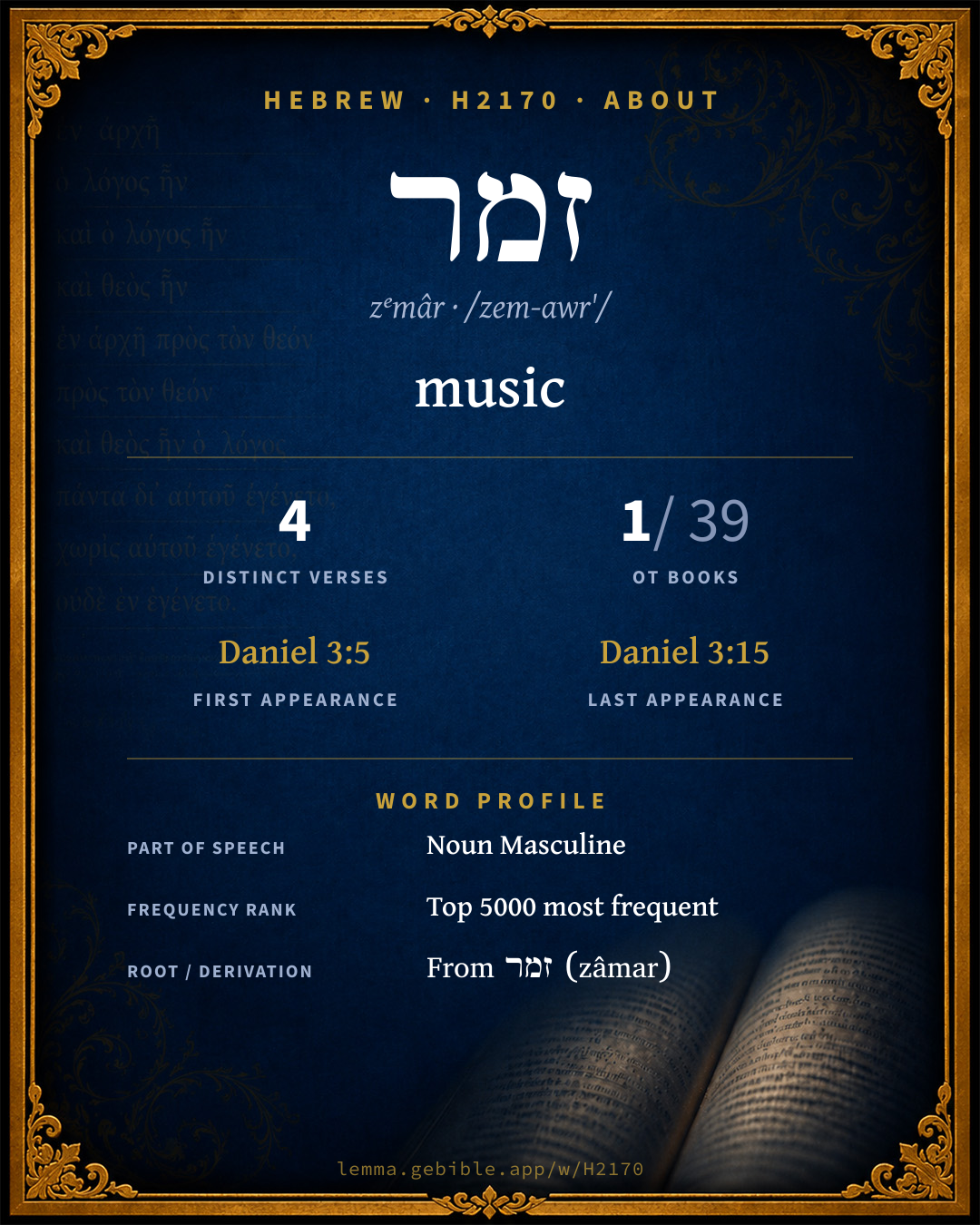
זְמָר
music
Full lexicon entry — Brown-Driver-Briggs (BDB)
From Brown-Driver-Briggs (BDB)
Where this word appears
Every verse where H2170 appears — 4 distinct verses across 1 book. Click any verse to open its interlinear word-by-word view. Verse text shown in the World English Bible for context — . Each verse’s Hebrew form is shown with its reference; the English is not keyword-highlighted, since the data carries no word-level English alignment. Use “Compare translations” on any verse to read it across multiple English versions. This concordance covers the Hebrew Bible; Septuagint (Greek Old Testament) occurrences are not indexed here.
Daniel 4 verses
- Daniel 3:5 זְמָרָ֑/א n c ms det + ptcl def.art that whenever you hear the sound of the horn, flute, zither, lyre, harp, pipe, and all kinds of music, you fall down and worship the golden image that Nebuchadnezzar the king has set up;
- Daniel 3:7 זְמָרָ֑/א n c ms det + ptcl def.art Therefore at that time, when all the peoples heard the sound of the horn, flute, zither, lyre, harp, pipe, and all kinds of music, all the peoples, the nations, and the languages, fell down and worshiped the golden image that Nebuchadnezzar the king had set up.
- Daniel 3:10 זְמָרָ֑/א n c ms det + ptcl def.art You, O king, have made a decree, that every man that shall hear the sound of the horn, flute, zither, lyre, harp, pipe, and all kinds of music, shall fall down and worship the golden image;
- Daniel 3:15 זְמָרָ֗/א n c ms det + ptcl def.art Now if you are ready whenever you hear the sound of the horn, flute, zither, lyre, harp, pipe, and all kinds of music to you fall down and worship the image which I have made, [well]: but if you don't worship, you shall be cast the same hour into the midst of a burning fiery furnace; and who is that god that shall deliver you out of my hands?
About this entry
At a glance — auto-summarized from this page’s data, not written by a person. Every figure links to its source below. This summary describes the numbers; it doesn’t interpret them.
At its core, זמר (zᵉmâr) means “music.” It is rare — just 4 verses in the entire Hebrew Bible. Its uses cluster heavily in Daniel (100% of all occurrences). It first appears in Daniel 3:5. Sharing its root, it stands alongside זמר, זמיר and זמר. Each statement above links to its evidence; the full detail follows below.
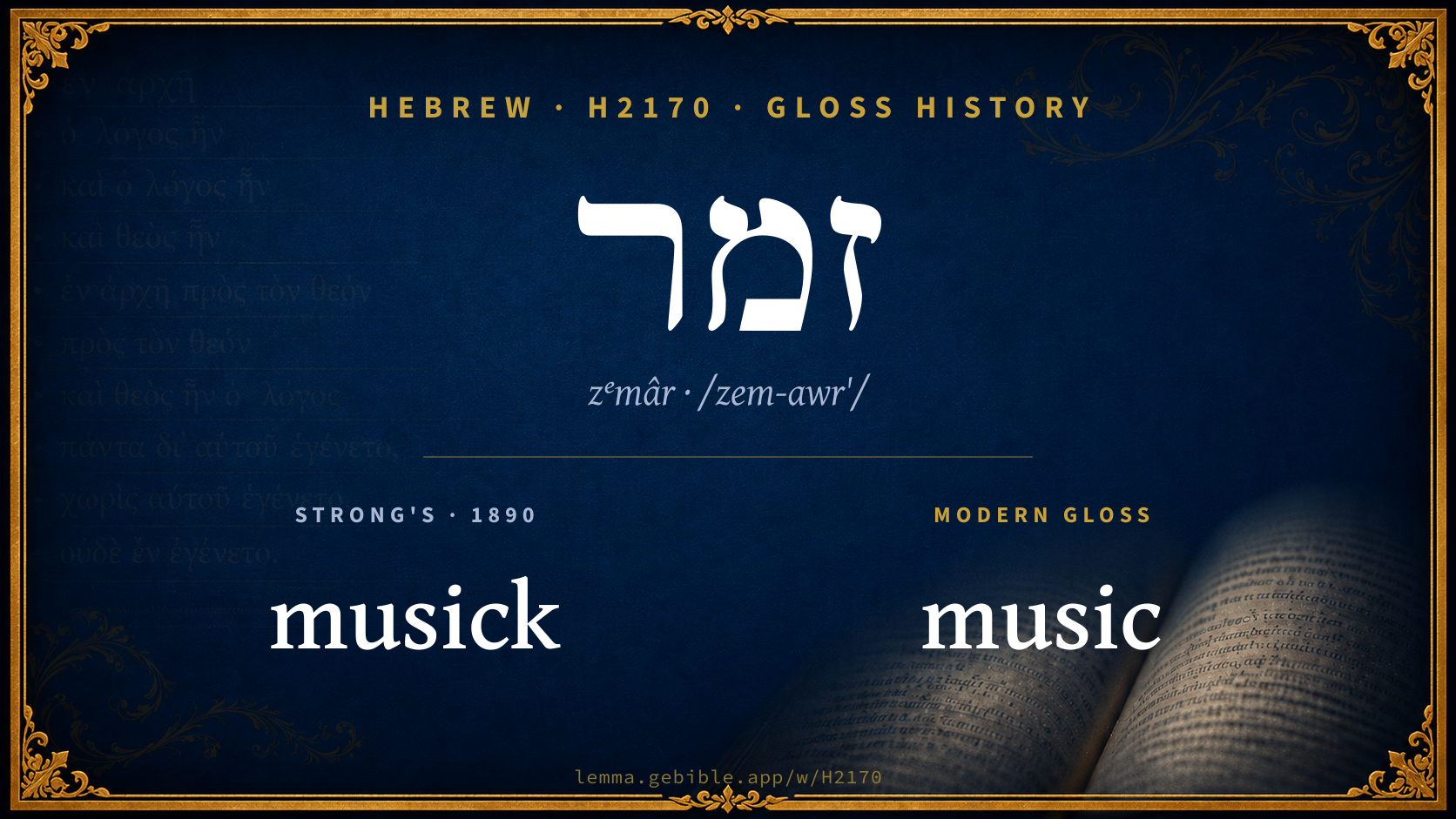
Gloss history
Strong's 1890 vs modern scholarship
About this word
Strong's H2170 catalogs a Hebrew word from the Hebrew Old Testament.
These counts are not copied from any lexicon or concordance. They are computed here, from the morphology-tagged Hebrew Old Testament. What Lemma adds →
- 4
- distinct verses
- The word appears in 4 distinct verses.
- 1 / 39
- OT books
- The word appears in 1 of 39 Old Testament books.
- #3,696
- by frequency
- Top 5000 most frequent Hebrew words (rank 3,696 of 8,640 Hebrew words by occurrence).
View all 4 occurrences in the concordance →
Most concentrated in
- Daniel 4 verses 100%
By section of the Old Testament
By traditional corpus
Conventional, traditional groupings — biblical authorship is debated, so this is a traditional corpus grouping, not an authorship claim. Each share is this word’s portion of its verses in that division of the Hebrew canon. Each figure is a share of the word’s 4 distinct verses.
- Writings (Ketuvim) 4 verses · 100%
How translations render this word
Counts come from each version’s own published word-to-Strong’s tagging or interlinear alignment — an approximate guide to how each version renders this word, not a word-level alignment the data otherwise carries. Because each total is that version’s own tagged count, the per-version totals vary from one another and need not match the appearance or distinct-verse counts above. These counts may also differ from a printed concordance because Lemma counts each distinctly tagged rendering and does not collapse phrase taggings into a single head-word total. This is a fixed set of word-tagged versions (KJV, ASV, BSB, ULT) and does not change with the reading translation you choose elsewhere. Each version’s license is shown beside its name below (and on Sources).
- King James Version: Musick 4×
- American Standard Version: Music 4×
- Berean Standard Bible: Music 4×
- unfoldingWord Literal Text: Music 4×
King James Version Public Domain
Renders H2170 across 4 tagged occurrences — most commonly:
American Standard Version Public Domain
Renders H2170 across 4 tagged occurrences — most commonly:
Berean Standard Bible Public Domain
Renders H2170 across 4 tagged occurrences — most commonly:
unfoldingWord Literal Text CC BY-SA 4.0
Renders H2170 across 4 tagged occurrences — most commonly:
Senses in BDB
The 1 sense BDB distinguishes for this word, in lexicon order (not ranked by frequency or importance). The full entry — with sub-senses — is in the Lexicon Entry tab.
- instrumental music, music
Word origin
Derived from זמר (zâmar) (H2167) — to sing.
Jastrow Dictionary
A second Hebrew/Aramaic lexicon for comparison, covering Aramaic and post-biblical (Talmudic, Targumic, Midrashic) usage that the biblical-Hebrew BDB does not. Matched by lemma rather than by Strong’s number, so a lemma may carry more than one Jastrow headword (shown separately below), and the entries cover usage well beyond the Bible.
זָמַר I
- (b. h.) to nip; to prune; to cut. Sabb. 73ᵇ זוֹמֵר וצריך וכ׳ if one trims a tree (on the Sabbath) for making use of the wood. Snh. 26ᵃ כהן וזומר (not וזמר) a priest is he, and he prunes the vine (in the sabbatical year)!; a. fr.
- to be pruned, trnsf. to be checked, unnerved, defeated. Cant. R. to II, 12 (ref. to זמיר ib.) הגיע זמנה של ערלה שתִּזָּמֵר the time for pruning the preputium (circumcision) has come (v. Ex. R. s. 19); הגיע … שיִזָּמֵרוּ the time has come for the Egyptians to be checked; Pesik. Haḥod., p. 50ᵃ; Pesik. R. s. 15.—Lev. R. s. 9, beg. Akhan is named Zimri (I Chr. II, 6, cmp. with Josh. VII, 24) שנִזְמְרוּ … על ידו because through him the Israelites were unnerved (Josh. VII, 5); a. e. e.g. 1 Chronicles 2:6
זְמַר
- Af. אַזְמֵיר same. Y. Shebi. IV, 35ᵃ חמא חד אַ׳ וכ׳ (not איז׳) saw one prune &c. (in the Sabbatical year).
זָמַר II
- to tingle, make music, sing. V. זֶמֶר.
- 1. to sing one’s praise. Cant. R. to II, 16 הוא זִמְּרַנִי … זִמַּרְתִּיו (or זְמָרַנִי, זְמַרְתִּיו) He praised me, and I &c.—Gen. R. s. 91, end (expl. מזמרת, Gen. XLIII, 11) דברים שהן מְזַמְּרִין וכ׳ things which men praise all over the world. e.g. Genesis 43:11
- 2. to review a lesson in recitative chant (v. זִמְרָה). Snh. 99ᵇ top זַמֵּר בכל יום chant every day; Tosef. Ohol. XVI, 8 זַ׳ בי תדירה זַ׳ (the Law says) review me steadily &c.; ib. Par. IV (III), 7; cmp. גְּמָרָא.
זְמַר ²
- Pa. זַמֵּיר same,
- 1. to sing. Targ. Ps. XVIII, 50; a. e.—Sot. 48ᵃ זַמְּרי גברי וכ׳ when men sing and women respond.
- 2. to sing a satire, deride. Targ. Lam. III, 14.
*זָמַר III
- , Hif. הִזְמִיר (cmp. זְמוֹרָא) to look bluish. Y’lamd. to Num. XXV, 14, quot. in Ar. (play on זִמְרִי) עד שה׳ בשרו כביצה מוזרת until his flesh (through his lewdness) had the color of a smashed (rotten) egg; (cmp. Tanḥ. Pinḥ. 2, Num. R. s. 21, beg., Snh. 82ᵇ—where our w. is omitted).
זֶמֶר I
- (זָמַר II) music, song; כלי ז׳ (or sub. כלי) musical instrument. Sot. 48ᵃ בארבעה מיני ז׳ to the music of four instruments. Y. ib. VII, 21ᶜ top לעז לז׳ Greek is adapted for song; Y. Meg. I, 71ᵇ bot.—Snh. 101ᵃ ועושה אותו כמין ז׳ and treats it (a verse of Song of Songs) like a (secular) song; Yalk. Prov. 953; a. fr.
זֶמֶר II
- (זָמַר I; cmp. זמרה, Gen. XLIII, 11) fruits, (grapes &c.), dessert. Y. Pes. X, 37ᵈ bot. (expl. אפיקומין) מיני ז׳ various dessert fruits (Bab. ib. 119ᵇ תמרים וכ׳; Tosef. ib. X, 11 אגוזים וכ׳). e.g. Genesis 43:11
זַמָּר
- (זָמַר I) musician, singer. Kel. XVI, 7 מרכוף של ז׳, v. מַרְכּוֹף. Yalk. Lam. 1001.
A Dictionary of the Targumim, the Talmud Babli and Yerushalmi, and the Midrashic Literature (Marcus Jastrow; London, Luzac, 1903) — Public Domain. Digitized via Sefaria. Digitized via Sefaria. Full attribution on Sources.
Forms in the corpus
The 2 distinct written forms H2170 takes in the Hebrew Bible, most frequent first — each parse links to that state’s occurrences in the concordance. Hebrew forms include their vowel points and cantillation, so a single lemma takes many written forms.
| Form | Parsing | Example | Uses |
|---|---|---|---|
| זְמָרָ֑/א | Particle, Definite Article | Daniel 3:5 | 3 |
| זְמָרָ֗/א | Particle, Definite Article | Daniel 3:15 | 1 |
Same root — word family
Other BDB entries built from the same root as H2170, grouped by Strong’s listed origin. These share a root / origin per the lexicon — not necessarily a shared meaning. Each links to that word’s own entry.
Derives from
Shares the same root
- זמיר zâmîyr H2158 song
- זמר zâmar H2168 to prune
- זמר zemer H2169 wild goat
- זמרה zimrâh H2172 song
- זמרת zimrâth H2176 song of praise
- מזמור mizmôwr H4210 psalm
Derived from this word
Proper names from this root
People and places named from this root — a name, not an additional meaning of the word.
Compare all same-root words → Showing 4 of 11 — not the complete family. 2 of the same-root words are proper names (people or places). They share a root, not necessarily a meaning.
Septuagint verse parallels
This word appears in 4 verses that also exist in the Greek Old Testament (Septuagint), out of the 4 Hebrew verses it occurs in. You can read those verses in Greek by switching the Old Testament edition to the Septuagint.
Read these verses in the Septuagint
This is a verse-level parallel only — the same verses exist in both the Hebrew and Greek Old Testaments. No word-level Hebrew↔Greek correspondence is claimed: the data carries no such alignment, so no Greek word is shown as this Hebrew word’s translation. Coverage is not total — the Septuagint omits the deuterocanon and renumbers the Psalms, so some Hebrew verses have no direct Greek parallel.