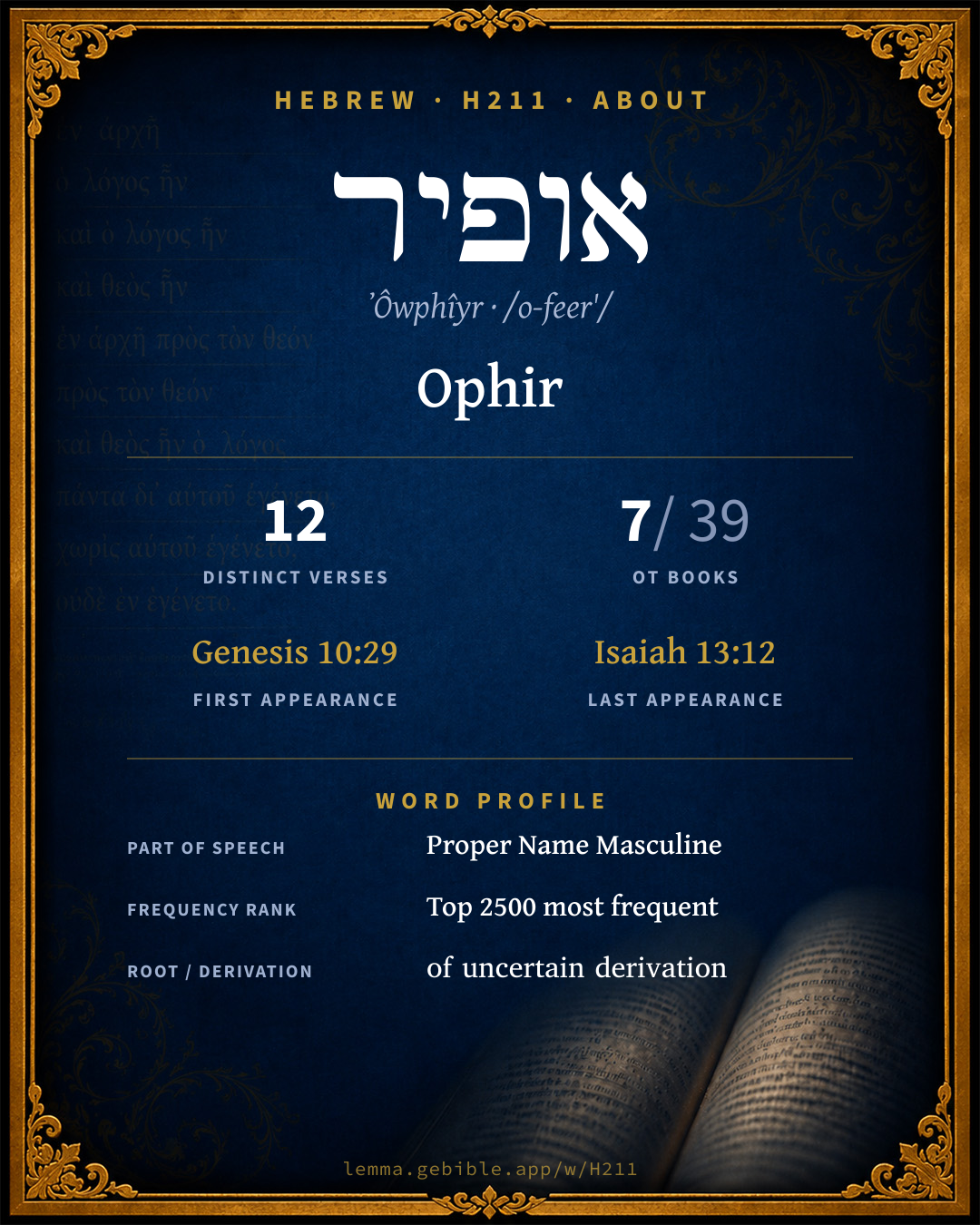
אוֹפִיר
Ophir
BDB lists 5 entries for ‘Ophir’ fuller range ↓
Full lexicon entry — Brown-Driver-Briggs (BDB)
From Brown-Driver-Briggs (BDB)
Where this word appears
Grammar key — what these labels mean
Part of speech
- Noun
- A naming word — a person, place, thing, or idea.
Noun type
- Proper
- A name of a specific person, place, or people (e.g. Abraham, Zion, Israel).
Every verse where H211 appears in the Book of Job — 2 distinct verses. Click any verse to open its interlinear word-by-word view. Verse text shown in the World English Bible for context — . Each verse’s Hebrew form is shown with its reference; the English is not keyword-highlighted, since the data carries no word-level English alignment. Use “Compare translations” on any verse to read it across multiple English versions. This concordance covers the Hebrew Bible; Septuagint (Greek Old Testament) occurrences are not indexed here.
Job
About this entry
At a glance — auto-summarized from this page’s data, not written by a person. Every figure links to its source below. This summary describes the numbers; it doesn’t interpret them.
At its core, אופיר (ʼÔwphîyr) means “Ophir.” Scripture first uses it in Genesis 10:29. Spanning 12 verses in 7 books, it ranks among the uncommon words of the Hebrew Bible. Its uses concentrate in 1 Kings (25% of all occurrences). Dig into 12-verse concordance and the renderings breakdown below.
Gloss history
Strong's 1890 vs modern scholarship
About this word
Strong's H211 catalogs a Hebrew word from the Hebrew Old Testament.
These counts are not copied from any lexicon or concordance. They are computed here, from the morphology-tagged Hebrew Old Testament. What Lemma adds →
- 12
- distinct verses
- The word appears in 12 distinct verses.
- 7 / 39
- OT books
- The word appears in 7 of 39 Old Testament books.
- #2,001
- by frequency
- Top 2500 most frequent Hebrew words (rank 2,001 of 8,640 Hebrew words by occurrence).
View all 12 occurrences in the concordance →
Most concentrated in
- 1 Kings 3 verses 25%
- 1 Chronicles 2 verses 17%
- 2 Chronicles 2 verses 17%
By section of the Old Testament
By traditional corpus
Conventional, traditional groupings — biblical authorship is debated, so this is a traditional corpus grouping, not an authorship claim. Each share is this word’s portion of its verses in that division of the Hebrew canon. Each figure is a share of the word’s 12 distinct verses.
- Writings (Ketuvim) 7 verses · 58%
- Prophets (Nevi'im) 4 verses · 33%
- Torah (Pentateuch) 1 verse · 8%
How translations render this word
Counts come from each version’s own published word-to-Strong’s tagging or interlinear alignment — an approximate guide to how each version renders this word, not a word-level alignment the data otherwise carries. Because each total is that version’s own tagged count, the per-version totals vary from one another and need not match the appearance or distinct-verse counts above. These counts may also differ from a printed concordance because Lemma counts each distinctly tagged rendering and does not collapse phrase taggings into a single head-word total. This is a fixed set of word-tagged versions (KJV, ASV, BSB, ULT) and does not change with the reading translation you choose elsewhere. Each version’s license is shown beside its name below (and on Sources).
- King James Version: Ophir 12×
- American Standard Version: Ophir 12×
- Berean Standard Bible: Ophir 12×
- unfoldingWord Literal Text: Ophir 13×
King James Version Public Domain
Renders H211 across 13 tagged occurrences — most commonly:
Plus 1 rendering that appears only once — usually multi-word phrases or single function words the recovered tagging swept in, not distinct renderings.
American Standard Version Public Domain
Renders H211 across 13 tagged occurrences — most commonly:
Plus 1 rendering that appears only once — usually multi-word phrases or single function words the recovered tagging swept in, not distinct renderings.
Berean Standard Bible Public Domain
Renders H211 across 13 tagged occurrences — most commonly:
Plus 1 rendering that appears only once — usually multi-word phrases or single function words the recovered tagging swept in, not distinct renderings.
unfoldingWord Literal Text CC BY-SA 4.0
Renders H211 across 13 tagged occurrences — most commonly:
Senses in the full BDB
What do BDB’s symbols mean?
BDB uses these scholarly abbreviations:
| Symbol | Meaning |
|---|---|
| 𝔊 | the Septuagint (the ancient Greek translation, LXX) |
| 𝔙 | the Vulgate (the Latin translation) |
| 𝔖 | the Syriac version (the Peshitta) |
| 𝔗 | the Targum (the Aramaic translation) |
| ψ | the Psalms |
| √ | root (the underlying root or stem) |
| ‖ | parallel passage (a synonymous or contrasted parallel) |
| † | the dagger: every passage where the word occurs is cited |
The 4 senses and sub-senses the full Brown-Driver-Briggs lexicon distinguishes for this word, in lexicon order (not ranked by frequency), with BDB’s own verbatim wording and sub-sense lettering. Shown in Hebrew script with BDB’s own scholarly abbreviations. The condensed entry is in the Lexicon Entry tab. See also the Forms in the corpus table below.
- 1. n.pr.m. 11th son of Joktan Gn 10:29 (J) = 1 Ch 1:23; 𝔊 Οὐφειρ, Ὠφειρ, name of an Arabian tribe, vid. Gn 10:30 & Di. e.g. Genesis 10:29
- 2. n.pr.loc. (land or city S. or SE. from Palestine, exact position unknown, cf. infr.; 𝔊 Σωφηρα, Σωφειρα, Σουφειρ, etc.; Jb 28:16 Ὠφειρ AC, cf. 1 K 22:49 A Ὠφειρδε, B om.) place whither Sol.’s ships went from Ezion Geber, bringing thence gold 1 K 9:28—cf. 22:49—2 Ch 8:18; gold, almug-(sandal-?) wood & gems 1 K 10:11(×2), cf. 2 Ch 9:10; prob. 1 K 10:22 ref. to same ships; they came once in 3 years with gold, silver, ivory, apes & peacocks (all from Ophir?); 2 Ch 9:21 makes these ships go to Tarshish (but on Tarshish-ships, i.e. large, sea-going vessels, merchantmen, v. 1 K 22:49 & sub תַּרְשִׁישׁ). e.g. Job 28:16
- 3. characteristic of fine gold (poet. & late) זְהַב א׳ 1 Ch 29:4; כֶּחֶם א׳ Is 13:12; Jb 28:16 ψ 45:10. e.g. 1 Chronicles 29:4
- 4. hence for fine gold itself Jb 22:24 (‖ בֶּצֶר).—(If 2 = 1, the southern, prob. south-eastern, Arabia (cf. Di Gn 10:29) furnished the gold; and other articles, which point farther E. (e.g. to India, toward which the words קוֹפִים apes & תֻּכִּיִּים peacockes seem to lead), were either brought to Ophir by traders, & so found there by Sol.’s men, or were found elsewhere by the latter, whose cruise may have taken them beyond Ophir, the name of Ophir alone, as source of gold-supply, being preserved. If (less likely) 1 & 2 are not the same, the only data for determining loc. of 2 are the articles brought, & one may look toward India, Ceylon or other islands, or even lower Africa. Particular theories have as yet no adequate support; e.g. (a) old city Supara, or Uppara, in the region of Goa, Malabar coast (cf. 𝔊 supr. 2, but also 1; form with Σ said on Copt. authority to denote India, v. JablonskiiOpusc. ed. te Water i. 337; cf. also JosAnt. 8:6, 4; in that case its use by 𝔊 may indicate a theory of the location of Ophir); (b) peninsula Malacca; (c) island Sumatra; (d) Sofâla, with city Zimbabye (SE. Africa); (e) west coast of Arabia (where gold & silver formerly found), etc. On these & other theories, v. Di Gn 10:29 RiHWB, Herzog, SmithDict. Bib.; cf. GlaserSkizze ii. 367 ff. WMMAs. u. Eur. 111 identifies with Egypt. Pvnt, on W. coast of Red Sea). e.g. Job 22:24
Senses from the full Brown-Driver-Briggs lexicon (Brown, Driver, Briggs; Oxford 1906 — public domain), digitized via Sefaria, supplemented by the OpenScriptures HebrewLexicon (CC BY 4.0). Full attribution on Sources.
Word origin
n.pr. Ophir—א׳ 1 K 10:11 +; אוֹפִ֫ירָה 9:28 + אוֹפִר †Gn 10:29; אֹפִיר †1 K 10:11—
— Brown-Driver-Briggs (Oxford 1906, public domain), digitized via Sefaria, supplemented by the OpenScriptures HebrewLexicon (CC BY 4.0). See Sources.
Origin: of uncertain derivation
Forms in the corpus
The 8 distinct written forms H211 takes in the Hebrew Bible, most frequent first — each parse links to that state’s occurrences in the concordance. Hebrew forms include their vowel points and cantillation, so a single lemma takes many written forms.
| Form | Parsing | Example | Uses |
|---|---|---|---|
| אוֹפִֽיר | Noun, Proper | Isaiah 13:12 | 3 |
| אוֹפִ֑יר | Noun, Proper | 1 Chronicles 29:4 | 2 |
| אוֹפִ֔ירָ/ה | Noun, Proper | 1 Kings 9:28 | 2 |
| מֵ/אוֹפִ֑יר | Noun, Proper | 1 Kings 10:11 | 2 |
| אוֹפִ֛ירָ/ה | Noun, Proper | 1 Kings 22:48 | 1 |
| אוֹפִ֥יר | Noun, Proper | 1 Chronicles 1:23 | 1 |
| אוֹפִ֥ר | Noun, Proper | Genesis 10:29 | 1 |
| מֵ/אֹפִ֜יר | Noun, Proper | 1 Kings 10:11 | 1 |
Same root — word family
Other BDB entries built from the same root as H211, grouped by Strong’s listed origin. These share a root / origin per the lexicon — not necessarily a shared meaning. Each links to that word’s own entry.
Proper names from this root
People and places named from this root — a name, not an additional meaning of the word.
Compare all same-root words → 1 of the same-root words is a proper name (a person or place). They share a root, not necessarily a meaning.
Bible dictionary
Public-domain dictionary articles matched to this entry by name (Ophir). A biblical name can be shared by more than one person or place, so an article may treat several.
Easton's Bible Dictionary · M. G. Easton, 1897
(1.) One of the sons of Joktan (Gen. 10:29).
(2.) Some region famous for its gold (1 Kings 9:28; 10:11; 22:48; Job 22:24; 28:16; Isa. 13:12). In the LXX. this word is rendered "Sophir," and "Sofir" is the Coptic name for India, which is the rendering of the Arabic version, as also of the Vulgate. Josephus has identified it with the Golden Chersonese, i.e., the Malay peninsula. It is now generally identified with Abhira, at the mouth of the Indus. Much may be said, however, in favour of the opinion that it was somewhere in Arabia.
Smith's Bible Dictionary · William Smith, 1863
(abundane).
+ The eleventh in order of the sons of Joktan. (Genesis 10:29; 1 Chronicles 1:23) (B.C. after 2450.) + A seaport or region from which the Hebrews in the time of Solomon obtained gold. The gold was proverbial for its fineness, so that "gold of Ophir" is several times used as an expression for fine gold, (1 Chronicles 29:4; Job 28:16; Psalms 45:9; Isaiah 13:12) and in one passage (Job 22:24) the word "Ophir" by itself is used for gold of Ophir, and for gold generally. In addition to gold, the vessels brought from Ophir almug wood and precious stones. The precise geographical situation of Ophir has long been a subject of doubt and discussion. The two countries which have divided the opinions of the learned have been Arabia and India, while some have placed it in Africa. In five passages Ophir is mentioned by name - (1 Kings 9:28; 10:11; 22:18; 2 Chronicles 8:18; 9:10) If the three passages of the book of Kings are carefully examined, it will be seen that all the information given respecting Ophir is that it was a place or region accessible by sea from Ezion-geber on the Red Sea, from which imports of gold, almug trees and precious stones were brought back by the Tyrian and Hebrew sailors. The author of the tenth chapter of Genesis certainly regarded Ophir as the name of some city, region or tribe in Arabia. It is almost certain that the Ophir of Genesis is the Ophir of the book of Kings. There is no mention, either in the Bible or elsewhere, of any other Ophir; and the idea of there having been two Ophirs evidently arose from a perception of the obvious meaning of the tenth chapter of Genesis on the one hand, coupled with the erroneous opinion, on the other that the Ophir of the book of Kings could not have been in Arabia. (Hence we conclude that Ophir was in southern Arabia, upon the border of the Indian Ocean; for even if all the things brought over in Solomon's ships are not now found in Arabia, but are found in India, yet, there is evidence that they once were known in Arabia and, moreover, Ophir may not have been the original place of production of some of them, but the great market for traffic in them.)
Hitchcock's Bible Names Dictionary · Roswell D. Hitchcock, 1869
fruitful region
Classic public-domain reference works; full attribution on Sources.
Septuagint verse parallels
This word appears in 10 verses that also exist in the Greek Old Testament (Septuagint), out of the 12 Hebrew verses it occurs in. You can read those verses in Greek by switching the Old Testament edition to the Septuagint.
Read these verses in the Septuagint
This is a verse-level parallel only — the same verses exist in both the Hebrew and Greek Old Testaments. No word-level Hebrew↔Greek correspondence is claimed: the data carries no such alignment, so no Greek word is shown as this Hebrew word’s translation. Coverage is not total — the Septuagint omits the deuterocanon and renumbers the Psalms, so some Hebrew verses have no direct Greek parallel.