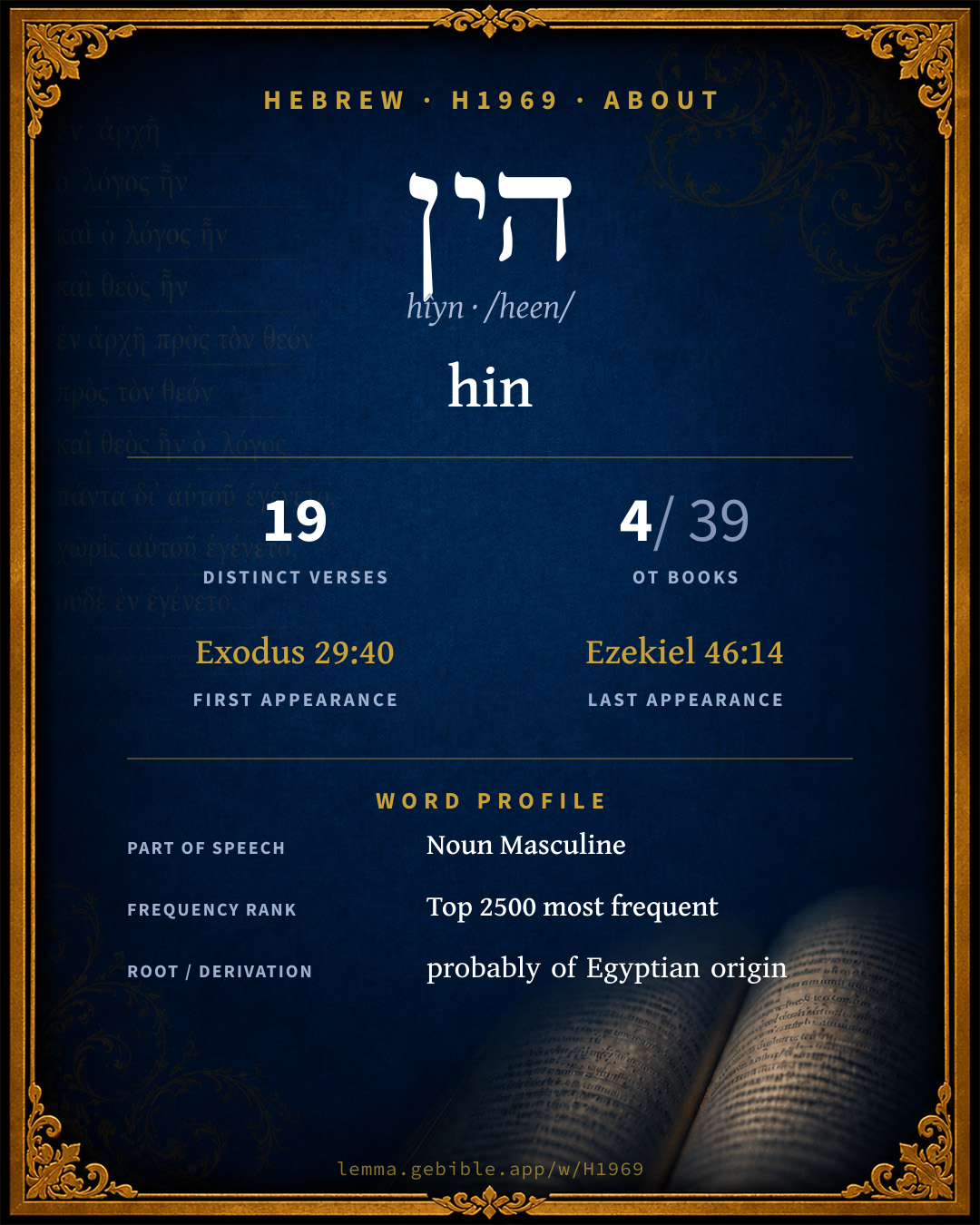
הִין
hin
‘hin’ is one of 3 main senses fuller range ↓
Full lexicon entry — Brown-Driver-Briggs (BDB)
From Brown-Driver-Briggs (BDB)
Where this word appears
See every Absolute-state word in the Hebrew Bible →
Grammar key — what these labels mean
Part of speech
- Noun
- A naming word — a person, place, thing, or idea.
Noun type
- Common
- A common noun — a general class of person, place, or thing (“king,” “city,” “water”), not a specific name.
State
- Absolute
- The independent form of a noun, not bound to a following word.
- Construct
- A noun bound to a following noun in a possessive / “of” relationship (the construct chain).
Gender
- Masculine
- Grammatically masculine.
Number
- Singular
- One.
Every verse where H1969 appears in the Book of Leviticus — 2 distinct verses. Click any verse to open its interlinear word-by-word view. Verse text shown in the World English Bible for context — . Each verse’s Hebrew form is shown with its reference; the English is not keyword-highlighted, since the data carries no word-level English alignment. Use “Compare translations” on any verse to read it across multiple English versions. This concordance covers the Hebrew Bible; Septuagint (Greek Old Testament) occurrences are not indexed here.
Leviticus
- Leviticus 19:36 וְ/הִ֥ין conj + n c ms cs Just balances, just weights, a just ephah, and a just hin, shall you have. I am Yahweh your God, who brought you out of the land of Egypt.
- Leviticus 23:13 הַ/הִֽין ptcl def.art + n c ms The meal offering with it shall be two tenth parts of an ephah of fine flour mingled with oil, an offering made by fire to Yahweh for a sweet savor; and the drink offering with it shall be of wine, the fourth part of a hin.
About this entry
At a glance — auto-summarized from this page’s data, not written by a person. Every figure links to its source below. This summary describes the numbers; it doesn’t interpret them.
At its core, הין (hîyn) means “hin.” First canonically at Exodus 29:40, it enters the text early. It appears 19 verses across 4 books of the Hebrew Bible, among its uncommon vocabulary. The word gravitates to Numbers (47%), then Ezekiel and Exodus. Carrying more than one sense, it rewards its full sense range. Each statement above links to its evidence; the full detail follows below.
Gloss history
Strong's 1890 vs modern scholarship
About this word
Strong's H1969 catalogs a Hebrew word from the Hebrew Old Testament.
These counts are not copied from any lexicon or concordance. They are computed here, from the morphology-tagged Hebrew Old Testament. What Lemma adds →
- 19
- distinct verses
- The word appears in 19 distinct verses.
- 4 / 39
- OT books
- The word appears in 4 of 39 Old Testament books.
- #1,412
- by frequency
- Top 2500 most frequent Hebrew words (rank 1,412 of 8,640 Hebrew words by occurrence).
View all 19 occurrences in the concordance →
By section of the Old Testament
By traditional corpus
Conventional, traditional groupings — biblical authorship is debated, so this is a traditional corpus grouping, not an authorship claim. Each share is this word’s portion of its verses in that division of the Hebrew canon. Each figure is a share of the word’s 19 distinct verses.
- Torah (Pentateuch) 13 verses · 68%
- Prophets (Nevi'im) 6 verses · 32%
How translations render this word
Counts come from each version’s own published word-to-Strong’s tagging or interlinear alignment — an approximate guide to how each version renders this word, not a word-level alignment the data otherwise carries. Because each total is that version’s own tagged count, the per-version totals vary from one another and need not match the appearance or distinct-verse counts above. These counts may also differ from a printed concordance because Lemma counts each distinctly tagged rendering and does not collapse phrase taggings into a single head-word total. This is a fixed set of word-tagged versions (KJV, ASV, BSB, ULT) and does not change with the reading translation you choose elsewhere. Each version’s license is shown beside its name below (and on Sources).
- King James Version: Hin 13×, Part of an hin 9×
- American Standard Version: Hin 13×, Part of a hin 9×
- Berean Standard Bible: Hin 18×, Along with a hin 4×
- unfoldingWord Literal Text: Hin 14×, Hin of 8×
King James Version Public Domain
Renders H1969 across 22 tagged occurrences — most commonly:
American Standard Version Public Domain
Renders H1969 across 22 tagged occurrences — most commonly:
Berean Standard Bible Public Domain
Renders H1969 across 22 tagged occurrences — most commonly:
unfoldingWord Literal Text CC BY-SA 4.0
Renders H1969 across 22 tagged occurrences — most commonly:
Senses in the full BDB
What do BDB’s symbols mean?
BDB uses these scholarly abbreviations:
| Symbol | Meaning |
|---|---|
| 𝔊 | the Septuagint (the ancient Greek translation, LXX) |
| 𝔙 | the Vulgate (the Latin translation) |
| 𝔖 | the Syriac version (the Peshitta) |
| 𝔗 | the Targum (the Aramaic translation) |
| ψ | the Psalms |
| √ | root (the underlying root or stem) |
| ‖ | parallel passage (a synonymous or contrasted parallel) |
| † | the dagger: every passage where the word occurs is cited |
The 6 senses and sub-senses the full Brown-Driver-Briggs lexicon distinguishes for this word, in lexicon order (not ranked by frequency), with BDB’s own verbatim wording and sub-sense lettering. Shown in Hebrew script with BDB’s own scholarly abbreviations. The condensed entry is in the Lexicon Entry tab. See also the Forms in the corpus table below.
- 1. a measure, used of quantity of water for drinking Ez 4:11; usually in connexion with offerings: e.g. Ezekiel 4:11
- a. of oil used with meal-offering Ex 29:40; Nu 15:4, 6, 9; 28:5 (all P), Ez 45:24 46:5, 6, 11, 14;—usually ¼ hin to 1/10 ephah (of meal-offering); Nu 15:6 1/3; v 9 1/2; in Ez a (whole) hin, except 46:14 1/3 hin to 1/6 ephah. e.g. Exodus 29:40
- b. used in mixing the anointing oil Ex 30:24. e.g. Exodus 30:24
- c. of wine as drink-offering Lv 23:13 (H); elsewhere P, Ex 29:40; Nu 15:5; 28:14 (all 1/4 hin) 15:7; 28:14 (both 1/3 hin), 15:10; 28:14 (both ½ hin; all with 1/10 to 3/10 ephah in case of meal-offering). e.g. Leviticus 23:13
- d. once of שֵׁכָר as drink-offering Nu 28:7 (P; ¼ hin; cf. Di). e.g. Numbers 28:7
- 2. vessel with capacity of hin Lv 19:36 (H) הִין־צֶדֶק a just hin (‖ מֹאזְנֵי צ׳, אַבְנֵי־צ׳, אֵיפַת צ׳).—The hin = 1/6 bath according to JosephAnt iii. 8, 3; 9, 4, = 6.06 litres (Hultschl.c.), v. ii. בַּת. On order of words in above passages, note that הִין (רְבִיעִת ה׳ etc.) is usually appos. of liquid measured, & either precedes it Ex 29:40 Nu 15:4; 28:14, or, more often, follows it Ex 30:24 + 10 times; Nu 28:7 they are in diff. clauses; in Ex 29:40 we find בְּשֶׁמֶן … רֶבַע הַהִין, cf. Nu 15:6, 9; 28:5;—Nu 28:14 is peculiar: וְנִסְכֵּיהֶם חֲצִי הַהִין יִהְיֶה לַפָּר וּשְׁלִישִׁת הַהִין לָאַיִל וּרְבִיעִת הַהִין לַכֶּבֶשׂ יָ֑יִן (יין only at end). e.g. Leviticus 19:36
Senses from the full Brown-Driver-Briggs lexicon (Brown, Driver, Briggs; Oxford 1906 — public domain), digitized via Sefaria, supplemented by the OpenScriptures HebrewLexicon (CC BY 4.0). Full attribution on Sources.
Word origin
n.m. Lv 19:36 hin, a liquid measure (𝔊 εἵν (ἵν; 𝔊L ἵν); but χοῦς Lv 19:36; Gk. ἵνιον, Egypt. measure, = sextarius, according to BöckhMetrol. Unters. 244 cf. BrandisMünz- Mass- & Gewichtswesen 29, 30; the Heb. hin (6.06 litres) was, however, much larger than the Egypt. hin (0.456 litre), v. HultschMetrol., Tab. xxi. p. 714, & pp. 368, 450 ff.; v. further RiHWB SmithDict. Bib. E. MeyerGesch. i. 228)—abs. הִין Ex 30:24 + 4 times Ez 45, 46; הַהִין Ex 29:40(×2) + 14 times; cstr. הִין Lv 19:36;—
— Brown-Driver-Briggs (Oxford 1906, public domain), digitized via Sefaria, supplemented by the OpenScriptures HebrewLexicon (CC BY 4.0). See Sources.
Origin: probably of Egyptian origin
Jastrow Dictionary
A second Hebrew/Aramaic lexicon for comparison, covering Aramaic and post-biblical (Talmudic, Targumic, Midrashic) usage that the biblical-Hebrew BDB does not. Matched by lemma rather than by Strong’s number, so a lemma may carry more than one Jastrow headword (shown separately below), and the entries cover usage well beyond the Bible.
הֵין
- 1. yes, v. הֵן.
- 2. (= b. h. הֵן) behold!, now. Sifra Vayikra, Ḥobah, ch. IX, Par. 8 הין אם האומר וכ׳ now, if he who speaks (seducing to idolatry) is not punishable, how can he &c.? (Yalk. Lev. 470 only אם האומר).
*הִין I
- = אִין II. Y. Bicc. I, 63ᵈ top ה׳ תימר (interchanging with אין).
הִין II
- (b. h.) Hin, a liquid measure, equal to twelve Log. Eduy. I, 3; Sabb. 15ᵃ Hillel said מלא ה׳ וכ׳ a hin of &c., (using hin instead of twelve Log) because one must use his teacher’s words, v. לָשׁוֹן. Men. IX, 2. Ib. 88ᵃ הוה ה׳ דעבד משה וכ׳ there was (in the Temple) the hin which Moses made for &c.; a. e.—2) homiletical interpretation of hin tsedek (Lev. XIX, 36) = הֵן, yes. B. Mets. 49ᵃ שיהא הן שלך וכ׳ that thy yes be true and thy no be true. Y. Maas. Sh. IV, 55ᵇ top והינו היו צדק and where is (what becomes of) the hin tsedek (that thy yes must be true &c.)?; Y. Gitt. VI, 47ᵈ bot. והָן הוא ה׳ צ׳. e.g. Leviticus 19:36
הֵן ²
- (b. h. הֵן)
- 1. here is, behold. הִינָּם, הִינָּן behold, they are. Ned. V, 6 (48ᵃ) והי׳ לפניך אלא וכ׳ Bab. ed. (Mish. ואינן; Y. ed. והן בפניך עד) and behold they are before thee (thine), but only in order that my father &c.
- 2. (introducing a question or exclamation) how?, indeed! Y. Shek. I, 45ᵈ bot. הן נקרא ולא וכ׳ can we, indeed, read this and not feel ashamed? (Bab. ed. הניקרא, marginal correct. Ms. M. הן נק׳).
- 3. if. Dan. II, 5, sq.; a. fr.—הן—הן whether—or. Ezra VII, 26.—B. Bath. VII, 2 הן חסר הן יתר whether it be less (than a Beth Kor) or more. Ib. 3; a. e. e.g. Daniel 2:5
- 4. yes (cmp. אִין I). B. Mets. 49ᵃ, v. הִין II Mekh. Yithro s. 4 answer על לאו לאו ועל הן הן no to a prohibition and yes to a positive command. Ib. s. 5 ה׳ וה׳ yes, indeed; a fr.—Ned. 11ᵃ, a. fr. מכלל לאו אתה שומע הן from the negative we derive the affirmative by implication; Y. ib. I, end, 37ᵃ, a. e. ממשמע לאו וכ׳. Men. X, 3 (65ᵃ).
A Dictionary of the Targumim, the Talmud Babli and Yerushalmi, and the Midrashic Literature (Marcus Jastrow; London, Luzac, 1903) — Public Domain. Digitized via Sefaria. Digitized via Sefaria. Full attribution on Sources.
Forms in the corpus
The 10 distinct written forms H1969 takes in the Hebrew Bible, most frequent first — each parse links to that state’s occurrences in the concordance. Hebrew forms include their vowel points and cantillation, so a single lemma takes many written forms.
| Form | Parsing | Example | Uses |
|---|---|---|---|
| הִ֥ין | Noun, Common, Masculine, Singular, Absolute | Ezekiel 45:24 | 4 |
| הַ/הִֽין | Noun, Common, Masculine, Singular, Absolute | Leviticus 23:13 | 4 |
| הַ/הִ֑ין | Noun, Common, Masculine, Singular, Absolute | Ezekiel 4:11 | 3 |
| הַ/הִ֔ין | Noun, Common, Masculine, Singular, Absolute | Exodus 29:40 | 3 |
| הַ/הִ֖ין | Noun, Common, Masculine, Singular, Absolute | Exodus 29:40 | 3 |
| הִֽין | Noun, Common, Masculine, Singular, Absolute | Exodus 30:24 | 1 |
| הַ/הִ֛ין | Noun, Common, Masculine, Singular, Absolute | Numbers 28:14 | 1 |
| הַ/הִ֣ין | Noun, Common, Masculine, Singular, Absolute | Numbers 28:14 | 1 |
| הַ/הִין֩ | Noun, Common, Masculine, Singular, Absolute | Numbers 28:14 | 1 |
| וְ/הִ֥ין | Noun, Common, Masculine, Singular, Construct | Leviticus 19:36 | 1 |
Septuagint verse parallels
This word appears in 19 verses that also exist in the Greek Old Testament (Septuagint), out of the 19 Hebrew verses it occurs in. You can read those verses in Greek by switching the Old Testament edition to the Septuagint.
Read these verses in the Septuagint
This is a verse-level parallel only — the same verses exist in both the Hebrew and Greek Old Testaments. No word-level Hebrew↔Greek correspondence is claimed: the data carries no such alignment, so no Greek word is shown as this Hebrew word’s translation. Coverage is not total — the Septuagint omits the deuterocanon and renumbers the Psalms, so some Hebrew verses have no direct Greek parallel.