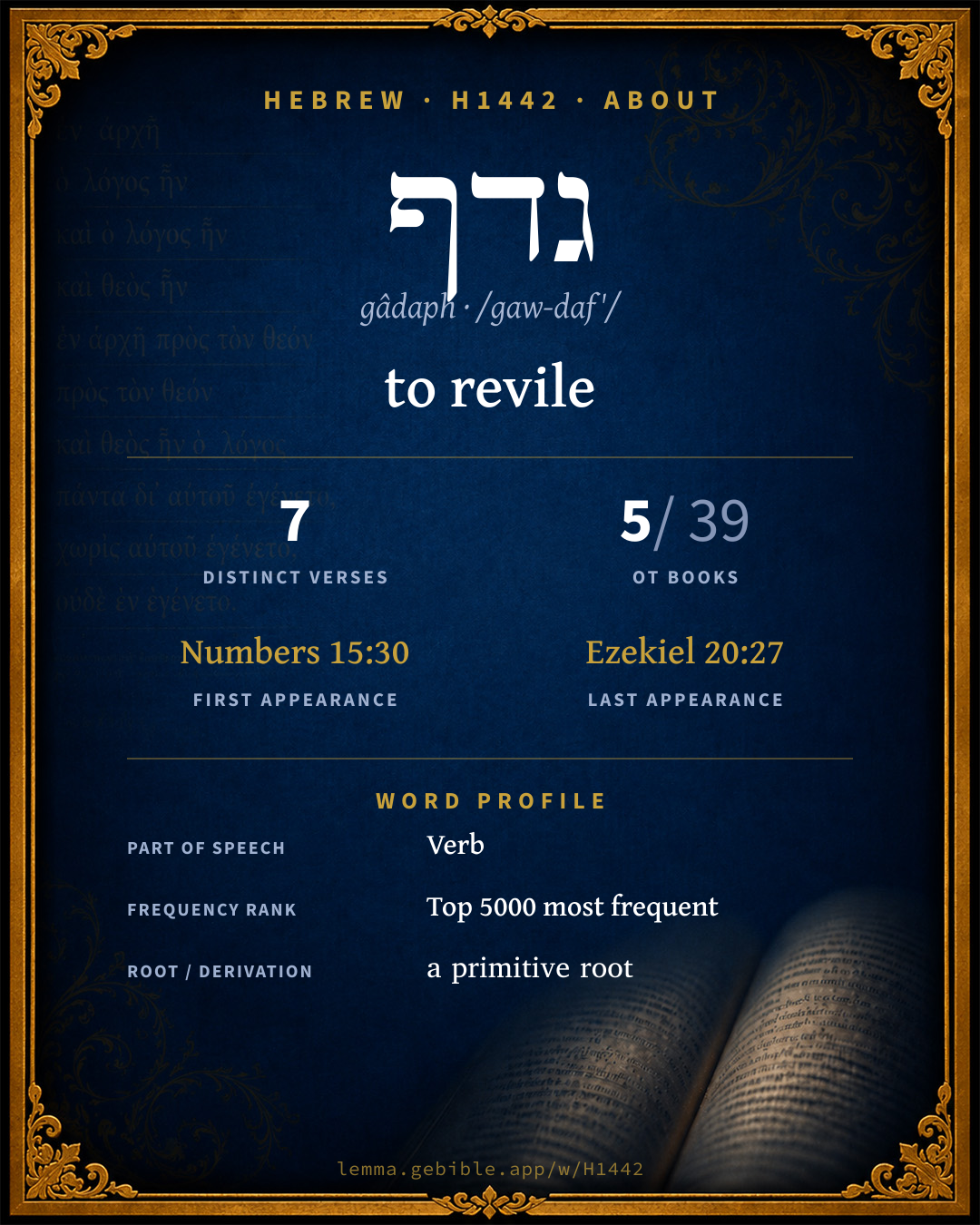
גָּדַף
to revile
‘to revile’ is one of 3 main senses fuller range ↓
Full lexicon entry — Brown-Driver-Briggs (BDB)
From Brown-Driver-Briggs (BDB)
Where this word appears
Grammar key — what these labels mean
Part of speech
- Verb
- An action or state-of-being word.
Stem
- Piel
- An intensive or resultative active stem.
Form
- Perfect
- A completed action or state — Hebrew marks aspect (completeness) more than strict tense (“he wrote”).
- Participle Active
- A verbal adjective expressing ongoing or characteristic action (“writing / one who writes”).
State
- Absolute
- The independent form of a noun, not bound to a following word.
Person
- 3rd Person
- The one spoken about (“he / she / it / they”).
- 2nd Person
- The one addressed (“you”).
Gender
- Common
- Either gender — not distinguished for this form.
- Masculine
- Grammatically masculine.
Number
- Plural
- More than one (in Hebrew, generally three or more).
- Singular
- One.
Every verse where H1442 appears in the Book of 2 Kings — 2 distinct verses. Click any verse to open its interlinear word-by-word view. Verse text shown in the World English Bible for context — . Each verse’s Hebrew form is shown with its reference; the English is not keyword-highlighted, since the data carries no word-level English alignment. Use “Compare translations” on any verse to read it across multiple English versions. This concordance covers the Hebrew Bible; Septuagint (Greek Old Testament) occurrences are not indexed here.
2 Kings
- 2 Kings 19:6 גִּדְּפ֛וּ Piel pf 3cp Isaiah said to them, Thus shall you tell your master, Thus says Yahweh, Don't be afraid of the words that you have heard, with which the servants of the king of Assyria have blasphemed me.
- 2 Kings 19:22 וְ/גִדַּ֔פְתָּ conj + Piel pf 2ms Whom have you defied and blasphemed? and against whom have you exalted your voice and lifted up your eyes on high? [even] against the Holy One of Israel.
About this entry
At a glance — auto-summarized from this page’s data, not written by a person. Every figure links to its source below. This summary describes the numbers; it doesn’t interpret them.
“to revile” is the headline sense of the Hebrew verb גדף (gâdaph). First canonically at Numbers 15:30, it enters the text early. The Hebrew Bible uses it across 7 verses — uncommon. More than a quarter of its appearances fall in 2 Kings. Catalogued under 3 senses, its meaning is not single-sense. The sections below give every sense, occurrence, and version rendering.
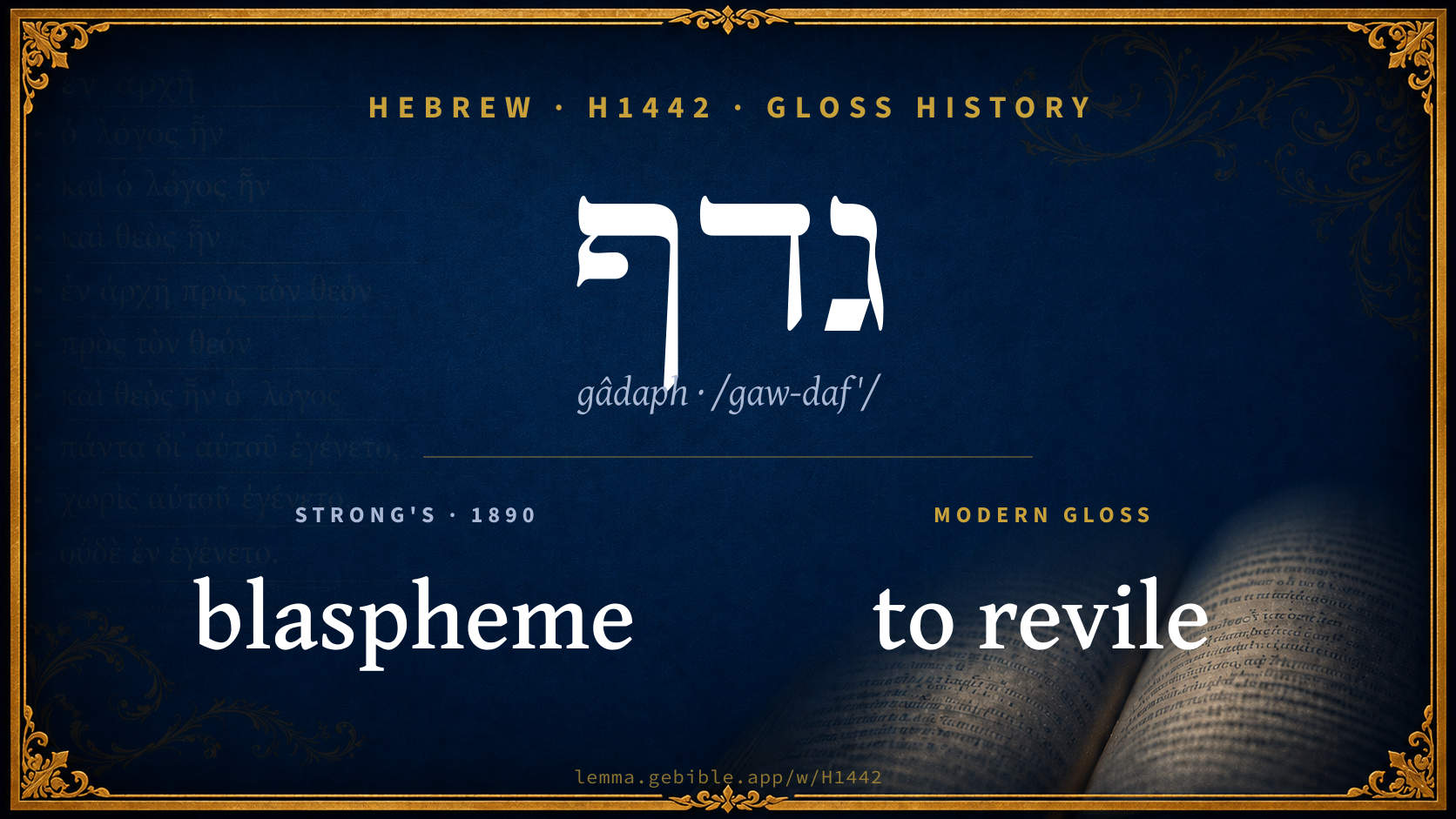
Gloss history
Strong's 1890 vs modern scholarship
About this word
Strong's H1442 catalogs a Hebrew word from the Hebrew Old Testament.
These counts are not copied from any lexicon or concordance. They are computed here, from the morphology-tagged Hebrew Old Testament. What Lemma adds →
- 7
- distinct verses
- The word appears in 7 distinct verses.
- 5 / 39
- OT books
- The word appears in 5 of 39 Old Testament books.
- #2,835
- by frequency
- Top 5000 most frequent Hebrew words (rank 2,835 of 8,640 Hebrew words by occurrence).
View all 7 occurrences in the concordance →
By section of the Old Testament
By traditional corpus
Conventional, traditional groupings — biblical authorship is debated, so this is a traditional corpus grouping, not an authorship claim. Each share is this word’s portion of its verses in that division of the Hebrew canon. Each figure is a share of the word’s 7 distinct verses.
- Prophets (Nevi'im) 5 verses · 71%
- Torah (Pentateuch) 1 verse · 14%
- Writings (Ketuvim) 1 verse · 14%
How translations render this word
Counts come from each version’s own published word-to-Strong’s tagging or interlinear alignment — an approximate guide to how each version renders this word, not a word-level alignment the data otherwise carries. Because each total is that version’s own tagged count, the per-version totals vary from one another and need not match the appearance or distinct-verse counts above. These counts may also differ from a printed concordance because Lemma counts each distinctly tagged rendering and does not collapse phrase taggings into a single head-word total. This is a fixed set of word-tagged versions (KJV, ASV, BSB, ULT) and does not change with the reading translation you choose elsewhere. Each version’s license is shown beside its name below (and on Sources).
- King James Version: Have blasphemed 3×, Blasphemed 2×
- American Standard Version: Blasphemed 3×, Have blasphemed me 2×
- Berean Standard Bible: Blasphemed 3×
- unfoldingWord Literal Text: Have blasphemed 2×, Taunted 2×
King James Version Public Domain
Renders H1442 across 7 tagged occurrences — most commonly:
Plus 2 renderings that appear only once — usually multi-word phrases or single function words the recovered tagging swept in, not distinct renderings.
American Standard Version Public Domain
Renders H1442 across 7 tagged occurrences — most commonly:
Plus 2 renderings that appear only once — usually multi-word phrases or single function words the recovered tagging swept in, not distinct renderings.
Berean Standard Bible Public Domain
Renders H1442 across 7 tagged occurrences — most commonly:
Plus 4 renderings that appear only once — usually multi-word phrases or single function words the recovered tagging swept in, not distinct renderings.
unfoldingWord Literal Text CC BY-SA 4.0
Renders H1442 across 7 tagged occurrences — most commonly:
Plus 3 renderings that appear only once — usually multi-word phrases or single function words the recovered tagging swept in, not distinct renderings.
Senses in BDB
The 3 senses BDB distinguishes for this word, in lexicon order (not ranked by frequency or importance). The full entry — with sub-senses — is in the Lexicon Entry tab.
- to revile men, blaspheme God
(Piel)
- to revile (between men)
- to blaspheme (God)
Word origin
[ גָּדַף ] vb. only Pi. revile, blaspheme
— Brown-Driver-Briggs (Oxford 1906, public domain), digitized via Sefaria, supplemented by the OpenScriptures HebrewLexicon (CC BY 4.0). See Sources.
Origin: a primitive root
Jastrow Dictionary
A second Hebrew/Aramaic lexicon for comparison, covering Aramaic and post-biblical (Talmudic, Targumic, Midrashic) usage that the biblical-Hebrew BDB does not. Matched by lemma rather than by Strong’s number, so a lemma may carry more than one Jastrow headword (shown separately below), and the entries cover usage well beyond the Bible.
גָּדַף
- cmp. preced.) to cut, scrape. Part. pass. גָּדוּף, pl. גְּדוּפִין. Pes. 42ᵃ מים הג׳ Ar., v. גָּרַף.—מיתה גְדוּפָה, v. infra.
- 1. to hollow out, scrape or chisel so as to form an enclosure or rim (cmp. גדפא, גדנפא).).
- 2. to scrape, to empty to the dregs. Kerith. 7ᵇ (explain. מגדף, Num. XV, 30, as a metaphor) as one says to his neighbor גִּדַּפְתָּ את הקערה וחיסרת Ar. (ed. גֵירַ׳; Sifré Num. 112 גֵרַרְתָּה מן וכ׳) thou hast scraped out the dish and lessened the thickness of the vessel (i.e. besides worshipping the forces of Nature to impair, so to speak, the supremacy of the Creator); he who thus explains, is of the opinion that מגדף means blaspheming the Divine Name; ג׳ הקערה ולא וכ׳ thou hast scraped the dish clean but not impaired it (i.e. to worship natural forces without denying the Divine supremacy); he who thus explains, is of the opinion that מגדף is a worshipper of idols; [Y. Snh. VII, 25ᵇ top גיר׳ את כל וכ׳ thou hast emptied the whole dish and left nothing in it, i.e. thou hast erased the entire Law; Sifré l. c. גררתה וכ׳].—Trnsf. (cmp. ארר, קלל, נקב) to blaspheme (God); to revile, reproach. Kerith. I, 2 אף המְגַדֵּף the blasphemer is also excluded from the rule (and has not to offer a sacrifice in the case of sinning through ignorance); expl. ib. 7ᵇ,Kerith. I, 2 אף המְגַדֵּף the blasphemer is also excluded from the rule (and has not to offer a sacrifice in the case of sinning through ignorance); expl. ib. 7ᵇ, v. supra. Snh. VII, 5; a. fr.—Num. R. s. 10 לפי שהיה מחרפם ומְגַדְּפָם בנחיצה לכן מת מיתה גְדוּפָה וכ׳ because be (Sisera) disgraced and reviled them (the Israelites) with oppressive measures, therefore he died an ignominious death, for (the Lord) delivered him into the hands of a woman; a. fr. e.g. Numbers 15:30
גְּדַף
- Pa. גַּדֵּיף
- 1. same, to blaspheme. Targ. I Kings XXI, 13; a. e.—Y. M. Kat. III, 83ᵇ; Y. Snh. VII, 25ᵇ top.
- 2. (with ב) to sneer at. Snh. 40ᵇ; Ab. Zar. 35ᵃ … מְגַדֵּף בה ר׳ R. … sneered at the opinion.
A Dictionary of the Targumim, the Talmud Babli and Yerushalmi, and the Midrashic Literature (Marcus Jastrow; London, Luzac, 1903) — Public Domain. Digitized via Sefaria. Digitized via Sefaria. Full attribution on Sources.
Forms in the corpus
The 5 distinct written forms H1442 takes in the Hebrew Bible, most frequent first — each parse links to that stem’s occurrences in the concordance. Hebrew forms include their vowel points and cantillation, so a single lemma takes many written forms.
| Form | Parsing | Example | Uses |
|---|---|---|---|
| גִּדְּפ֛וּ | Verb, Piel, Perfect, 3rd Person, Common, Plural | 2 Kings 19:6 | 2 |
| וְ/גִדַּ֔פְתָּ | Verb, Piel, Perfect, 2nd Person, Masculine, Singular | 2 Kings 19:22 | 2 |
| גִּדְּפ֤וּ | Verb, Piel, Perfect, 3rd Person, Common, Plural | Ezekiel 20:27 | 1 |
| וּ/מְגַדֵּ֑ף | Verb, Piel, Participle Active, Masculine, Singular, Absolute | Psalms 44:16 | 1 |
| מְגַדֵּ֑ף | Verb, Piel, Participle Active, Masculine, Singular, Absolute | Numbers 15:30 | 1 |
Same root — word family
Other BDB entries built from the same root as H1442, grouped by Strong’s listed origin. These share a root / origin per the lexicon — not necessarily a shared meaning. Each links to that word’s own entry.
Derived from this word
Compare all same-root words → They share a root, not necessarily a meaning.
Septuagint verse parallels
This word appears in 7 verses that also exist in the Greek Old Testament (Septuagint), out of the 7 Hebrew verses it occurs in. You can read those verses in Greek by switching the Old Testament edition to the Septuagint.
Read these verses in the Septuagint
This is a verse-level parallel only — the same verses exist in both the Hebrew and Greek Old Testaments. No word-level Hebrew↔Greek correspondence is claimed: the data carries no such alignment, so no Greek word is shown as this Hebrew word’s translation. Coverage is not total — the Septuagint omits the deuterocanon and renumbers the Psalms, so some Hebrew verses have no direct Greek parallel.