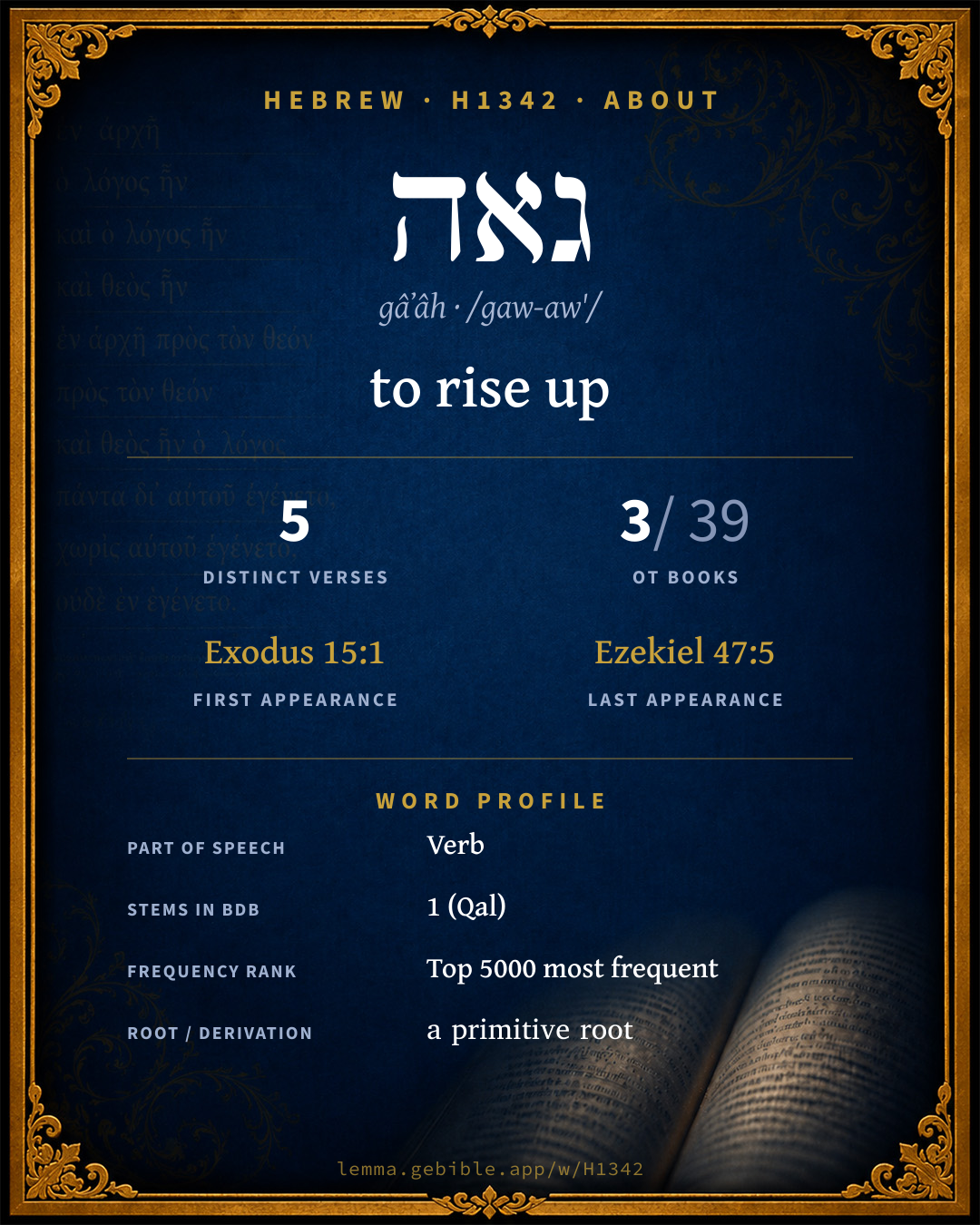
גָּאָה
to rise up
‘to rise up’ is one of 4 main senses fuller range ↓
Full lexicon entry — Brown-Driver-Briggs (BDB)
From Brown-Driver-Briggs (BDB)
Where this word appears
Grammar key — what these labels mean
Part of speech
- Verb
- An action or state-of-being word.
Stem
- Qal
- The basic, simple active stem — the plain form of the verb (“he wrote”). Here: ‘rise up’
Form
- Infinitive Absolute
- An unbound verbal noun, often intensifying or standing in for a finite verb.
- Perfect
- A completed action or state — Hebrew marks aspect (completeness) more than strict tense (“he wrote”).
- Imperfect
- An incomplete, ongoing, or future action (“he will / would write”).
Person
- 3rd Person
- The one spoken about (“he / she / it / they”).
Gender
- Masculine
- Grammatically masculine.
- Common
- Either gender — not distinguished for this form.
Number
- Singular
- One.
- Plural
- More than one (in Hebrew, generally three or more).
Every verse where H1342 appears in the Book of Job — 2 distinct verses. Click any verse to open its interlinear word-by-word view. Verse text shown in the World English Bible for context — . Each verse’s Hebrew form is shown with its reference; the English is not keyword-highlighted, since the data carries no word-level English alignment. Use “Compare translations” on any verse to read it across multiple English versions. This concordance covers the Hebrew Bible; Septuagint (Greek Old Testament) occurrences are not indexed here.
Job
About this entry
At a glance — auto-summarized from this page’s data, not written by a person. Every figure links to its source below. This summary describes the numbers; it doesn’t interpret them.
גאה — transliterated gâʼâh — is a Hebrew verb carrying the sense “to rise up.” It is rare — just 5 verses in the entire Hebrew Bible. More than a third of its appearances fall in Exodus. Its earliest occurrence is Exodus 15:1. The lexicon spreads it across several senses; see its full sense range. See the sense tree, 5-verse concordance, and the renderings breakdown below.
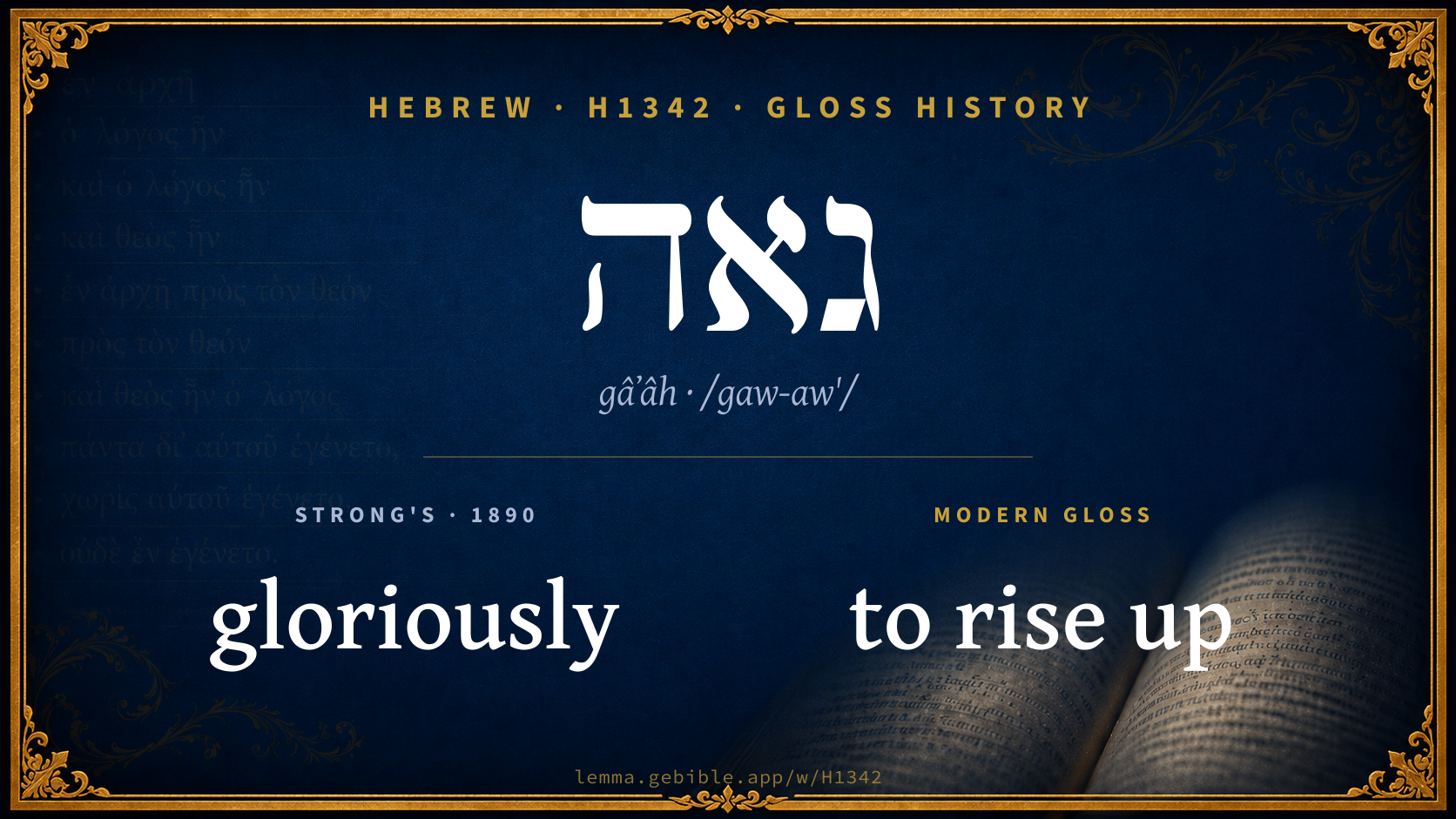
Gloss history
Strong's 1890 vs modern scholarship
About this word
Strong's H1342 catalogs a Hebrew word from the Hebrew Old Testament.
These counts are not copied from any lexicon or concordance. They are computed here, from the morphology-tagged Hebrew Old Testament. What Lemma adds →
- 5
- distinct verses
- The word appears in 5 distinct verses.
- 3 / 39
- OT books
- The word appears in 3 of 39 Old Testament books.
- #2,835
- by frequency
- Top 5000 most frequent Hebrew words (rank 2,835 of 8,640 Hebrew words by occurrence).
View all 5 occurrences in the concordance →
By section of the Old Testament
By traditional corpus
Conventional, traditional groupings — biblical authorship is debated, so this is a traditional corpus grouping, not an authorship claim. Each share is this word’s portion of its verses in that division of the Hebrew canon. Each figure is a share of the word’s 5 distinct verses.
- Torah (Pentateuch) 2 verses · 40%
- Writings (Ketuvim) 2 verses · 40%
- Prophets (Nevi'im) 1 verse · 20%
How translations render this word
Counts come from each version’s own published word-to-Strong’s tagging or interlinear alignment — an approximate guide to how each version renders this word, not a word-level alignment the data otherwise carries. Because each total is that version’s own tagged count, the per-version totals vary from one another and need not match the appearance or distinct-verse counts above. These counts may also differ from a printed concordance because Lemma counts each distinctly tagged rendering and does not collapse phrase taggings into a single head-word total. This is a fixed set of word-tagged versions (KJV, ASV, BSB, ULT) and does not change with the reading translation you choose elsewhere. Each version’s license is shown beside its name below (and on Sources).
- King James Version: Gloriously 2×, He hath triumphed 2×
- American Standard Version: Gloriously 2×, He hath triumphed 2×
- Berean Standard Bible: He is highly exalted 2×
- unfoldingWord Literal Text: Triumphantly 2×
King James Version Public Domain
Renders H1342 across 7 tagged occurrences — most commonly:
Plus 3 renderings that appear only once — usually multi-word phrases or single function words the recovered tagging swept in, not distinct renderings.
American Standard Version Public Domain
Renders H1342 across 7 tagged occurrences — most commonly:
Plus 3 renderings that appear only once — usually multi-word phrases or single function words the recovered tagging swept in, not distinct renderings.
Berean Standard Bible Public Domain
Renders H1342 across 5 tagged occurrences — most commonly:
Plus 3 renderings that appear only once — usually multi-word phrases or single function words the recovered tagging swept in, not distinct renderings. Not rendered by a distinct English word in 2 further occurrences.
unfoldingWord Literal Text CC BY-SA 4.0
Renders H1342 across 9 tagged occurrences — most commonly:
Plus 7 renderings that appear only once — usually multi-word phrases or single function words the recovered tagging swept in, not distinct renderings.
Senses in the full BDB
What do BDB’s symbols mean?
BDB uses these scholarly abbreviations:
| Symbol | Meaning |
|---|---|
| 𝔊 | the Septuagint (the ancient Greek translation, LXX) |
| 𝔙 | the Vulgate (the Latin translation) |
| 𝔖 | the Syriac version (the Peshitta) |
| 𝔗 | the Targum (the Aramaic translation) |
| ψ | the Psalms |
| √ | root (the underlying root or stem) |
| ‖ | parallel passage (a synonymous or contrasted parallel) |
| † | the dagger: every passage where the word occurs is cited |
The 4 senses and sub-senses the full Brown-Driver-Briggs lexicon distinguishes for this word, in lexicon order (not ranked by frequency), with BDB’s own verbatim wording and sub-sense lettering. Shown in Hebrew script with BDB’s own scholarly abbreviations. The condensed entry is in the Lexicon Entry tab. See also the Forms in the corpus table below.
Qal
- Pf. ג׳ Ex 15:1, 21, גָּאוּ Ez 47:5; Impf. יִגְאֶה Jb 8:11; 10:16, Inf. abs. גָּאֹה Ex 15:1, 21;— e.g. Exodus 15:1
- 1. rise up, of waters Ez 47:5. e.g. Ezekiel 47:5
- 2. grow up, of plants Jb 8:11. e.g. Job 8:11
- 3. be lifted up, exalted, of head Jb 10:16, of י׳ in triumph Ex 15:1, 21. e.g. Job 10:16
Senses from the full Brown-Driver-Briggs lexicon (Brown, Driver, Briggs; Oxford 1906 — public domain), digitized via Sefaria, supplemented by the OpenScriptures HebrewLexicon (CC BY 4.0). Full attribution on Sources.
Word origin
vb. rise up (Aramaic Pe. (𝔗 1 S 2:5) & often Ethiopic אֶתְגָּאֵי, ܐܶܬܓܰܠܻܝ be boastful, proud, cf. also NH)—
— Brown-Driver-Briggs (Oxford 1906, public domain), digitized via Sefaria, supplemented by the OpenScriptures HebrewLexicon (CC BY 4.0). See Sources.
Origin: a primitive root
Jastrow Dictionary
A second Hebrew/Aramaic lexicon for comparison, covering Aramaic and post-biblical (Talmudic, Targumic, Midrashic) usage that the biblical-Hebrew BDB does not. Matched by lemma rather than by Strong’s number, so a lemma may carry more than one Jastrow headword (shown separately below), and the entries cover usage well beyond the Bible.
גָּאָה
- , v. גאי
גֵּאֶה
- preced.) lofty; ruler, lord; proud, haughty. Pes. 113ᵇ דל ג׳ a proud pauper.—Pl. גֵּאִים, גֵּיאִים. Gen. R. s. 63 (ref. to גיים, Gen. XXV, 23) שני גֵיאֵי גוים וכ׳ two rulers of nations (Rome and Israel); Ber. 57ᵇ; Ab. Zar. 11ᵃ אל תקרי גוים אלא גֵּיִים read the word גיים not goyim (as the Masorah intimates) but geyim (lords); (Ms. M. a. Yalk. Gen. 110 גֵּאִים). Sifra B’ḥuck. Par. 2, ch. V (ref. to Lev. XXVI, 19) אלו הג׳ וכ׳ the ‘pride of your power’, those are the lordly (patrons) of whom Israel is proud. Cant. R. to III, 10 ארבע ג׳ הם גאה וכ׳ there are four majestic rulers (in the animal kingdom) the ruler among birds &c.; Ex. R. s. 23. Ḥag. 13ᵇ שמתגאה על הג׳ who is exalted (rules) over the rulers.—Y. Kidd. IV, end, 66ᶜ. רובן של עבדים ג׳ most slaves (when raised to power) are overbearing; Treat. Sof’rim XV, 10 נאים (corr. acc.); a. fr.—V. גֵּאִים. e.g. Genesis 25:23
גאי
- , גה to rise; to be arched, caved) to rise, swell; trnsf. to be elated, proud; to be exalted, majestic. Mekh. B’shall., Shirah 2, v. infra. [Tosef. M. Kat. I, 7 גּוֹאֶה, v. גָּהָה.]
- to exalt. Mekh. l. c. גֵּאַנִּי וגֵאתִיו He (the Lord) exalted me, and I exalt him; Tanḥ. ib. 12 גֵּאַוְנִי וגֵאִיתִיו; Yalk. Ex. 242 וגואותיו (corr. acc.). Y. Taan. III, 67ᵃ top (ref. to Job XXIII, 29) אני אמרתי להשפילן … לגָאוֹתָן I (the Lord) decreed to humble them (by dearth), and thou—to raise them (Bab. ib. 23ᵃ הגבהתו). e.g. Job 23:29
- , Nithpa. נִתְגָּאֶה to show one’s self glorious, exalt one’s self, be exalted; (in an evil sense) to be proud, boast, to lord it. Mekh. l. c. (ref. to Ex. XV, 1) גָּאָה ועתיד להִתְגָּאוֹת He was glorious and will be &c. Ib. מִתְגָּאֶה הוא על כל המִתְגָּאִים He exalts himself above all those who are boastful, שֶׁבַּמֶּה שאו"ה מתג׳ לפניו וכ׳ for that with which the nations boast themselves, becomes the means of their punishment; Tanḥ. l. c.—Ḥag. 13ᵇ, v. גֵּאֶה. Ib. 5ᵇ פרנס המתג׳ וכ׳ an officer who lords it over the community. B. Bath. 98ᵃ המתג׳ בטלית וכ׳ who parades the scholar’s cloak. Tosef. Sot. III, 10 sq. לא נִתְגָּאוּ אלא וכ׳ became haughty only in consequence of the bounties &c.; Snh. 109ᵃ. Ber. 10ᵇ לאחר שאכל ושתה ונתג׳ זה Ms. M. (ed. לאחר שנתג׳; Yalk. Kings … זה ונתג׳; Lev. 616 לאחר שגאה) after this man has eaten and drunk and become haughty, v. גֵּאִים. Lev. R. s. 10 נתג׳ לבו עליו (Ex. R. s. 37 זחה דעתו) became overbearing. e.g. Exodus 15:1
A Dictionary of the Targumim, the Talmud Babli and Yerushalmi, and the Midrashic Literature (Marcus Jastrow; London, Luzac, 1903) — Public Domain. Digitized via Sefaria. Digitized via Sefaria. Full attribution on Sources.
Forms in the corpus
The 5 distinct written forms H1342 takes in the Hebrew Bible, most frequent first — each parse links to that stem’s occurrences in the concordance. Hebrew forms include their vowel points and cantillation, so a single lemma takes many written forms.
| Form | Parsing | Example | Uses |
|---|---|---|---|
| גָאֹ֣ה | Verb, Qal, Infinitive Absolute | Exodus 15:1 | 2 |
| גָּאָ֔ה | Verb, Qal, Perfect, 3rd Person, Masculine, Singular | Exodus 15:1 | 2 |
| גָא֤וּ | Verb, Qal, Perfect, 3rd Person, Common, Plural | Ezekiel 47:5 | 1 |
| הֲ/יִֽגְאֶה | Verb, Qal, Imperfect, 3rd Person, Masculine, Singular | Job 8:11 | 1 |
| וְ֭/יִגְאֶה | Verb, Qal, Imperfect, 3rd Person, Masculine, Singular | Job 10:16 | 1 |
Same root — word family
Other BDB entries built from the same root as H1342, grouped by Strong’s listed origin. These share a root / origin per the lexicon — not necessarily a shared meaning. Each links to that word’s own entry.
Derived from this word
- גאה gêʼeh H1343 proud
- גאה gêʼâh H1344 pride
- גאוה gaʼăvâh H1346 pride
- גאון gâʼôwn H1347 majesty
- גאות gêʼûwth H1348 majesty
- גאיון gaʼăyôwn H1349 proud
- גג gâg H1406 roof
- גו gêv H1460 back
Proper names from this root
People and places named from this root — a name, not an additional meaning of the word.
Compare all same-root words → Showing 4 of 10 — not the complete family. 1 of the same-root words is a proper name (a person or place). They share a root, not necessarily a meaning.
Septuagint verse parallels
This word appears in 5 verses that also exist in the Greek Old Testament (Septuagint), out of the 5 Hebrew verses it occurs in. You can read those verses in Greek by switching the Old Testament edition to the Septuagint.
Read these verses in the Septuagint
This is a verse-level parallel only — the same verses exist in both the Hebrew and Greek Old Testaments. No word-level Hebrew↔Greek correspondence is claimed: the data carries no such alignment, so no Greek word is shown as this Hebrew word’s translation. Coverage is not total — the Septuagint omits the deuterocanon and renumbers the Psalms, so some Hebrew verses have no direct Greek parallel.