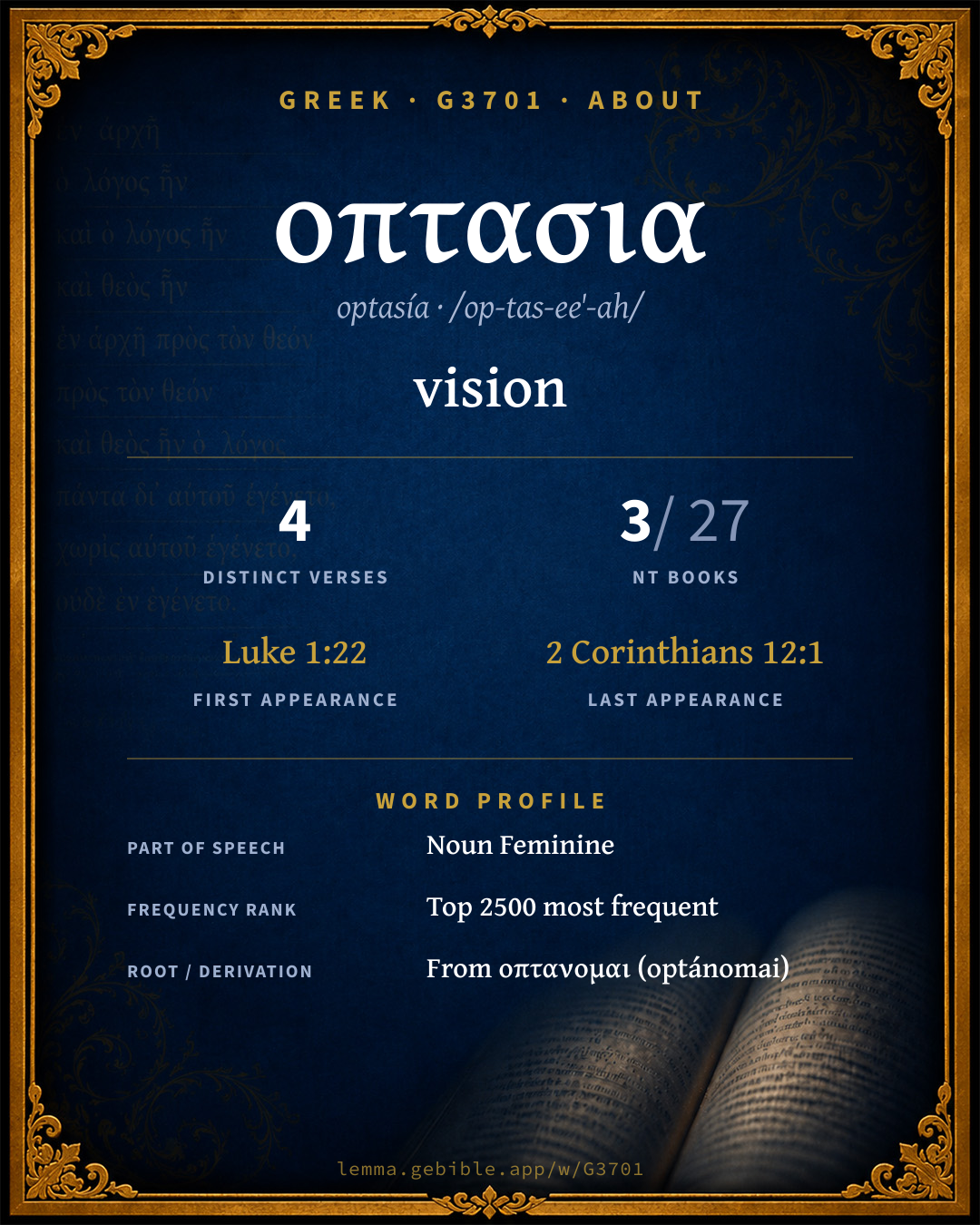
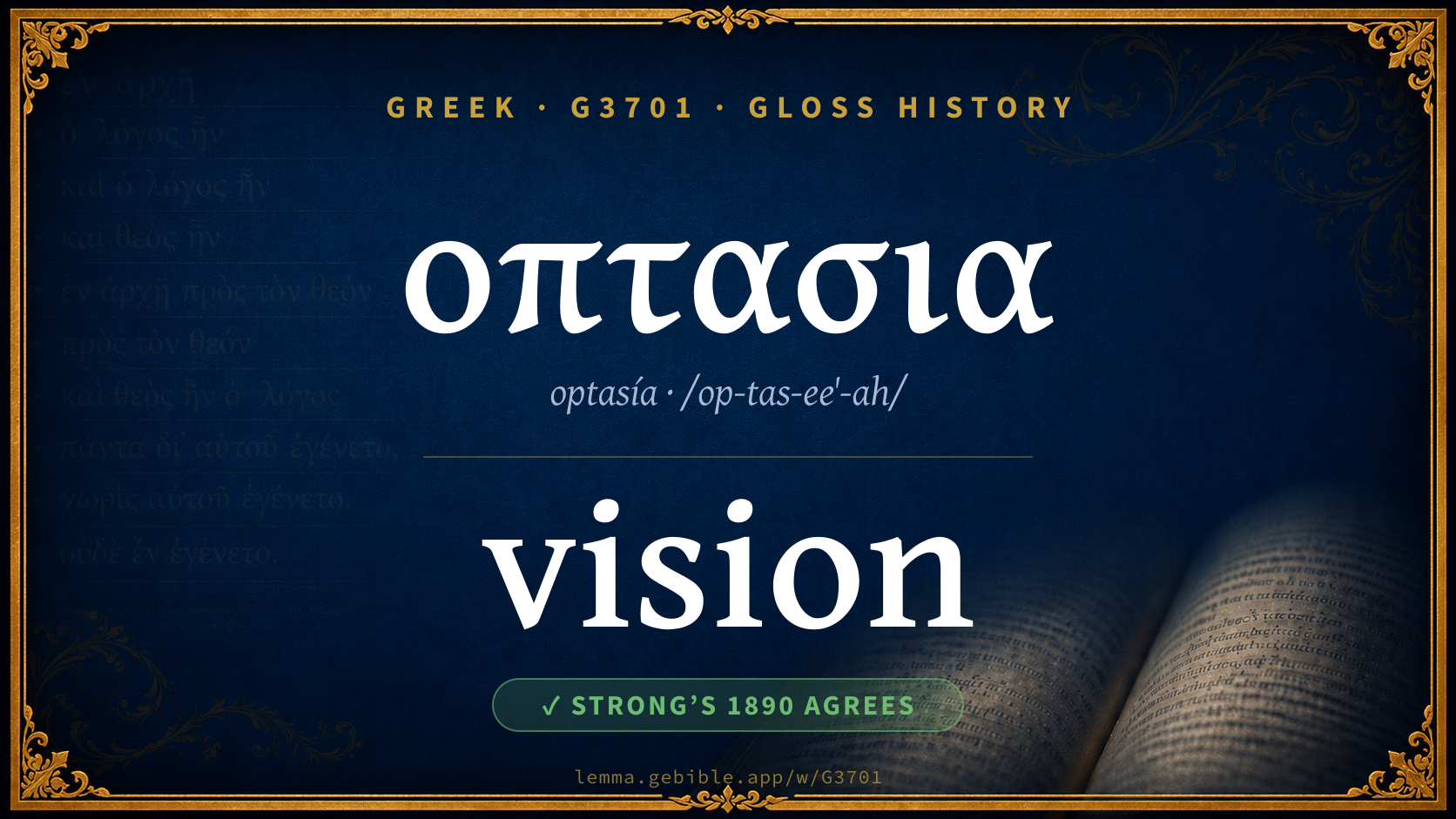
ὀπτασία
vision
‘vision’ is one of 2 main senses fuller range ↓
Full lexicon entry — Thayer's Greek Lexicon
From Thayer's Greek Lexicon
Where this word appears
See every Accusative-case word in the Greek New Testament →
Grammar key — what these labels mean
Part of speech
- Noun
- A naming word — a person, place, thing, or idea.
Case
- Accusative
- The case of the direct object and of extent.
- Dative
- The case of the indirect object, means, or location — “to / for / with / in.”
Gender
- Feminine
- Grammatically feminine.
Number
- Singular
- One.
- Plural
- More than one.
3 distinct verses where G3701 appears in the Accusative case, across 2 books. Filtered view — show all forms. Click any verse to open its interlinear word-by-word view. Verse text shown in the World English Bible for context — . Each verse’s Greek form is shown with its reference; the English is not keyword-highlighted, since the data carries no word-level English alignment. Use “Compare translations” on any verse to read it across multiple English versions. This concordance covers the Greek New Testament; Septuagint (Greek Old Testament) occurrences of this word are not indexed here.
Luke 2 verses
- Luke 1:22 ὀπτασίαν n acc sg fem When he came out, he could not speak to them, and they perceived that he had seen a vision in the temple. He continued making signs to them, and remained mute.
- Luke 24:23 ὀπτασίαν n acc sg fem and when they didn't find his body, they came saying that they had also seen a vision of angels, who said that he was alive.
2 Corinthians 1 verse
About this entry
At a glance — auto-summarized from this page’s data, not written by a person. Every figure links to its source below. This summary describes the numbers; it doesn’t interpret them.
At its core, οπτασια (optasía) means “vision.” It is rare — just 4 verses in the entire Greek New Testament. The word gravitates to Luke (50%), then Acts and 2 Corinthians. Scripture first uses it in Luke 1:22. Catalogued under 2 senses, its meaning is not single-sense. Dig into 4-verse concordance and the renderings breakdown below.
Gloss history
Strong's 1890 vs modern scholarship
About this word
Strong's G3701 catalogs a Greek word from the Greek New Testament.
These counts are not copied from any lexicon or concordance. They are computed here, from the morphology-tagged Greek New Testament. What Lemma adds →
- 4
- distinct verses
- The word appears in 4 distinct verses.
- 3 / 27
- NT books
- The word appears in 3 of 27 New Testament books.
- #1,877
- by frequency
- Top 2500 most frequent Greek words (rank 1,877 of 5,347 Greek words by occurrence).
View all 4 occurrences in the concordance →
Most concentrated in
- Luke 2 verses 50%
- Acts 1 verse 25%
- 2 Corinthians 1 verse 25%
By section of the New Testament
By traditional corpus
Conventional, traditional groupings — biblical authorship is debated, so this is a traditional corpus grouping, not an authorship claim. Some books belong to more than one corpus (Luke is in both the Gospels and the Lukan corpus, and so on), so these shares overlap and need not total 100%. Each figure is a share of the word’s 4 distinct verses.
- Lukan (Luke–Acts) 3 verses · 75%
- Gospels 2 verses · 50%
- Pauline corpus 1 verse · 25%
How translations render this word
Counts come from each version’s own published word-to-Strong’s tagging or interlinear alignment — an approximate guide to how each version renders this word, not a word-level alignment the data otherwise carries. Because each total is that version’s own tagged count, the per-version totals vary from one another and need not match the appearance or distinct-verse counts above. These counts may also differ from a printed concordance because Lemma counts each distinctly tagged rendering and does not collapse phrase taggings into a single head-word total. This is a fixed set of word-tagged versions (KJV, ASV, BSB, ULT) and does not change with the reading translation you choose elsewhere. Each version’s license is shown beside its name below (and on Sources).
- King James Version: Vision 3×
- American Standard Version: Vision 3×
- Berean Standard Bible: Vision 3×
- unfoldingWord Literal Text: Vision 3×
King James Version Public Domain
Renders G3701 across 4 tagged occurrences — most commonly:
Plus 1 rendering that appears only once — usually multi-word phrases or single function words the recovered tagging swept in, not distinct renderings.
American Standard Version Public Domain
Renders G3701 across 4 tagged occurrences — most commonly:
Plus 1 rendering that appears only once — usually multi-word phrases or single function words the recovered tagging swept in, not distinct renderings.
Berean Standard Bible Public Domain
Renders G3701 across 4 tagged occurrences — most commonly:
Plus 1 rendering that appears only once — usually multi-word phrases or single function words the recovered tagging swept in, not distinct renderings.
unfoldingWord Literal Text CC BY-SA 4.0
Renders G3701 across 5 tagged occurrences — most commonly:
Plus 2 renderings that appear only once — usually multi-word phrases or single function words the recovered tagging swept in, not distinct renderings.
Senses in Thayer's
The 2 senses Thayer's distinguishes for this word, in lexicon order (not ranked by frequency or importance). The full entry — with sub-senses — is in the Lexicon Entry tab.
- the act of exhibiting one's self to view
- a sight, a vision, an appearance presented to one whether asleep or awake
Word origin
Derived from οπτανομαι (optánomai) (G3700) — to look at.
From a presumed derivative of G3700 ; visuality that is (concretely) an apparition : - vision.
— Strong’s Exhaustive Concordance (1890), public domain.
Forms in the corpus
The 3 distinct written forms G3701 takes in the Greek New Testament, most frequent first — each parse links to that case’s occurrences in the concordance.
| Form | Parsing | Example | Uses |
|---|---|---|---|
| ὀπτασίαν optasían | Noun, Accusative, Singular, Feminine | Luke 1:22 | 2 |
| ὀπτασίας optasías | Noun, Accusative, Plural, Feminine | 2 Corinthians 12:1 | 1 |
| ὀπτασίᾳ optasía | Noun, Dative, Singular, Feminine | Acts 26:19 | 1 |
Same root — word family
Other Thayer's entries built from the same root as G3701, grouped by Strong’s listed origin. These share a root / origin per the lexicon — not necessarily a shared meaning. Each links to that word’s own entry.
Derives from
Shares the same root
- ομμα ómma G3659 eye
- οπη opḗ G3692 opening
- οπισθεν ópisthen G3693 behind
- οραω horáō G3708 to see
- οφθαλμος ophthalmós G3788 eye
- οφις óphis G3789 serpent
- οφρυς ophrŷs G3790 eyebrow
- οψις ópsis G3799 face
- σκυθρωπος skythrōpós G4659 sad-faced
Proper names from this root
People and places named from this root — a name, not an additional meaning of the word.
Compare all same-root words → Showing 4 of 12 — not the complete family. 1 of the same-root words is a proper name (a person or place). They share a root, not necessarily a meaning.
Septuagint usage
The same Greek word οπτασια appears 1 time in the Greek Old Testament (Septuagint), across 1 verse in 1 book.
- 1
- LXX occurrences
- Tagged occurrences of this Greek word in the Septuagint.
- 1
- verse
- Distinct Septuagint verses containing this word.
- 1 / 39
- OT books
- The word appears in 1 of the 39 Old Testament books.
Sample Septuagint occurrences
- Malachi 3:2 ὀπτασία
Septuagint occurrences (same lexeme)
Every verse where the same Strong’s number (G3701) appears in the Greek Septuagint. Verse text shown in the World English Bible for context; the Greek form is the matched word — the English is not keyword-highlighted.
These are occurrences of the same Greek lexeme (G3701) in the Septuagint — not a translation of any one Hebrew word. The store carries no word-level Hebrew↔Greek alignment, so no Hebrew original is asserted here. Counts come from the recovered LXX Strong's tagging — high-frequency vocabulary is well covered, while rare or late forms may be untagged — so they reflect tagged occurrences and may slightly undercount.