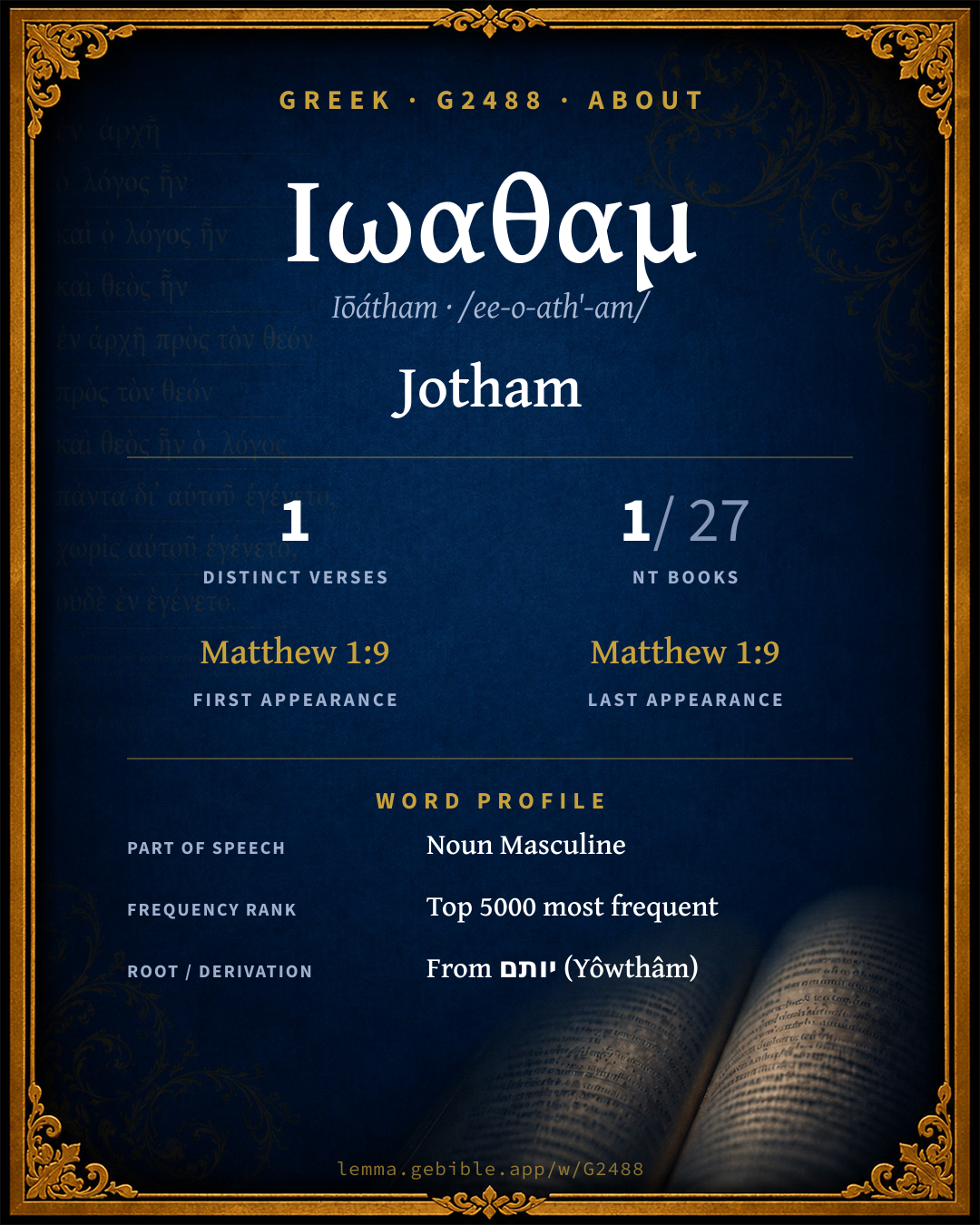
Ἰωαθαμ
Jotham
Thayer's lists 2 entries for ‘Jotham’ fuller range ↓
Full lexicon entry — Thayer's Greek Lexicon
From Thayer's Greek Lexicon
Where this word appears
Every verse where G2488 appears — 1 distinct verse across 1 book. Click any verse to open its interlinear word-by-word view. Verse text shown in the World English Bible for context — . Each verse’s Greek form is shown with its reference; the English is not keyword-highlighted, since the data carries no word-level English alignment. Use “Compare translations” on any verse to read it across multiple English versions. This concordance covers the Greek New Testament; Septuagint (Greek Old Testament) occurrences of this word are not indexed here.
Matthew 1 verse
About this entry
At a glance — auto-summarized from this page’s data, not written by a person. Every figure links to its source below. This summary describes the numbers; it doesn’t interpret them.
Ιωαθαμ (Iōátham) is a Greek name most often rendered “Jotham.” It occurs a mere 1 verse across Scripture. It clusters heavily in Matthew, which alone accounts for 100% of its uses. Found nowhere else but Matthew 1:9. The sections below give every occurrence and version rendering.
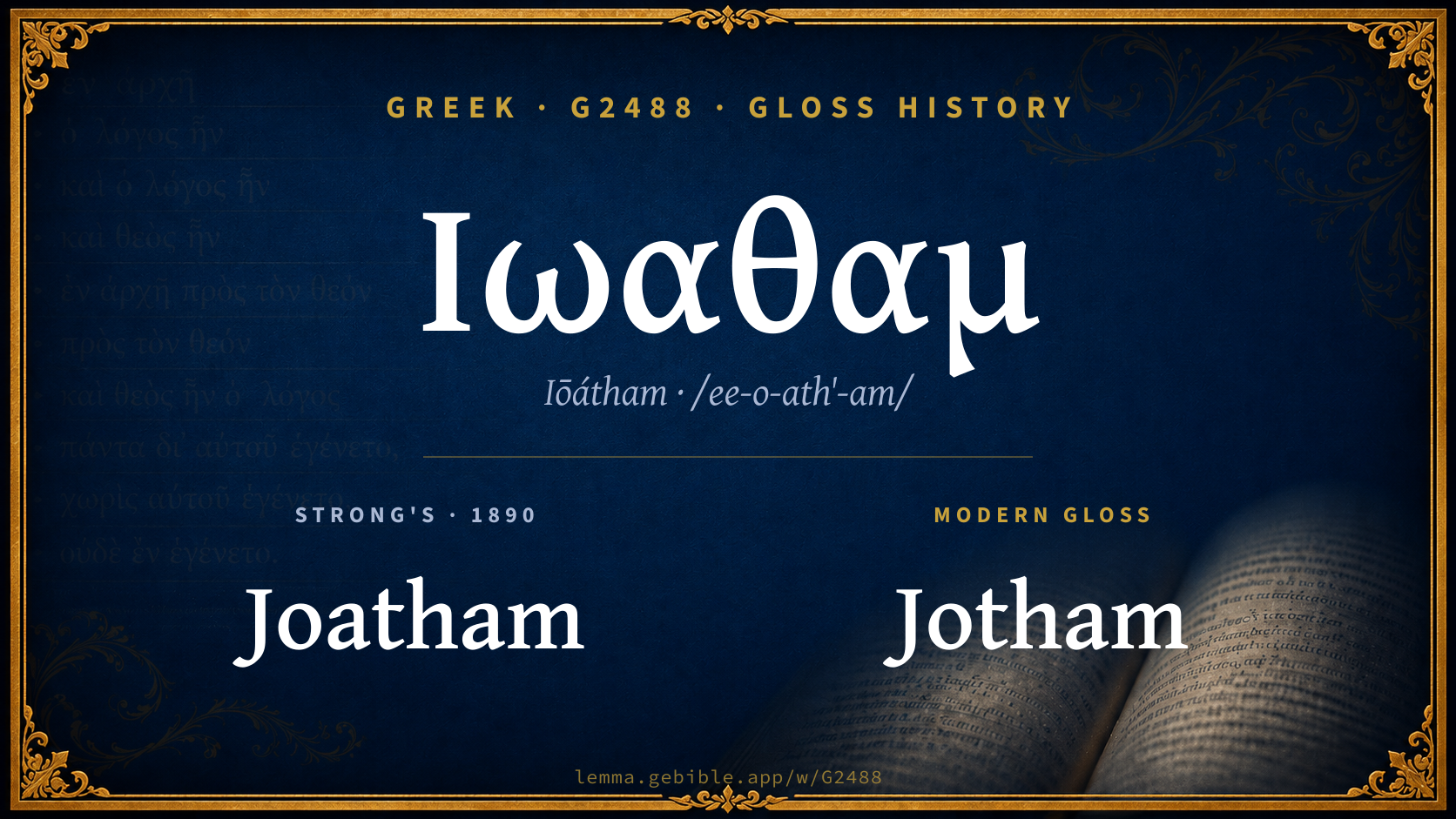
Gloss history
Strong's 1890 vs modern scholarship
About this word
Strong's G2488 catalogs a Greek word from the Greek New Testament.
These counts are not copied from any lexicon or concordance. They are computed here, from the morphology-tagged Greek New Testament. What Lemma adds →
- 1
- distinct verses
- The word appears in 1 distinct verse.
- 1 / 27
- NT books
- The word appears in 1 of 27 New Testament books.
- #2,678
- by frequency
- Top 5000 most frequent Greek words (rank 2,678 of 5,347 Greek words by occurrence).
View all 1 occurrence in the concordance →
Most concentrated in
- Matthew 1 verse 100%
By section of the New Testament
By traditional corpus
Conventional, traditional groupings — biblical authorship is debated, so this is a traditional corpus grouping, not an authorship claim. Some books belong to more than one corpus (Luke is in both the Gospels and the Lukan corpus, and so on), so these shares overlap and need not total 100%. Each figure is a share of the word’s 1 distinct verse.
- Gospels 1 verse · 100%
How translations render this word
Counts come from each version’s own published word-to-Strong’s tagging or interlinear alignment — an approximate guide to how each version renders this word, not a word-level alignment the data otherwise carries. Because each total is that version’s own tagged count, the per-version totals vary from one another and need not match the appearance or distinct-verse counts above. These counts may also differ from a printed concordance because Lemma counts each distinctly tagged rendering and does not collapse phrase taggings into a single head-word total. This is a fixed set of word-tagged versions (KJV, ASV, BSB, ULT) and does not change with the reading translation you choose elsewhere. Each version’s license is shown beside its name below (and on Sources).
- King James Version: Joatham 2×
- American Standard Version: Jotham 2×
- Berean Standard Bible: Jotham 2×
- unfoldingWord Literal Text: Jotham 2×
King James Version Public Domain
Renders G2488 across 2 tagged occurrences — most commonly:
American Standard Version Public Domain
Renders G2488 across 2 tagged occurrences — most commonly:
Berean Standard Bible Public Domain
Renders G2488 across 2 tagged occurrences — most commonly:
unfoldingWord Literal Text CC BY-SA 4.0
Renders G2488 across 2 tagged occurrences — most commonly:
Senses in Thayer's
The 2 senses Thayer's distinguishes for this word, in lexicon order (not ranked by frequency or importance). The full entry — with sub-senses — is in the Lexicon Entry tab.
- Jotham = "Jehovah is upright"
- the son of King Uzziah or Azariah and Jerusha
Word origin
Derived from יותם (Yôwthâm) (H3147) — Jotham.
Of hebrew origin [ H3147 ]; Joatham (that is Jotham ) an Israelite : - Joatham.
— Strong’s Exhaustive Concordance (1890), public domain.
Forms in the corpus
The 2 distinct written forms G2488 takes in the Greek New Testament, most frequent first — each parse links to that case’s occurrences in the concordance.
| Form | Parsing | Example | Uses |
|---|---|---|---|
| Ἰωαθάμ Iōathám | Noun, Proper, indeclinable | Matthew 1:9 | 1 |
| Ἰωαθὰμ Iōathàm | Noun, Proper, indeclinable | Matthew 1:9 | 1 |
Bible dictionary
Public-domain dictionary articles matched to this entry by name (Jotham). A biblical name can be shared by more than one person or place, so an article may treat several.
Easton's Bible Dictionary · M. G. Easton, 1897
Jehovah is perfect. (1.) The youngest of Gideon's seventy sons. He escaped when the rest were put to death by the order of Abimelech (Judg. 9:5). When "the citizens of Shechem and the whole house of Millo" were gathered together "by the plain of the pillar" (i.e., the stone set up by Joshua, 24:26; comp. Gen. 35:4) "that was in Shechem, to make Abimelech king," from one of the heights of Mount Gerizim he protested against their doing so in the earliest parable, that of the bramble-king. His words then spoken were prophetic. There came a recoil in the feelings of the people toward Abimelech, and then a terrible revenge, in which many were slain and the city of Shechem was destroyed by Abimelech (Judg. 9:45). Having delivered his warning, Jotham fled to Beer from the vengeance of Abimelech (9:7-21).
(2.) The son and successor of Uzziah on the throne of Judah. As during his last years Uzziah was excluded from public life on account of his leprosy, his son, then twenty-five years of age, administered for seven years the affairs of the kingdom in his father's stead (2 Chr. 26:21, 23; 27:1). After his father's death he became sole monarch, and reigned for sixteen years (B.C. 759-743). He ruled in the fear of God, and his reign was prosperous. He was contemporary with the prophets Isaiah, Hosea, and Micah, by whose ministrations he profited. He was buried in the sepulchre of the kings, greatly lamented by the people (2 Kings 15:38; 2 Chr. 27:7-9).
Smith's Bible Dictionary · William Smith, 1863
(Jehovah is upright).
+ The youngest son of Gideon, (Judges 9:5) who escaped from the massacre of his brethren. (B.C. after 1256.) His parable of the reign of the bramble is the earliest example of the kind. + The son of King Uzziah or Azariah and Jerushah. After administering the kingdom for some years during his father's leprosy, he succeeded to the throne B.C. 758, when he was 25 years old, and reigned 16 years in Jerusalem. He was contemporary with Pekah and with the prophet Isaiah. His history is contained in (2 Kings 15:1) ... and 2Chr 27:1 ... + A descendant of Judah, son of Jahdai. (1 Chronicles 2:47)
Hitchcock's Bible Names Dictionary · Roswell D. Hitchcock, 1869
the perfection of the Lord
Classic public-domain reference works; full attribution on Sources.
Septuagint usage
The same Greek word Ιωαθαμ appears 19 times in the Greek Old Testament (Septuagint), across 19 verses in 6 books.
- 19
- LXX occurrences
- Tagged occurrences of this Greek word in the Septuagint.
- 19
- verses
- Distinct Septuagint verses containing this word.
- 6 / 39
- OT books
- The word appears in 6 of the 39 Old Testament books.
Sample Septuagint occurrences
- 2 Kings 15:5 ιωαθαμ
- 1 Chronicles 2:47 ιωαθαμ
- 2 Chronicles 26:21 ιωαθαμ
- Isaiah 1:1 ιωαθαμ
- Hosea 1:1 ιωαθαμ
- Micah 1:1 ιωαθαμ
Septuagint occurrences (same lexeme)
Every verse where the same Strong’s number (G2488) appears in the Greek Septuagint. Verse text shown in the World English Bible for context; the Greek form is the matched word — the English is not keyword-highlighted.
- 2 Kings 15:5 ιωαθαμ Yahweh struck the king, so that he was a leper to the day of his death, and lived in a separate house. Jotham the king's son was over the household, judging the people of the land.
- 2 Kings 15:7 ιωαθαμ Azariah slept with his fathers; and they buried him with his fathers in the city of David: and Jotham his son reigned in his place.
- 2 Kings 15:30 ιωαθαμ Hoshea the son of Elah made a conspiracy against Pekah the son of Remaliah, and struck him, and killed him, and reigned in his place, in the twentieth year of Jotham the son of Uzziah.
- 2 Kings 15:32 ιωαθαμ In the second year of Pekah the son of Remaliah king of Israel began Jotham the son of Uzziah king of Judah to reign.
- 2 Kings 15:36 ιωαθαμ Now the rest of the acts of Jotham, and all that he did, aren't they written in the book of the chronicles of the kings of Judah?
- 2 Kings 15:38 ιωαθαμ Jotham slept with his fathers, and was buried with his fathers in the city of David his father: and Ahaz his son reigned in his place.
- 2 Kings 16:1 ιωαθαμ In the seventeenth year of Pekah the son of Remaliah Ahaz the son of Jotham king of Judah began to reign.
- 1 Chronicles 2:47 ιωαθαμ The sons of Jahdai: Regem, and Jothan, and Geshan, and Pelet, and Ephah, and Shaaph.
- 1 Chronicles 5:17 ιωαθαμ All these were reckoned by genealogies in the days of Jotham king of Judah, and in the days of Jeroboam king of Israel.
- 2 Chronicles 26:21 ιωαθαμ Uzziah the king was a leper to the day of his death, and lived in a separate house, being a leper; for he was cut off from the house of Yahweh: and Jotham his son was over the king's house, judging the people of the land.
- 2 Chronicles 26:23 ιωαθαμ So Uzziah slept with his fathers; and they buried him with his fathers in the field of burial which belonged to the kings; for they said, He is a leper: and Jotham his son reigned in his place.
- 2 Chronicles 27:1 ιωαθαμ Jotham was twenty-five years old when he began to reign; and he reigned sixteen years in Jerusalem: and his mother's name was Jerushah the daughter of Zadok.
- 2 Chronicles 27:6 ιωαθαμ So Jotham became mighty, because he ordered his ways before Yahweh his God.
- 2 Chronicles 27:7 ιωαθαμ Now the rest of the acts of Jotham, and all his wars, and his ways, behold, they are written in the book of the kings of Israel and Judah.
- 2 Chronicles 27:8 ιωαθαμ He was five and twenty years old when he began to reign, and reigned sixteen years in Jerusalem.
- Isaiah 1:1 ιωαθαμ The vision of Isaiah the son of Amoz, which he saw concerning Judah and Jerusalem, in the days of Uzziah, Jotham, Ahaz, and Hezekiah, kings of Judah.
- Isaiah 7:1 ιωαθαμ It happened in the days of Ahaz the son of Jotham, the son of Uzziah, king of Judah, that Rezin the king of Syria, and Pekah the son of Remaliah, king of Israel, went up to Jerusalem to war against it, but could not prevail against it.
- Hosea 1:1 ιωαθαμ The word of Yahweh that came to Hosea the son of Beeri, in the days of Uzziah, Jotham, Ahaz, and Hezekiah, kings of Judah, and in the days of Jeroboam the son of Joash, king of Israel.
- Micah 1:1 ιωαθαμ The word of Yahweh that came to Micah the Morashtite in the days of Jotham, Ahaz, and Hezekiah, kings of Judah, which he saw concerning Samaria and Jerusalem.
These are occurrences of the same Greek lexeme (G2488) in the Septuagint — not a translation of any one Hebrew word. The store carries no word-level Hebrew↔Greek alignment, so no Hebrew original is asserted here. Counts come from the recovered LXX Strong's tagging — high-frequency vocabulary is well covered, while rare or late forms may be untagged — so they reflect tagged occurrences and may slightly undercount.