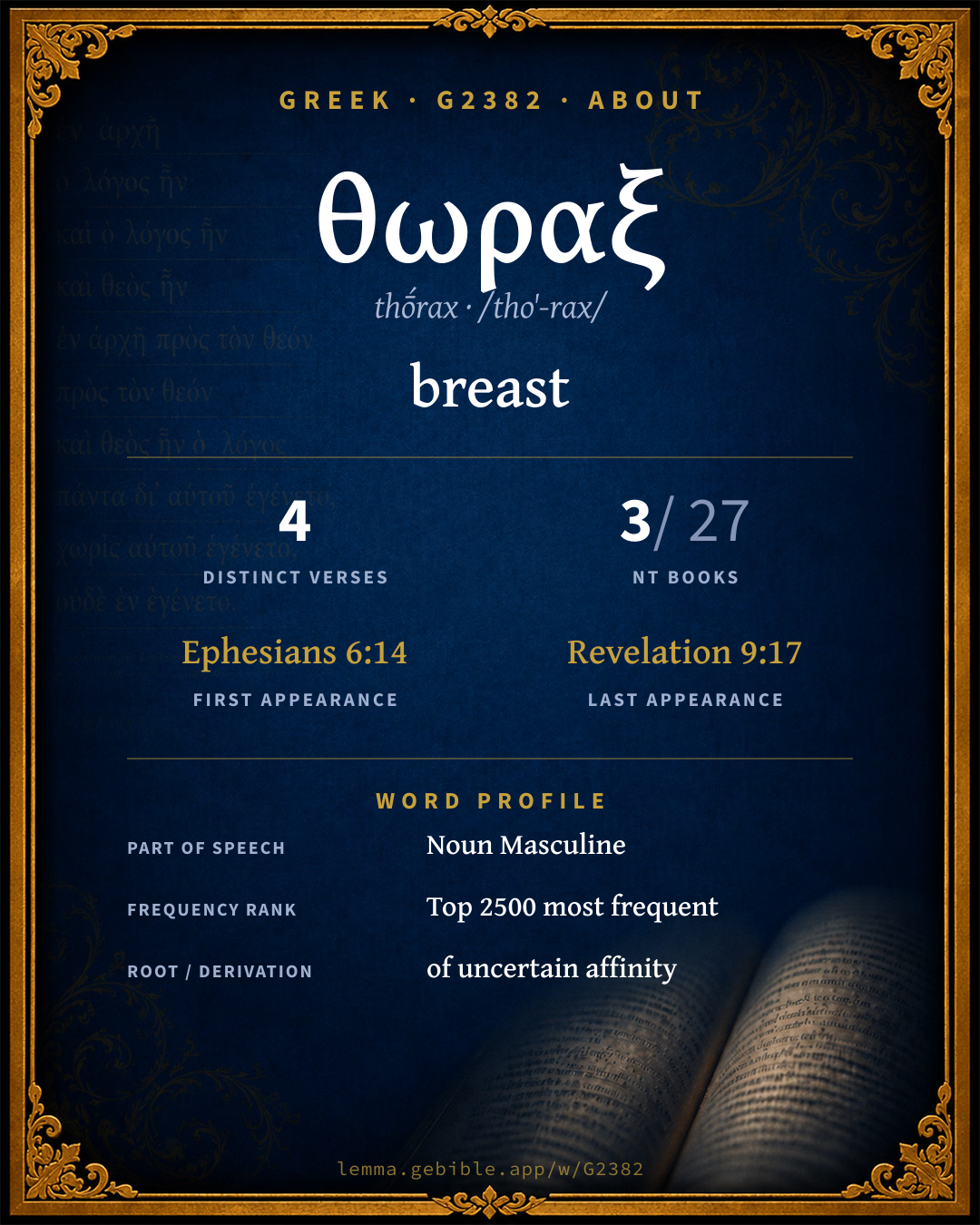
θώραξ
breast
‘breast’ is one of 2 main senses fuller range ↓
Full lexicon entry — Thayer's Greek Lexicon
From Thayer's Greek Lexicon
Where this word appears
Grammar key — what these labels mean
Part of speech
- Noun
- A naming word — a person, place, thing, or idea.
Case
- Accusative
- The case of the direct object and of extent.
Gender
- Masculine
- Grammatically masculine.
Number
- Plural
- More than one.
- Singular
- One.
Every verse where G2382 appears in the Book of Revelation — 2 distinct verses. Click any verse to open its interlinear word-by-word view. Verse text shown in the World English Bible for context — . Each verse’s Greek form is shown with its reference; the English is not keyword-highlighted, since the data carries no word-level English alignment. Use “Compare translations” on any verse to read it across multiple English versions. This concordance covers the Greek New Testament; Septuagint (Greek Old Testament) occurrences of this word are not indexed here.
Revelation
- Revelation 9:9 θώρακας θώρακας n acc pl masc n acc pl masc They had breastplates, like breastplates of iron. The sound of their wings was like the sound of chariots, or of many horses rushing to war.
- Revelation 9:17 θώρακας n acc pl masc Thus I saw the horses in the vision, and those who sat on them, having breastplates of fiery red, hyacinth blue, and sulfur yellow; and the heads of lions. Out of their mouths proceed fire, smoke, and sulfur.
About this entry
At a glance — auto-summarized from this page’s data, not written by a person. Every figure links to its source below. This summary describes the numbers; it doesn’t interpret them.
“breast” is the headline sense of the Greek noun θωραξ (thṓrax). With only 4 verses it sits in the long tail of Greek New Testament vocabulary. More than half of its appearances fall in Revelation. Scripture first uses it in Ephesians 6:14. Catalogued under 2 senses, its meaning is not single-sense. See the sense tree, 4-verse concordance, and the renderings breakdown below.
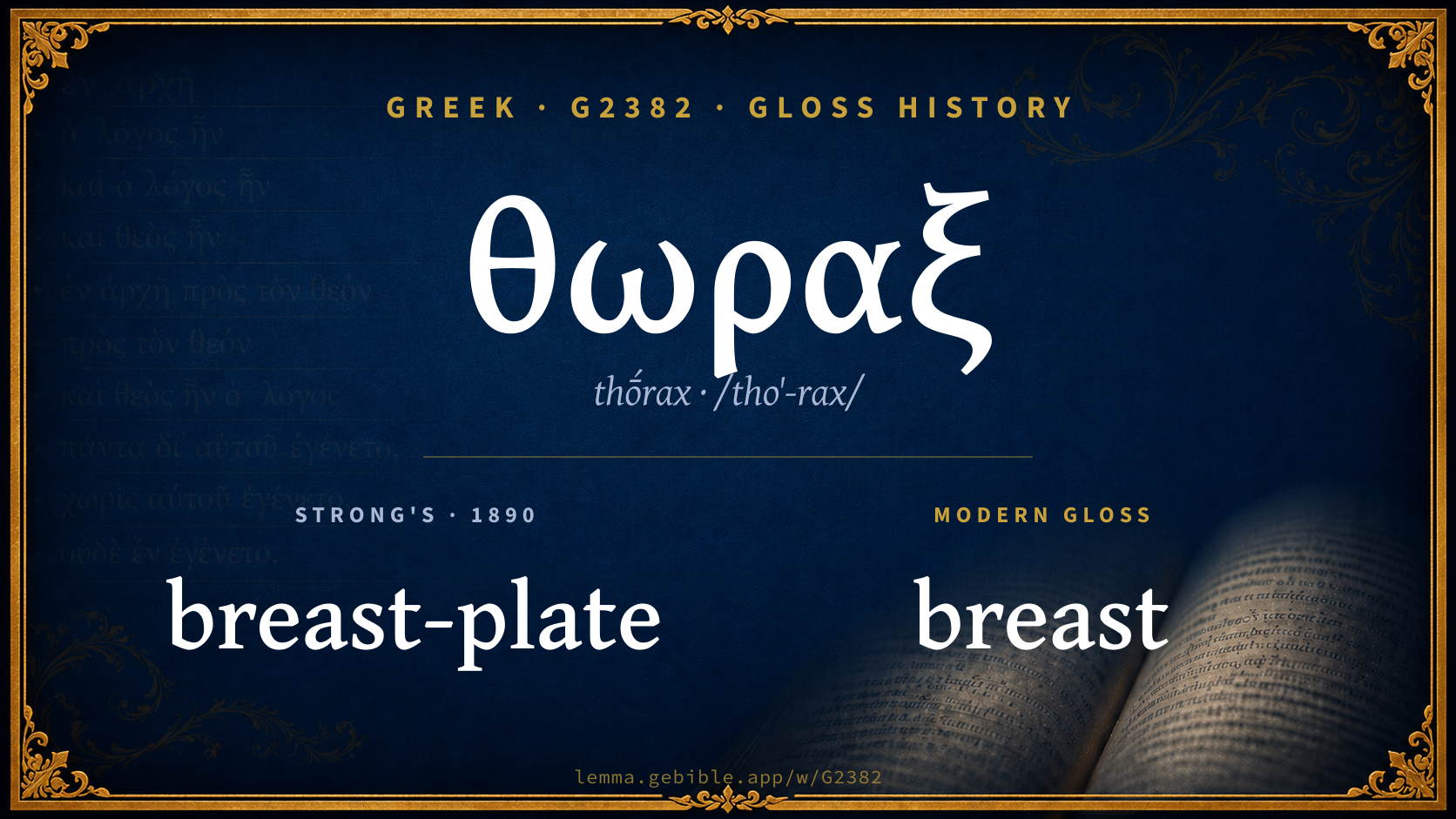
Gloss history
Strong's 1890 vs modern scholarship
About this word
Strong's G2382 catalogs a Greek word from the Greek New Testament.
These counts are not copied from any lexicon or concordance. They are computed here, from the morphology-tagged Greek New Testament. What Lemma adds →
- 4
- distinct verses
- The word appears in 4 distinct verses.
- 3 / 27
- NT books
- The word appears in 3 of 27 New Testament books.
- #1,648
- by frequency
- Top 2500 most frequent Greek words (rank 1,648 of 5,347 Greek words by occurrence).
View all 4 occurrences in the concordance →
Most concentrated in
- Revelation 2 verses 50%
- Ephesians 1 verse 25%
- 1 Thessalonians 1 verse 25%
By section of the New Testament
By traditional corpus
Conventional, traditional groupings — biblical authorship is debated, so this is a traditional corpus grouping, not an authorship claim. Some books belong to more than one corpus (Luke is in both the Gospels and the Lukan corpus, and so on), so these shares overlap and need not total 100%. Each figure is a share of the word’s 4 distinct verses.
- Johannine 2 verses · 50%
- Pauline corpus 2 verses · 50%
- Revelation 2 verses · 50%
How translations render this word
Counts come from each version’s own published word-to-Strong’s tagging or interlinear alignment — an approximate guide to how each version renders this word, not a word-level alignment the data otherwise carries. Because each total is that version’s own tagged count, the per-version totals vary from one another and need not match the appearance or distinct-verse counts above. These counts may also differ from a printed concordance because Lemma counts each distinctly tagged rendering and does not collapse phrase taggings into a single head-word total. This is a fixed set of word-tagged versions (KJV, ASV, BSB, ULT) and does not change with the reading translation you choose elsewhere. Each version’s license is shown beside its name below (and on Sources).
- King James Version: Breastplates 3×, Breastplate 2×
- American Standard Version: Breastplates 3×, Breastplate 2×
- Berean Standard Bible: Breastplates 3×, Breastplate 2×
- unfoldingWord Literal Text: Breastplates 3×, Breastplate 2×
King James Version Public Domain
Renders G2382 across 5 tagged occurrences — most commonly:
American Standard Version Public Domain
Renders G2382 across 5 tagged occurrences — most commonly:
Berean Standard Bible Public Domain
Renders G2382 across 5 tagged occurrences — most commonly:
unfoldingWord Literal Text CC BY-SA 4.0
Renders G2382 across 5 tagged occurrences — most commonly:
Senses in Thayer's
The 2 senses Thayer's distinguishes for this word, in lexicon order (not ranked by frequency or importance). The full entry — with sub-senses — is in the Lexicon Entry tab.
- the breast, the part of the body from the neck to the navel, where the ribs end
- a breastplate or corset consisting of two parts and protecting the body on both sides from the neck to the middle
Word origin
Origin: of uncertain affinity
Of uncertain affinity; the chest (thorax) that is (by implication) a corslet : - breastplate.
— Strong’s Exhaustive Concordance (1890), public domain.
Forms in the corpus
The 2 distinct written forms G2382 takes in the Greek New Testament, most frequent first — each parse links to that case’s occurrences in the concordance.
| Form | Parsing | Example | Uses |
|---|---|---|---|
| θώρακας thṓrakas | Noun, Accusative, Plural, Masculine | Revelation 9:9 | 3 |
| θώρακα thṓraka | Noun, Accusative, Singular, Masculine | Ephesians 6:14 | 2 |
Septuagint usage
The same Greek word θωραξ appears 11 times in the Greek Old Testament (Septuagint), across 10 verses in 8 books.
- 11
- LXX occurrences
- Tagged occurrences of this Greek word in the Septuagint.
- 10
- verses
- Distinct Septuagint verses containing this word.
- 8 / 39
- OT books
- The word appears in 8 of the 39 Old Testament books.
Sample Septuagint occurrences
- 1 Samuel 17:5 θώραξ
- 1 Kings 22:34 θώραξ
- 2 Chronicles 18:33 θώραξ
- Ezra 14:10 θώραξ
- Job 41:5 θώραξ
- Isaiah 59:17 θώραξ
- Jeremiah 26:4 θώραξ
- Ezekiel 38:4 θώραξ
Septuagint occurrences (same lexeme)
Every verse where the same Strong’s number (G2382) appears in the Greek Septuagint. Verse text shown in the World English Bible for context; the Greek form is the matched word — the English is not keyword-highlighted.
- 1 Samuel 17:5 θώραξ He had a helmet of brass on his head, and he was clad with a coat of mail; and the weight of the coat was five thousand shekels of brass.
- 1 Kings 22:34 θώραξ A certain man drew his bow at a venture, and struck the king of Israel between the joints of the armor: therefore he said to the driver of his chariot, Turn your hand, and carry me out of the host; for I am severely wounded.
- 2 Chronicles 18:33 θώραξ A certain man drew his bow at a venture, and struck the king of Israel between the joints of the armor. Therefore he said to the driver of the chariot, Turn your hand, and carry me out of the host; for I am sore wounded.
- 2 Chronicles 26:14 θώραξ Uzziah prepared for them, even for all the host, shields, and spears, and helmets, and coats of mail, and bows, and stones for slinging.
- Ezra 14:10 θώραξ
- Job 41:5 θώραξ Will you play with him as with a bird? Or will you bind him for your girls?
- Job 41:18 θώραξ His sneezing flashes forth light, His eyes are like the eyelids of the morning.
- Isaiah 59:17 θώραξ He put on righteousness as a breastplate, and a helmet of salvation on his head; and he put on garments of vengeance for clothing, and was clad with zeal as a mantle.
- Jeremiah 26:4 θώραξ You shall tell them, Thus says Yahweh: If you will not listen to me, to walk in my law, which I have set before you,
- Ezekiel 38:4 θώραξ and I will turn you about, and put hooks into your jaws, and I will bring you forth, and all your army, horses and horsemen, all of them clothed in full armor, a great company with buckler and shield, all of them handling swords;
These are occurrences of the same Greek lexeme (G2382) in the Septuagint — not a translation of any one Hebrew word. The store carries no word-level Hebrew↔Greek alignment, so no Hebrew original is asserted here. Counts come from the recovered LXX Strong's tagging — high-frequency vocabulary is well covered, while rare or late forms may be untagged — so they reflect tagged occurrences and may slightly undercount.