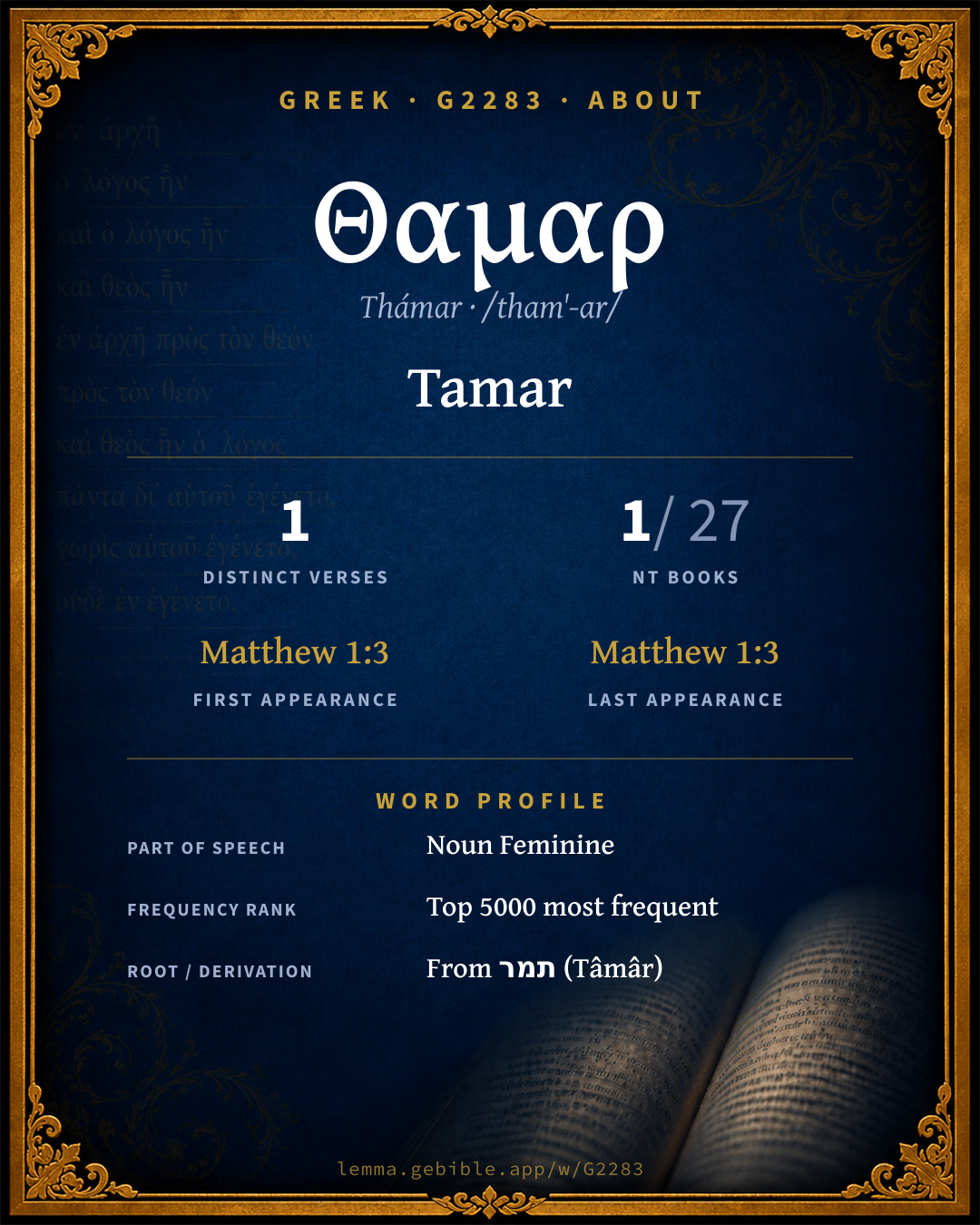
Θάμαρ
Tamar
Thayer's lists 2 entries for ‘Tamar’ fuller range ↓
Full lexicon entry — Thayer's Greek Lexicon
From Thayer's Greek Lexicon
Where this word appears
Every verse where G2283 appears — 1 distinct verse across 1 book. Click any verse to open its interlinear word-by-word view. Verse text shown in the World English Bible for context — . Each verse’s Greek form is shown with its reference; the English is not keyword-highlighted, since the data carries no word-level English alignment. Use “Compare translations” on any verse to read it across multiple English versions. This concordance covers the Greek New Testament; Septuagint (Greek Old Testament) occurrences of this word are not indexed here.
Matthew 1 verse
About this entry
At a glance — auto-summarized from this page’s data, not written by a person. Every figure links to its source below. This summary describes the numbers; it doesn’t interpret them.
The Greek name Θαμαρ centers on the idea of “Tamar.” It occurs a mere 1 verse across Scripture. Matthew dominates its distribution — 1 of 1 verses. Scripture uses it exactly once, at Matthew 1:3. Dig into 1-verse concordance and the renderings breakdown below.
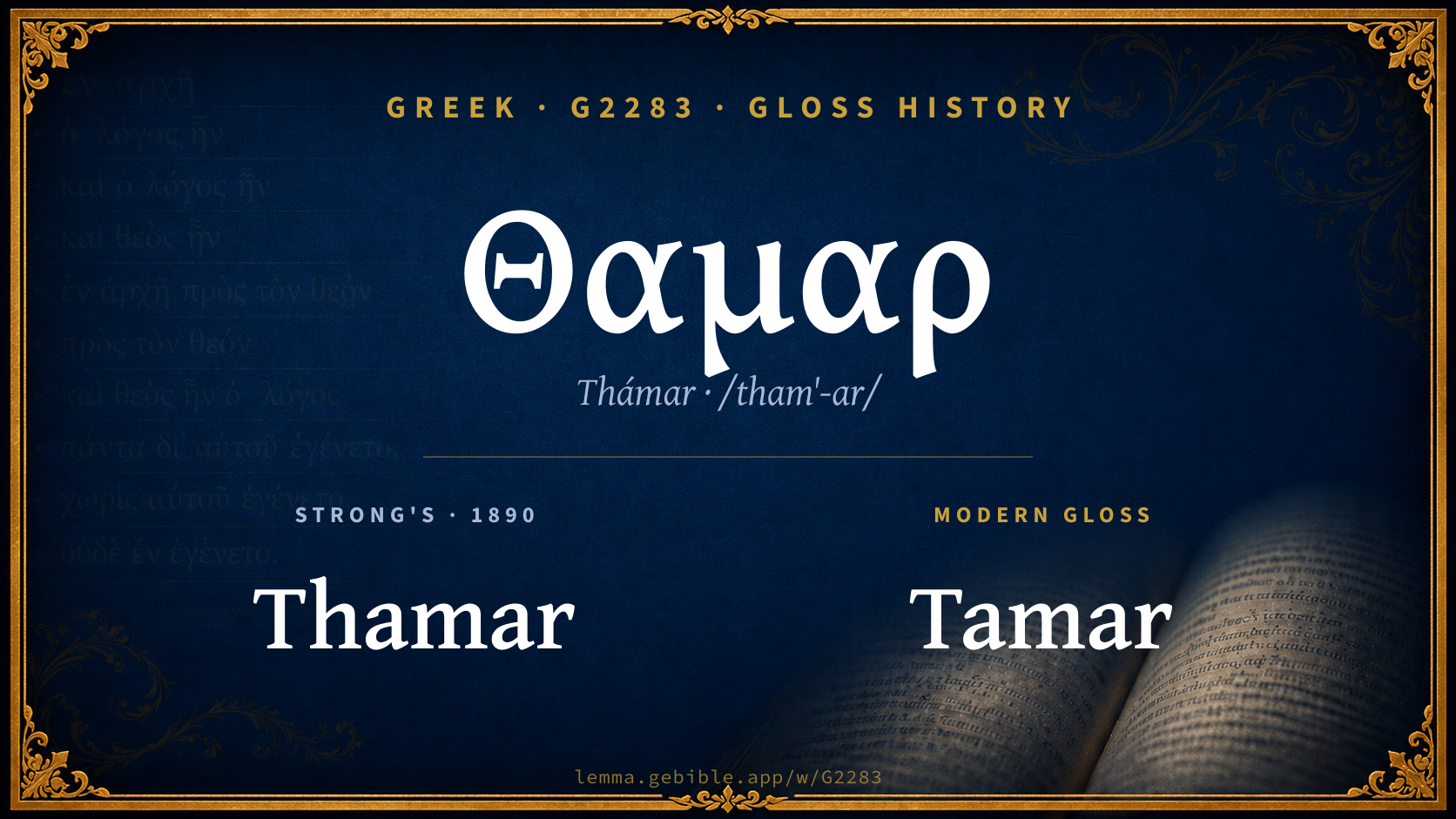
Gloss history
Strong's 1890 vs modern scholarship
About this word
Strong's G2283 catalogs a Greek word from the Greek New Testament.
These counts are not copied from any lexicon or concordance. They are computed here, from the morphology-tagged Greek New Testament. What Lemma adds →
- 1
- distinct verses
- The word appears in 1 distinct verse.
- 1 / 27
- NT books
- The word appears in 1 of 27 New Testament books.
- #3,503
- by frequency
- Top 5000 most frequent Greek words (rank 3,503 of 5,347 Greek words by occurrence).
View all 1 occurrence in the concordance →
Most concentrated in
- Matthew 1 verse 100%
By section of the New Testament
By traditional corpus
Conventional, traditional groupings — biblical authorship is debated, so this is a traditional corpus grouping, not an authorship claim. Some books belong to more than one corpus (Luke is in both the Gospels and the Lukan corpus, and so on), so these shares overlap and need not total 100%. Each figure is a share of the word’s 1 distinct verse.
- Gospels 1 verse · 100%
How translations render this word
Counts come from each version’s own published word-to-Strong’s tagging or interlinear alignment — an approximate guide to how each version renders this word, not a word-level alignment the data otherwise carries. Because each total is that version’s own tagged count, the per-version totals vary from one another and need not match the appearance or distinct-verse counts above. These counts may also differ from a printed concordance because Lemma counts each distinctly tagged rendering and does not collapse phrase taggings into a single head-word total. This is a fixed set of word-tagged versions (KJV, ASV, BSB, ULT) and does not change with the reading translation you choose elsewhere. Each version’s license is shown beside its name below (and on Sources).
- King James Version: Thamar 1×
- American Standard Version: Tamar 1×
- Berean Standard Bible: Tamar 1×
- unfoldingWord Literal Text: Tamar 1×
King James Version Public Domain
Renders G2283 across 1 tagged occurrence — most commonly:
American Standard Version Public Domain
Renders G2283 across 1 tagged occurrence — most commonly:
Berean Standard Bible Public Domain
Renders G2283 across 1 tagged occurrence — most commonly:
unfoldingWord Literal Text CC BY-SA 4.0
Renders G2283 across 1 tagged occurrence — most commonly:
Senses in Thayer's
The 2 senses Thayer's distinguishes for this word, in lexicon order (not ranked by frequency or importance). The full entry — with sub-senses — is in the Lexicon Entry tab.
- Tamar = "palm tree"
- the wife of the two sons of Judah, Er and Onan.
Word origin
Derived from תמר (Tâmâr) (H8559) — Tamar.
Of hebrew origin [ H8559 ]; Thamar (that is Tamar ) an Israelitess : - Thamar.
— Strong’s Exhaustive Concordance (1890), public domain.
Bible dictionary
Public-domain dictionary articles matched to this entry by name (Tamar). A biblical name can be shared by more than one person or place, so an article may treat several.
Easton's Bible Dictionary · M. G. Easton, 1897
Palm. (1.) A place mentioned by Ezekiel (47:19; 48:28), on the southeastern border of Palestine. Some suppose this was "Tadmor" (q.v.).
(2.) The daughter-in-law of Judah, to whose eldest son, Er, she was married (Gen. 38:6). After her husband's death, she was married to Onan, his brother (8), and on his death, Judah promised to her that his third son, Shelah, would become her husband. This promise was not fulfilled, and hence Tamar's revenge and Judah's great guilt (38:12-30).
(3.) A daughter of David (2 Sam. 13:1-32; 1 Chr. 3:9), whom Amnon shamefully outraged and afterwards "hated exceedingly," thereby illustrating the law of human nature noticed even by the heathen, "Proprium humani ingenii est odisse quem laeseris", i.e., "It is the property of human nature to hate one whom you have injured."
(4.) A daughter of Absalom (2 Sam. 14:27).
Smith's Bible Dictionary · William Smith, 1863
(palm tree).
+ The wife successively of the two sons of Judah, Er and Onan. (Genesis 38:8-30) (B.C. about 1718.) Her importance in the sacred narrative depends on the great anxiety to keep up the lineage of Judah. It seemed as if the family were on the point of extinction. Er and Onan had successively perished suddenly. Judah's wife, Bathshuah, died; and there only remained a child, Shelah, whom Judah was unwilling to trust to the dangerous union as it appeared, with Tamar, lest he should meet with the same fate as his brothers. Accordingly she resorted to the desperate expedient of entrapping the father himself into the union which he feared for his son. The fruits of this intercourse were twins, Pharez and Zarah, and through Pharez the sacred line was continued. + Daughter of David and Maachah the Geshurite princess, and thus sister of Absalom. (2 Samuel 13:1-32; 1 Chronicles 3:9) (B.C. 1033.) She and her brother were alike remarkable for their extraordinary beauty. This fatal beauty inspired a frantic passion in her half-brother Amnon, the oldest son of David by Ahinoam. In her touching remonstrance two points are remarkable: first, the expression of the infamy of such a crime "in Israel" implying the loftier standard of morals that prevailed, as compared with other countries at that time; and second, the belief that even this standard might be overborne lawfully by royal authority--"Speak to the king, for he will not withhold me from thee." The intense hatred of Amnon succeeding to his brutal passion, and the indignation of Tamar at his barbarous insult, even surpassing her indignation at his shameful outrage, are pathetically and graphically told. + Daughter of Absalom, (2 Samuel 14:7) became, by her marriage with Uriah of Gibeah, the mother of Maachah, the future queen of Judah or wife of Abijah. (1 Kings 15:2) (B.C. 1023.) + A spot on the southeastern frontier of Judah, named in (Ezekiel 47:19; 48:28) only, evidently called from a palm tree. If not Hazazon-tamar, the old name of Engedi, it may he a place called Thamar in the Onamasticon [HAZAZON-TAMAR), a day's journey south of Hebron.
Hitchcock's Bible Names Dictionary · Roswell D. Hitchcock, 1869
palm; palm-tree
Classic public-domain reference works; full attribution on Sources.
Septuagint usage
The same Greek word Θαμαρ appears 8 times in the Greek Old Testament (Septuagint), across 7 verses in 3 books.
- 8
- LXX occurrences
- Tagged occurrences of this Greek word in the Septuagint.
- 7
- verses
- Distinct Septuagint verses containing this word.
- 3 / 39
- OT books
- The word appears in 3 of the 39 Old Testament books.
Sample Septuagint occurrences
- Genesis 38:6 θαμαρ
- Ruth 4:12 θαμαρ
- 1 Chronicles 2:4 θαμαρ
Septuagint occurrences (same lexeme)
Every verse where the same Strong’s number (G2283) appears in the Greek Septuagint. Verse text shown in the World English Bible for context; the Greek form is the matched word — the English is not keyword-highlighted.
- Genesis 38:6 θαμαρ Judah took a wife for Er, his firstborn, and her name was Tamar.
- Genesis 38:11 θαμαρ Then Judah said to Tamar, his daughter-in-law, "Remain a widow in your father's house, until Shelah, my son, is grown up;" for he said, "Lest he also die, like his brothers." Tamar went and lived in her father's house.
- Genesis 38:13 θαμαρ It was told Tamar, saying, "Behold, your father-in-law is going up to Timnah to shear his sheep."
- Genesis 38:24 θαμαρ It happened about three months later, that it was told Judah, saying, "Tamar, your daughter-in-law, has played the prostitute; and moreover, behold, she is with child by prostitution." Judah said, "Bring her forth, and let her be burnt."
- Genesis 38:26 θαμαρ Judah acknowledged them, and said, "She is more righteous than I, because I didn't give her to Shelah, my son." He knew her again no more.
- Ruth 4:12 θαμαρ and let your house be like the house of Perez, whom Tamar bore to Judah, of the seed which Yahweh shall give you of this young woman.
- 1 Chronicles 2:4 θαμαρ Tamar his daughter-in-law bore him Perez and Zerah. All the sons of Judah were five.
These are occurrences of the same Greek lexeme (G2283) in the Septuagint — not a translation of any one Hebrew word. The store carries no word-level Hebrew↔Greek alignment, so no Hebrew original is asserted here. Counts come from the recovered LXX Strong's tagging — high-frequency vocabulary is well covered, while rare or late forms may be untagged — so they reflect tagged occurrences and may slightly undercount.