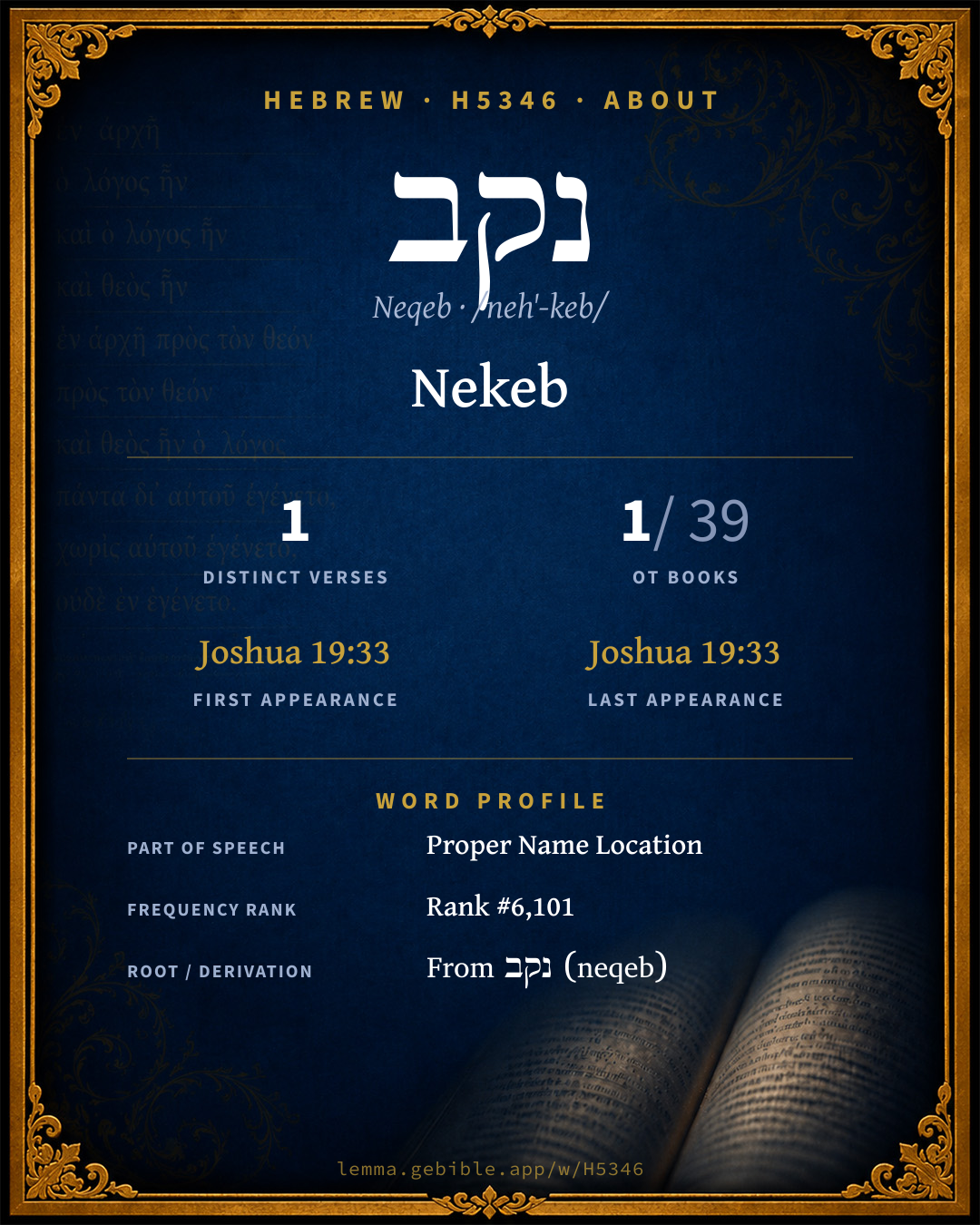
נֶ֫קֶב
Nekeb
BDB lists 2 entries for ‘Nekeb’ fuller range ↓
Full lexicon entry — Brown-Driver-Briggs (BDB)
From Brown-Driver-Briggs (BDB)
Where this word appears
Grammar key — what these labels mean
Part of speech
- Noun
- A naming word — a person, place, thing, or idea.
Noun type
- Proper
- A name of a specific person, place, or people (e.g. Abraham, Zion, Israel).
Every verse where H5346 appears — 1 distinct verse across 1 book. Click any verse to open its interlinear word-by-word view. Verse text shown in the World English Bible for context — . Each verse’s Hebrew form is shown with its reference; the English is not keyword-highlighted, since the data carries no word-level English alignment. Use “Compare translations” on any verse to read it across multiple English versions. This concordance covers the Hebrew Bible; Septuagint (Greek Old Testament) occurrences are not indexed here.
Joshua 1 verse
About this entry
At a glance — auto-summarized from this page’s data, not written by a person. Every figure links to its source below. This summary describes the numbers; it doesn’t interpret them.
נקב (Neqeb) is a Hebrew name most often rendered “Nekeb.” With only 1 verse it sits in the long tail of Hebrew Bible vocabulary. Joshua dominates its distribution — 1 of 1 verses. It occurs only once, in Joshua 19:33. For the data behind this summary, explore 1-verse concordance and the renderings breakdown below.
Gloss history
Strong's 1890 vs modern scholarship
About this word
Strong's H5346 catalogs a Hebrew word from the Hebrew Old Testament.
These counts are not copied from any lexicon or concordance. They are computed here, from the morphology-tagged Hebrew Old Testament. What Lemma adds →
- 1
- distinct verses
- The word appears in 1 distinct verse.
- 1 / 39
- OT books
- The word appears in 1 of 39 Old Testament books.
- #6,101
- by frequency
- Rank #6,101 (rank 6,101 of 8,640 Hebrew words by occurrence).
View all 1 occurrence in the concordance →
Most concentrated in
- Joshua 1 verse 100%
By section of the Old Testament
By traditional corpus
Conventional, traditional groupings — biblical authorship is debated, so this is a traditional corpus grouping, not an authorship claim. Each share is this word’s portion of its verses in that division of the Hebrew canon. Each figure is a share of the word’s 1 distinct verse.
- Prophets (Nevi'im) 1 verse · 100%
How translations render this word
Counts come from each version’s own published word-to-Strong’s tagging or interlinear alignment — an approximate guide to how each version renders this word, not a word-level alignment the data otherwise carries. Because each total is that version’s own tagged count, the per-version totals vary from one another and need not match the appearance or distinct-verse counts above. These counts may also differ from a printed concordance because Lemma counts each distinctly tagged rendering and does not collapse phrase taggings into a single head-word total. This is a fixed set of word-tagged versions (KJV, ASV, BSB, ULT) and does not change with the reading translation you choose elsewhere. Each version’s license is shown beside its name below (and on Sources).
- King James Version: Nekeb 1×
- American Standard Version: not separately translated
- unfoldingWord Literal Text: Adami nekeb 1×
King James Version Public Domain
Renders H5346 across 1 tagged occurrence — most commonly:
American Standard Version Public Domain
Does not render H5346 with a distinct English word (not separately translated in its 1 tagged occurrence).
unfoldingWord Literal Text CC BY-SA 4.0
Renders H5346 across 1 tagged occurrence — most commonly:
Senses in BDB
The 2 senses BDB distinguishes for this word, in lexicon order (not ranked by frequency or importance). The full entry — with sub-senses — is in the Lexicon Entry tab.
- Nekeb or Nekeb = "cavern"
- one of the towns on the boundary of Naphtali
Word origin
n.pr.loc. pass in Naphtali, Jos 19:33 v. נקב.
— Brown-Driver-Briggs (Oxford 1906, public domain), digitized via Sefaria, supplemented by the OpenScriptures HebrewLexicon (CC BY 4.0). See Sources.
Derived from נקב (neqeb) (H5345) — hole.
Jastrow Dictionary
A second Hebrew/Aramaic lexicon for comparison, covering Aramaic and post-biblical (Talmudic, Targumic, Midrashic) usage that the biblical-Hebrew BDB does not. Matched by lemma rather than by Strong’s number, so a lemma may carry more than one Jastrow headword (shown separately below), and the entries cover usage well beyond the Bible.
נָקַב
- 1. to bore, perforate. Snh. 97ᵇ מקרא זה נוֹקֵב וכ׳ this verse bores and penetrates to the depth. Ib. 6ᵇ, a. e. יִקּוֹב הדין וכ׳, v. דִּין II; a. e.—Part. pass. נָקוּב; f. נְקוּבָה; pl. נְקוּבִים, נְקוּבִין; נְקוּבוֹת. Y. Keth. XII, 35ᵃ top; Y. Kil. IX, 32ᵇ top; (Gen. R. s. 100 נקופה), v. אָרוֹן. Cant. R. to VIII, 5 מצאתי חככם נ׳ וכ׳ I found your palate perforated, unable to receive blessings.—Esp. נקובה the case of an animal found to have a vital organ perforated. Ḥull. III, 1 נְקוּבַת הושט, v. וֶשֶׁט. Ib. 43ᵃ; a. fr.—Esp. (נְקָבִים) נְקוּבִים female parts. Y. Meg. I, 71ᵈ bot. (reported as one of the changes adopted in the Greek translation of the Pentateuch, ref. to Gen. I, 27, a. V, 2) זכר ונְקוּבָיו בראם a male with corresponding female parts created he them; Gen. R. s. 8; Mekh. Bo, s. 14 (v. Gen. R. l. c., beg.).—[Y. Meg. I, 71ᶜ לנקוביו, v. נֶקֶב.]—2) (cmp. אָרַר) to curse, blaspheme. Snh. 56ᵃ (ref. to Lev. XXIV, 16) ממאי דהאי נוֹקֵב וכ׳ whence do you prove that this noḳeb is used in the sense of blasphemy?… perhaps it means to perforate? Ib. למימרא דנוקב וכ׳ to indicate that noḳeb means curse. e.g. Genesis 1:27
- 3. to point out, to pronounce. Ib. אימא פרושי שמיה חוא I might say, noḳeb means uttering His name (the Tetragrammaton)? Tanḥ. Emor 24 התחיל לִנְקוֹב וכ׳ he began to pronounce the Name and curse Him.—[Midr. Till. to Ps. I ונקובות ידים; ed. Bub. נקיבת ירק, read: קְנִיבַת ירק, v. קְנִיבָה.]
- to be perforated, punctured. Ḥull. III, 1 הריאה שנִיקְּבָה if a lung is found to be perforated. Ib. עד שתִּינָּקֵב וכ׳ until the puncture reaches &c. Ib. 43ᵃ נ׳ זה בלא זה if only one of the two is perforated. Bekh. 44ᵇ אם נִקְּבוּ זה וכ׳ if there is a perforation going from one channel to the other; a. fr.
נְקַב
- , to perforate. Targ. II Kings XII, 10; a. fr.—Ḥull. 48ᵃ אי האי נְקִיב וכ׳ whether this lobe is perforated or the other; a. e.
- same. Ib.ᵇ נַקּוּבֵי נקיב ואתאי the needle perforated (the entrails) and came into the lungs.
- to be perforated Ib. Ib. 45ᵃ; a. e.
נֶקֶב
- preced.) hole, perforation, incision. Ḥull. 45ᵃ נ׳ אחד ארוך one lengthy incision; a. fr.—Pl. נְקָבִים, נְקָבִין. Ib. נ׳ שיש בהן חסרון perforations connected with loss of substance (holes); נ׳ שאין בהן חסרון mere punctures. Bekh. 44ᵇ שני נ׳ יש בו וכ׳ two channels are in the membrum. Gen. R. s. 1, beg.; a. fr.—Esp. the organs of the extremities, urinary organ &c. Tosef. Ber. II, 18 ויהא צריך לנְקָבָיו when needing to ease himself; Ber. 23ᵃ; Y. Meg. I, 71ᶜ לנְקוּבָיו. Sabb. 152ᵃ; a. fr.
A Dictionary of the Targumim, the Talmud Babli and Yerushalmi, and the Midrashic Literature (Marcus Jastrow; London, Luzac, 1903) — Public Domain. Digitized via Sefaria. Digitized via Sefaria. Full attribution on Sources.
Bible dictionary
Public-domain dictionary articles matched to this entry by name (Nekeb). A biblical name can be shared by more than one person or place, so an article may treat several.
Easton's Bible Dictionary · M. G. Easton, 1897
Cavern, a town on the boundary of Naphtali (Josh. 19:33). It has with probability, been identified with Seiyadeh, nearly 2 miles east of Bessum, a ruin half way between Tiberias and Mount Tabor.
Smith's Bible Dictionary · William Smith, 1863
(cavern), one of the towns on the boundary of Naphtali. (Joshua 19:3) It lay between Adami and Jabneel. A great number of commentators have taken this name as being connected with the preceding.
Classic public-domain reference works; full attribution on Sources.
Septuagint verse parallels
This word appears in 1 verse that also exists in the Greek Old Testament (Septuagint), out of the 1 Hebrew verse it occurs in. You can read those verses in Greek by switching the Old Testament edition to the Septuagint.
Read these verses in the Septuagint
This is a verse-level parallel only — the same verses exist in both the Hebrew and Greek Old Testaments. No word-level Hebrew↔Greek correspondence is claimed: the data carries no such alignment, so no Greek word is shown as this Hebrew word’s translation. Coverage is not total — the Septuagint omits the deuterocanon and renumbers the Psalms, so some Hebrew verses have no direct Greek parallel.