
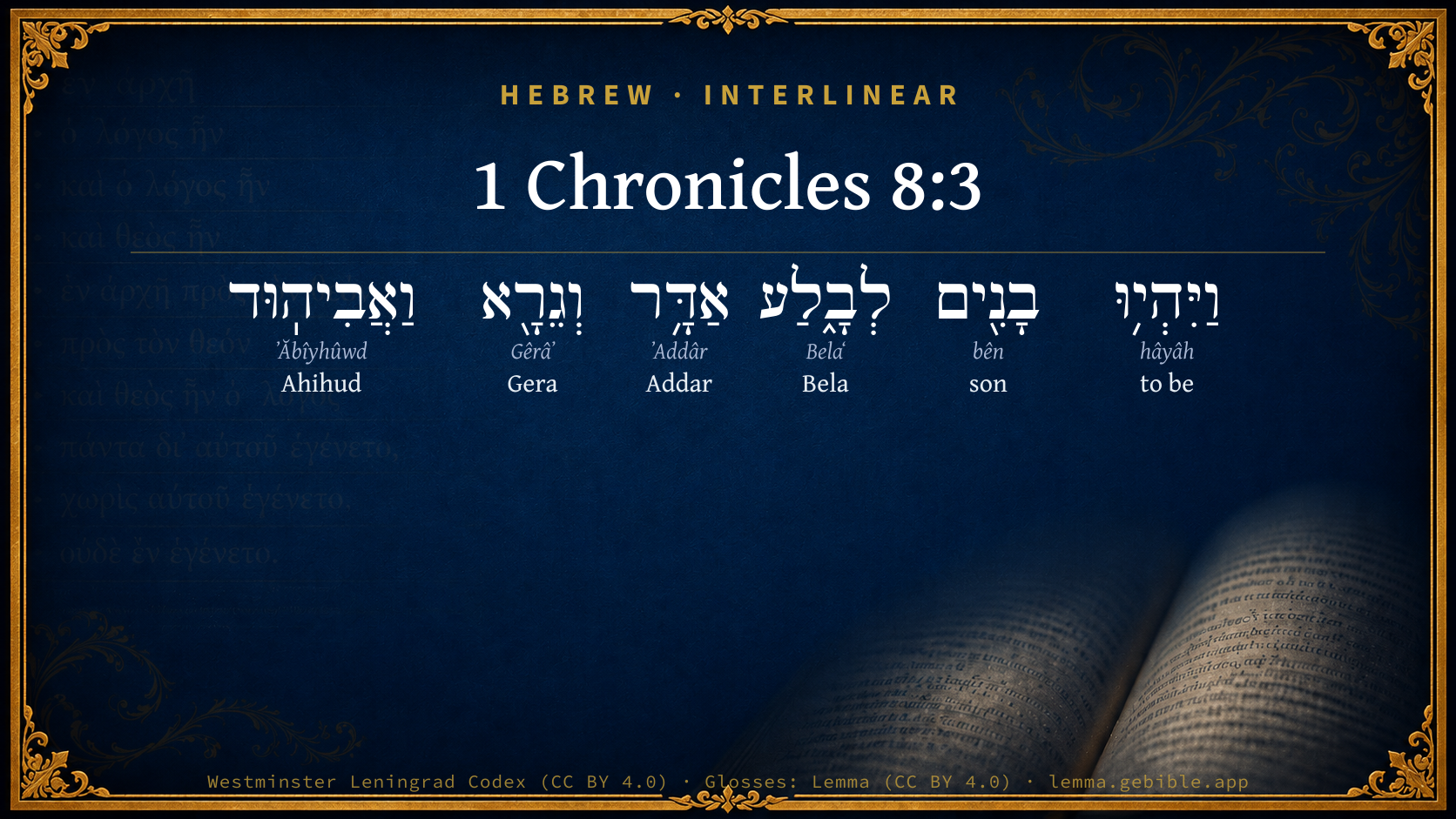
1 Chronicles 8:3

Hebrew (Westminster Leningrad Codex) 1 Chronicles 8:3 appears in the Hebrew Old Testament. The text above is from the Westminster Leningrad Codex. Each word links to its Strong’s number, a concise gloss, and parsing drawn from the Open Scriptures Hebrew Bible morphology. Click any word for its full Brown-Driver-Briggs (BDB) entry.
Download image
Cite this verse

1 Chronicles 8:3 (World English Bible). Public Domain. Lemma interlinear Bible study tool, https://lemma.gebible.app/v/1-chronicles/8/3.

Show BibTeX & RIS
BibTeX
RIS
English Translation
Bela had sons: Addar, and Gera, and Abihud,
World English Bible · Public Domain
Highlights
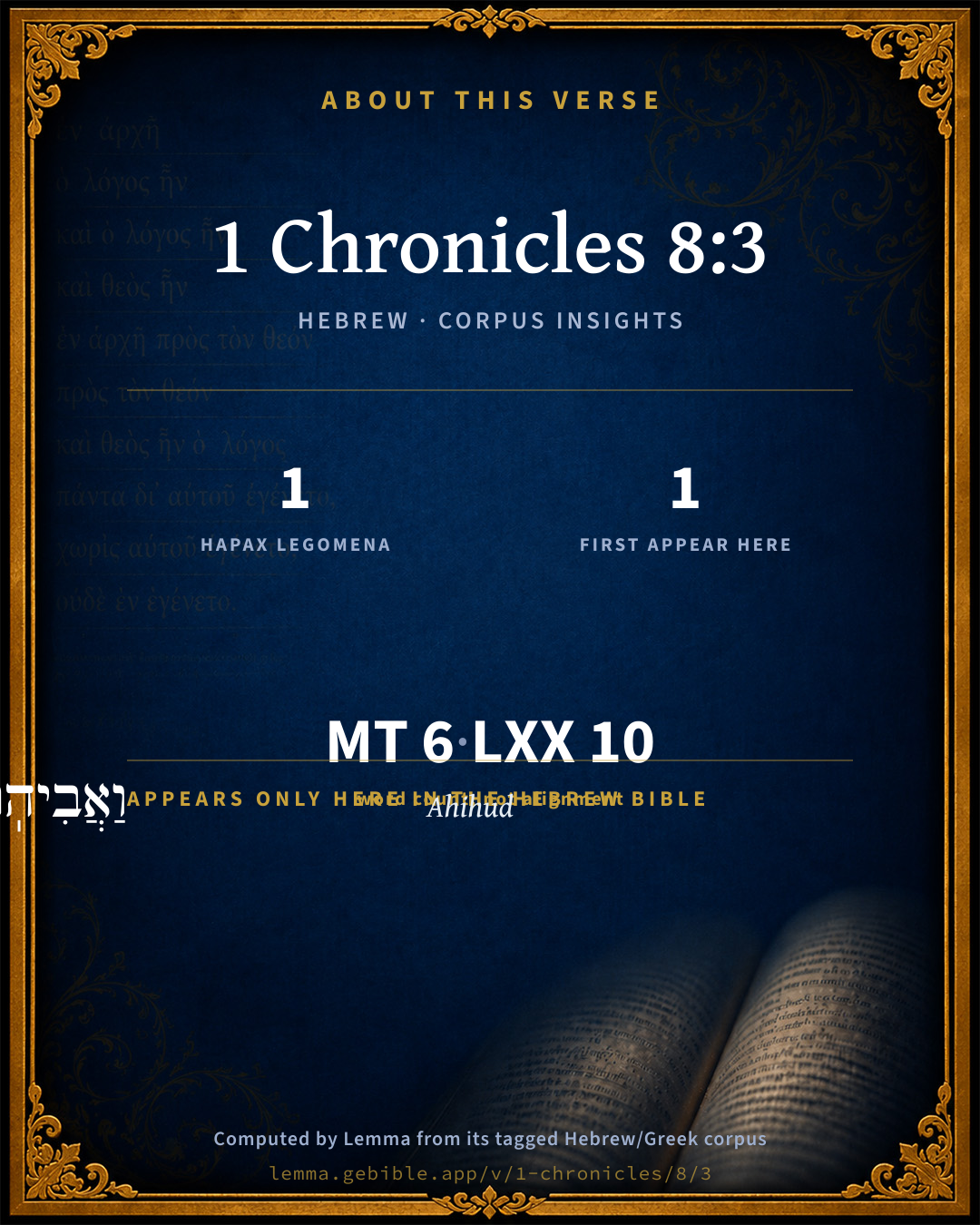
  • 1 hapax legomenon — only here in the Hebrew Bible
  • 1 first appearance in the Hebrew Bible
Full analysis ↓
Download a study sheet

One document with this verse’s original text, its word-by-word gloss line, the meaning frame, cross-references with their text, attributed commentary, and full source and license credits — printable, and it pastes into notes with its structure intact.

This verse Autodidact and up

Study sheet (.html) Plain text (.txt)

A passage Seminary Student

Up to 50 verses in one chapter. A passage sheet keeps up to 6 commentary sources and 12 cross-references per verse, in the order this page ranks them, and says so on the sheet whenever that leaves anything out. Ask for a single verse and you get the Autodidact verse sheet above.

Everything on this page stays free to read, with no account — the sheet is a download of what is already on screen, not access to it.

Want to remove ads? Support Godless Engineer
Compare translations 3

The same verse in 3 English versions, stacked beneath the original-language interlinear above. Click any original word for its lexicon entry.

Each is an independent rendering of the whole verse — the interlinear is not word-aligned to these translations.

Highlighted words mark where these versions differ — a whole-verse word diff, not a word-by-word alignment.

  • World English Bible Public Domain
    Bela had sons: Addar, and Gera, and Abihud,
  • King James Version Public Domain
    And the sons of Bela were, Addar, and Gera, and Abihud,
  • unfoldingWord Literal Text CC BY-SA 4.0
    And sons were to Bela: Addar and Gera and Abihud

unfoldingWord Literal Text — © unfoldingWord, licensed CC BY-SA 4.0. Word-aligned USFM3 via Door43 (git.door43.org/unfoldingWord/en_ult).

Versions to compare (up to 4)

3 of 4 selected

Show all 18 translations

Every available English version of this verse, each an independent rendering of the whole verse.

  • World English Bible Public Domain
    Bela had sons: Addar, and Gera, and Abihud,
  • Berean Standard Bible Public Domain
    The sons of Bela: Addar, Gera, Abihud,
  • Majority Standard Bible Public Domain
    The sons of Bela: Addar, Gera, Abihud,
  • King James Version Public Domain
    And the sons of Bela were, Addar, and Gera, and Abihud,
  • American Standard Version (1901) Public Domain
    And Bela had sons: Addar, and Gera, and Abihud,
  • Revised Version (1885) Public Domain
    And Bela had sons, Addar, and Gera, and Abihud;
  • Geneva Bible (1599) Public Domain
    And the sonnes of Bela were Addar, and Gera, and Abihud,
  • Douay-Rheims (1899) Public Domain
    And the sons of Bale were Addar, and Gera, and Abiud,
  • Young's Literal Translation Public Domain
    And there are sons to Bela: Addar, and Gera,
  • Literal Standard Version CC BY-SA 4.0
    And there are sons to Bela: Addar, and Gera,
  • Unlocked Literal Bible CC BY-SA 4.0
    Bela's sons were Addar, Gera, Abihud,
  • unfoldingWord Literal Text CC BY-SA 4.0
    And sons were to Bela: Addar and Gera and Abihud
  • Darby Bible Public Domain
    And Bela had sons: Addar, and Gera, and Abihud,
  • World Messianic Bible Public Domain
    Bela had sons: Addar, Gera, Abihud,
  • Webster's Bible Public Domain
    And the sons of Bela were Addar, and Gera, and Abihud,
  • Free Bible Version CC BY-SA 4.0
    The sons of Bela were: Addar, Gera, Abihud,
  • Bible in Basic English Public Domain
    And Bela had sons, Addar and Gera, the father of Ehud,
  • JPS Tanakh (1917) Public Domain
    And Bela had sons, Addar, and Gera, and Abihud;

Literal Standard Version (2020), Covenant Press — licensed CC BY-SA 4.0. Text via the HelloAO Bible API (eBible.org). Unlocked Literal Bible (unfoldingWord) — licensed CC BY-SA 4.0. Text via the HelloAO Bible API (eBible.org). unfoldingWord Literal Text — © unfoldingWord, licensed CC BY-SA 4.0. Word-aligned USFM3 via Door43 (git.door43.org/unfoldingWord/en_ult). Free Bible Version, Dr. Jonathan Gallagher — licensed CC BY-SA 4.0. Text via the HelloAO Bible API (eBible.org).

Word by word

More ways to search: Search by grammar → Find every occurrence → Compare this word →

Practice this passage: Drill this verse → Learn its vocabulary →

About this verse

These counts appear in no published source. They are computed here, from the morphology-tagged text and Lemma’s own curated glosses. What Lemma adds →

6
words
6
distinct lemmas
Historical
section

Notable vocabulary

1 hapax legomenon — a word that appears only here in the entire Hebrew Bible:

  • וַאֲבִיהֽוּד Ahihud H31

First appearance in Scripture

This word makes its first canonical appearance in the Hebrew Bible here:

  • וַאֲבִיהֽוּד Ahihud H31

Shared distinctive vocabulary

אַדָּ֥ר Addar H146 occurs in 2 verses of the Hebrew Bible. Also found in:

Grammatical profile

  • 1 verb
  • 5 nouns

Verb forms

  • וַיִּהְי֥וּ Qal · Sequential Imperfect

Hebrew & Septuagint length

In English translation the verse runs 8 words from the Hebrew and 11 from the Septuagint (LXX English) — closely comparable.

A rough comparison of the two English renderings, which tokenize alike — not a word-level alignment.

Word counts can differ between the Hebrew and the Greek without any difference in meaning — e.g. the Hebrew direct-object marker אֵת has no separate Greek word, and Greek often adds the article ὁ.

In the original languages it is 6 Hebrew tokens and 10 Greek tokens — but the two are counted differently (Hebrew bundles its prefixes and suffixes into one token; the Greek is in lemma form), so that isn’t a like-for-like length.

Cross-references

2

Topical passages linked to 1 Chronicles 8:3 in the Treasury of Scripture Knowledge — connected by theme and wording, ordered by reader-vote popularity; previews shown in the World English Bible.

  • Genesis 46:21 The sons of Benjamin: Bela, Becher, Ashbel, Gera, Naaman, Ehi, Rosh, Muppim, Huppim, and Ard.
  • Numbers 26:40 The sons of Bela were Ard and Naaman: [of Ard], the family of the Ardites; of Naaman, the family of the Naamites.

Cross-references courtesy of OpenBible.info (CC BY 4.0).

Hebrew and Greek witnesses Masoretic Hebrew ↔ Greek Septuagint

The same verse in the two great witnesses to the Old Testament, shown verse-for-verse.

These are two independent witnesses, not word-aligned to each other, and the Septuagint is shown in lemma (dictionary) form.

Hebrew 1 Chronicles 8:3 Masoretic · Westminster Leningrad Codex

וַיִּהְי֥וּ בָנִ֖ים לְבָ֑לַע אַדָּ֥ר וְגֵרָ֖א וַאֲבִיהֽוּד

Bela had sons: Addar, and Gera, and Abihud,

World English Bible · Public Domain

Greek LXX 1 Chronicles 8:3 Septuagint · lemma form

καί εἰμί υἱός ὁ βαλε αδερ καί γηρα καί αβιουδ

And the sons of Bale were, Adir, and Gera, and Abiud,

LXX2012 (modern English Septuagint) · Public Domain

Hebrew: Westminster Leningrad Codex (CC BY 4.0). Greek: Septuagint (public domain); English from LXX2012 (modern English Septuagint) (Public Domain). How the Septuagint differs from the Hebrew →

Commentary

Notes on 1 Chronicles 8:3 from classic Christian and Jewish commentators (each source and its license shown beneath its notes). The classic Christian expositions comment on the surrounding passage and are grouped to its opening verse, so a note may address several verses; the Jewish commentaries on the Tanakh (Rashi and others) are per-verse, so they appear only where the commentator wrote on this verse.

Lemma curates 59 commentaries, every one of them public domain or Creative Commons licensed, each selected and text-cleaned for this edition rather than reprinted as found. About our sources →

Tyndale Open Study Notes

Tyndale Open Resources

8:3 Gera, Abihud: As translated, Bela had two sons named Gera (8:3, 5), an unusual situation. If the rendering suggested in the NLT note is correct, the second Gera was the first Gera’s son.

Tyndale Open Study Notes — © Tyndale Open Resources, licensed CC BY-SA 4.0. Text via the HelloAO Bible API.

The Cambridge Bible for Schools and Colleges

gen. ed. J. J. S. Perowne

3. Addar] perhaps to be read Ard, as Gen_46:21; Num_26:40.

The Cambridge Bible for Schools and Colleges (gen. ed. J. J. S. Perowne; Cambridge University Press, 1878–1918) — public domain. Text from a community e-Sword module.

John Gill's Exposition

And Abishua, and Naaman, and Ahoah, and Gera, and Shephuphan, and Huram. These were all the sons of Bela; one of the name of Naaman is reckoned among the sons of Benjamin, Gen 46:21 and from this grandson the family of the Naamanites are named, Num 26:40, and Ahoah is by some thought to be the same with Ehi, mentioned in Gen 46:21 as one of Benjamin's sons. Some take the three last to be the sons of Ehud, spoken of in the next verse; but Shephuphan and Huram seem to be the same with Shupham and Hupham, Num 26:39.

.

1 Chronicles 8:6

ch1 8:6

ch1 8:6

ch1 8:6And these are the sons of Ehud,.... Not he that was a judge in Israel, Jdg 3:15 but perhaps a son of Huram the last mentioned; for not the three last are his sons, as some think, but the three following in the next verse; what follows being to be read in a parenthesis:

(these are the heads of the fathers of the inhabitants of Geba;) a city in the tribe of Benjamin, Jos 18:24 namely, those sons of Ehud, after mentioned, were principal men in that tribe, and chief of the inhabitants of the city of Geba:

and they removed them to Manahath; the name of a country referred to in Ch1 2:52 according to Jarchi, which was in the tribe of Judah; Geba being too small, either the inhabitants of Geba removed them, or they removed themselves, or their fathers removed them, Ch1 8:7, or it may be read impersonally, they were removed thither for the sake of a better habitation; the Targum adds,"to the land of the house of Esau,''to Edom; which is not likely.

John Gill's Exposition of the Whole Bible (1746–1763) — public domain (CC PDM 1.0). Text via the HelloAO Bible API.

Haydock's Catholic Bible Commentary

Addar, Ared or Hered. (Calmet)

George Leo Haydock (1774–1849), Haydock's Catholic Family Bible and Commentary, 1859 edition — public domain. Excludes Psalms (Douay-Rheims chapter numbering differs from Protestant) and Deuterocanonical books (Catholic canon only).

The Pulpit Commentary

Vers. 3-5 Nine sons are here assigned to Bela. only finds us clearly three of them, and these in very different order, viz. Gera, Naaman, and Arel; and Numbers (Num_26:39, Num_26:40) finds us only three, viz. Ard, Naaman, and Shupham. Yet our Huram may correspond with Hupham, and then the four pairs of names Shephuphan and Huram, Shupham and Hupham, Shuppim and Huppim, and Muppim and Huppim may be interpreted as designating one and the same couple of persons. The recurrence of the name Gera in ver. 5, so close upon the same name in ver. 3, would of course be more remarkable, and point inevitably to the disordered state of the text, if it were necessary to suppose that these nine persons were really brothers, as well as called sons of Bela.

The Pulpit Commentary (1880–1919), ed. H.D.M. Spence-Jones & Joseph S. Exell — public domain. Text from a community e-Sword module.

Keil & Delitzsch

C. F. Keil & F. Delitzsch

And Abishua, and Naaman, and Ahoah, and Gera, and Shephuphan, and Huram. These were all the sons of Bela; one of the name of Naaman is reckoned among the sons of Benjamin, Gen 46:21 and from this grandson the family of the Naamanites are named, Num 26:40, and Ahoah is by some thought to be the same with Ehi, mentioned in Gen 46:21 as one of Benjamin's sons. Some take the three last to be the sons of Ehud, spoken of in the next verse; but Shephuphan and Huram seem to be the same with Shupham and Hupham, Num 26:39.

.

1 Chronicles 8:6

ch1 8:6

ch1 8:6

ch1 8:6And these are the sons of Ehud,.... Not he that was a judge in Israel, Jdg 3:15 but perhaps a son of Huram the last mentioned; for not the three last are his sons, as some think, but the three following in the next verse; what follows being to be read in a parenthesis:

(these are the heads of the fathers of the inhabitants of Geba;) a city in the tribe of Benjamin, Jos 18:24 namely, those sons of Ehud, after mentioned, were principal men in that tribe, and chief of the inhabitants of the city of Geba:

and they removed them to Manahath; the name of a country referred to in Ch1 2:52 according to Jarchi, which was in the tribe of Judah; Geba being too small, either the inhabitants of Geba removed them, or they removed themselves, or their fathers removed them, Ch1 8:7, or it may be read impersonally, they were removed thither for the sake of a better habitation; the Targum adds,"to the land of the house of Esau,''to Edom; which is not likely.

Keil & Delitzsch — Biblical Commentary on the Old Testament (1861–1891) — public domain (CC PDM 1.0). Text via the HelloAO Bible API. (Old Testament only.)

Lesson kit

Teaching starters — assembled from the data on this page, not authored interpretation. Every prompt links to the verse data it draws on. Edit before teaching.

1 Chronicles, in the Historical, opens this verse with 6 words (6 distinct Hebrew lemmas). Its most distinctive word is ʼĂbîyhûwd (“Ahihud”). A historical commentator’s framing appears above. Read the whole chapter for the surrounding context.

Discussion questions

  1. How does “Ahihud” (ʼĂbîyhûwd) shape what this verse is saying?
  2. This verse holds 1 word here found nowhere else in the Hebrew Bible. What might the rare word draw attention to?
  3. The word “Ahihud” first appears here in Scripture. What is being introduced at this debut?
  4. Joshua 15:3 shares the word «Addar» with this verse. How do the two illuminate each other?
  5. The translations on this page render this verse differently — a whole-verse word diff, not a word-by-word alignment. What might account for the different wordings?
  6. The verb «וַיִּהְי֥וּ» is Qal Sequential Imperfect. How does its form color the action?
  7. Reading how Tyndale Open Study Notes and The Cambridge Bible for Schools and Colleges read this verse, where do the two commentators agree and where do they part?

Things to notice

Reading settings

Reading text

Shown beneath each verse's original-language words.

Old Testament
Old Testament edition

Read the OT as the Masoretic Hebrew (MT) or the Greek Septuagint (LXX).

English shown for the Greek Septuagint (in the Hebrew ↔ Greek comparison).

Comparing translations? Open the Compare panel on any verse page to stack up to four side by side.