Numbers 32:25

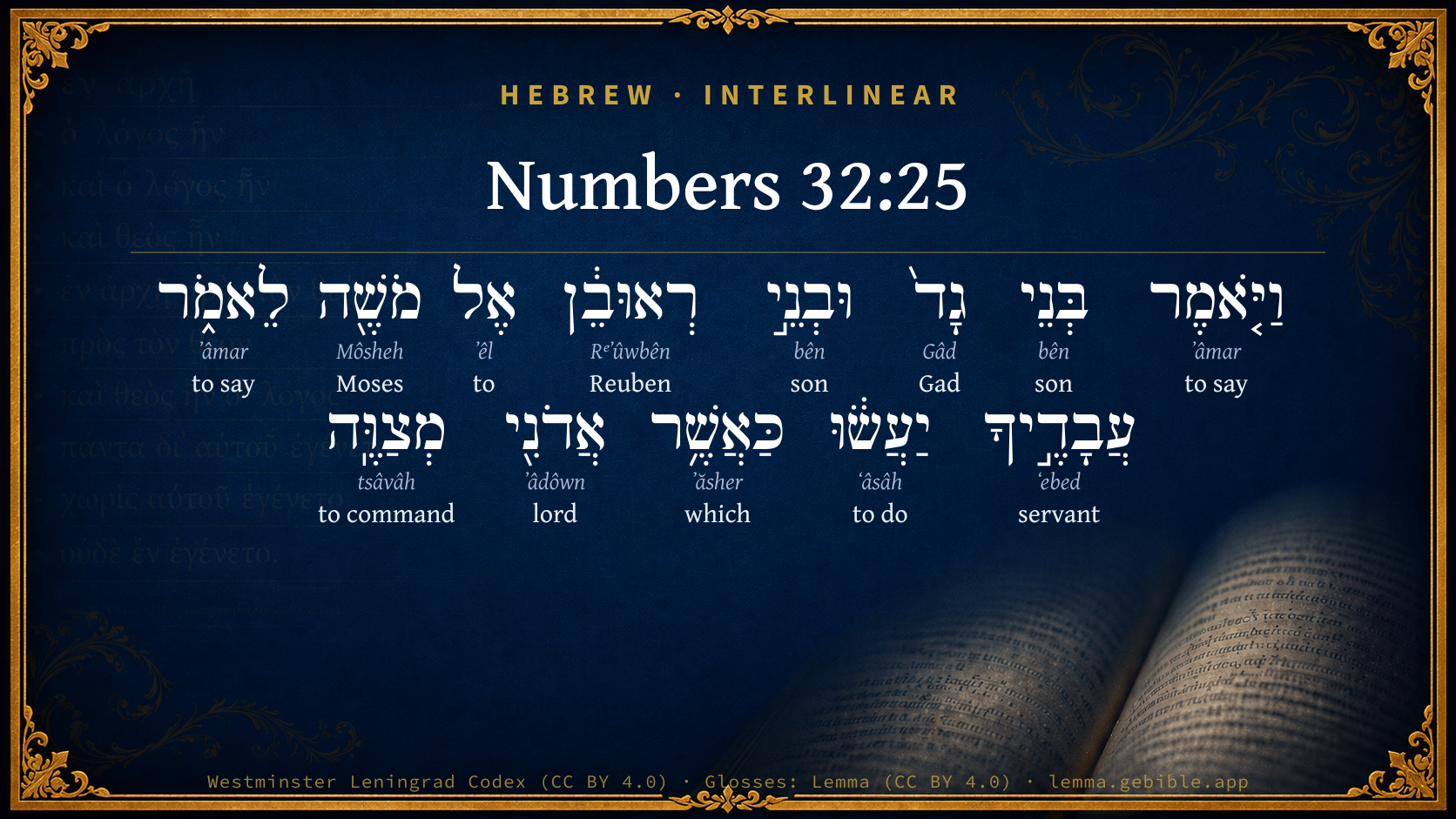
Hebrew (Westminster Leningrad Codex) Numbers 32:25 appears in the Hebrew Old Testament. The text above is from the Westminster Leningrad Codex. Each word links to its Strong’s number, a concise gloss, and parsing drawn from the Open Scriptures Hebrew Bible morphology. Click any word for its full Brown-Driver-Briggs (BDB) entry.
Download image
Cite this verse

Numbers 32:25 (World English Bible). Public Domain. Lemma interlinear Bible study tool, https://lemma.gebible.app/v/numbers/32/25.

Show BibTeX & RIS
BibTeX
RIS
English Translation
The children of Gad and the children of Reuben spoke to Moses, saying, Your servants will do as my lord commands.
World English Bible · Public Domain
Download a study sheet

One document with this verse’s original text, its word-by-word gloss line, the meaning frame, cross-references with their text, attributed commentary, and full source and license credits — printable, and it pastes into notes with its structure intact.

This verse Autodidact and up

Study sheet (.html) Plain text (.txt)

A passage Seminary Student

Up to 50 verses in one chapter. A passage sheet keeps up to 6 commentary sources and 12 cross-references per verse, in the order this page ranks them, and says so on the sheet whenever that leaves anything out. Ask for a single verse and you get the Autodidact verse sheet above.

Everything on this page stays free to read, with no account — the sheet is a download of what is already on screen, not access to it.

Want to remove ads? Support Godless Engineer
Compare translations 3

The same verse in 3 English versions, stacked beneath the original-language interlinear above. Click any original word for its lexicon entry.

Each is an independent rendering of the whole verse — the interlinear is not word-aligned to these translations.

Highlighted words mark where these versions differ — a whole-verse word diff, not a word-by-word alignment.

  • World English Bible Public Domain
    The children of Gad and the children of Reuben spoke to Moses, saying, Your servants will do as my lord commands.
  • King James Version Public Domain
    And the children of Gad and the children of Reuben spake unto Moses, saying, Thy servants will do as my lord commandeth.
  • unfoldingWord Literal Text CC BY-SA 4.0
    And the sons of Gad and the sons of Reuben spoke to Moses, saying, “Your servants will do just as my master is commanding.

unfoldingWord Literal Text — © unfoldingWord, licensed CC BY-SA 4.0. Word-aligned USFM3 via Door43 (git.door43.org/unfoldingWord/en_ult).

Versions to compare (up to 4)

3 of 4 selected

Show all 18 translations

Every available English version of this verse, each an independent rendering of the whole verse.

  • World English Bible Public Domain
    The children of Gad and the children of Reuben spoke to Moses, saying, Your servants will do as my lord commands.
  • Berean Standard Bible Public Domain
    The Gadites and Reubenites said to Moses, “Your servants will do just as our lord commands.
  • Majority Standard Bible Public Domain
    The Gadites and Reubenites said to Moses, “Your servants will do just as our lord commands.
  • King James Version Public Domain
    And the children of Gad and the children of Reuben spake unto Moses, saying, Thy servants will do as my lord commandeth.
  • American Standard Version (1901) Public Domain
    And the children of Gad and the children of Reuben spake unto Moses, saying, Thy servants will do as my lord commandeth.
  • Revised Version (1885) Public Domain
    And the children of Gad and the children of Reuben spake unto Moses, saying, Thy servants will do as my lord commandeth.
  • Geneva Bible (1599) Public Domain
    Then the children of Gad and the children of Reuben spake vnto Moses, saying, Thy seruats will doe as my lorde commandeth:
  • Douay-Rheims (1899) Public Domain
    And the children of Gad and Ruben said to Moses: We are thy servants, we will do what my lord commandeth.
  • Young's Literal Translation Public Domain
    And the sons of Gad and the sons of Reuben speak unto Moses, saying, `Thy servants do as my lord is commanding;
  • Literal Standard Version CC BY-SA 4.0
    And the sons of Gad and the sons of Reuben speak to Moses, saying, “Your servants do as my lord is commanding;
  • Unlocked Literal Bible CC BY-SA 4.0
    The descendants of Gad and Reuben spoke to Moses and said, “Your servants will do as you, our master, commands.
  • unfoldingWord Literal Text CC BY-SA 4.0
    And the sons of Gad and the sons of Reuben spoke to Moses, saying, “Your servants will do just as my master is commanding.
  • Darby Bible Public Domain
    And the children of Gad and the children of Reuben spoke to Moses, saying, Thy servants will do as my lord commands.
  • World Messianic Bible Public Domain
    The children of Gad and the children of Reuben spoke to Moses, saying, “Your servants will do as my lord commands.
  • Webster's Bible Public Domain
    And the children of Gad and the children of Reuben spoke to Moses, saying, Thy servants will do as my lord commandeth.
  • Free Bible Version CC BY-SA 4.0
    The tribes of Gad and Reuben promised Moses, “Sir, we your servants will do just as you have ordered.
  • Bible in Basic English Public Domain
    And the children of Gad and the children of Reuben said to Moses, Your servants will do as my lord says.
  • JPS Tanakh (1917) Public Domain
    And the children of Gad and the children of Reuben spoke unto Moses, saying: 'Thy servants will do as my lord commandeth.

Literal Standard Version (2020), Covenant Press — licensed CC BY-SA 4.0. Text via the HelloAO Bible API (eBible.org). Unlocked Literal Bible (unfoldingWord) — licensed CC BY-SA 4.0. Text via the HelloAO Bible API (eBible.org). unfoldingWord Literal Text — © unfoldingWord, licensed CC BY-SA 4.0. Word-aligned USFM3 via Door43 (git.door43.org/unfoldingWord/en_ult). Free Bible Version, Dr. Jonathan Gallagher — licensed CC BY-SA 4.0. Text via the HelloAO Bible API (eBible.org).

Word by word

More ways to search: Search by grammar → Find every occurrence → Compare this word →

Practice this passage: Drill this verse → Learn its vocabulary →

גָד֙
Gâd
H1410
“Gad”
Noun, Proper
Part of Speech
Noun
Type
Proper
Full BDB Definition

Origin: from H1464

TWOT: None

Gad = "troop" - seventh son of Jacob by Zilpah, Leah's handmaid, and full brother of Asher. - the tribe descended from Gad - a prophet during the time of David; appears to have joined David when in the hold; reappears in connection with the punishment for taking a census; also assisted in the arrangements for the musical service of the " house of God"
  1. וַיֹּ֤אמֶר ʼâmar H559 “and · to say” Conjunction + Verb, Qal, Sequential Imperfect, 3rd Person, Masculine, Singular
  2. בְּנֵי bên H1121 “sons of” Noun, Common, Masculine, Plural, Construct
  3. וּבְנֵ֣י bên H1121 “and · sons of” Conjunction + Noun, Common, Masculine, Plural, Construct
  4. רְאוּבֵ֔ן Rᵉʼûwbên H7205 “Reuben” Noun, Proper
  5. אֶל ʼêl H413 “to” Preposition
  6. מֹשֶׁ֖ה Môsheh H4872 “Moses” Noun, Proper
  7. לֵאמֹ֑ר ʼâmar H559 “to say” Preposition + Verb, Qal, Infinitive Construct
  8. עֲבָדֶ֣יךָ ʻebed H5650 “servants · your” Noun, Common, Masculine, Plural, Construct + Suffix, Personal, 2nd Person, Masculine, Singular
  9. יַעֲשׂ֔וּ ʻâsâh H6213 “to do” Verb, Qal, Imperfect, 3rd Person, Masculine, Plural
  10. כַּאֲשֶׁ֥ר ʼăsher H834 “like/as · which” Preposition + Particle, Relative
  11. אֲדֹנִ֖י ʼâdôwn H113 “lord · my” Noun, Common, Masculine, Singular, Construct + Suffix, Personal, 1st Person, Common, Singular
  12. מְצַוֶּֽה tsâvâh H6680 “commanding” Verb, Piel, Participle Active, Masculine, Singular, Absolute

About this verse

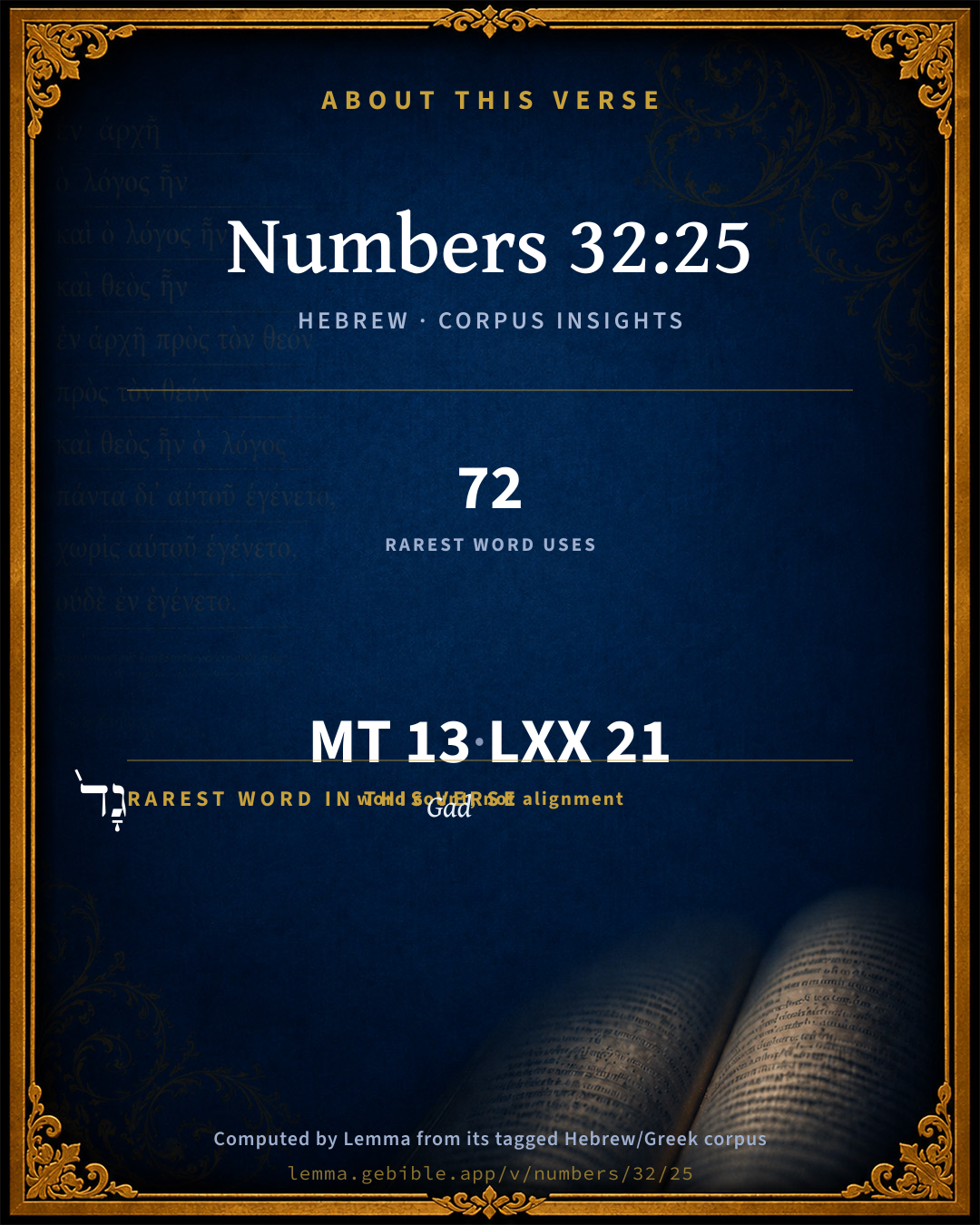
These counts appear in no published source. They are computed here, from the morphology-tagged text and Lemma’s own curated glosses. What Lemma adds →

13
words
11
distinct lemmas
Pentateuch
section

Grammatical profile

  • 4 verbs
  • 7 nouns
  • 1 preposition
  • 1 particle

Verb forms

  • וַיֹּ֤אמֶר Qal · Sequential Imperfect
  • לֵאמֹ֑ר Qal · Infinitive Construct
  • יַעֲשׂ֔וּ Qal · Imperfect
  • מְצַוֶּֽה Piel · Participle Active

Repetition

Words recur within this verse — often emphatic in Hebrew:

  • וַיֹּ֤אמֶר to say H559 ×2
  • בְּנֵי son H1121 ×2

Hebrew & Septuagint length

In English translation the verse runs 21 words from the Hebrew and 22 from the Septuagint (LXX English) — closely comparable.

A rough comparison of the two English renderings, which tokenize alike — not a word-level alignment.

Word counts can differ between the Hebrew and the Greek without any difference in meaning — e.g. the Hebrew direct-object marker אֵת has no separate Greek word, and Greek often adds the article ὁ.

In the original languages it is 13 Hebrew tokens and 21 Greek tokens — but the two are counted differently (Hebrew bundles its prefixes and suffixes into one token; the Greek is in lemma form), so that isn’t a like-for-like length.

Cross-references

1

Topical passages linked to Numbers 32:25 in the Treasury of Scripture Knowledge — connected by theme and wording, ordered by reader-vote popularity; previews shown in the World English Bible.

  • Joshua 1:13–14 Remember the word which Moses the servant of Yahweh commanded you, saying, Yahweh your God gives you rest, and will give you this land.

Cross-references courtesy of OpenBible.info (CC BY 4.0).

Hebrew and Greek witnesses Masoretic Hebrew ↔ Greek Septuagint

The same verse in the two great witnesses to the Old Testament, shown verse-for-verse.

These are two independent witnesses, not word-aligned to each other, and the Septuagint is shown in lemma (dictionary) form.

Hebrew Numbers 32:25 Masoretic · Westminster Leningrad Codex

וַיֹּ֤אמֶר בְּנֵי גָד֙ וּבְנֵ֣י רְאוּבֵ֔ן אֶל מֹשֶׁ֖ה לֵאמֹ֑ר עֲבָדֶ֣יךָ יַעֲשׂ֔וּ כַּאֲשֶׁ֥ר אֲדֹנִ֖י מְצַוֶּֽה

The children of Gad and the children of Reuben spoke to Moses, saying, Your servants will do as my lord commands.

World English Bible · Public Domain

Greek LXX Numbers 32:25 Septuagint · lemma form

καί εἶπον ὁ υἱός ρουβην καί ὁ υἱός γαδ πρός μωυσῆς λέγω ὁ παῖς σύ ποιέω καθά ὁ κύριος ἐγώ ἐντέλλομαι

And the sons of Ruben and the sons of Gad spoke to Moses, saying, Your servants will do as our lord commands.

LXX2012 (modern English Septuagint) · Public Domain

Hebrew: Westminster Leningrad Codex (CC BY 4.0). Greek: Septuagint (public domain); English from LXX2012 (modern English Septuagint) (Public Domain). How the Septuagint differs from the Hebrew →

Targum (Aramaic paraphrase)

2

The Targum is the ancient Jewish Aramaic paraphrase of the Hebrew Scriptures — an interpretive translation, not the Hebrew text itself. Onkelos (literal) and Pseudo-Jonathan (expansive) render the Torah, and Jonathan the Prophets. Coverage is partial: where no permissively-licensed English translation exists for a verse, only the Aramaic is shown. This is verse-level text, not a word-by-word alignment to the Hebrew.

  1. Targum Onkelos Torah (Genesis–Deuteronomy)
    וַאֲמָרוּ בְנֵי גָד וּבְנֵי רְאוּבֵן לְמשֶׁה לְמֵימָר עַבְדָיךְ יַעְבְדוּן כְּמָא דִי רִבּוֹנִי מְפַקֵד

    (no public-domain English translation for this verse)

    Targum Onkelos — Aramaic: “Onkelos Genesis” (public domain); “Onkelos Exodus” (public domain); “Onkelos Leviticus” (public domain); “Onkelos Numbers” (public domain); “Onkelos Deuteronomy” (public domain). English: “Sefaria Community Translation” (CC0 1.0 (public-domain dedication)); “J.W. Etheridge. The Targums of Onkelos and Jonathan Ben Uzziel on the Pentateuch. London: Longmans, Green, 1862” (public domain). Text via Sefaria.

  2. Targum Pseudo-Jonathan Torah (Genesis–Deuteronomy)
    וַאֲמָרוּ בְּנֵי גָד וּבְנֵי רְאוּבֵן בְּאַסְכָּמוּתָא חֲדָא לְמשֶׁה לְמֵימָר עַבְדָךְ יַעַבְדוּן כָּל דְרִבּוֹנִי מְפַקֵיד

    And the sons of Gad and Reuben spake to Mosheh with one consent, saying, Thy servants will do whatever my lord hath commanded:

    Targum Pseudo-Jonathan — Aramaic: “Targum Jonathan on Genesis” (public domain); “Targum Jonathan on Exodus” (public domain); “Targum Jonathan on Leviticus” (public domain); “Targum Jonathan on Numbers” (public domain); “Targum Jonathan on Deuteronomy” (public domain). English: “The Targum of Jonathan ben Uzziel, trans. J. W. Etheridge, London, 1862” (public domain). Text via Sefaria.

Commentary

Notes on Numbers 32:25 from classic Christian and Jewish commentators (each source and its license shown beneath its notes). The classic Christian expositions comment on the surrounding passage and are grouped to its opening verse, so a note may address several verses; the Jewish commentaries on the Tanakh (Rashi and others) are per-verse, so they appear only where the commentator wrote on this verse.

Lemma curates 59 commentaries, every one of them public domain or Creative Commons licensed, each selected and text-cleaned for this edition rather than reprinted as found. About our sources →

Tyndale Open Study Notes

Tyndale Open Resources

32:25-27 Reuben and Gad did in fact fulfill the agreement (Josh 4:12-13; 22:1-9).

Tyndale Open Study Notes — © Tyndale Open Resources, licensed CC BY-SA 4.0. Text via the HelloAO Bible API.

Haydock's Catholic Bible Commentary

Ruben. No mention is made of those of the half tribe of Manasses. Perhaps they only joined the rest afterwards, chap. v. 33. They occupied the northern parts. (Haydock) --- The Hebrew has here a solecism, "the sons of Gad he said;" to avoid which, Onkelos adds, the tribe, &c. (Houbigant)

George Leo Haydock (1774–1849), Haydock's Catholic Family Bible and Commentary, 1859 edition — public domain. Excludes Psalms (Douay-Rheims chapter numbering differs from Protestant) and Deuterocanonical books (Catholic canon only).

Rashi

Rabbi Shlomo Yitzchaki (Rashi)

ויאמר בני גד AND THE CHILDREN OF GAD SAID, all of them as one man (ויאמר is the singular form of the verb, whilst the subject בגי גד is the plural; cf. Rashi on Exodus 19:2 s. v.).

Rashi on the Tanakh — English translations: “The Judaica Press complete Tanach with Rashi, translated by A. J. Rosenberg” (CC BY 4.0); “Pentateuch with Rashi's commentary by M. Rosenbaum and A.M. Silbermann, 1929-1934” (public domain); “The Metsudah Tanach series, Lakewood, N.J” (CC BY 4.0); and “The Book of Joshua, Metsudah Publications, 1997” (CC BY 4.0). Text via Sefaria.

Lesson kit

Teaching starters — assembled from the data on this page, not authored interpretation. Every prompt links to the verse data it draws on. Edit before teaching.

Numbers, in the Pentateuch, opens this verse with 13 words (11 distinct Hebrew lemmas). Its most distinctive word is Gâd (“Gad”). A historical commentator’s framing appears above. Read the whole chapter for the surrounding context.

Discussion questions

  1. The word Gâd carries the sense “Gad.” How does it shape the verse?
  2. Joshua 1:13–14 shares this passage’s theme. How do the two illuminate each other?
  3. “to say” occurs 2× in this one verse. What is the effect of the repetition?
  4. These translations render this verse differently. What is at stake in choosing one wording over another?
  5. The verb «וַיֹּ֤אמֶר» is Qal Sequential Imperfect. How does its form color the action?
  6. Reading how Tyndale Open Study Notes and Haydock's Catholic Bible Commentary read this verse, where do the two commentators agree and where do they part?

Things to notice

Reading settings

Reading text

Shown beneath each verse's original-language words.

Old Testament
Old Testament edition

Read the OT as the Masoretic Hebrew (MT) or the Greek Septuagint (LXX).

English shown for the Greek Septuagint (in the Hebrew ↔ Greek comparison).

Comparing translations? Open the Compare panel on any verse page to stack up to four side by side.