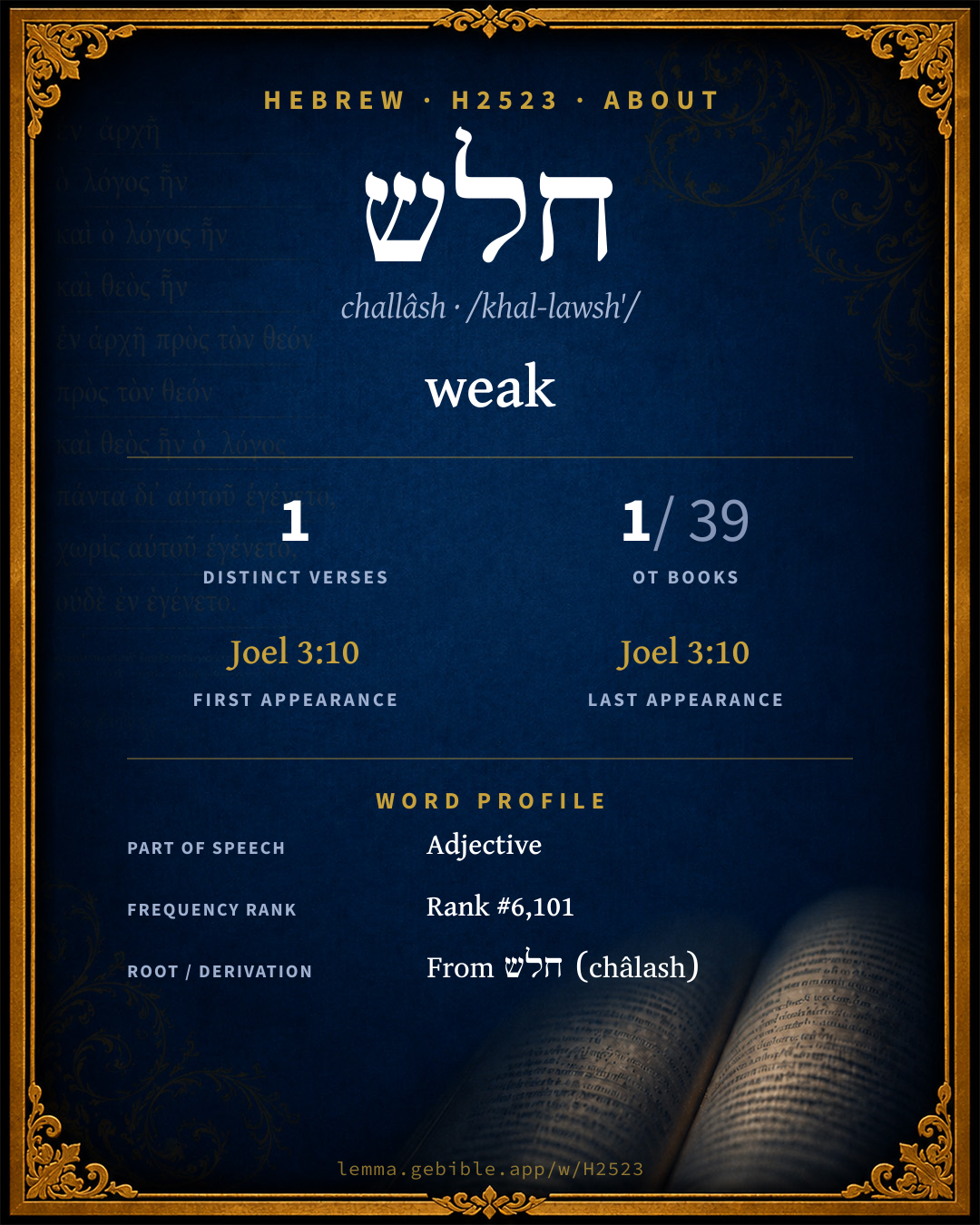
חַלָּשׁ
weak
Full lexicon entry — Brown-Driver-Briggs (BDB)
From Brown-Driver-Briggs (BDB)
Where this word appears
Grammar key — what these labels mean
State
- Absolute
- The independent form of a noun, not bound to a following word.
Gender
- Masculine
- Grammatically masculine.
Number
- Singular
- One.
Every verse where H2523 appears — 1 distinct verse across 1 book. Click any verse to open its interlinear word-by-word view. Verse text shown in the World English Bible for context — . Each verse’s Hebrew form is shown with its reference; the English is not keyword-highlighted, since the data carries no word-level English alignment. Use “Compare translations” on any verse to read it across multiple English versions. This concordance covers the Hebrew Bible; Septuagint (Greek Old Testament) occurrences are not indexed here.
Joel 1 verse
About this entry
At a glance — auto-summarized from this page’s data, not written by a person. Every figure links to its source below. This summary describes the numbers; it doesn’t interpret them.
The Hebrew adjective חלש centers on the idea of “weak.” The Hebrew Bible uses it only 1 verse. The word gravitates to Joel (100%). It occurs only once, in Joel 3:10. It clusters with חלש and חלושה under a shared root. Dig into 1-verse concordance and the renderings breakdown below.
Gloss history
Strong's 1890 vs modern scholarship
About this word
Strong's H2523 catalogs a Hebrew word from the Hebrew Old Testament.
These counts are not copied from any lexicon or concordance. They are computed here, from the morphology-tagged Hebrew Old Testament. What Lemma adds →
- 1
- distinct verses
- The word appears in 1 distinct verse.
- 1 / 39
- OT books
- The word appears in 1 of 39 Old Testament books.
- #6,101
- by frequency
- Rank #6,101 (rank 6,101 of 8,640 Hebrew words by occurrence).
View all 1 occurrence in the concordance →
Most concentrated in
- Joel 1 verse 100%
By section of the Old Testament
By traditional corpus
Conventional, traditional groupings — biblical authorship is debated, so this is a traditional corpus grouping, not an authorship claim. Each share is this word’s portion of its verses in that division of the Hebrew canon. Each figure is a share of the word’s 1 distinct verse.
- Prophets (Nevi'im) 1 verse · 100%
How translations render this word
Counts come from each version’s own published word-to-Strong’s tagging or interlinear alignment — an approximate guide to how each version renders this word, not a word-level alignment the data otherwise carries. Because each total is that version’s own tagged count, the per-version totals vary from one another and need not match the appearance or distinct-verse counts above. These counts may also differ from a printed concordance because Lemma counts each distinctly tagged rendering and does not collapse phrase taggings into a single head-word total. This is a fixed set of word-tagged versions (KJV, ASV, BSB, ULT) and does not change with the reading translation you choose elsewhere. Each version’s license is shown beside its name below (and on Sources).
- King James Version: Let the weak 1×
- American Standard Version: Let the weak 1×
- Berean Standard Bible: Let the weak 1×
- unfoldingWord Literal Text: Weak 1×
King James Version Public Domain
Renders H2523 across 1 tagged occurrence — most commonly:
American Standard Version Public Domain
Renders H2523 across 1 tagged occurrence — most commonly:
Berean Standard Bible Public Domain
Renders H2523 across 1 tagged occurrence — most commonly:
unfoldingWord Literal Text CC BY-SA 4.0
Renders H2523 across 1 tagged occurrence — most commonly:
Senses in BDB
The 1 sense BDB distinguishes for this word, in lexicon order (not ranked by frequency or importance). The full entry — with sub-senses — is in the Lexicon Entry tab.
- weak
Word origin
חַלָּשׁ adj. weak, only c. art. as subst., Jo 4:10
— Brown-Driver-Briggs (Oxford 1906, public domain), digitized via Sefaria, supplemented by the OpenScriptures HebrewLexicon (CC BY 4.0). See Sources.
Derived from חלש (châlash) (H2522) — to weaken.
Jastrow Dictionary
A second Hebrew/Aramaic lexicon for comparison, covering Aramaic and post-biblical (Talmudic, Targumic, Midrashic) usage that the biblical-Hebrew BDB does not. Matched by lemma rather than by Strong’s number, so a lemma may carry more than one Jastrow headword (shown separately below), and the entries cover usage well beyond the Bible.
חָלַשׁ
- (b. h.)
- 1. to relax, be weak, prostrated (cmp. חָלָה).—V. חַלָּשׁ.
- 2. [to round, smoothen, denom. חֵלֶשׁ smooth stone; (cmp. חֵלֶק) ballot; fr. which חָלַשׁ] to cast a lot; to assign. Pesik. Zakh., p. 22ᵃ expl. ויחלש, (Ex. XVIII, 13) הפיל עליהן גורלות he (Joshua) cast lots over them (for their destruction). Arakh. IX, 4 (31ᵇ) שיהא חוֹלֵשׁ … ללשכה (Mish. ed. בלשכה) that he might assign his redeeming money to the Temple fund (deposit it there, to assert his privilege of redemption). e.g. Exodus 18:13
חֲלַשׁ
- 1. to be weak, get sick. Targ. Is. II, 9. Targ. Lam. V, 17; a. e.—Pes. 50ᵃ; B. Bath. 10ᵇ, v. נְגַד.—R. Hash. 17ᵃ; a. fr.—Yoma 18ᵃ חַלְשָׁא דעתיה he might feel discouraged.
- 2. to pass away. R. Hash. l. c. חזייה דחליש ליה עלמא (Yalk. Mic. 559 … חזא דחלש) he saw that his world (life) was passing away (he was sinking rapidly).
- 3. to be smooth and fine. Ḥull. 48ᵃ סכינא דחָ׳ פומיה a knife whose edge is very fine.—
- *4. to untie, undress. Gen. R. s. 22 דין אמר חֲלוֹשׁ Ar. ed. Koh. (ed., a. Yalk. ib. 38 חֲלוֹץ) the one (Abel) said, Take thy clothes off. Gen. R. s. 75 ח׳ פורפירא Ar. (ed. שלח) he took off the purple cloak.
- 1. to weaken, reduce. Targ. Job XII, 21 Ms. (ed. מַחֲלִישׁ, מַחֲלֵשׁ Af.).
- 2. to smoothen, polish, forge (armour). Ab. Zar. 16ᵃ משׁום דחַלְּשֵׁי וכ׳ (Ms. M. דחשלי; v. infra) because they forge of them their polished armour.
- 1. to weaken, v. supra.
- 2. to cut with a sharp and smooth edge, opp. to בזע to tear with a notched knife. Ḥull. 17ᵇ (Rashi quoting Ab. Zar. l. c. דחשלי, a. Keth. 77ᵃ חשלי דודי appears to have read מחשיל).—
- *3. to strip. Targ. Y. II, Lev. I, 6 (O. a. Y. I שלח). Targ. Y. II, Num. XX, 26 ותחלישׁ (some ed. ותשליח).
חִלֶשׁ
- (v. חָלַשׁ, cmp. חֵלֶק) lot, ballot. Pesik. Zakh., p. 22ᵃ (ref. to ויחלש, Ex. XIII, 13) בח׳ לקה וכ׳ Amalek was smitten by ballot (v. חָלַשׁ). Ib. ארבעה שמות נקראו לגורל ח׳ וכ׳ the lot has four names, Ḥêlesh, pûr &c.; Yalk. Ex. 265.—Pl. חֲלָשִׁים, חֲלָשִׁין. Ib. (quotation) וכאשר יטילו ח׳ על המנות; Sabb. XXIII, 2 (148ᵇ) מטילין ח׳ וכ׳ lots may be cast for shares of sacred meat &c. Sabb. 149ᵇ מאי משמע דהאי ח׳ וכ׳ what evidence is there that ḥălashim means lot? (Answ. ref. to Is. XIV, 12). e.g. Exodus 13:13
חֵלַשׁ
- reed, v. חֵילַשׁ.
חַלָּשׁ
- weak. Sabb. 77ᵇ אימת ח׳ וכ׳ the fear with which the weak inspires the strong person.—Ex. R. s. 24; Sifré Deut. 309; a. e.—Pl. חַלָּשִׁים, חַלָּשִׁין. Ex. R. l. c.
חַלָּשׁ ²
- , v. חֲלִישׁ. Targ. O. Deut. XXVIII, 44. Targ. I Sam. IX, 21.—Pl. חַלָּשִׁין, חֲלָ׳. Targ. Ex. XXXII, 18.
A Dictionary of the Targumim, the Talmud Babli and Yerushalmi, and the Midrashic Literature (Marcus Jastrow; London, Luzac, 1903) — Public Domain. Digitized via Sefaria. Digitized via Sefaria. Full attribution on Sources.
Same root — word family
Other BDB entries built from the same root as H2523, grouped by Strong’s listed origin. These share a root / origin per the lexicon — not necessarily a shared meaning. Each links to that word’s own entry.
Derives from
Shares the same root
Compare all same-root words → They share a root, not necessarily a meaning.