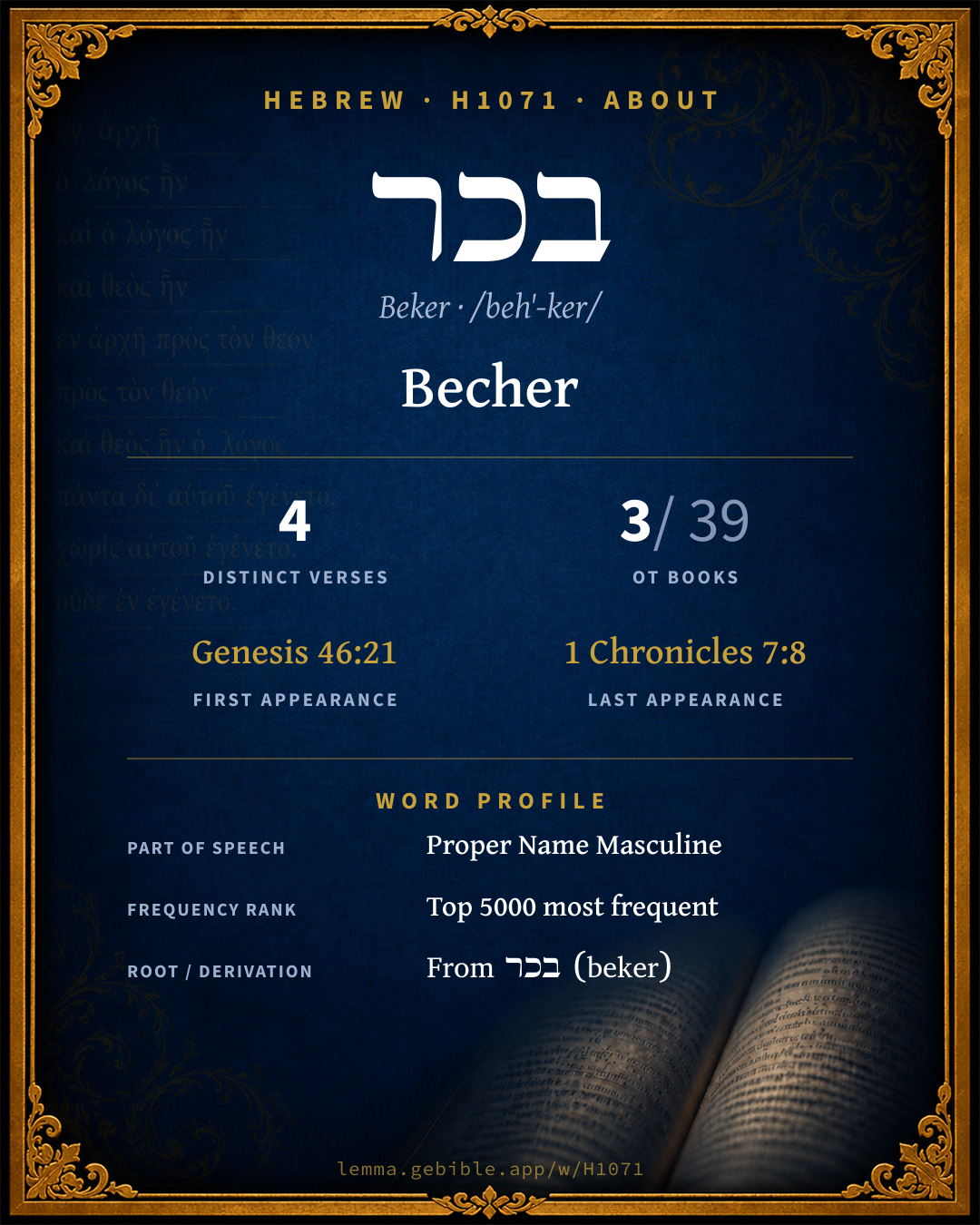
בֶּ֫כֶר
Becher
BDB lists 3 entries for ‘Becher’ fuller range ↓
Full lexicon entry — Brown-Driver-Briggs (BDB)
From Brown-Driver-Briggs (BDB)
Where this word appears
Grammar key — what these labels mean
Part of speech
- Noun
- A naming word — a person, place, thing, or idea.
Noun type
- Proper
- A name of a specific person, place, or people (e.g. Abraham, Zion, Israel).
Every verse where H1071 appears — 4 distinct verses across 3 books. Click any verse to open its interlinear word-by-word view. Verse text shown in the World English Bible for context — . Each verse’s Hebrew form is shown with its reference; the English is not keyword-highlighted, since the data carries no word-level English alignment. Use “Compare translations” on any verse to read it across multiple English versions. This concordance covers the Hebrew Bible; Septuagint (Greek Old Testament) occurrences are not indexed here.
Genesis 1 verse
Numbers 1 verse
1 Chronicles 2 verses
- 1 Chronicles 7:6 וָ/בֶ֛כֶר conj + n Proper [The sons of] Benjamin: Bela, and Becher, and Jediael, three.
- 1 Chronicles 7:8 בֶ֗כֶר בָֽכֶר n Proper n Proper The sons of Becher: Zemirah, and Joash, and Eliezer, and Elioenai, and Omri, and Jeremoth, and Abijah, and Anathoth, and Alemeth. All these were the sons of Becher.
About this entry
At a glance — auto-summarized from this page’s data, not written by a person. Every figure links to its source below. This summary describes the numbers; it doesn’t interpret them.
At its core, בכר (Beker) means “Becher.” A scarce word — 4 verses in all of the Hebrew Bible. Its uses cluster heavily in 1 Chronicles (50% of all occurrences). Scripture first uses it in Genesis 46:21. Dig into 4-verse concordance and the renderings breakdown below.
Gloss history
Strong's 1890 vs modern scholarship
About this word
Strong's H1071 catalogs a Hebrew word from the Hebrew Old Testament.
These counts are not copied from any lexicon or concordance. They are computed here, from the morphology-tagged Hebrew Old Testament. What Lemma adds →
- 4
- distinct verses
- The word appears in 4 distinct verses.
- 3 / 39
- OT books
- The word appears in 3 of 39 Old Testament books.
- #3,337
- by frequency
- Top 5000 most frequent Hebrew words (rank 3,337 of 8,640 Hebrew words by occurrence).
View all 4 occurrences in the concordance →
Most concentrated in
- 1 Chronicles 2 verses 50%
- Genesis 1 verse 25%
- Numbers 1 verse 25%
By section of the Old Testament
By traditional corpus
Conventional, traditional groupings — biblical authorship is debated, so this is a traditional corpus grouping, not an authorship claim. Each share is this word’s portion of its verses in that division of the Hebrew canon. Each figure is a share of the word’s 4 distinct verses.
- Torah (Pentateuch) 2 verses · 50%
- Writings (Ketuvim) 2 verses · 50%
How translations render this word
Counts come from each version’s own published word-to-Strong’s tagging or interlinear alignment — an approximate guide to how each version renders this word, not a word-level alignment the data otherwise carries. Because each total is that version’s own tagged count, the per-version totals vary from one another and need not match the appearance or distinct-verse counts above. These counts may also differ from a printed concordance because Lemma counts each distinctly tagged rendering and does not collapse phrase taggings into a single head-word total. This is a fixed set of word-tagged versions (KJV, ASV, BSB, ULT) and does not change with the reading translation you choose elsewhere. Each version’s license is shown beside its name below (and on Sources).
- King James Version: Becher 5×
- American Standard Version: Becher 5×
- Berean Standard Bible: Becher 4×
- unfoldingWord Literal Text: Beker 5×
King James Version Public Domain
Renders H1071 across 5 tagged occurrences — most commonly:
American Standard Version Public Domain
Renders H1071 across 5 tagged occurrences — most commonly:
Berean Standard Bible Public Domain
Renders H1071 across 5 tagged occurrences — most commonly:
Plus 1 rendering that appears only once — usually multi-word phrases or single function words the recovered tagging swept in, not distinct renderings.
unfoldingWord Literal Text CC BY-SA 4.0
Renders H1071 across 5 tagged occurrences — most commonly:
Senses in the full BDB
What do BDB’s symbols mean?
BDB uses these scholarly abbreviations:
| Symbol | Meaning |
|---|---|
| 𝔊 | the Septuagint (the ancient Greek translation, LXX) |
| 𝔙 | the Vulgate (the Latin translation) |
| 𝔖 | the Syriac version (the Peshitta) |
| 𝔗 | the Targum (the Aramaic translation) |
| ψ | the Psalms |
| √ | root (the underlying root or stem) |
| ‖ | parallel passage (a synonymous or contrasted parallel) |
| † | the dagger: every passage where the word occurs is cited |
The 2 senses and sub-senses the full Brown-Driver-Briggs lexicon distinguishes for this word, in lexicon order (not ranked by frequency), with BDB’s own verbatim wording and sub-sense lettering. Shown in Hebrew script with BDB’s own scholarly abbreviations. The condensed entry is in the Lexicon Entry tab. See also the Forms in the corpus table below.
- 1. son of Ephraim Nu. 26:35 = בֶּרֶד 1 Ch 7:20. e.g. Numbers 26:35
- 2. son of Benjamin Gn 46:21; 1 Ch 7:6, 8 (בָּ֑כֶר). e.g. Genesis 46:21
Senses from the full Brown-Driver-Briggs lexicon (Brown, Driver, Briggs; Oxford 1906 — public domain), digitized via Sefaria, supplemented by the OpenScriptures HebrewLexicon (CC BY 4.0). Full attribution on Sources.
Word origin
n.pr.m. (young camel, Arabic بَكْرٌ, Assyrian bakru Asrb.Annals ix. 65)—
— Brown-Driver-Briggs (Oxford 1906, public domain), digitized via Sefaria, supplemented by the OpenScriptures HebrewLexicon (CC BY 4.0). See Sources.
Derived from בכר (beker) (H1070) — young camel.
Jastrow Dictionary
A second Hebrew/Aramaic lexicon for comparison, covering Aramaic and post-biblical (Talmudic, Targumic, Midrashic) usage that the biblical-Hebrew BDB does not. Matched by lemma rather than by Strong’s number, so a lemma may carry more than one Jastrow headword (shown separately below), and the entries cover usage well beyond the Bible.
בָּכַר
- [to break forth,] to be early. [Kal prob. not used.]
- 1. to be early, produce first fruits. Tanḥ. Vayḥi 14; Gen. R. s. 99 מְבַכֶּרֶת (פירותיה) has early crops, opp. מלקשת, מאפלת. [Ib. end מבכרין מפירותיהם read מכבדין, v. כָּבַד.]
- 2. to bear for the first time (of animals). Bekh. I, 3 sq. שלא בִיכְּרָה that never before had given birth; a. fr.
- 3. (neut. v.) to be first in ripening. Bicc. III, 1 and sees תאנה שבִּכְּרָה a fig which is first ripe, אשכול שביכר a cluster of grapes which &c. Y. Maasr. I, 49ᵃ top משיְבַכֵּר צמייא וכ׳, v. צמייא. Ib. משבִּיכֵּירוּ בנות שבע, v. בְּרַת. Ib. בִּיכֵּירוּ, משיְבַכְּרוּ (v. בָּחַל as to spelling).
- 4. (b. h.) to recognize as first-born (בכור). B. Bath. 130ᵃ sq.
- same. Bekh. III, 2 המַבְכִּירוֹת those animals which have given birth for the first time.
- tohasten. Yalk. Gen. 161 שהיא מִתְבַּכֶּרֶת בפירותיה, v. supra.
בְּכַר
- —Pa. בַּכִּר
- 1. to produce, mature. Targ. Y. Deut. XXXIII, 14 דמְבַכְּרָא וכ׳ which his land produces.
- 2. to recognize as first-born. Targ. O. Deut. XXI, 16.
- to be dedicated as the first-born. Targ. O. Lev. XXVII, 26.
כַּר
- , v. כָּרָה)
- 1. bolster, mattress. Mikv. X, 2. Kel. XXVI, 5, v. כֶּסֶת; a. fr.—Pl. כָּרִים. Kil. IX, 2; a. fr.—Meg. 12ᵃ (expl. כרפס, Esth. I, 6) כ׳ של פסים mattresses of striped goods. e.g. Esther 1:6
- 2. rounded; (cmp. כֶּבֶשׂ) fat lamb. Men. 66ᵇ, a. e., v. כַּרְמֶל.—Esth. R. to I, 14 (play on כ̇ר̇ש̇נ̇א) מי … כ̇ר̇ בן ש̇נ̇ה (not פר) who offers unto thee a lamb one year old?—Pl. as ab. Meg. 12ᵇ כ׳ בני שנה; Yalk. Esth. 1051 פרים (corr. acc.). [Y. Sabb. V, 7ᵇ bot. כ׳ יוצאין לבובין ed. Krot., read: זכרים.]—Trnsf. commander.—Pl. as ab. Koh. R. to XII, 7, a. e., v. כלירכין.—4) runner, roller.—Pl. as ab. Gen. R. s. 69 מעבירין כ׳ עליהם pass the paving rollers over them; (ib. s. 41 רדיה; Yalk. Is. 337 דדין).
כַּר ²
- , bolster. Gitt. 47ᵃ כריסי כָּרִי my fat belly is my bolster. Y. Yoma VIII, 44ᵈ top; Y. Taan. I, 64ᶜ [read:] (תותי) תחות כָּרֵיה under his bolster.—Pl. כָּרִין. Targ. Lam. II, 21.
A Dictionary of the Targumim, the Talmud Babli and Yerushalmi, and the Midrashic Literature (Marcus Jastrow; London, Luzac, 1903) — Public Domain. Digitized via Sefaria. Digitized via Sefaria. Full attribution on Sources.
Forms in the corpus
The 5 distinct written forms H1071 takes in the Hebrew Bible, most frequent first — each parse links to that state’s occurrences in the concordance. Hebrew forms include their vowel points and cantillation, so a single lemma takes many written forms.
| Form | Parsing | Example | Uses |
|---|---|---|---|
| בֶ֗כֶר | Noun, Proper | 1 Chronicles 7:8 | 1 |
| בָֽכֶר | Noun, Proper | 1 Chronicles 7:8 | 1 |
| וָ/בֶ֛כֶר | Noun, Proper | 1 Chronicles 7:6 | 1 |
| וָ/בֶ֨כֶר֙ | Noun, Proper | Genesis 46:21 | 1 |
| לְ/בֶ֕כֶר | Noun, Proper | Numbers 26:35 | 1 |
Same root — word family
Other BDB entries built from the same root as H1071, grouped by Strong’s listed origin. These share a root / origin per the lexicon — not necessarily a shared meaning. Each links to that word’s own entry.
Derives from
Shares the same root
Proper names from this root
People and places named from this root — a name, not an additional meaning of the word.
Compare all same-root words → 1 of the same-root words is a proper name (a person or place). They share a root, not necessarily a meaning.
Bible dictionary
Public-domain dictionary articles matched to this entry by name (Becher). A biblical name can be shared by more than one person or place, so an article may treat several.
Easton's Bible Dictionary · M. G. Easton, 1897
First-born; a youth, the second son of Benjamin (Gen. 46:21), who came down to Egypt with Jacob. It is probable that he married an Ephraimitish heiress, and that his descendants were consequently reckoned among the tribe of Ephraim (Num. 26:35; 1 Chr. 7:20, 21). They are not reckoned among the descendants of Benjamin (Num. 26:38).
Smith's Bible Dictionary · William Smith, 1863
(young or firstborn)
+ The second son of Benjamin, according to the list in both (Genesis 46:21) and 1Chr 7:6 But omitted in (1 Chronicles 8:1) (B.C. about 1690.) + Son of Ephraim, (Numbers 26:35) called Bered in (1 Chronicles 7:20) Same as the preceding.
Hitchcock's Bible Names Dictionary · Roswell D. Hitchcock, 1869
first begotten; first fruits
Classic public-domain reference works; full attribution on Sources.
Septuagint verse parallels
This word appears in 4 verses that also exist in the Greek Old Testament (Septuagint), out of the 4 Hebrew verses it occurs in. You can read those verses in Greek by switching the Old Testament edition to the Septuagint.
Read these verses in the Septuagint
This is a verse-level parallel only — the same verses exist in both the Hebrew and Greek Old Testaments. No word-level Hebrew↔Greek correspondence is claimed: the data carries no such alignment, so no Greek word is shown as this Hebrew word’s translation. Coverage is not total — the Septuagint omits the deuterocanon and renumbers the Psalms, so some Hebrew verses have no direct Greek parallel.