
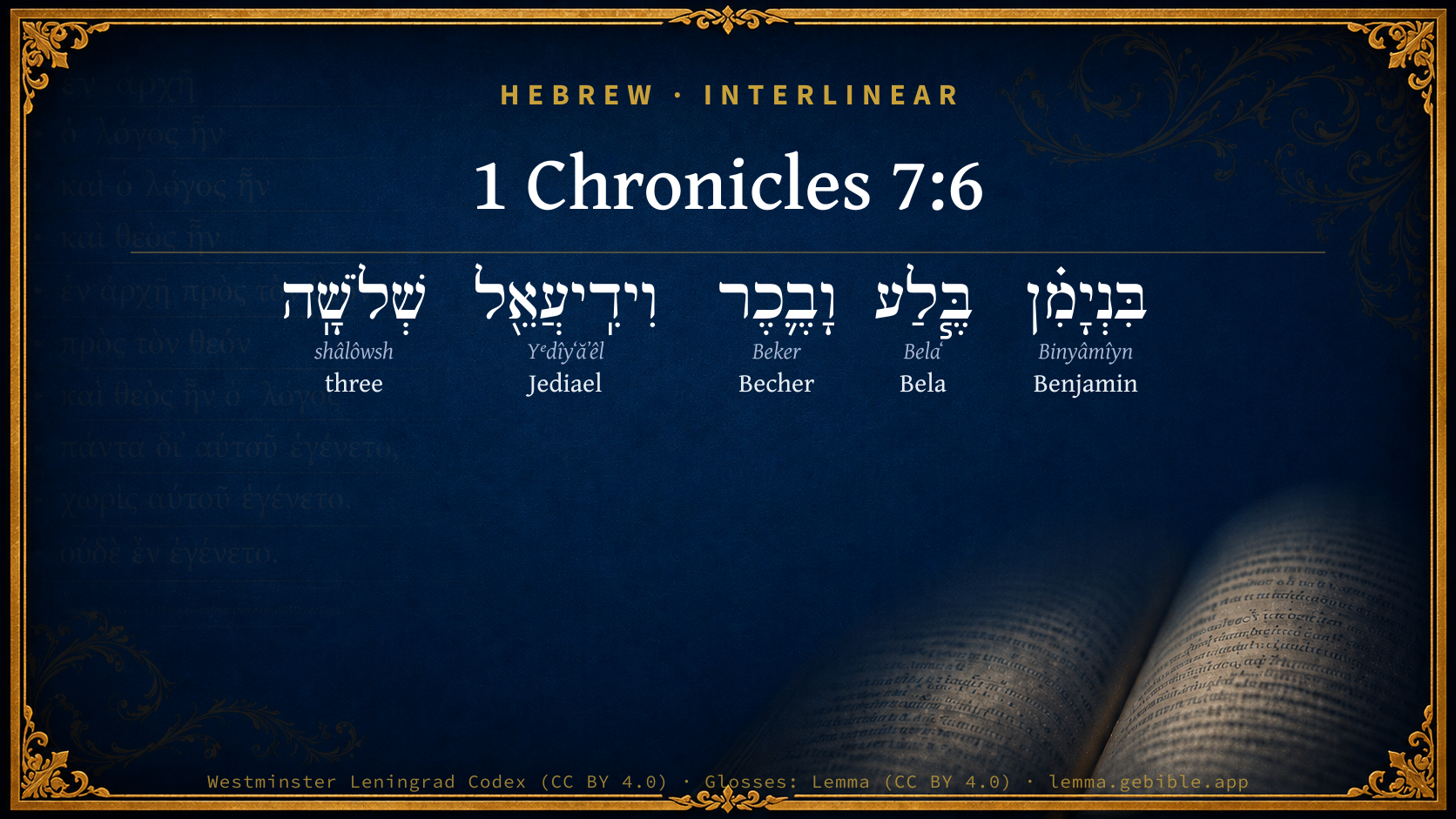
1 Chronicles 7:6

Hebrew (Westminster Leningrad Codex) 1 Chronicles 7:6 appears in the Hebrew Old Testament. The text above is from the Westminster Leningrad Codex. Each word links to its Strong’s number, a concise gloss, and parsing drawn from the Open Scriptures Hebrew Bible morphology. Click any word for its full Brown-Driver-Briggs (BDB) entry.
Download image
Cite this verse

1 Chronicles 7:6 (World English Bible). Public Domain. Lemma interlinear Bible study tool, https://lemma.gebible.app/v/1-chronicles/7/6.

Show BibTeX & RIS
BibTeX
RIS
English Translation
[The sons of] Benjamin: Bela, and Becher, and Jediael, three.
World English Bible · Public Domain
Highlights
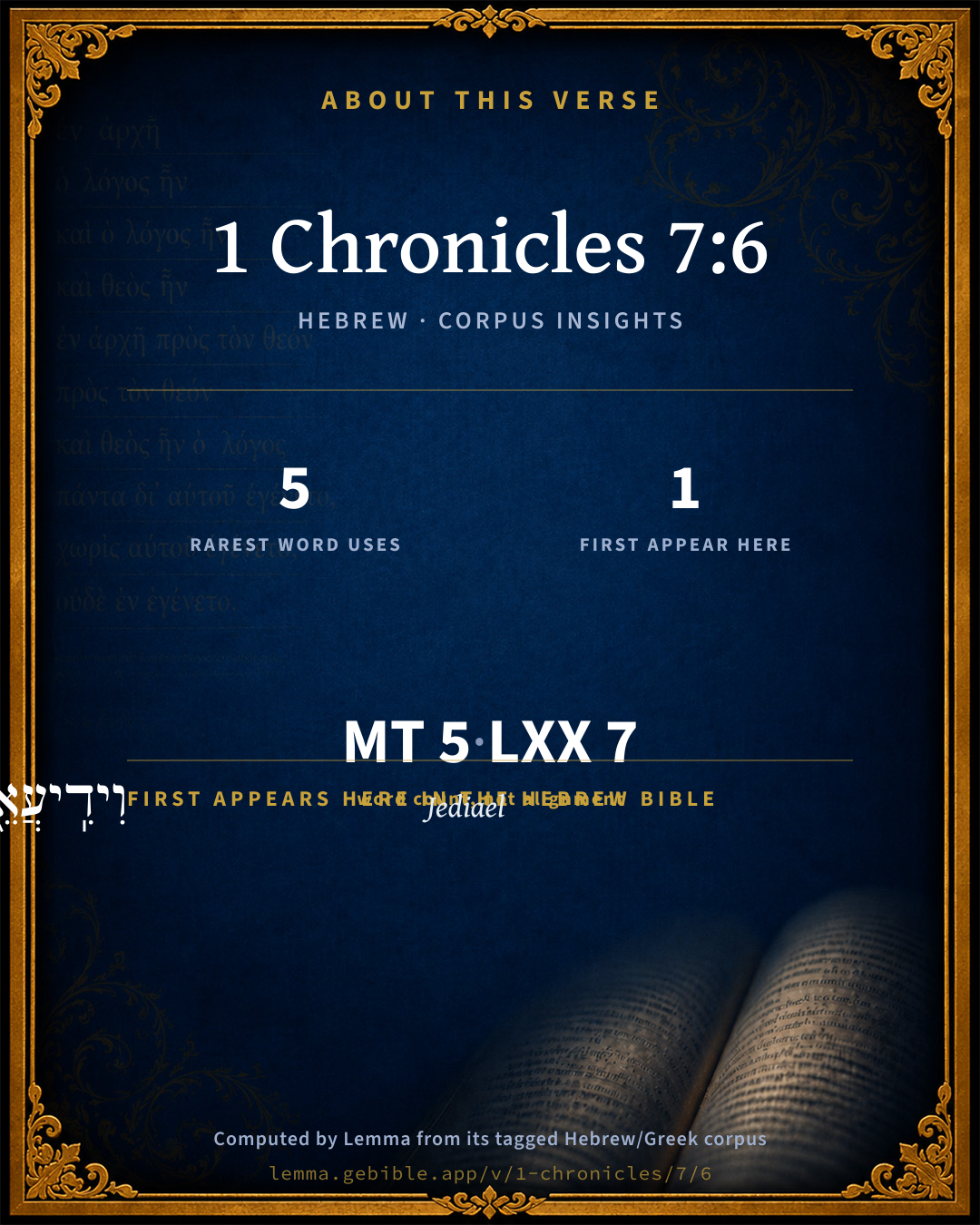
  • 1 first appearance in the Hebrew Bible
Full analysis ↓
Download a study sheet

One document with this verse’s original text, its word-by-word gloss line, the meaning frame, cross-references with their text, attributed commentary, and full source and license credits — printable, and it pastes into notes with its structure intact.

This verse Autodidact and up

Study sheet (.html) Plain text (.txt)

A passage Seminary Student

Up to 50 verses in one chapter. A passage sheet keeps up to 6 commentary sources and 12 cross-references per verse, in the order this page ranks them, and says so on the sheet whenever that leaves anything out. Ask for a single verse and you get the Autodidact verse sheet above.

Everything on this page stays free to read, with no account — the sheet is a download of what is already on screen, not access to it.

Want to remove ads? Support Godless Engineer
Compare translations 3

The same verse in 3 English versions, stacked beneath the original-language interlinear above. Click any original word for its lexicon entry.

Each is an independent rendering of the whole verse — the interlinear is not word-aligned to these translations.

Highlighted words mark where these versions differ — a whole-verse word diff, not a word-by-word alignment.

  • World English Bible Public Domain
    [The sons of] Benjamin: Bela, and Becher, and Jediael, three.
  • King James Version Public Domain
    The sons of Benjamin; Bela, and Becher, and Jediael, three.
  • unfoldingWord Literal Text CC BY-SA 4.0
    Benjamin: Bela and Beker and Jediael—three.

unfoldingWord Literal Text — © unfoldingWord, licensed CC BY-SA 4.0. Word-aligned USFM3 via Door43 (git.door43.org/unfoldingWord/en_ult).

Versions to compare (up to 4)

3 of 4 selected

Show all 18 translations

Every available English version of this verse, each an independent rendering of the whole verse.

  • World English Bible Public Domain
    [The sons of] Benjamin: Bela, and Becher, and Jediael, three.
  • Berean Standard Bible Public Domain
    The three sons of Benjamin: Bela, Becher, and Jediael.
  • Majority Standard Bible Public Domain
    The three sons of Benjamin: Bela, Becher, and Jediael.
  • King James Version Public Domain
    The sons of Benjamin; Bela, and Becher, and Jediael, three.
  • American Standard Version (1901) Public Domain
    `The sons of' Benjamin: Bela, and Becher, and Jediael, three.
  • Revised Version (1885) Public Domain
    The sons of Benjamin; Bela, and Becher, and Jediael, three.
  • Geneva Bible (1599) Public Domain
    The sonnes of Beniamin were Bela, and Becher, and Iediael, three.
  • Douay-Rheims (1899) Public Domain
    The sons of s Benjamin were Bela, and Bechor, and Jadihel, three.
  • Young's Literal Translation Public Domain
    Of Benjamin: Bela, and Becher, and Jediael, three.
  • Literal Standard Version CC BY-SA 4.0
    Of Benjamin: Bela, and Becher, and Jediael—three.
  • Unlocked Literal Bible CC BY-SA 4.0
    Benjamin's three sons were Bela, Beker, and Jediael.
  • unfoldingWord Literal Text CC BY-SA 4.0
    Benjamin: Bela and Beker and Jediael—three.
  • Darby Bible Public Domain
    [The sons of] Benjamin: Bela, and Becher, and Jediael, three.
  • World Messianic Bible Public Domain
    The sons of Benjamin: Bela, Becher, and Jediael, three.
  • Webster's Bible Public Domain
    The sons of Benjamin; Bela, and Becher, and Jediael, three.
  • Free Bible Version CC BY-SA 4.0
    Three sons of Benjamin: Bela, Beker, and Jediael.
  • Bible in Basic English Public Domain
    The sons of Benjamin: Bela and Becher and Jediael, three.
  • JPS Tanakh (1917) Public Domain
    The sons of Benjamin: Bela, and Becher, and Jediael, three.

Literal Standard Version (2020), Covenant Press — licensed CC BY-SA 4.0. Text via the HelloAO Bible API (eBible.org). Unlocked Literal Bible (unfoldingWord) — licensed CC BY-SA 4.0. Text via the HelloAO Bible API (eBible.org). unfoldingWord Literal Text — © unfoldingWord, licensed CC BY-SA 4.0. Word-aligned USFM3 via Door43 (git.door43.org/unfoldingWord/en_ult). Free Bible Version, Dr. Jonathan Gallagher — licensed CC BY-SA 4.0. Text via the HelloAO Bible API (eBible.org).

Word by word

More ways to search: Search by grammar → Find every occurrence → Compare this word →

Practice this passage: Drill this verse → Learn its vocabulary →

About this verse

These counts appear in no published source. They are computed here, from the morphology-tagged text and Lemma’s own curated glosses. What Lemma adds →

5
words
5
distinct lemmas
Historical
section

Notable vocabulary

The rarest word here is וָבֶ֛כֶר Becher H1071 — appearing just 5 times in the whole Hebrew Bible.

First appearance in Scripture

This word makes its first canonical appearance in the Hebrew Bible here:

  • וִידִֽיעֲאֵ֖ל Jediael H3043

Shared distinctive vocabulary

וָבֶ֛כֶר Becher H1071 occurs in 4 verses of the Hebrew Bible. Also found in:

Grammatical profile

  • 4 nouns
  • 1 adjective

Hebrew & Septuagint length

In English translation the verse runs 10 words from the Hebrew and 10 from the Septuagint (LXX English) — the same length.

A rough comparison of the two English renderings, which tokenize alike — not a word-level alignment.

Word counts can differ between the Hebrew and the Greek without any difference in meaning — e.g. the Hebrew direct-object marker אֵת has no separate Greek word, and Greek often adds the article ὁ.

In the original languages it is 5 Hebrew tokens and 7 Greek tokens — but the two are counted differently (Hebrew bundles its prefixes and suffixes into one token; the Greek is in lemma form), so that isn’t a like-for-like length.

Cross-references

4

Topical passages linked to 1 Chronicles 7:6 in the Treasury of Scripture Knowledge — connected by theme and wording, ordered by reader-vote popularity; previews shown in the World English Bible.

  • Genesis 46:21 The sons of Benjamin: Bela, Becher, Ashbel, Gera, Naaman, Ehi, Rosh, Muppim, Huppim, and Ard.
  • 1 Chronicles 8:1–40 Benjamin became the father of Bela his firstborn, Ashbel the second, and Aharah the third,
  • Numbers 26:38–41 The sons of Benjamin after their families: of Bela, the family of the Belaites; of Ashbel, the family of the Ashbelites; of Ahiram, the family of the Ahiramites;
  • 1 Chronicles 7:10–11 The sons of Jediael: Bilhan. The sons of Bilhan: Jeush, and Benjamin, and Ehud, and Chenaanah, and Zethan, and Tarshish, and Ahishahar.

Cross-references courtesy of OpenBible.info (CC BY 4.0).

Hebrew and Greek witnesses Masoretic Hebrew ↔ Greek Septuagint

The same verse in the two great witnesses to the Old Testament, shown verse-for-verse.

These are two independent witnesses, not word-aligned to each other, and the Septuagint is shown in lemma (dictionary) form.

Hebrew 1 Chronicles 7:6 Masoretic · Westminster Leningrad Codex

בִּנְיָמִ֗ן בֶּ֧לַע וָבֶ֛כֶר וִידִֽיעֲאֵ֖ל שְׁלֹשָֽׁה

[The sons of] Benjamin: Bela, and Becher, and Jediael, three.

World English Bible · Public Domain

Greek LXX 1 Chronicles 7:6 Septuagint · lemma form

βενιαμιν βαλε καί βαχιρ καί ιαδιηλ τρεῖς

The sons of Benjamin; Bale, and Bachir, and Jediel, three.

LXX2012 (modern English Septuagint) · Public Domain

Hebrew: Westminster Leningrad Codex (CC BY 4.0). Greek: Septuagint (public domain); English from LXX2012 (modern English Septuagint) (Public Domain). How the Septuagint differs from the Hebrew →

Commentary

Notes on 1 Chronicles 7:6 from classic Christian and Jewish commentators (each source and its license shown beneath its notes). The classic Christian expositions comment on the surrounding passage and are grouped to its opening verse, so a note may address several verses; the Jewish commentaries on the Tanakh (Rashi and others) are per-verse, so they appear only where the commentator wrote on this verse.

Lemma curates 59 commentaries, every one of them public domain or Creative Commons licensed, each selected and text-cleaned for this edition rather than reprinted as found. About our sources →

Jamieson, Fausset & Brown

Robert Jamieson, A. R. Fausset & David Brown

OF BENJAMIN. (Ch1 7:6-12)

The sons of Benjamin--Ten are named in Gen 46:21, but only five later (Ch1 8:1; Num 26:38). Perhaps five of them were distinguished as chiefs of illustrious families, but two having fallen in the bloody wars waged against Benjamin (Jdg 20:46), there remained only three branches of this tribe, and these only are enumerated.

Jediael--Or Asbel (Genesis 46. 21).

Jamieson, Fausset & Brown — Commentary Critical and Explanatory on the Whole Bible (1871) — public domain (CC PDM 1.0). Text via the HelloAO Bible API.

John Gill's Exposition

And the sons of Becher,.... Another son of Benjamin, Ch1 7:6,

Zemira, and Joash, and Eliezer and Elioenai, and Omri, and Jerimoth, and Abiah, and Anathoth, and Alameth; the two last of these, according to Kimchi, gave names to two cities in Benjamin, built by them; Anathoth, the native place of Jeremiah the prophet, and Alameth, the same with Bahurim, Sa2 16:5.

all these are the sons of Becher; before named.

John Gill's Exposition of the Whole Bible (1746–1763) — public domain (CC PDM 1.0). Text via the HelloAO Bible API.

Trapp's Complete Commentary

John Trapp

1Ch 7:6 [The sons] of Benjamin; Bela, and Becher, and Jediael, three.

Ver. 6. The sons of Benjamin.] The genealogies of Dan and Zebulon are left out, for causes unknown; haply, because at their return out of Babylon their genealogies were not found. Dan is also - for their apostasy, likely, and idolatry - not reckoned among the rest that were sealed. {Rev 7:5-8} That Antichrist should be one of this tribe, is a fiction rightly exploded. We read of Hushim, {1Ch 7:12} the sons of Aher, which signifieth Another - and so some render it - by Another, understanding Dan, {compare Gen 46:23} whom the penman of this book held not worth the naming. The Hebrews, when they would show their detestation of any person or thing, they call it acher; a sow they call dabshar acher, that is, another thing; so leaven at the passover, &c. {a}

{a} Elias Thisbit.

John Trapp, A Commentary or Exposition upon All the Books of the Old and New Testament (1647–1656) — public domain. Text from a community e-Sword module.

Joseph Benson's Commentary

1Ch 7:6. The sons of Benjamin, three — They were ten, (Gen 46:21,) and five of them are named 1Ch 8:1, but here only three are mentioned, either because they were most eminent, or because the other families were now extinct.

Joseph Benson's Commentary on the Old and New Testaments (1811–1818) — public domain. Text from a community e-Sword module.

Keil & Delitzsch

C. F. Keil & F. Delitzsch

And the sons of Becher,.... Another son of Benjamin, Ch1 7:6,

Zemira, and Joash, and Eliezer and Elioenai, and Omri, and Jerimoth, and Abiah, and Anathoth, and Alameth; the two last of these, according to Kimchi, gave names to two cities in Benjamin, built by them; Anathoth, the native place of Jeremiah the prophet, and Alameth, the same with Bahurim, Sa2 16:5.

all these are the sons of Becher; before named.

Keil & Delitzsch — Biblical Commentary on the Old Testament (1861–1891) — public domain (CC PDM 1.0). Text via the HelloAO Bible API. (Old Testament only.)

Geneva Bible (1599)

Geneva Bible translators

Called also Ashbel, Gen. 46:21; Num. 26:38.

Which were the chief: for else there were seven in all as appeareth, Gen. 46:21.

Geneva Bible (1599) marginal notes — public domain. Text via Bolls.life.

Adam Clarke's Commentary

Verse 6. The sons of Benjamin; Bela, and Becher and Jediael] In Ge 46:21, ten sons of Benjamin are reckoned; viz., Bela, Becher, Ashbel, Gera, Naaman, Eri, Rosh, Muppim, Huppim, and Ard. In Nu 26:38, c., five sons only of Benjamin are mentioned, Bela, Ashbel, Ahiram, Shupham, and Hupham: and Ard and Naaman are there said to be the sons of Bela consequently grandsons of Benjamin. In the beginning of the following chapter, five sons of Benjamin are mentioned, viz., Bela, Ashbel, Aharah, Nohah, and Rapha; where also Addar, Gera, Abihud, Abishua, Naaman, Ahoah, a second Gera, Shephuphan, and Huram, are all represented as grandsons, not sons, of Benjamin: hence we see that in many cases grandsons are called sons, and both are often confounded in the genealogical tables. To attempt to reconcile such discrepancies would be a task as endless as it would be useless. The rabbins say that Ezra, who wrote this book, did not know whether some of these were sons or grandsons; and they intimate also that the tables from which he copied were often defective, and here we must leave all such matters.

Adam Clarke's Commentary on the Bible (1810–1826) — public domain. Text from a community e-Sword/MySword module.

Ellicott's Commentary for English Readers

(6) Becher with different vowels would mean firstborn; and the original reading in Genesis 46 may have been Bela bechoro—“Bela his firstborn,” as in 1Ch_8:1.

Jediael, friend of God, may be a substitute for Ashbel, i.e., Eshbaal, man of Bel or Baal. (Comp. 1Ch_3:8, Eliada for Beeliada.) Ashbel is the second son of Benjamin in Numbers 26 and 1 Chronicles 8, and the third (perhaps second) in Genesis 46

(6-11) The tribe of Benjamin.

(6) Benjamin.—Before this word bnê (sons of . . .) has been lost, because Benjamin in Hebrew begins with the same three letters. The present list of the sons of Benjamin may be compared with three others, that of Gen. xlvi 21, that of Num. xxvi 38-41, and that of the next 1chron 1Ch_7:1-5.

A Bible Commentary for English Readers, edited by Charles John Ellicott (1878–1897) — public domain. Text from a community e-Sword module.

The Cambridge Bible for Schools and Colleges

gen. ed. J. J. S. Perowne

6–12 (cp. ch. 1Ch_8:1-40). The Genealogy of Benjamin

6. The sons of Benjamin] The Heb. word for the sons of being just like the beginning of the word Benjamin has fallen out through an error of transcription. The names of these are also given in 1Ch_8:1-5; Gen_46:21; Num_26:38-41. There are variations of reading and probably also variations of tradition in the different lists; e.g. here the sons of Benjamin are reckoned to be three in number, but in 1Ch_8:2 to be five.

Bela, and Becher, and Jediael] These three names come from Gen_46:21, Jediael (“Known to God”) being substituted for the heathen-sounding Ashbel (= Ishbaal, “Man of Baal”). The Chronicler in this case conforms literally to the principle laid down in Hos_2:17. (See note on Eshbaal, 1Ch_8:33.) In 1Ch_8:1 on the contrary the three names Bela, Ashbel, Aharah (= Ahiram) are taken from Num_26:38 without misgiving.

The Cambridge Bible for Schools and Colleges (gen. ed. J. J. S. Perowne; Cambridge University Press, 1878–1918) — public domain. Text from a community e-Sword module.

Albert Barnes' Notes on the Bible

Three - In Genesis, ten “sons” of Benjamin are mentioned; in Numbers, five (marginal references). Neither list, however, contains Jediael who was perhaps a later chieftain. If so, “son” as applied to him means only “descendant.”

It is conjectured that Becher has disappeared from the lists in 1 Chr. 8 and in Numbers, because he, or his heir, married an Ephraimite heiress, and that his house thus passed over in a certain sense into the tribe of Ephraim, in which the “Bachrites” are placed in Numbers Num 26:35. He retains, however, his place here, because, by right of blood, he really belonged to Benjamin.

Albert Barnes' Notes on the Bible (1834–1885) — public domain. Text from a community e-Sword/MySword module.

Haydock's Catholic Bible Commentary

Benjamin; a man, perhaps, of the tribe of Issachar. See ver. 10. Or the patriarch had originally ten sons, (Genesis xlvi. 21.) or grandsons, five of whom only had children, and perhaps two of their families perished entirely in the war with the other tribes; (Judges xx. 46.) so that, under David, only three branches were acknowledged. (Calmet) --- Jadihel, or Asbel in Genesis.

George Leo Haydock (1774–1849), Haydock's Catholic Family Bible and Commentary, 1859 edition — public domain. Excludes Psalms (Douay-Rheims chapter numbering differs from Protestant) and Deuterocanonical books (Catholic canon only).

Matthew Poole's English Annotations

There were ten, Gen 46:21, and five of them are named, 1Ch 8:1, but here only three are mentioned, either because these were most eminent for courage or fruitfulness, or because the other families were now extinct.

Matthew Poole's English Annotations on the Holy Bible (1683–1685) — public domain. Text from a community e-Sword/MySword module.

The Pulpit Commentary

The sons of Benjamin; Bela, and Becher, and Jediael, three. We have four passages for our authorities as to the sons of Benjamin, and it is not altogether easy to bring them into verbal harmony. They are Gen_46:21; Num_26:38-41; the present passage; and ch. 8. Our present passage mentions three sons, as though they were all, and immediately proceeds to their posterity. The list in Genesis mentions ten, of whom, however, we know (Num_26:40; 1Ch_8:3, 1Ch_8:4) that three, Naaman, Ard, and Gem, were grandsons, being sons of Bela, under which circumstances the order in which the two former stand in Genesis is remarkable. Again, while Becher is given as the second son in both Genesis and our present place, he is not mentioned in Num_26:38-41 and in 1Ch_8:1. Ashbel, who in Genesis is given as the third, is expressly called the second son. Among the Ephraimites, however, (Num_26:35) a Becher, with his descendants the Bachrites, is mentioned, and it is not improbable that, by marriage, the family were at that time, for manifest reasons of inheritance and possession, reckoned in this tribe, though by blood of the tribe of Benjamin. This subject is skilfully discussed by Lord A. C. Hervey (Smith"s "Bible Dictionary," 1:175). Lastly, Jediael of this passage and ver. 10 is not found in Genesis, in Numbers, or in our ch. 8. This name seems to have superseded in our passage the name Ashbel in Genesis, though it is impossible to speak certainly. It cannot be supposed to designate the same person, but rather a descendant in the same branch, whose family had come to importance "in the days of David."

The Pulpit Commentary (1880–1919), ed. H.D.M. Spence-Jones & Joseph S. Exell — public domain. Text from a community e-Sword module.

John Wesley's Explanatory Notes

Three - They were ten, Gen. xlvi, 25, and five of them are named, chap. chap. viii, 1, but here only three are mentioned, either because these were most eminent; or because the other families are now extinct.

John Wesley, Explanatory Notes Upon the Whole Bible (1754–1765) — public domain. Text via the GEBible commentary corpus.

unfoldingWord translationNotes

Door43 World Missions Community

General Information:

All of the names here are the names of men. (See: How to Translate Names)

22,034 fighting men

"twenty-two thousand and thirty-four" (See: Numbers)

fathers' houses

extended families, people related to each other who usually lived in different houses, what the UDB calls "clans"

translationWords

Benjamin

unfoldingWord translationNotes — © Distant Shores Media and the Door43 World Missions Community, licensed CC BY-SA 4.0. Source: git.door43.org/Door43/en_tn.

Rashi

Rabbi Shlomo Yitzchaki (Rashi)

Benjamin: Bela, and Becher, and Jediael This is the one called Ashbel in the “Book of the Just.” (Gen. 46:21).

Rashi on the Tanakh — English translations: “The Judaica Press complete Tanach with Rashi, translated by A. J. Rosenberg” (CC BY 4.0); “Pentateuch with Rashi's commentary by M. Rosenbaum and A.M. Silbermann, 1929-1934” (public domain); “The Metsudah Tanach series, Lakewood, N.J” (CC BY 4.0); and “The Book of Joshua, Metsudah Publications, 1997” (CC BY 4.0). Text via Sefaria.

Lesson kit

Teaching starters — assembled from the data on this page, not authored interpretation. Every prompt links to the verse data it draws on. Edit before teaching.

1 Chronicles, in the Historical, opens this verse with 5 words (5 distinct Hebrew lemmas). Its most distinctive word is Beker (“Becher”). A historical commentator’s framing appears above. Read the whole chapter for the surrounding context.

Discussion questions

  1. What does “Becher” (Beker) contribute to the verse as a whole?
  2. The word “Jediael” first appears here in Scripture. What is being introduced at this debut?
  3. Genesis 46:21 shares the word «Becher» with this verse. How do the two illuminate each other?
  4. These translations render this verse differently. What is at stake in choosing one wording over another?
  5. Reading how Jamieson, Fausset & Brown and John Gill's Exposition read this verse, where do the two commentators agree and where do they part?

Things to notice

Reading settings

Reading text

Shown beneath each verse's original-language words.

Old Testament
Old Testament edition

Read the OT as the Masoretic Hebrew (MT) or the Greek Septuagint (LXX).

English shown for the Greek Septuagint (in the Hebrew ↔ Greek comparison).

Comparing translations? Open the Compare panel on any verse page to stack up to four side by side.