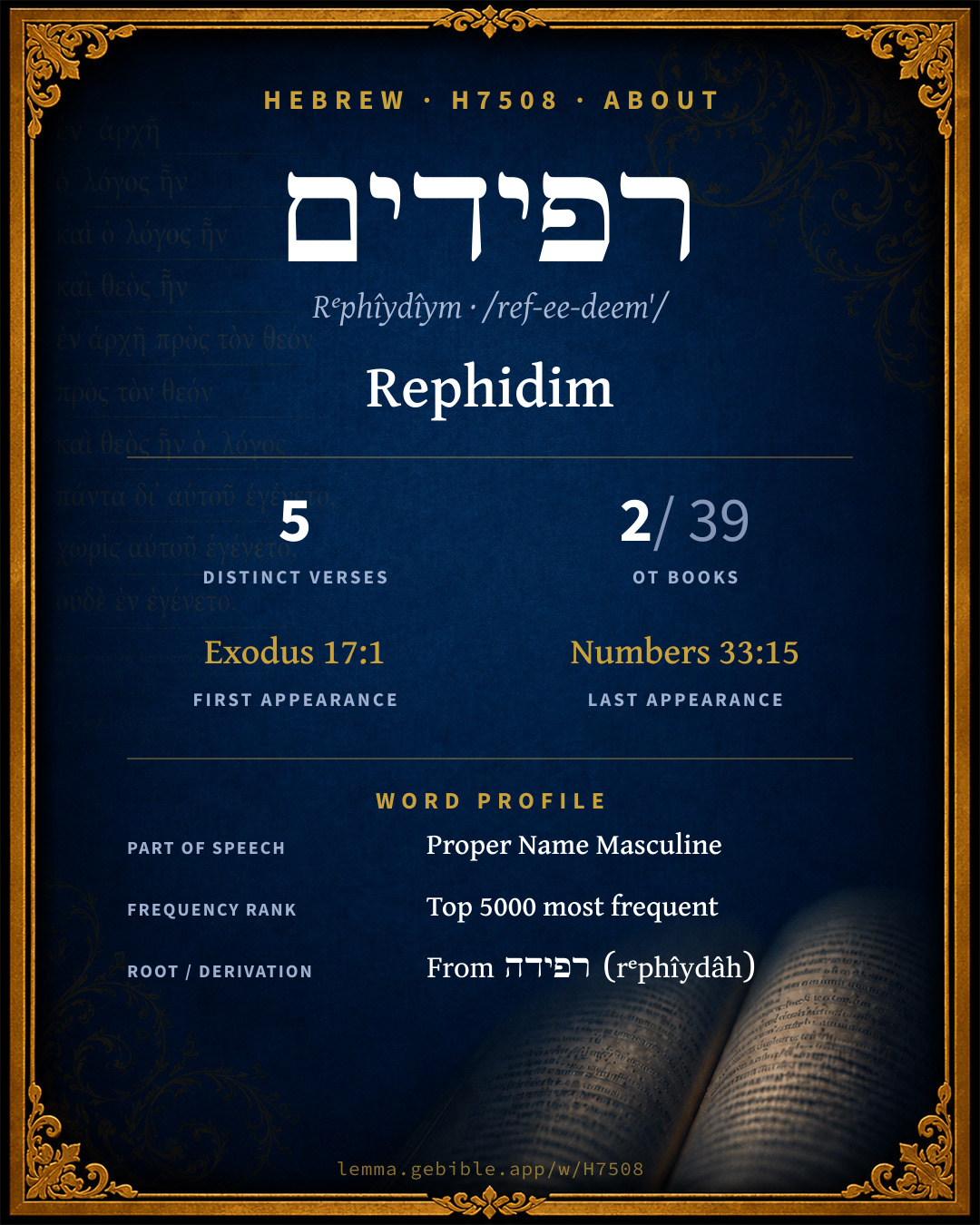
רְפִידִים
Rephidim
BDB lists 2 entries for ‘Rephidim’ fuller range ↓
Full lexicon entry — Brown-Driver-Briggs (BDB)
From Brown-Driver-Briggs (BDB)
Where this word appears
Grammar key — what these labels mean
Noun type
- Proper
- A name of a specific person, place, or people (e.g. Abraham, Zion, Israel).
Every verse where H7508 appears — 5 distinct verses across 2 books. Click any verse to open its interlinear word-by-word view. Verse text shown in the World English Bible for context — . Each verse’s Hebrew form is shown with its reference; the English is not keyword-highlighted, since the data carries no word-level English alignment. Use “Compare translations” on any verse to read it across multiple English versions. This concordance covers the Hebrew Bible; Septuagint (Greek Old Testament) occurrences are not indexed here.
Exodus 3 verses
- Exodus 17:1 בִּ/רְפִידִ֔ים prep + n Proper All the congregation of the children of Israel traveled from the wilderness of Sin, by their journeys, according to Yahweh's commandment, and encamped in Rephidim; but there was no water for the people to drink.
- Exodus 17:8 בִּ/רְפִידִֽם prep + n Proper Then Amalek came and fought with Israel in Rephidim.
- Exodus 19:2 מֵ/רְפִידִ֗ים prep + n Proper When they had departed from Rephidim, and had come to the wilderness of Sinai, they encamped in the wilderness; and there Israel encamped before the mountain.
Numbers 2 verses
About this entry
At a glance — auto-summarized from this page’s data, not written by a person. Every figure links to its source below. This summary describes the numbers; it doesn’t interpret them.
רפידים (Rᵉphîydîym) is a Hebrew name most often rendered “Rephidim.” It occurs a mere 5 verses across Scripture. It clusters heavily in Exodus, which alone accounts for 60% of its uses. Debuting at Exodus 17:1, it then recurs through the corpus. For the data behind this summary, explore 5-verse concordance and the renderings breakdown below.
Gloss history
Strong's 1890 vs modern scholarship
About this word
Strong's H7508 catalogs a Hebrew word from the Hebrew Old Testament.
These counts are not copied from any lexicon or concordance. They are computed here, from the morphology-tagged Hebrew Old Testament. What Lemma adds →
- 5
- distinct verses
- The word appears in 5 distinct verses.
- 2 / 39
- OT books
- The word appears in 2 of 39 Old Testament books.
- #3,337
- by frequency
- Top 5000 most frequent Hebrew words (rank 3,337 of 8,640 Hebrew words by occurrence).
View all 5 occurrences in the concordance →
By traditional corpus
Conventional, traditional groupings — biblical authorship is debated, so this is a traditional corpus grouping, not an authorship claim. Each share is this word’s portion of its verses in that division of the Hebrew canon. Each figure is a share of the word’s 5 distinct verses.
- Torah (Pentateuch) 5 verses · 100%
How translations render this word
Counts come from each version’s own published word-to-Strong’s tagging or interlinear alignment — an approximate guide to how each version renders this word, not a word-level alignment the data otherwise carries. Because each total is that version’s own tagged count, the per-version totals vary from one another and need not match the appearance or distinct-verse counts above. These counts may also differ from a printed concordance because Lemma counts each distinctly tagged rendering and does not collapse phrase taggings into a single head-word total. This is a fixed set of word-tagged versions (KJV, ASV, BSB, ULT) and does not change with the reading translation you choose elsewhere. Each version’s license is shown beside its name below (and on Sources).
- King James Version: Rephidim 5×
- American Standard Version: Rephidim 5×
- Berean Standard Bible: Rephidim 5×
- unfoldingWord Literal Text: Rephidim 5×
King James Version Public Domain
Renders H7508 across 5 tagged occurrences — most commonly:
American Standard Version Public Domain
Renders H7508 across 5 tagged occurrences — most commonly:
Berean Standard Bible Public Domain
Renders H7508 across 5 tagged occurrences — most commonly:
unfoldingWord Literal Text CC BY-SA 4.0
Renders H7508 across 5 tagged occurrences — most commonly:
Senses in BDB
The 2 senses BDB distinguishes for this word, in lexicon order (not ranked by frequency or importance). The full entry — with sub-senses — is in the Lexicon Entry tab.
- Rephidim = "rests" or " stays" or " resting places"
- a station of Israel in the wilderness between Egypt and Sinai
Word origin
רְפִידִים n.pr.loc. station of Isr. at Exodus (in P)
— Brown-Driver-Briggs (Oxford 1906, public domain), digitized via Sefaria, supplemented by the OpenScriptures HebrewLexicon (CC BY 4.0). See Sources.
Derived from רפידה (rᵉphîydâh) (H7507) — support.
Jastrow Dictionary
A second Hebrew/Aramaic lexicon for comparison, covering Aramaic and post-biblical (Talmudic, Targumic, Midrashic) usage that the biblical-Hebrew BDB does not. Matched by lemma rather than by Strong’s number, so a lemma may carry more than one Jastrow headword (shown separately below), and the entries cover usage well beyond the Bible.
רְפִידִים
- (b. h.) pr. n. pl. Rephidim, a station in the wilderness. Bekh. 5ᵇ שאלתיו מאי לשון ר׳ ואמר לי ר׳ שמה I asked him (R. Eliezer), what is the meaning of r’phidim?, and he told me, the name of the place is R.; Snh. 106ᵃ; Tanḥ. B’shall. 25, v. רָפָה; a. fr.—V. next w.
A Dictionary of the Targumim, the Talmud Babli and Yerushalmi, and the Midrashic Literature (Marcus Jastrow; London, Luzac, 1903) — Public Domain. Digitized via Sefaria. Digitized via Sefaria. Full attribution on Sources.
Forms in the corpus
The 5 distinct written forms H7508 takes in the Hebrew Bible, most frequent first — each parse links to that state’s occurrences in the concordance. Hebrew forms include their vowel points and cantillation, so a single lemma takes many written forms.
| Form | Parsing | Example | Uses |
|---|---|---|---|
| בִּ/רְפִידִ֔ים | Noun, Proper | Exodus 17:1 | 1 |
| בִּ/רְפִידִ֔ם | Noun, Proper | Numbers 33:14 | 1 |
| בִּ/רְפִידִֽם | Noun, Proper | Exodus 17:8 | 1 |
| מֵ/רְפִידִ֑ם | Noun, Proper | Numbers 33:15 | 1 |
| מֵ/רְפִידִ֗ים | Noun, Proper | Exodus 19:2 | 1 |
Bible dictionary
Public-domain dictionary articles matched to this entry by name (Rephidim). A biblical name can be shared by more than one person or place, so an article may treat several.
Easton's Bible Dictionary · M. G. Easton, 1897
Supports, one of the stations of the Israelites, situated in the Wady Feiran, near its junction with the Wady esh-Sheikh. Here no water could be found for the people to drink, and in their impatience they were ready to stone Moses, as if he were the cause of their distress. At the command of God Moses smote "the rock in Horeb," and a copious stream flowed forth, enough for all the people. After this the Amalekites attacked the Israelites while they were here encamped, but they were utterly defeated (Ex. 17:1, 8-16). They were the "first of the nations" to make war against Israel (Num. 24:20).
Leaving Rephidim, the Israelites advanced into the wilderness of Sinai (Ex. 19:1, 2; Num. 33:14, 15), marching probably through the two passes of the Wady Solaf and the Wady esh-Sheikh, which converge at the entrance to the plain er-Rahah, the "desert of Sinai," which is two miles long and about half a mile broad. (See SINAI; MERIBAH.)
Smith's Bible Dictionary · William Smith, 1863
(Exodus 17:1,8; 19:2) The name means rests or stays, i.e. resting places. The place lies in the march of the Israelites from Egypt to Sinai. Its site is not certain, but it is perhaps Wady Feiran, a rather broad valley about 25 miles from Jebel Musa (Mount Sinai). Others place it in Wady es Sheikh, an eastern continuation of Feiran, and about 12 miles from Sinai. Here the Israelites fought their first battle and gained their first victory after leaving Egypt, the Amalekites having attacked them; here also the people murmured from thirst, and Moses brought water for them out of the rock. From this murmuring the place was called "Massah" and "Meribah."
Hitchcock's Bible Names Dictionary · Roswell D. Hitchcock, 1869
beds; places of rest
Classic public-domain reference works; full attribution on Sources.
Septuagint verse parallels
This word appears in 5 verses that also exist in the Greek Old Testament (Septuagint), out of the 5 Hebrew verses it occurs in. You can read those verses in Greek by switching the Old Testament edition to the Septuagint.
Read these verses in the Septuagint
This is a verse-level parallel only — the same verses exist in both the Hebrew and Greek Old Testaments. No word-level Hebrew↔Greek correspondence is claimed: the data carries no such alignment, so no Greek word is shown as this Hebrew word’s translation. Coverage is not total — the Septuagint omits the deuterocanon and renumbers the Psalms, so some Hebrew verses have no direct Greek parallel.