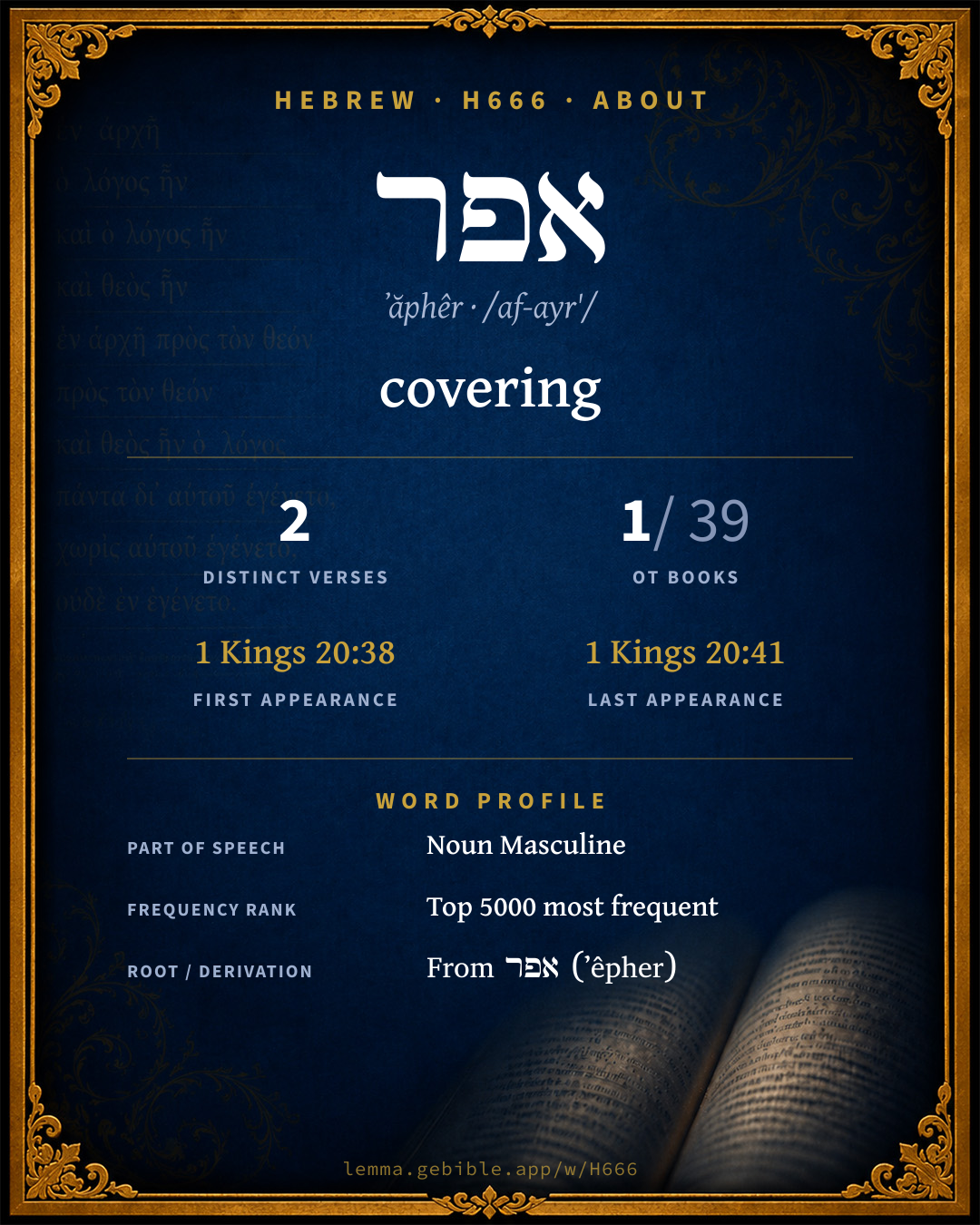
אֲפֵר
covering
Full lexicon entry — Brown-Driver-Briggs (BDB)
From Brown-Driver-Briggs (BDB)
Where this word appears
Grammar key — what these labels mean
Noun type
- Common
- A common noun — a general class of person, place, or thing (“king,” “city,” “water”), not a specific name.
State
- Absolute
- The independent form of a noun, not bound to a following word.
Gender
- Masculine
- Grammatically masculine.
Number
- Singular
- One.
Every verse where H666 appears — 2 distinct verses across 1 book. Click any verse to open its interlinear word-by-word view. Verse text shown in the World English Bible for context — . Each verse’s Hebrew form is shown with its reference; the English is not keyword-highlighted, since the data carries no word-level English alignment. Use “Compare translations” on any verse to read it across multiple English versions. This concordance covers the Hebrew Bible; Septuagint (Greek Old Testament) occurrences are not indexed here.
1 Kings 2 verses
- 1 Kings 20:38 בָּ/אֲפֵ֖ר prep det + n c ms So the prophet departed, and waited for the king by the way, and disguised himself with his headband over his eyes.
- 1 Kings 20:41 הָ֣/אֲפֵ֔ר ptcl def.art + n c ms He hurried, and took the headband away from his eyes; and the king of Israel discerned him that he was of the prophets.
About this entry
At a glance — auto-summarized from this page’s data, not written by a person. Every figure links to its source below. This summary describes the numbers; it doesn’t interpret them.
At its core, אפר (ʼăphêr) means “covering.” It is rare — just 2 verses in the entire Hebrew Bible. The word gravitates to 1 Kings (100%). Scripture first uses it in 1 Kings 20:38. Dig into 2-verse concordance and the renderings breakdown below.
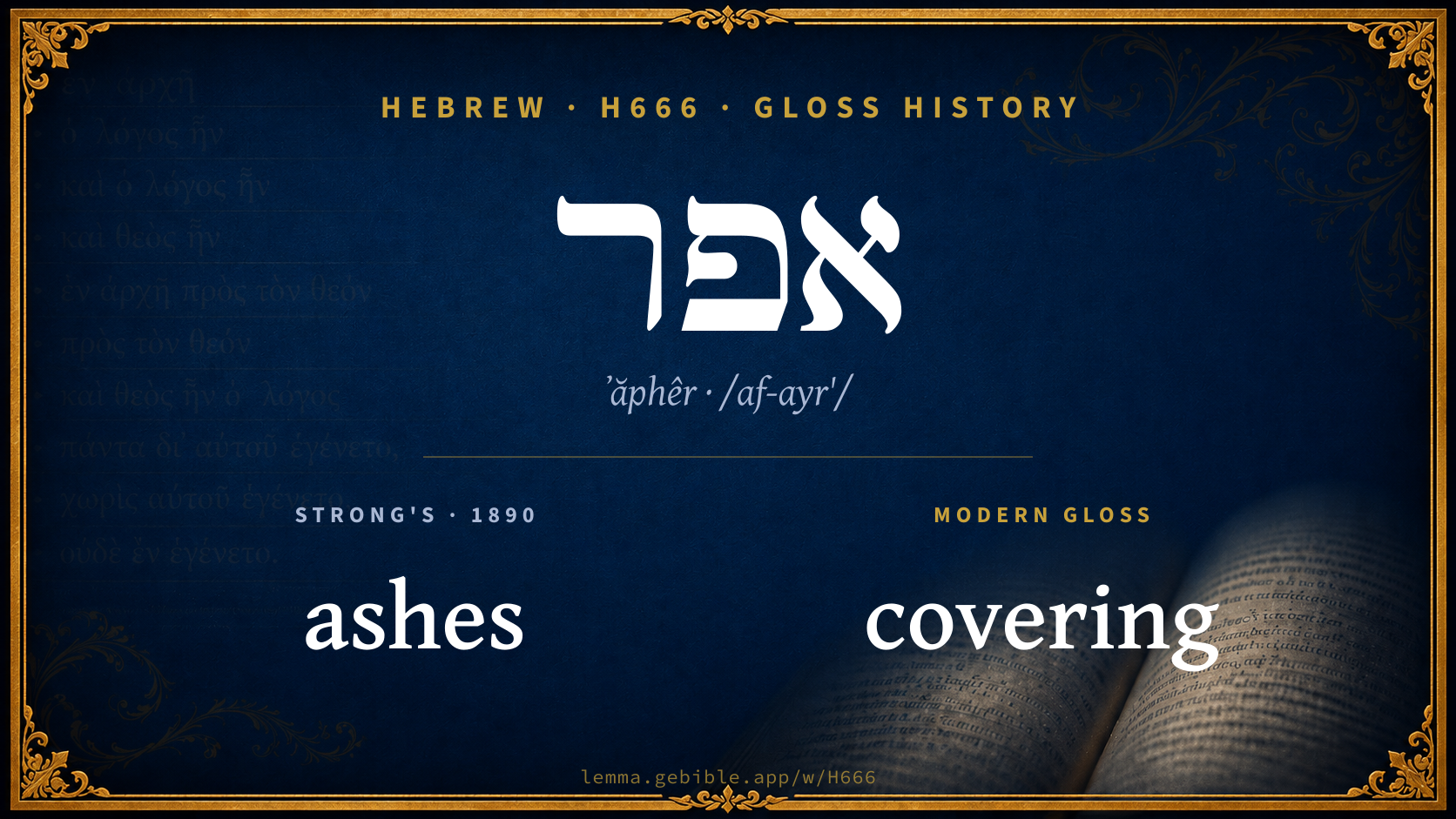
Gloss history
Strong's 1890 vs modern scholarship
About this word
Strong's H666 catalogs a Hebrew word from the Hebrew Old Testament.
These counts are not copied from any lexicon or concordance. They are computed here, from the morphology-tagged Hebrew Old Testament. What Lemma adds →
- 2
- distinct verses
- The word appears in 2 distinct verses.
- 1 / 39
- OT books
- The word appears in 1 of 39 Old Testament books.
- #4,807
- by frequency
- Top 5000 most frequent Hebrew words (rank 4,807 of 8,640 Hebrew words by occurrence).
View all 2 occurrences in the concordance →
Most concentrated in
- 1 Kings 2 verses 100%
By section of the Old Testament
By traditional corpus
Conventional, traditional groupings — biblical authorship is debated, so this is a traditional corpus grouping, not an authorship claim. Each share is this word’s portion of its verses in that division of the Hebrew canon. Each figure is a share of the word’s 2 distinct verses.
- Prophets (Nevi'im) 2 verses · 100%
How translations render this word
Counts come from each version’s own published word-to-Strong’s tagging or interlinear alignment — an approximate guide to how each version renders this word, not a word-level alignment the data otherwise carries. Because each total is that version’s own tagged count, the per-version totals vary from one another and need not match the appearance or distinct-verse counts above. These counts may also differ from a printed concordance because Lemma counts each distinctly tagged rendering and does not collapse phrase taggings into a single head-word total. This is a fixed set of word-tagged versions (KJV, ASV, BSB, ULT) and does not change with the reading translation you choose elsewhere. Each version’s license is shown beside its name below (and on Sources).
- King James Version: Himself with ashes 1×, Took the ashes 1×
- American Standard Version: Himself with his headband 1×, Took the headband 1×
- Berean Standard Bible: Bandage 2×
- unfoldingWord Literal Text: Covering 2×
King James Version Public Domain
Renders H666 across 2 tagged occurrences — most commonly:
American Standard Version Public Domain
Renders H666 across 2 tagged occurrences — most commonly:
Berean Standard Bible Public Domain
Renders H666 across 2 tagged occurrences — most commonly:
unfoldingWord Literal Text CC BY-SA 4.0
Renders H666 across 2 tagged occurrences — most commonly:
Senses in BDB
The 1 sense BDB distinguishes for this word, in lexicon order (not ranked by frequency or importance). The full entry — with sub-senses — is in the Lexicon Entry tab.
- covering, bandage
Word origin
אֲפֵר n.[m.] covering, bandage
— Brown-Driver-Briggs (Oxford 1906, public domain), digitized via Sefaria, supplemented by the OpenScriptures HebrewLexicon (CC BY 4.0). See Sources.
Derived from אפר (ʼêpher) (H665) — ashes.
Jastrow Dictionary
A second Hebrew/Aramaic lexicon for comparison, covering Aramaic and post-biblical (Talmudic, Targumic, Midrashic) usage that the biblical-Hebrew BDB does not. Matched by lemma rather than by Strong’s number, so a lemma may carry more than one Jastrow headword (shown separately below), and the entries cover usage well beyond the Bible.
*אפר
- , Y. Bicc. II, beg. 64ᶜ bot. א׳ חמשים, א׳ שתין—. The entire passage is corrupt, and allows no inference that אפר means (= עבר) to pass, be past. The text possibly read: אפי׳, אפי׳ (בן) חמשים ועשה דבר שהוא בהיכרת (בן) ששים ועשה דבר שהוא בעון מיתה מת בהיכרת כהא דתני ר׳ חנינ׳ וכ׳. [אבל רב חדי a. אבל חדי ibid. (read: אבל רבתי) is a gloss referr. to Treat. S’maḥoth ch. III.]
אֵפֶר
- ashes. Ohol. II, 2 א׳ שרופים ashes of persons burnt to death (by accident). B. Bath. 60ᵇ; Taan. II, 1 א׳ מקלה calcined ashes (symbol of mourning, supplication &c.). Y. ib. II, 65ᵃ אֶפְרוֹ של יצחק the ashes of (the ram substituted for) Isaac. Gen. R. s. 49. Lev. R. s. 36; a. fr.
אֲפַר
- (√פר, cmp. Ges. H. Dict. s. v. פרא) pasture-ground (outside of the town), in gen. meadow. Bets. V, 7. Pes. 8ᵇ; a. fr.
אֲפַר ²
- Targ. Y. II, Ex. II, 3; 5 (Var. אפרה; Targ. O. יערא). [Y. Sabb. I, 3ᵇ חד אפר, v. חוֹחָא.]
פְּרַר
- to be broken, crushed, crumbled. Targ. Ps. XXII, 15 Ms., v. פַּרְפֵּר I.—Pes. 74ᵇ דמִפְּרִיר (Ms. M. דמִיפְּרַךְ; Ms. O. דמִיפְּרַד), v. סְמִידָא.
- to make void, invalidate. Ned. 73ᵃ לכי שמע לֵיפֵר לה הוא when he hears of the vow, why does he not disallow it himself (what need has he of the agent)? Ib. 70ᵃ לא מצי מֵיפַר he has no power to invalidate her vows. Ib. 70ᵇ לא מצי מיפר אב her father has no power &c.; a. e.
A Dictionary of the Targumim, the Talmud Babli and Yerushalmi, and the Midrashic Literature (Marcus Jastrow; London, Luzac, 1903) — Public Domain. Digitized via Sefaria. Digitized via Sefaria. Full attribution on Sources.
Forms in the corpus
The 2 distinct written forms H666 takes in the Hebrew Bible, most frequent first — each parse links to that state’s occurrences in the concordance. Hebrew forms include their vowel points and cantillation, so a single lemma takes many written forms.
| Form | Parsing | Example | Uses |
|---|---|---|---|
| בָּ/אֲפֵ֖ר | Noun, Common, Masculine, Singular, Absolute | 1 Kings 20:38 | 1 |
| הָ֣/אֲפֵ֔ר | Noun, Common, Masculine, Singular, Absolute | 1 Kings 20:41 | 1 |