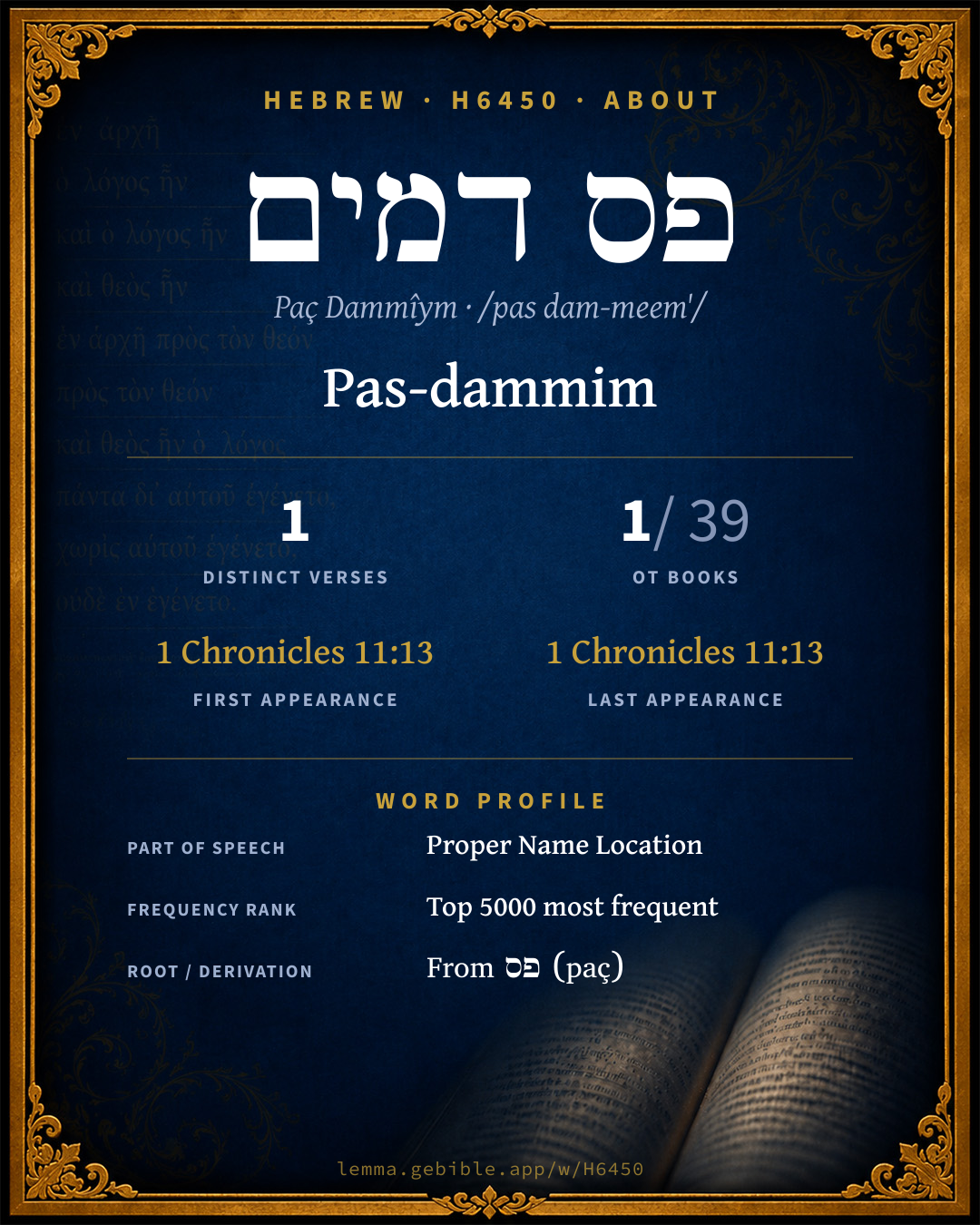
פַּס דַּמִּים
Pas-dammim
BDB lists 2 entries for ‘Pas-dammim’ fuller range ↓
Full lexicon entry — Brown-Driver-Briggs (BDB)
From Brown-Driver-Briggs (BDB)
Where this word appears
Grammar key — what these labels mean
Part of speech
- Noun
- A naming word — a person, place, thing, or idea.
Noun type
- Proper
- A name of a specific person, place, or people (e.g. Abraham, Zion, Israel).
Every verse where H6450 appears — 1 distinct verse across 1 book. Click any verse to open its interlinear word-by-word view. Verse text shown in the World English Bible for context — . Each verse’s Hebrew form is shown with its reference; the English is not keyword-highlighted, since the data carries no word-level English alignment. Use “Compare translations” on any verse to read it across multiple English versions. This concordance covers the Hebrew Bible; Septuagint (Greek Old Testament) occurrences are not indexed here.
1 Chronicles 1 verse
About this entry
At a glance — auto-summarized from this page’s data, not written by a person. Every figure links to its source below. This summary describes the numbers; it doesn’t interpret them.
“Pas-dammim” is the headline sense of the Hebrew name פס דמים (Paç Dammîym). A scarce word — 1 verse in all of the Hebrew Bible. More than three-quarters of its appearances fall in 1 Chronicles. Scripture uses it exactly once, at 1 Chronicles 11:13. The sections below give every occurrence and version rendering.
Gloss history
Strong's 1890 vs modern scholarship
About this word
Strong's H6450 catalogs a Hebrew word from the Hebrew Old Testament.
These counts are not copied from any lexicon or concordance. They are computed here, from the morphology-tagged Hebrew Old Testament. What Lemma adds →
- 1
- distinct verses
- The word appears in 1 distinct verse.
- 1 / 39
- OT books
- The word appears in 1 of 39 Old Testament books.
- #4,807
- by frequency
- Top 5000 most frequent Hebrew words (rank 4,807 of 8,640 Hebrew words by occurrence).
View all 1 occurrence in the concordance →
Most concentrated in
- 1 Chronicles 1 verse 100%
By section of the Old Testament
By traditional corpus
Conventional, traditional groupings — biblical authorship is debated, so this is a traditional corpus grouping, not an authorship claim. Each share is this word’s portion of its verses in that division of the Hebrew canon. Each figure is a share of the word’s 1 distinct verse.
- Writings (Ketuvim) 1 verse · 100%
How translations render this word
Counts come from each version’s own published word-to-Strong’s tagging or interlinear alignment — an approximate guide to how each version renders this word, not a word-level alignment the data otherwise carries. Because each total is that version’s own tagged count, the per-version totals vary from one another and need not match the appearance or distinct-verse counts above. These counts may also differ from a printed concordance because Lemma counts each distinctly tagged rendering and does not collapse phrase taggings into a single head-word total. This is a fixed set of word-tagged versions (KJV, ASV, BSB, ULT) and does not change with the reading translation you choose elsewhere. Each version’s license is shown beside its name below (and on Sources).
- King James Version: Pasdammim 1×
- American Standard Version: Pasdammim 1×
- Berean Standard Bible: Pas-dammim 1×
- unfoldingWord Literal Text: Dammim 1×, Pas 1×
King James Version Public Domain
Renders H6450 across 1 tagged occurrence — most commonly:
American Standard Version Public Domain
Renders H6450 across 1 tagged occurrence — most commonly:
Berean Standard Bible Public Domain
Renders H6450 across 1 tagged occurrence — most commonly:
unfoldingWord Literal Text CC BY-SA 4.0
Renders H6450 across 2 tagged occurrences — most commonly:
Senses in BDB
The 2 senses BDB distinguishes for this word, in lexicon order (not ranked by frequency or importance). The full entry — with sub-senses — is in the Lexicon Entry tab.
- Pas-dammim = "boundary of blood"
- a place in western Judah
Word origin
אֶ֫פֶס דַּמִּים n.pr.loc. in Judah, c. 16 miles SW. of Jerusalem, called in 1 Ch 11:13 פַּס דַּמִּים, only 1 S 17:1.
— Brown-Driver-Briggs (Oxford 1906, public domain), digitized via Sefaria, supplemented by the OpenScriptures HebrewLexicon (CC BY 4.0). See Sources.
Derived from פס (paç) (H6446) — palm.
Jastrow Dictionary
A second Hebrew/Aramaic lexicon for comparison, covering Aramaic and post-biblical (Talmudic, Targumic, Midrashic) usage that the biblical-Hebrew BDB does not. Matched by lemma rather than by Strong’s number, so a lemma may carry more than one Jastrow headword (shown separately below), and the entries cover usage well beyond the Bible.
דָּם
- , constr. דַּם (b. h.; דום or דמם, cmp. דבב) liquid; blood; life. Men. 44ᵃ בדָמוֹ (not בדמה, v. Rabb. D. S. a. l. note) with the juice of the purple shell.—Sabb. 31ᵇ רביעית ד׳ וכ׳ one fourth of a Log of blood did I (the Lord) put in your body (the smallest quantity required to sustain life, v. Sot. 5ᵃ). Snh. 72ᵇ (ref. to Gen. IX, 6) הצל דָּמוֹ וכ׳ save the life of the one (who is pursued) at the expense of the life of the other (the pursuer).—דַּם ברית = ד׳ של מילה the blood lost at circumcision. Tosef. Sabb. XV (XVI), 9 צריך להטיף … ד׳ ב׳ he must cause the blood of the covenant to flow from him (even if born without preputium). Ib. 8; a. fr.—Pes. 16ᵇ ד׳ שהנפש וכ׳ the blood with which life escapes when cutting the animal’s throat is called a fluid (with regard to levitical purity, v. כָּשַׁר); a. v. fr.—Pl. דָּמִים. Keth. 9ᵇ טענת ד׳ complaint of absence of the token of virginity.—שְׁפִיכוּת ד׳ (abbr. ש"ד) murder. Yoma 67ᵇ; a. fr.—Midd. III, 1, a. e. ד׳ העליונים blood sprinkled against the upper part of the altar, opp. ד׳ התחתונים.—Snh. VIII, 6, a. fr. (with ref. to Ex. XXII, 1) יש לו ד׳ his blood is revenged, אין לו ד׳ may be killed with impunity. Ib. 72ᵃ בד׳ קננהו he acquired possession of them by risking his life.—[דָּמִים equivalent, v. דָּמִים.) e.g. Genesis 9:6
דָּמִים
- , constr. דְּמֵי (דמה) equivalent, compensation; (cmp. שָׁוָה) price, value; payment. Pes. 112ᵇ do not bargain בשעה שאין לך ד׳ when thou hast no money to pay with. Kerith. 13ᵇ ד׳ וערכין the assessment of an object to be redeemed or of an object the value of which was dedicated, v. עֶרֶךְ.—Pes. 32ᵃ לפי מידה … או לפי ד׳ וכ׳ must he pay the fine according to quantity or according to value?—Kidd. I, 6 כל הנעשה ד׳ באחר whatever is used as payment for another object; expl. ib. 28ᵃ כל הנישום ד׳ וכ׳ whatever is assessed as an equivalent, i.e. an exchange is meant and not a sale for cash. Ib. 28ᵇ החליף דמי שור בפרה if he gives a cow in payment of money which he owes for an ox; a. fr.—Keth. 103ᵇ נהוג נשיאותך בד׳ Ar. conduct thy office of Nasi as something valuable (Var. in Ar., a. ed. ברָמִים).
פָּס
- = אָפֵס, Pas, name of two Amoraim. Y. Taan. IV, 68ᵃ. Y. Yoma V, 43ᵃ bot.—Y. Kidd. III, 64ᵃ bot. (v. Fr. M’bo, p. 122ᵃ).
פַּס I
- , v. פְּסַס
פַּס II
- 1. strip, stripe.—Pl. פַּסִּים, פַּסִּין. Gen. R. s. 84 (ref. to Gen. XXXVII, 3 sq., a. Ps. LXVI, 5 sq.; v. עֲלִּילָה) why ‘did they hate him’? That (in the course of events it should come about that) שיקרע הים לפניהם פ׳ פ׳ the sea be rent before them in strips (ed. Wil. פ̇ס̇י̇ם̇ פס ים passim alludes to ‘strip of the sea’).—Esp. (cmp. פֶּרֶק) פס יד, palm, the hand from the wrist to the tip of the finger; פס רגל the foot to the ankle, interch. with פִּסַּת, פִּיסַּת (constr. of פִּסָּה). Ib. (expl. פסים, Gen. l. c.) שהיתה מגעת עד פס ידו the coat reached with its sleeves to his wrist; שהיתה … בפס ידו it was very fine and light, and could be (compressed and) hidden in his hand (cmp. מַלְמֵלָה). Meg. IV, 8 (24ᵇ) נתנה … על פס ידו וכ׳ if he placed the T’fillin on his forehead or on his palm. Yoma 87ᵃ (play on ה̇ת̇ר̇פ̇ס̇, Prov. VI, 3) [read:] אם ממון יש לו בידך ה̇ת̇ר לו פ̇ס̇ת יד וכ׳ if thou owest him (whom thou hast wronged) money, untie thy hand to him (pay him), if not (if thou hast otherwise wronged him), get several friends around him (to ask his pardon in their presence); B. Mets. 115ᵃ; B. Bath. 173ᵇ; Yalk. Prov. 938. Gen. R. s. 78 (play on מ̇ת̇ר̇פ̇ס בר̇צ̇י, Ps. LXIV, 31) מ̇ת̇יר̇ את הפ̇ס̇ ומ̇ת̇ר̇צ̇ה בכסף he (Edom-Rome) opens his hand (for bribery), and is appeased with silver; Ex. R. s. 35 מתרת את הפס וכ׳ she (Rome) opens &c.; Yalk. Ps. 800 שפושטין פסת יד … ואין עושין ר̇צ̇ון וכ׳ they stretch forth their hand to accept silver, and then do not what the givers desire; Pes. 118ᵇ שפושטין פסת יד וכ׳ Ms. M. (ed. שפושטין יד). Yoma 47ᵃ על פ׳ ידו up to his wrist, v. חָפָה; Sifra Vayikra, N’dab., ch. X, Par. 9 חופה את פס ידו וכ׳ he bends his hand (grabbing) in the pan &c. Ohol. I, 8 שלשים בפס הרגל thirty joints in the foot. Yalk. Sam. 143 חלילה … פ׳ יד ופ׳ רגל ועקב מגולין never were their wrists or their feet or their heels seen uncovered; Midr. Sam. ch. XXV (corr. acc.); a. fr. e.g. Genesis 37:3
- 2. partition, board, barrier. Erub. 5ᵃ אם יש שם פם ארבעה if a bar of four handbreadths is left or placed above the breach. Ib. 10ᵇ עושה פם גבוה עשרה וכ׳ he cuts a board ten handbreadths high and four cubits long &c.; a. fr.—Pl. as ab. Ib. II, 1 עושין פ׳ לביראות וכ׳ you must place partitions around watering stations in the shape of four cornerpieces &c., v. דְּיוֹמַד. Ib. 11ᵃ פַּסֵּי ביראות the partitions of watering stations; a. fr.—[Maasr. I, 7, v. פַּץ.]
- 3. pl. (v. ) tax; פַּסֵּי העיר town tax (used for maintaining the safety of the town). Tosef. Peah IV, 9 לפ׳ העיר לשנים וכ׳ ed. Zuck. (ed. לעניי, corr. acc.) in order to be assessed for the town tax one must have been a resident for twelve months; B. Bath. 8ᵃ; Y. Peah VIII, 21ᵃ bot. לפסין ולצדקות for the town tax and for the charities, expl. for the salaries of public school teachers; Y. B. Bath. I, beg. 12ᵈ לפסים ולזימיות for town tax and town fines.
פַּס
- 1. strip, stripe.—Pl. פַּסֵּי. Targ. O. Gen. XXXVII, 3; 23 (ed. Berl. פָּסֵי, פַּסֵי). Targ. II Sam. XIII, 18 (ed. Wil. פַּסֵי).
- 2. פ׳ ידא palm; פס רגלא foot, v. פִּיסְּתָא.
- 3. piece, portion; bread. Bekh. 43ᵇ, v. סְקִיפַס. Lam. R. to III, 16 Ar., v. פְּטִילִיק.—Y. Ber. VI, 10ᵇ bot., v. פִּיסְּתָא.
- 4. (from its shape, cmp. כַּף) spade or shovel. Lev. R. s. 24; s. 25 Ar., v. מַכּוֹשָׁא II.—
- *5. פ׳ דביר (v. preced.) watering station. Targ. Y. I Deut. XXXIII, 3 ושריין כמין פ׳ דב׳ (not דבַר) and they rest as it were at a watering station; (Y. II על פום דבירוי).
A Dictionary of the Targumim, the Talmud Babli and Yerushalmi, and the Midrashic Literature (Marcus Jastrow; London, Luzac, 1903) — Public Domain. Digitized via Sefaria. Digitized via Sefaria. Full attribution on Sources.
Forms in the corpus
The 2 distinct written forms H6450 takes in the Hebrew Bible, most frequent first — each parse links to that state’s occurrences in the concordance. Hebrew forms include their vowel points and cantillation, so a single lemma takes many written forms.
| Form | Parsing | Example | Uses |
|---|---|---|---|
| בַּ/פַּ֣ס | Noun, Proper | 1 Chronicles 11:13 | 1 |
| דַּמִּ֗ים | Noun, Proper | 1 Chronicles 11:13 | 1 |
Bible dictionary
Public-domain dictionary articles matched to this entry by name (Pas-dammim). A biblical name can be shared by more than one person or place, so an article may treat several.
Easton's Bible Dictionary · M. G. Easton, 1897
The border of blood = Ephes-dammim (q.v.), between Shochoh and Azekah (1 Sam. 17:1; 1 Chr. 11:13).
Smith's Bible Dictionary · William Smith, 1863
(boundary of blood). [EPHES-DAMMIM]
Classic public-domain reference works; full attribution on Sources.
Septuagint verse parallels
This word appears in 1 verse that also exists in the Greek Old Testament (Septuagint), out of the 1 Hebrew verse it occurs in. You can read those verses in Greek by switching the Old Testament edition to the Septuagint.
Read these verses in the Septuagint
This is a verse-level parallel only — the same verses exist in both the Hebrew and Greek Old Testaments. No word-level Hebrew↔Greek correspondence is claimed: the data carries no such alignment, so no Greek word is shown as this Hebrew word’s translation. Coverage is not total — the Septuagint omits the deuterocanon and renumbers the Psalms, so some Hebrew verses have no direct Greek parallel.