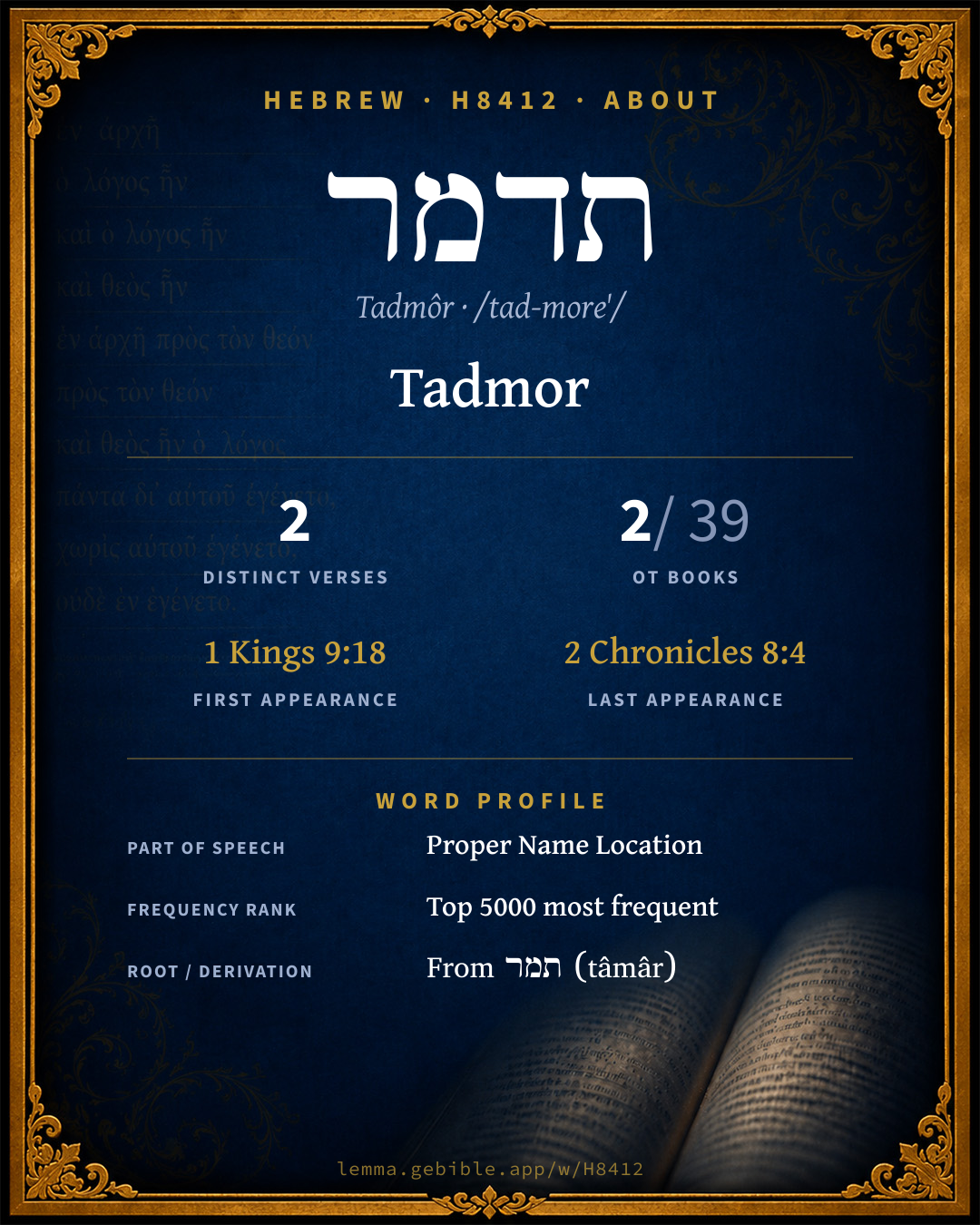
תַּדְמֹר
Tadmor
BDB lists 2 entries for ‘Tadmor’ fuller range ↓
Full lexicon entry — Brown-Driver-Briggs (BDB)
From Brown-Driver-Briggs (BDB)
Where this word appears
Grammar key — what these labels mean
Part of speech
- Noun
- A naming word — a person, place, thing, or idea.
Noun type
- Proper
- A name of a specific person, place, or people (e.g. Abraham, Zion, Israel).
Every verse where H8412 appears — 2 distinct verses across 2 books. Click any verse to open its interlinear word-by-word view. Verse text shown in the World English Bible for context — . Each verse’s Hebrew form is shown with its reference; the English is not keyword-highlighted, since the data carries no word-level English alignment. Use “Compare translations” on any verse to read it across multiple English versions. This concordance covers the Hebrew Bible; Septuagint (Greek Old Testament) occurrences are not indexed here.
1 Kings 1 verse
2 Chronicles 1 verse
About this entry
At a glance — auto-summarized from this page’s data, not written by a person. Every figure links to its source below. This summary describes the numbers; it doesn’t interpret them.
תדמר (Tadmôr) is a Hebrew name most often rendered “Tadmor.” The Hebrew Bible uses it only 2 verses. It clusters heavily in 1 Kings, which alone accounts for 50% of its uses. Scripture first uses it in 1 Kings 9:18. For the data behind this summary, explore 2-verse concordance and the renderings breakdown below.
Gloss history
Strong's 1890 vs modern scholarship
About this word
Strong's H8412 catalogs a Hebrew word from the Hebrew Old Testament.
These counts are not copied from any lexicon or concordance. They are computed here, from the morphology-tagged Hebrew Old Testament. What Lemma adds →
- 2
- distinct verses
- The word appears in 2 distinct verses.
- 2 / 39
- OT books
- The word appears in 2 of 39 Old Testament books.
- #4,807
- by frequency
- Top 5000 most frequent Hebrew words (rank 4,807 of 8,640 Hebrew words by occurrence).
View all 2 occurrences in the concordance →
Most concentrated in
- 1 Kings 1 verse 50%
- 2 Chronicles 1 verse 50%
By section of the Old Testament
By traditional corpus
Conventional, traditional groupings — biblical authorship is debated, so this is a traditional corpus grouping, not an authorship claim. Each share is this word’s portion of its verses in that division of the Hebrew canon. Each figure is a share of the word’s 2 distinct verses.
- Prophets (Nevi'im) 1 verse · 50%
- Writings (Ketuvim) 1 verse · 50%
How translations render this word
Counts come from each version’s own published word-to-Strong’s tagging or interlinear alignment — an approximate guide to how each version renders this word, not a word-level alignment the data otherwise carries. Because each total is that version’s own tagged count, the per-version totals vary from one another and need not match the appearance or distinct-verse counts above. These counts may also differ from a printed concordance because Lemma counts each distinctly tagged rendering and does not collapse phrase taggings into a single head-word total. This is a fixed set of word-tagged versions (KJV, ASV, BSB, ULT) and does not change with the reading translation you choose elsewhere. Each version’s license is shown beside its name below (and on Sources).
- King James Version: Tadmor 2×
- American Standard Version: Tadmor 1×, Tamar 1×
- Berean Standard Bible: Tadmor 1×
- unfoldingWord Literal Text: Tadmor 2×
King James Version Public Domain
Renders H8412 across 2 tagged occurrences — most commonly:
American Standard Version Public Domain
Renders H8412 across 2 tagged occurrences — most commonly:
Berean Standard Bible Public Domain
Renders H8412 across 1 tagged occurrence — most commonly:
unfoldingWord Literal Text CC BY-SA 4.0
Renders H8412 across 2 tagged occurrences — most commonly:
Senses in BDB
The 2 senses BDB distinguishes for this word, in lexicon order (not ranked by frequency or importance). The full entry — with sub-senses — is in the Lexicon Entry tab.
- Tadmor = "palm tree"
- a city built by Solomon after his conquest of Hamath-zobah
Word origin
n.pr.loc. built by Solomon, according to 1 K 9:18 Qr = 2 Ch 8:8; Tadmor = Palmyra (RSEncy. Brit. (9) Palmyra Mommsen Röm. Gesch. v. 423, cf. LagBN 125); but read in both places תָּמָר Th RSl.c. Mommsen l.c. Kmp Benz Kit Bur ReckendZMG xiii (1888), 402 Lagl.c. GASmGeogr. 270, N. 2; 580, N. 2; v. II. תָּמָר.
— Brown-Driver-Briggs (Oxford 1906, public domain), digitized via Sefaria, supplemented by the OpenScriptures HebrewLexicon (CC BY 4.0). See Sources.
Derived from תמר (tâmâr) (H8558) — palm tree.
Forms in the corpus
The 2 distinct written forms H8412 takes in the Hebrew Bible, most frequent first — each parse links to that state’s occurrences in the concordance. Hebrew forms include their vowel points and cantillation, so a single lemma takes many written forms.
| Form | Parsing | Example | Uses |
|---|---|---|---|
| תַּדְמֹ֖ר | Noun, Proper | 2 Chronicles 8:4 | 1 |
| תַּדְמֹ֥ר | Noun, Proper | 1 Kings 9:18 | 1 |
Same root — word family
Other BDB entries built from the same root as H8412, grouped by Strong’s listed origin. These share a root / origin per the lexicon — not necessarily a shared meaning. Each links to that word’s own entry.
Derives from
Shares the same root
- תימרה tîymârâh H8490 pillar
- תמר tômer H8560 palm column
- תמר timmôr H8561 palm ornament
- תמרור tamrûwr H8564 guideposts
Proper names from this root
People and places named from this root — a name, not an additional meaning of the word.
Compare all same-root words → Showing 4 of 7 — not the complete family. 1 of the same-root words is a proper name (a person or place). They share a root, not necessarily a meaning.
Bible dictionary
Public-domain dictionary articles matched to this entry by name (Tadmor). A biblical name can be shared by more than one person or place, so an article may treat several.
Easton's Bible Dictionary · M. G. Easton, 1897
Palm, a city built by Solomon "in the wilderness" (2 Chr. 8:4). In 1 Kings 9:18, where the word occurs in the Authorized Version, the Hebrew text and the Revised Version read "Tamar," which is properly a city on the southern border of Palestine and toward the wilderness (comp. Ezek. 47:19; 48:28). In 2 Chr. 8:14 Tadmor is mentioned in connection with Hamath-zobah. It is called Palmyra by the Greeks and Romans. It stood in the great Syrian wilderness, 176 miles from Damascus and 130 from the Mediterranean and was the centre of a vast commercial traffic with Western Asia. It was also an important military station. (See SOLOMON.) "Remains of ancient temples and palaces, surrounded by splendid colonnades of white marble, many of which are yet standing, and thousands of prostrate pillars, scattered over a large extent of space, attest the ancient magnificence of this city of palms, surpassing that of the renowned cities of Greece and Rome."
Smith's Bible Dictionary · William Smith, 1863
(city of palms), called "Tadmor in the wilderness," is the same as the city known to the Greeks and Romans under the name of Palmyra. It lay between the Euphrates and Hamath, to the southeast of that city, in a fertile tract or oasis of the desert. Being situated at a convenient distance from both the Mediterranean Sea and the Persian Gulf, it had great advantages for caravan traffic. It was built by Solomon after his conquest of Hamath-zobah. (1 Kings 9:18; 2 Chronicles 8:4) As the city is-nowhere else mentioned in the Bible, it would be out of place to enter into a detailed history of it. In the second century A.D. it seems to have been beautified by the emperor Hadrian. In the beginning of the third century--211-217 A.D.-- it became a Roman colony under Caracalla. Subsequently, in the reign of Gallienus, the Roman senate invested Odenathus, a senator of Palmyra, with the regal dignity, on account of his services in defeating Sapor, king of Persia. On the assassination of Odenathus, his wife, Zenobia, seems to have conceived the design of erecting Palmyra into an independent monarchy; and in prosecution of this object, she for a while successfully resisted the Roman arms. She was at length defeated and taken captive by the emperor Aurelian, A.D. 273, who left a Roman garrison in Palmyra. This garrison was massacred in a revolt; and Aurelian punished the city by the execution not only of those who were taken in arms, but likewise of common peasants, of old men, women and children. From this blow Palmyra never recovered, though there are proofs of its having continued to be inhabited until the downfall of the Roman empire. The grandeur and magnificence of the ruins of Palmyra cannot be exceeded, and attest its former greatness. Among the most remarkable are the Tombs, the Temple of the Sun and the Street of Columns.
Hitchcock's Bible Names Dictionary · Roswell D. Hitchcock, 1869
the palm-tree; bitterness
Classic public-domain reference works; full attribution on Sources.
Septuagint verse parallels
This word appears in 1 verse that also exists in the Greek Old Testament (Septuagint), out of the 2 Hebrew verses it occurs in. You can read those verses in Greek by switching the Old Testament edition to the Septuagint.
Read these verses in the Septuagint
This is a verse-level parallel only — the same verses exist in both the Hebrew and Greek Old Testaments. No word-level Hebrew↔Greek correspondence is claimed: the data carries no such alignment, so no Greek word is shown as this Hebrew word’s translation. Coverage is not total — the Septuagint omits the deuterocanon and renumbers the Psalms, so some Hebrew verses have no direct Greek parallel.