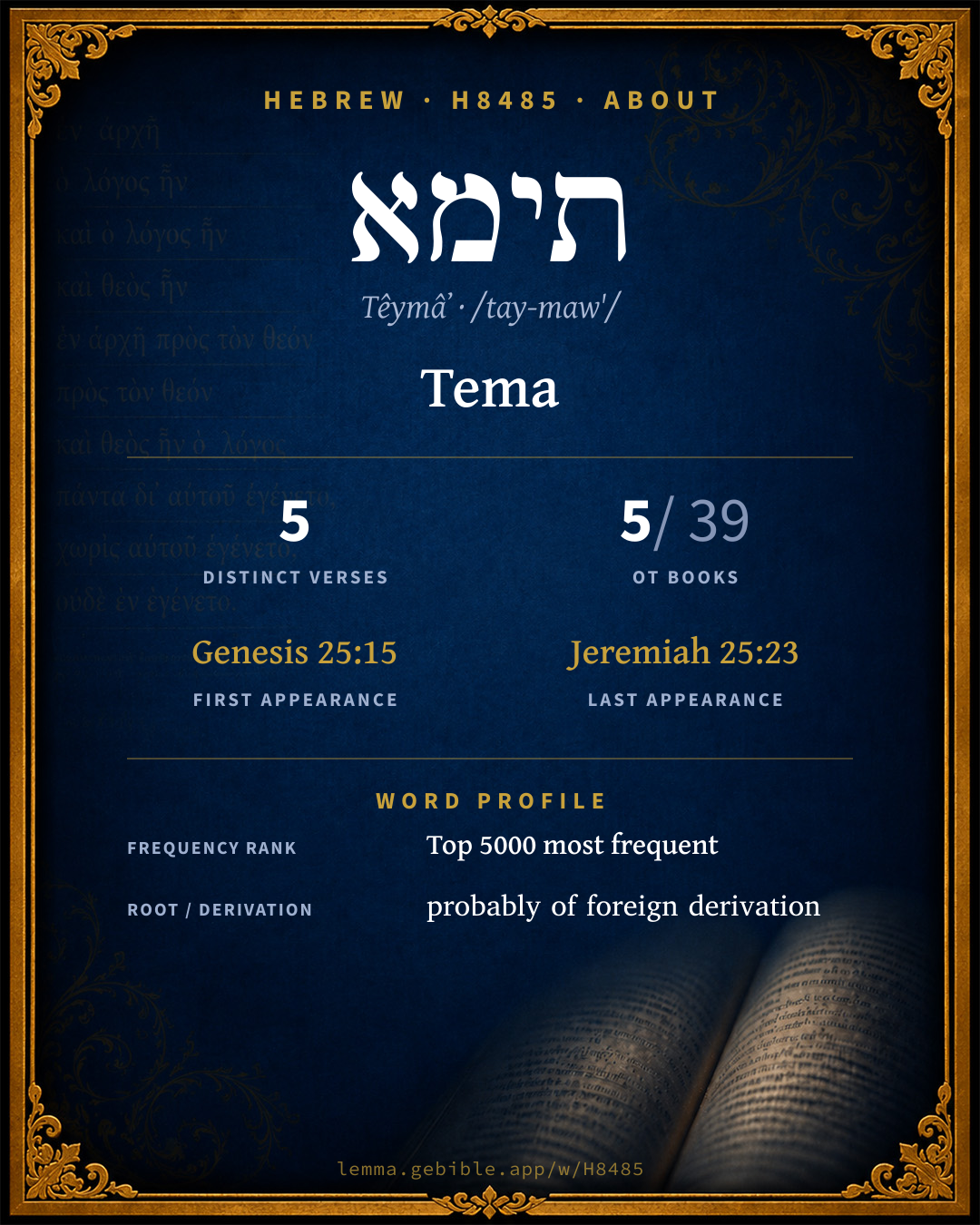
תֵּימָא
Tema
BDB lists 3 entries for ‘Tema’ fuller range ↓
Full lexicon entry — Brown-Driver-Briggs (BDB)
From Brown-Driver-Briggs (BDB)
Where this word appears
Grammar key — what these labels mean
Part of speech
- Noun
- A naming word — a person, place, thing, or idea.
Noun type
- Proper
- A name of a specific person, place, or people (e.g. Abraham, Zion, Israel).
Every verse where H8485 appears in the Book of Isaiah — 1 distinct verse. Click any verse to open its interlinear word-by-word view. Verse text shown in the World English Bible for context — . Each verse’s Hebrew form is shown with its reference; the English is not keyword-highlighted, since the data carries no word-level English alignment. Use “Compare translations” on any verse to read it across multiple English versions. This concordance covers the Hebrew Bible; Septuagint (Greek Old Testament) occurrences are not indexed here.
Isaiah
About this entry
At a glance — auto-summarized from this page’s data, not written by a person. Every figure links to its source below. This summary describes the numbers; it doesn’t interpret them.
תימא — transliterated Têymâʼ — is a Hebrew name carrying the sense “Tema.” With only 5 verses it sits in the long tail of Hebrew Bible vocabulary. It first appears in Genesis 25:15. See 5-verse concordance and the renderings breakdown below.
Gloss history
Strong's 1890 vs modern scholarship
About this word
Strong's H8485 catalogs a Hebrew word from the Hebrew Old Testament.
These counts are not copied from any lexicon or concordance. They are computed here, from the morphology-tagged Hebrew Old Testament. What Lemma adds →
- 5
- distinct verses
- The word appears in 5 distinct verses.
- 5 / 39
- OT books
- The word appears in 5 of 39 Old Testament books.
- #3,337
- by frequency
- Top 5000 most frequent Hebrew words (rank 3,337 of 8,640 Hebrew words by occurrence).
View all 5 occurrences in the concordance →
Most concentrated in
- Genesis 1 verse 20%
- 1 Chronicles 1 verse 20%
- Job 1 verse 20%
By section of the Old Testament
By traditional corpus
Conventional, traditional groupings — biblical authorship is debated, so this is a traditional corpus grouping, not an authorship claim. Each share is this word’s portion of its verses in that division of the Hebrew canon. Each figure is a share of the word’s 5 distinct verses.
- Prophets (Nevi'im) 2 verses · 40%
- Writings (Ketuvim) 2 verses · 40%
- Torah (Pentateuch) 1 verse · 20%
How translations render this word
Counts come from each version’s own published word-to-Strong’s tagging or interlinear alignment — an approximate guide to how each version renders this word, not a word-level alignment the data otherwise carries. Because each total is that version’s own tagged count, the per-version totals vary from one another and need not match the appearance or distinct-verse counts above. These counts may also differ from a printed concordance because Lemma counts each distinctly tagged rendering and does not collapse phrase taggings into a single head-word total. This is a fixed set of word-tagged versions (KJV, ASV, BSB, ULT) and does not change with the reading translation you choose elsewhere. Each version’s license is shown beside its name below (and on Sources).
- King James Version: Tema 5×
- American Standard Version: Tema 5×
- Berean Standard Bible: Tema 5×
- unfoldingWord Literal Text: Tema 5×
King James Version Public Domain
Renders H8485 across 5 tagged occurrences — most commonly:
American Standard Version Public Domain
Renders H8485 across 5 tagged occurrences — most commonly:
Berean Standard Bible Public Domain
Renders H8485 across 5 tagged occurrences — most commonly:
unfoldingWord Literal Text CC BY-SA 4.0
Renders H8485 across 5 tagged occurrences — most commonly:
Senses in BDB
The 3 senses BDB distinguishes for this word, in lexicon order (not ranked by frequency or importance). The full entry — with sub-senses — is in the Lexicon Entry tab.
- Tema = "desert"
- the 9th son of Ishmael (noun proper masculine)
- the land settled by Tema the son of Ishmael (noun proper locative)
Word origin
n.pr.terr. et gent. (O Aramaic תימא Lzb 385; in Assyrian Têma DlPa 301 f. Schr KGF 261 ff.; = south country, √ ימא (cf. II. תֵּימָן according to NöEncy. Bib. ishmael);—ישְׁבֵי אֶרֶץ ת׳ Is 21:14, people Je 25:23; ת׳ ‘son’ of Ishmael Gn 25:15 ‖ 1 Ch 1:30; אָרְחוֹת תֵּמָא (l.אֹרְ׳) Jb 6:19; Θαιμαν. Mod. Teyma, NW. Arabia, DoughtyArab. Des. i, pass., especially 284–299 WilsonHast. DB tema, and on inscr. found there EutNab. Inschr. 35 CIS ii, No. 113.114 NöSBAk 1884, 813 f. HalRÉJ xii, 111 ff. Cooke 195 ff.
— Brown-Driver-Briggs (Oxford 1906, public domain), digitized via Sefaria, supplemented by the OpenScriptures HebrewLexicon (CC BY 4.0). See Sources.
Origin: probably of foreign derivation
Jastrow Dictionary
A second Hebrew/Aramaic lexicon for comparison, covering Aramaic and post-biblical (Talmudic, Targumic, Midrashic) usage that the biblical-Hebrew BDB does not. Matched by lemma rather than by Strong’s number, so a lemma may carry more than one Jastrow headword (shown separately below), and the entries cover usage well beyond the Bible.
אֲמָא II
- , fut. יֵימָא, imper. אֵימָא (√אם to join, v. אמר) to say, speak, think. Targ. Y. Gen. XXXIII, 10.—Freq. in Talmud.—אפילו תימא even if you will say, i.e. it may come right even if you assume that &c. Succ. 13ᵇ; a. fr.—מי לֵימָא, (מי)נֵימָא, or לימא must it be said, does it mean to say? Ib.; a. fr.—(ואי) וכי תימא and if you should object. Ib.; a. fr.—אלא אימא but rather say, i.e. the correct version is. Ib.; a. fr.—אימא סיפא now read the second clause, i.e. how will you understand &c.? Ber. 21ᵇ; a. fr.—אֵימָא I might think. Ib.; a. fr.—הוה אמינא I might have thought, I might have been led to believe. Erub. 74ᵇ מאי הוה א׳ what might I have been led to believe?; a. fr.—נימא כוותיה let him express his opinion in agreement with his authority, i.e. why does he not say so expressly? Taan. 3ᵃ; a. fr.—Pes. 7ᵇ היכי נימא what else should he say? נימא למול should he use the expression lamol?—Gitt. 47ᵇ, a. fr. ס"ד אמינא it may occur to you to think; v. דַּעְתָּא. Yoma 85ᵇ אי הואי התם הוה אמינא had I been there, I should have said.—קאמינא = קא אמינא I say, speak of, v. קָא. Gitt. 47ᵇ; a. fr.
תִּימָא
- Tima, an Amora. Y. Snh. IV, 22ᵇ ת׳ בר פפייס.
תֵּימָא
- tema, name of a bird. Ḥull. 141ᵇ תימת (Ms. M. תימא; Mus. תֵּמָה; Ar. תֵּמָא).
A Dictionary of the Targumim, the Talmud Babli and Yerushalmi, and the Midrashic Literature (Marcus Jastrow; London, Luzac, 1903) — Public Domain. Digitized via Sefaria. Digitized via Sefaria. Full attribution on Sources.
Forms in the corpus
The 5 distinct written forms H8485 takes in the Hebrew Bible, most frequent first — each parse links to that state’s occurrences in the concordance. Hebrew forms include their vowel points and cantillation, so a single lemma takes many written forms.
| Form | Parsing | Example | Uses |
|---|---|---|---|
| וְ/תֵימָ֔א | Noun, Proper | Genesis 25:15 | 1 |
| וְ/תֵימָֽא | Noun, Proper | 1 Chronicles 1:30 | 1 |
| תֵּימָ֔א | Noun, Proper | Isaiah 21:14 | 1 |
| תֵּימָא֙ | Noun, Proper | Jeremiah 25:23 | 1 |
| תֵּמָ֑א | Noun, Proper | Job 6:19 | 1 |
Bible dictionary
Public-domain dictionary articles matched to this entry by name (Tema). A biblical name can be shared by more than one person or place, so an article may treat several.
Easton's Bible Dictionary · M. G. Easton, 1897
South; desert, one of the sons of Ishmael, and father of a tribe so called (Gen. 25:15; 1 Chr. 1:30; Job 6:19; Isa. 21:14; Jer. 25:23) which settled at a place to which he gave his name, some 250 miles south-east of Edom, on the route between Damascus and Mecca, in the northern part of the Arabian peninsula, toward the Syrian desert; the modern Teyma'.
Smith's Bible Dictionary · William Smith, 1863
(a desert), the ninth son of Ishmael, (Genesis 25:15; 1 Chronicles 1:30) whence the tribe called after him, mentioned in (Job 6:19; Jeremiah 25:23) and also the land occupied by this tribe. (Isaiah 21:13,14) (B.C. after 1850.) The name is identified with Teyma, a small town on the confines of Syria.
Hitchcock's Bible Names Dictionary · Roswell D. Hitchcock, 1869
admiration; perfection; consummation
Classic public-domain reference works; full attribution on Sources.
Septuagint verse parallels
This word appears in 4 verses that also exist in the Greek Old Testament (Septuagint), out of the 5 Hebrew verses it occurs in. You can read those verses in Greek by switching the Old Testament edition to the Septuagint.
Read these verses in the Septuagint
This is a verse-level parallel only — the same verses exist in both the Hebrew and Greek Old Testaments. No word-level Hebrew↔Greek correspondence is claimed: the data carries no such alignment, so no Greek word is shown as this Hebrew word’s translation. Coverage is not total — the Septuagint omits the deuterocanon and renumbers the Psalms, so some Hebrew verses have no direct Greek parallel.