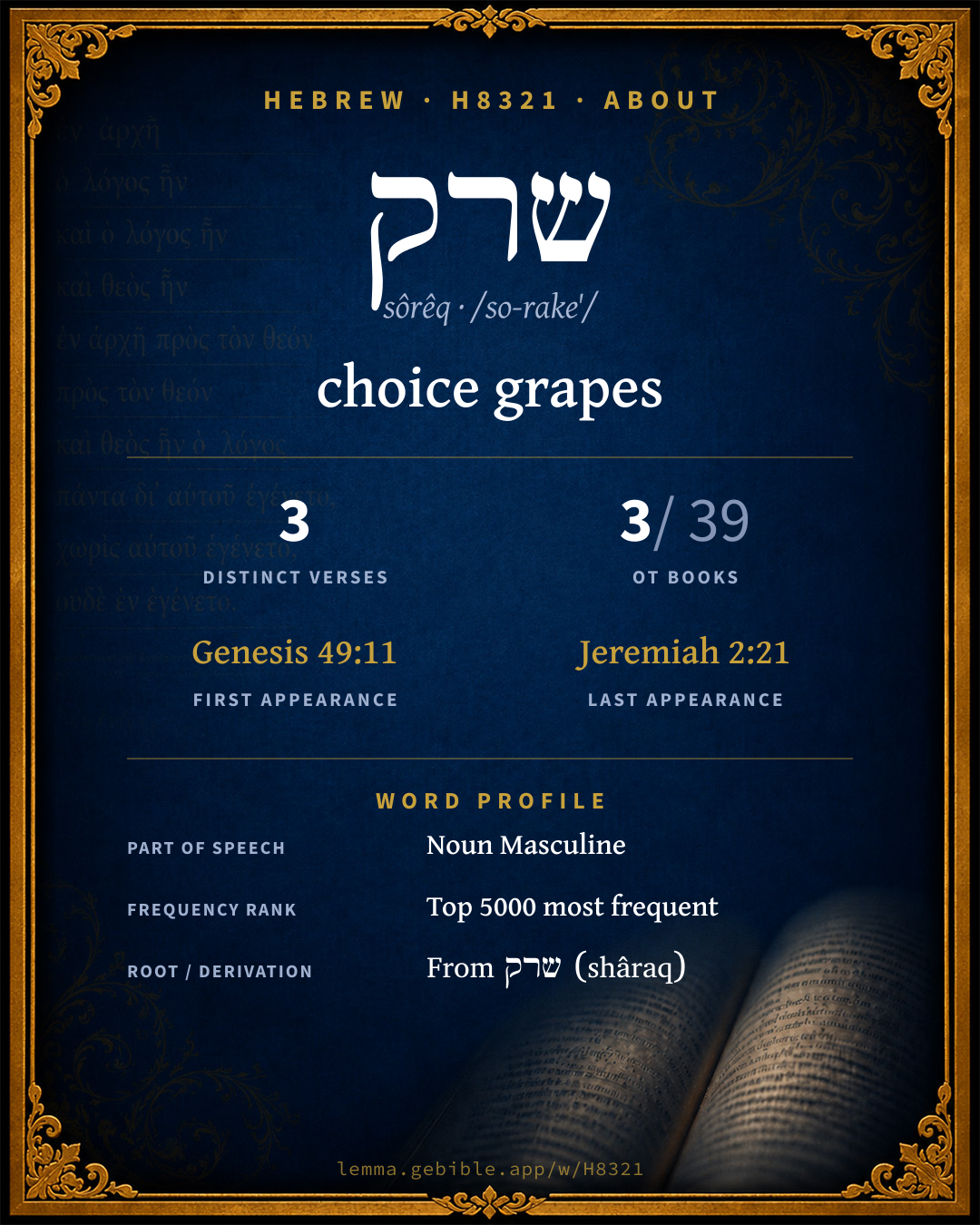
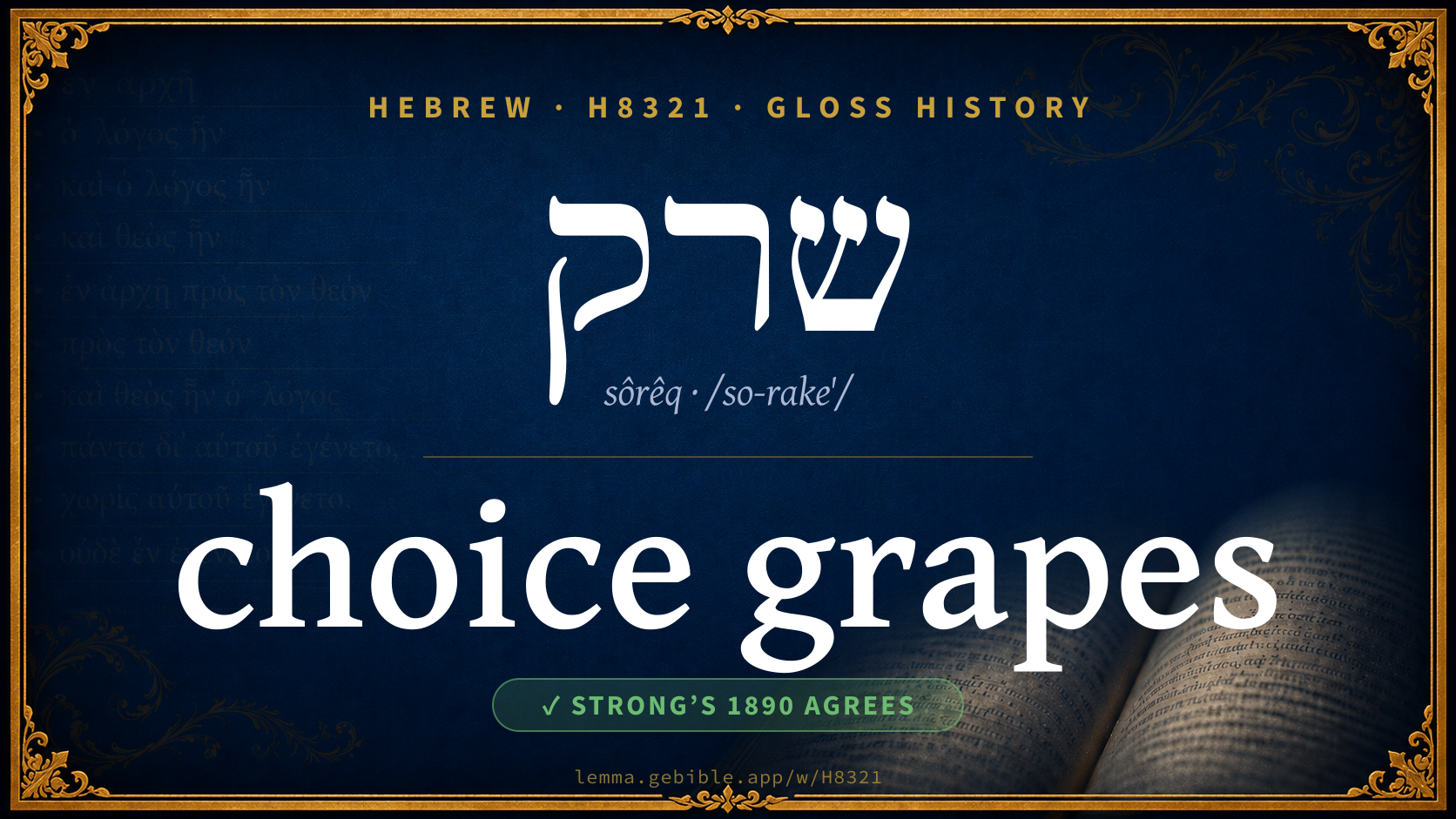
שֹׂרֵק
choice grapes
Full lexicon entry — Brown-Driver-Briggs (BDB)
From Brown-Driver-Briggs (BDB)
Where this word appears
Grammar key — what these labels mean
Part of speech
- Noun
- A naming word — a person, place, thing, or idea.
Noun type
- Common
- A common noun — a general class of person, place, or thing (“king,” “city,” “water”), not a specific name.
State
- Absolute
- The independent form of a noun, not bound to a following word.
Gender
- Masculine
- Grammatically masculine.
- Feminine
- Grammatically feminine.
Number
- Singular
- One.
Every verse where H8321 appears in the Book of Isaiah — 1 distinct verse. Click any verse to open its interlinear word-by-word view. Verse text shown in the World English Bible for context — . Each verse’s Hebrew form is shown with its reference; the English is not keyword-highlighted, since the data carries no word-level English alignment. Use “Compare translations” on any verse to read it across multiple English versions. This concordance covers the Hebrew Bible; Septuagint (Greek Old Testament) occurrences are not indexed here.
Isaiah
About this entry
At a glance — auto-summarized from this page’s data, not written by a person. Every figure links to its source below. This summary describes the numbers; it doesn’t interpret them.
The Hebrew noun שרק centers on the idea of “choice grapes.” A scarce word — 3 verses in all of the Hebrew Bible. Genesis dominates its distribution — 1 of 3 verses. Its earliest occurrence is Genesis 49:11. Sharing its root, it stands alongside שרק, משרוקי and שרוקה. For the data behind this summary, explore the sense tree and the renderings breakdown below.
Gloss history
Strong's 1890 vs modern scholarship
About this word
Strong's H8321 catalogs a Hebrew word from the Hebrew Old Testament.
These counts are not copied from any lexicon or concordance. They are computed here, from the morphology-tagged Hebrew Old Testament. What Lemma adds →
- 3
- distinct verses
- The word appears in 3 distinct verses.
- 3 / 39
- OT books
- The word appears in 3 of 39 Old Testament books.
- #4,179
- by frequency
- Top 5000 most frequent Hebrew words (rank 4,179 of 8,640 Hebrew words by occurrence).
View all 3 occurrences in the concordance →
By section of the Old Testament
By traditional corpus
Conventional, traditional groupings — biblical authorship is debated, so this is a traditional corpus grouping, not an authorship claim. Each share is this word’s portion of its verses in that division of the Hebrew canon. Each figure is a share of the word’s 3 distinct verses.
- Prophets (Nevi'im) 2 verses · 67%
- Torah (Pentateuch) 1 verse · 33%
How translations render this word
Counts come from each version’s own published word-to-Strong’s tagging or interlinear alignment — an approximate guide to how each version renders this word, not a word-level alignment the data otherwise carries. Because each total is that version’s own tagged count, the per-version totals vary from one another and need not match the appearance or distinct-verse counts above. These counts may also differ from a printed concordance because Lemma counts each distinctly tagged rendering and does not collapse phrase taggings into a single head-word total. This is a fixed set of word-tagged versions (KJV, ASV, BSB, ULT) and does not change with the reading translation you choose elsewhere. Each version’s license is shown beside its name below (and on Sources).
BDB lists this Strong’s number as 2 distinct words (homographs). Each count above pools all of them and is not split by sense — see the Senses section below. A low-frequency rendering may belong to a different one of those words, not the primary meaning.
- King James Version†: Choice vine 1×, Choicest vine 1×, Thee a noble vine 1×
- American Standard Version†: Choice vine 1×, Planted it with the choicest vine 1×, Thee a noble vine 1×
- Berean Standard Bible†: Choicest branch 1×, Finest vines 1×, Vine 1×
- unfoldingWord Literal Text†: Choice vine 2×
King James Version Public Domain
Renders H8321 across 3† tagged occurrences — most commonly:
American Standard Version Public Domain
Renders H8321 across 3† tagged occurrences — most commonly:
Berean Standard Bible Public Domain
Renders H8321 across 3† tagged occurrences — most commonly:
unfoldingWord Literal Text CC BY-SA 4.0
Renders H8321 across 4† tagged occurrences — most commonly:
Plus 2 renderings that appear only once — usually multi-word phrases or single function words the recovered tagging swept in, not distinct renderings.
Senses in the full BDB
What do BDB’s symbols mean?
BDB uses these scholarly abbreviations:
| Symbol | Meaning |
|---|---|
| 𝔊 | the Septuagint (the ancient Greek translation, LXX) |
| 𝔙 | the Vulgate (the Latin translation) |
| 𝔖 | the Syriac version (the Peshitta) |
| 𝔗 | the Targum (the Aramaic translation) |
| ψ | the Psalms |
| √ | root (the underlying root or stem) |
| ‖ | parallel passage (a synonymous or contrasted parallel) |
| † | the dagger: every passage where the word occurs is cited |
The 0 senses and sub-senses the full Brown-Driver-Briggs lexicon distinguishes for this word, in lexicon order (not ranked by frequency), with BDB’s own verbatim wording and sub-sense lettering. Shown in Hebrew script with BDB’s own scholarly abbreviations. The condensed entry is in the Lexicon Entry tab. See also the Forms in the corpus table below.
שרק I [m.] choice species of vine
שרק II (van d. H. שׂוֹ׳) n.pr.loc. in נַ֫חַל שׂ׳ Ju 16
Senses from the full Brown-Driver-Briggs lexicon (Brown, Driver, Briggs; Oxford 1906 — public domain), digitized via Sefaria, supplemented by the OpenScriptures HebrewLexicon (CC BY 4.0). Full attribution on Sources.
Word origin
I. n.[m.] choice species of vine;—abs. שׂ׳ Is 5:2, שׂוֹ׳ Je 2:21 (both in fig.).
II. (van d. H. שׂוֹ׳) n.pr.loc. in נַ֫חַל שׂ׳ Ju 16:4 (proposes Wady of choice vines);—𝔊 Σωρηχ[κ]; prob. Wady Ṣurâr (GASmGeogr. 218 ff.), on N. side of which is ruin Sûrîk, 3/4 h. W. of Ṣur‘ah (Ẓor‘ah), Surveyiii. 53 GFMad loc.
— Brown-Driver-Briggs (Oxford 1906, public domain), digitized via Sefaria, supplemented by the OpenScriptures HebrewLexicon (CC BY 4.0). See Sources.
Derived from שרק (shâraq) (H8319) — to hiss.
Jastrow Dictionary
A second Hebrew/Aramaic lexicon for comparison, covering Aramaic and post-biblical (Talmudic, Targumic, Midrashic) usage that the biblical-Hebrew BDB does not. Matched by lemma rather than by Strong’s number, so a lemma may carry more than one Jastrow headword (shown separately below), and the entries cover usage well beyond the Bible.
רִיקּוּחַ
- perfume.—Pl. רִיקּוּחִים, רִקּ. Tanḥ. Sh’moth 14, v. רִיכּוּךְ.
רַק
- , v. רָקַק, רְקַק.
רֹק
- , v. רוֹק
רַק ²
- only, except.—Pl. רַקִּין use of the word רַק. Gen. R. s. 1; Y. Ber. IX, 14ᵇ bot., v. אַךְ I.
רֵק
- , v. רֵיק, רֵיקָא.
שָׂרָק
- paint, v. סָרָק.
שָׁרַק
- onomatop.) to hiss, whistle; to quack. Ex. R. s. 10 צפרדע … ושָׁרְקָה להם וכ׳ there was one frog, and it quacked for them (other frogs), and they came; Snh. 67ᵇ; Yalk. Ex. 183.
שְׁרַק
- Targ. Lam. II, 15, sq. Targ. Job XXVII, 23.—Ḥull. 63ᵃ ההוא … כרבא וש׳ one (bird raḥam) sat among cabbage and whistled. Ib. יתיב אמידי ושָׁרֵיק רקרק Ar. (ed. ועביד שרקרק, v. Rabb. D. S. a. l. notes 40, 50) sits on some object (not on the ground), and sings raḳraḳ; אי יתיב אערעא ושריק וכ׳ when it sits on the ground and sings, the Messiah will come; Yalk. Lev. 537.
שְׁרַק II
- = שְׁרַג, to glide, slide. Nidd. 3ᵇ מיא שָׁרְקֵי וכ׳ water (when poured out of an inclined vessel) slides, but fruits do not slide (and you must invert the vessel in order to empty it). Ḥull. 111ᵃ דמא מִשְׁרַק שָׁרֵיק (Ms. R. 2, a. Ar. משרג שריג, v. Rabb. D. S. a. l. note 60) blood glides off, v. סְרַךְ II.
- to cause to slip, make slippery. B. Kam. 30ᵇ top תבנו … דמְשָׁרְקֵי the Mishnah speaks of straw and stubble (deposited in the public road), because they make the ground slippery.
- to slip, glide. Zeb. 62ᵃ דלא נִשְׁתָּרְקוּ (Rashi to Ex. XXVII, 5 יִשְׁתָּרְגוּ) that the priests might not slip. Ḥull. 52ᵃ כל מידי דמִישְּׁרִיק וכ׳ (some ed. דמִשְּׁ׳, Rashi דמִשְׁתְּרִיק; Ms. H. דמשתריג … לא סריג וכ׳, v. Rabb. D. S. a. l. note 90) in the case of an animal falling on things which slide (e.g. a pile of peas &c.), no internal injury is to be apprehended, but if it falls on things which do not slide &c. e.g. Exodus 27:5
שְׁרַק III
- (v.סָרַק III) to paint; to paste (with red or yellow clay). Y. Sabb. VII, 10ᶜ top דשָׁרְקָא אפה who paints her face (on the Sabbath); דש׳ מעזלה who paints her yarn (to rub her face with it; v. Tosef. Sabb. IX (X), 13, quot. s. v. סָרָק). Ned. 90ᵃ top שַׁרְקֵיה טינא וכ׳ he painted the man’s face with clay (to disguise him), and brought him &c.; (Tosaf.: he smeared clay over his garments). Bets. 32ᵇ דמר שָׁרְקִין ליה תנורא וכ׳ that they smear (fill up the cracks of) the stove for you on the Holy Day.—Part. pass. שְׁרִיקָא. Ab. Zar. 31ᵃ ש׳ וחתימא pasted with clay and sealed.
A Dictionary of the Targumim, the Talmud Babli and Yerushalmi, and the Midrashic Literature (Marcus Jastrow; London, Luzac, 1903) — Public Domain. Digitized via Sefaria. Digitized via Sefaria. Full attribution on Sources.
Forms in the corpus
The 2 distinct written forms H8321 takes in the Hebrew Bible, most frequent first — each parse links to that state’s occurrences in the concordance. Hebrew forms include their vowel points and cantillation, so a single lemma takes many written forms.
| Form | Parsing | Example | Uses |
|---|---|---|---|
| שֹׂרֵ֔ק | Noun, Common, Masculine, Singular, Absolute | Isaiah 5:2 | 2 |
| וְ/לַ/שֹּׂרֵקָ֖ה | Noun, Common, Feminine, Singular, Absolute | Genesis 49:11 | 1 |
Same root — word family
Other BDB entries built from the same root as H8321, grouped by Strong’s listed origin. These share a root / origin per the lexicon — not necessarily a shared meaning. Each links to that word’s own entry.
Derives from
Shares the same root
- משרוקי mashrôwqîy H4953 pipe
- שרוקה shᵉrûwqâh H8292 piping
- שרק sâruq H8320 bay
- שרקה shᵉrêqâh H8322 hissing
Derived from this word
Proper names from this root
People and places named from this root — a name, not an additional meaning of the word.
Compare all same-root words → Showing 4 of 9 — not the complete family. 1 of the same-root words is a proper name (a person or place). They share a root, not necessarily a meaning.
Septuagint verse parallels
This word appears in 3 verses that also exist in the Greek Old Testament (Septuagint), out of the 3 Hebrew verses it occurs in. You can read those verses in Greek by switching the Old Testament edition to the Septuagint.
Read these verses in the Septuagint
This is a verse-level parallel only — the same verses exist in both the Hebrew and Greek Old Testaments. No word-level Hebrew↔Greek correspondence is claimed: the data carries no such alignment, so no Greek word is shown as this Hebrew word’s translation. Coverage is not total — the Septuagint omits the deuterocanon and renumbers the Psalms, so some Hebrew verses have no direct Greek parallel.